
](https://kaishanpro.com/wp-content/uploads/2026/09/What-Is-the-Purpose-of-an-Air-Filter-in-an-Air-Compressor.webp)
Dust looks harmless in the air, but once a compressor pulls it inside, those particles can increase wear, reduce efficiency, contaminate lubricant, and shorten equipment life.
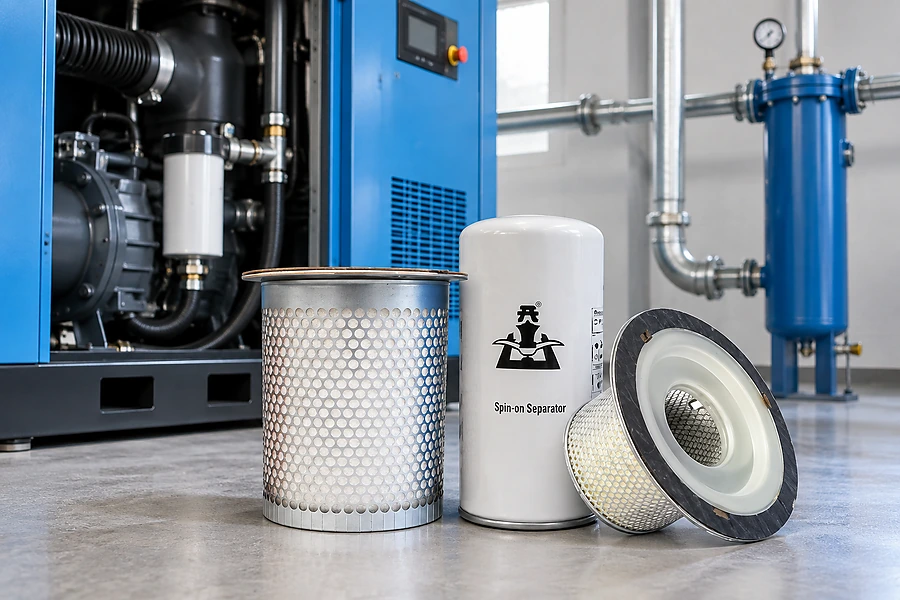
The purpose of an air filter in an air compressor is to remove dust, dirt, and other airborne particles before they enter the compression element. I use the intake filter to protect the airend, valves, bearings, lubricant, and other internal parts. Downstream filters then remove contaminants from the compressed air before it reaches equipment or processes.
I see the air filter as a small component with a large effect on compressor reliability. A good filter must do two things at the same time. It must capture harmful contamination, and it must allow enough air to flow through with low resistance. If filtration is poor, dirt enters the compressor. If the filter becomes badly clogged, pressure drop increases and compressor efficiency can fall.
What Does an Air Filter Do on an Air Compressor?
The compressor needs a large and continuous supply of atmospheric air. That air may contain dust, sand, fibers, insects, plant material, and many particles that I cannot see with the naked eye.
An air compressor intake filter cleans atmospheric air before it reaches the compression chamber or airend. It traps airborne particles that could damage rotors, cylinders, valves, bearings, lubricant, and other components. By keeping contaminants outside the compressor, the filter helps maintain performance, efficiency, reliability, and equipment life.
I consider the intake filter the compressor's first line of defense
Every air compressor must take air from somewhere.
A stationary screw compressor may take air from a factory compressor room. A portable diesel compressor may operate beside a quarry, mine, road project, or drilling site. A piston compressor may sit inside a workshop.
None of these environments contains perfectly clean air.
When the compressor draws atmospheric air through its inlet, the air filter captures solid contaminants before they enter the compression element. Atlas Copco notes that particles entering the compressor can damage the compressor element and reduce efficiency. Contamination can also make lubricant deteriorate faster.
For me, this makes filtration especially important in dusty industries.
Typical examples include:
- Mining
- Quarrying
- DTH drilling
- Construction
- Cement production
- Woodworking
- Metal fabrication
- Agriculture
- Road building
- Outdoor compressor applications
A compressor working at a clean indoor plant and a portable compressor working beside a drilling rig may need different inspection schedules even if both machines use similar filter technology.
The filter protects several compressor components
| Component | How clean intake air helps |
|---|---|
| Screw airend | Reduces abrasive contamination on rotors and housing |
| Piston and cylinder | Reduces abrasive wear |
| Intake valves | Helps prevent contamination and sticking |
| Bearings | Reduces contamination-related wear |
| Lubricant | Helps slow contamination and degradation |
| Oil separator | Reduces unnecessary contaminant loading |
| Downstream system | Reduces the amount of dirt entering the compressed-air stream |
I therefore do not view the air filter as an optional accessory. I see it as part of the compressor's protection system.
The cost of a filter element is normally very small compared with the cost of repairing an airend, rebuilding a compressor, or stopping a production line.
What Happens if an Air Compressor Air Filter Is Dirty?
A dirty filter does not always cause an immediate shutdown. This is one reason operators can ignore it for too long.
When an air compressor filter becomes dirty or clogged, airflow resistance increases. The compressor may lose capacity, work harder to maintain pressure, consume more energy, and experience higher operating stress. If filtration performance also deteriorates, dust can enter the compressor and accelerate wear of internal components.
A clogged filter restricts the air entering the machine
I think of a clogged intake filter as asking the compressor to breathe through a restriction.
The compressor still tries to produce the required compressed air. However, the inlet pressure drop becomes greater.
Natural Resources Canada states that excessive pressure differential across an inlet filter reduces compressor output capacity and decreases efficiency. Kaeser also explains that a clogged inlet filter can increase the pressure differential against which the compressor works, forcing the motor to use more power for the required output.
This creates a problem that is easy to misunderstand.
An operator may notice that system pressure is lower than expected and assume that the compressor itself is too small. The real problem may simply be restricted airflow.
Before I make a major sizing decision, I therefore check basic maintenance conditions.
I watch for these warning signs
A restricted or damaged intake system may be associated with:
- Reduced compressor capacity
- Difficulty maintaining system pressure
- Increased energy consumption
- Higher inlet restriction
- Frequent loading
- Dirty filter elements
- Abnormal operating temperature
- Premature lubricant contamination
- Increased internal wear
These signs do not automatically prove that the air filter is responsible. A compressor can also lose performance because of leaks, intake-valve problems, separator restriction, cooler problems, or other faults.
I use filter differential pressure, inspection results, operating data, and the manufacturer's service requirements together.
A cheap filter can become an expensive problem
The financial logic is simple.
| Situation | Possible result |
|---|---|
| Clean correct filter | Normal airflow and component protection |
| Clogged filter | Higher restriction and lower efficiency |
| Damaged filter | Contamination can pass downstream |
| Incorrect filter | Poor filtration or excessive pressure drop |
| Bad seal around filter | Unfiltered air may bypass the element |
| Delayed replacement | Higher risk of performance loss and wear |
I am especially careful about the last two points.
The filter media is not the only important part. The housing, seals, fit, and structural condition matter too. A filter that does not seal correctly can allow dirty air around the element instead of through it.
That is why I check the entire intake assembly instead of looking only at whether the filter appears dirty.
What Is the Difference Between an Intake Filter and a Compressed Air Filter?
The term “air filter” can refer to several different parts of a compressed-air system. This often creates confusion when people order replacement parts or design an air-treatment system.
An intake air filter cleans atmospheric air before compression and mainly protects the compressor. A downstream compressed-air or line filter cleans air after compression and mainly protects pneumatic equipment, production processes, and final products. Oil filters and air/oil separators perform different functions again and should not be confused with either type.
I separate compressor protection from compressed-air quality
The intake filter sits before the compression element.
Its primary job is to stop outside contamination from entering the compressor.
A line filter sits downstream after compression. Depending on its design, it can remove particles, liquid water, oil aerosols, or oil vapor from compressed air.
These are different jobs.
A good intake filter does not mean the factory automatically has high-quality compressed air at the point of use.
When atmospheric air is compressed, moisture becomes an important problem. An oil-lubricated compressor may also introduce lubricant carryover. The piping system itself can contribute rust and other particles.
This is why many systems require aftercoolers, moisture separators, dryers, and different stages of filtration.
The U.S. Department of Energy notes that downstream compressed-air filters are generally used to remove contaminants such as particles, condensate, and lubricant. It also recommends filtering only to the cleanliness level required by the application because additional filtration creates pressure drop.
Different filters have different purposes
| Filter or component | Location | Main purpose |
|---|---|---|
| Intake air filter | Before compressor airend | Remove airborne dirt and protect compressor |
| Oil filter | Lubrication circuit | Remove contamination from compressor oil |
| Air/oil separator | Inside oil-injected screw system | Separate lubricant from compressed air |
| Particulate line filter | Downstream | Remove solid particles |
| Coalescing filter | Downstream | Remove fine liquid water and oil aerosols |
| Activated carbon filter | Downstream | Reduce oil vapor and odors |
I therefore ask what someone means when they say they need an “air compressor filter.”
If they need to protect a screw airend from quarry dust, they are probably talking about the intake air filter.
If they are seeing oil or particles at a pneumatic machine, they may need to examine downstream air treatment.
If they need dry compressed air, simply adding another particulate filter may not solve the problem. They may need a refrigerated or desiccant dryer because filtration and drying perform different functions.
This distinction helps me avoid treating every compressed-air quality problem as a filter problem.
How Often Should I Change an Air Compressor Air Filter?
Changing filters too late can increase restriction and contamination risk. Changing every filter much earlier than necessary can also increase maintenance costs.
I change an air compressor intake filter according to the manufacturer's specified service interval, pressure differential, operating condition, and environment. Dusty mining, drilling, quarry, and construction sites can require more frequent inspection than clean indoor factories. I do not use one universal replacement interval for every compressor because filter designs and working conditions differ.
I follow the machine manual first
Different compressor manufacturers specify different maintenance intervals.
For example, Kaeser's current portable-compressor maintenance guidance gives a 500-hour replacement recommendation for the compressor air filter in the equipment covered by that schedule. It also recommends checking pressure differential, seals, structural condition, and the required micron rating.
I would not take that 500-hour number and apply it blindly to every compressor.
A large stationary screw compressor may have a different service interval.
A compressor with heavy-duty pre-filtration may have another interval.
A machine working in very clean conditions may load its filter differently from a compressor operating beside a blast-hole drilling rig.
The working environment changes filter life
I pay particular attention to these conditions:
| Working condition | My filtration concern |
|---|---|
| Clean compressor room | Standard inspection schedule may be adequate |
| Dusty workshop | Inspect more frequently |
| Quarry | Heavy dust loading |
| Mine | Dust plus long operating hours |
| DTH drilling | Very dusty outdoor operation |
| Cement plant | Fine airborne dust |
| Woodworking factory | High particulate loading |
| Outdoor construction | Dust and changing weather |
I also check how the compressor intake is installed.
A poor inlet location can make a good compressor operate in unnecessarily dirty or hot air. I prefer an inlet arrangement that avoids concentrated dust, exhaust gases, and hot discharged cooling air.
I do not judge only by appearance
A filter can look dirty and still function within the manufacturer's acceptable differential pressure. Another element can be damaged in a way that is not obvious from a quick visual inspection.
For this reason, I use several signals:
- Operating hours
- Calendar service requirements
- Differential pressure
- Physical inspection
- Compressor capacity
- Working environment
- Manufacturer recommendations
Downstream filters require similar discipline. Atlas Copco's 2026 guidance notes that clogged line-filter cartridges can cause pressure loss and higher energy use, while degraded filter media can allow contamination downstream.
The goal is not to make a filter last as long as possible.
The goal is to protect the compressor and air system without creating unnecessary pressure drop.
My insights: What Is the Purpose of an Air Filter in an Air Compressor
People often describe the air filter as a component that simply “keeps dust out.” I think that description is correct but incomplete because filtration affects much more than cleanliness.
The purpose of an air filter in an air compressor is to control contamination without creating excessive airflow restriction. I use the intake filter to protect the compressor from airborne particles, maintain reliable airflow, reduce avoidable wear, and support long service life. I use downstream filters separately when the compressed-air application requires controlled air quality.
My main insight is that filtration is a balance
I do not want the least restrictive filter if it lets harmful contamination through.
I also do not want unnecessary filtration that creates excessive pressure drop.
The best filtration system balances contaminant removal and airflow efficiency.
Atlas Copco describes this same design challenge as balancing efficient filtration, long filter life, and minimal pressure drop.
That balance matters because a compressor handles very large quantities of air.
A small amount of dust in each cubic meter may not sound serious. However, a continuously operating industrial compressor can process enormous volumes of atmospheric air over thousands of operating hours.
Small contamination problems therefore become long-term mechanical problems.
I see five purposes behind one intake filter
For practical industrial buying, I break the intake filter's purpose into five functions.
| Purpose | What it means to me |
|---|---|
| 1. Stop contamination | Keep atmospheric particles outside the airend |
| 2. Protect components | Reduce abrasive wear of important compressor parts |
| 3. Protect lubricant | Reduce dirt entering the oil system |
| 4. Maintain performance | Allow enough intake airflow with low restriction |
| 5. Support service life | Reduce avoidable contamination-related failures |
The fifth point is especially important.
I do not judge the value of the filter from the filter price. I judge it from the machinery it protects.
An airend, compressor motor, bearings, valves, lubricant system, and production process are much more valuable than a replaceable intake element.
I also separate filtration from air treatment
Another important insight is that the compressor intake filter cannot solve every air-quality problem.
It does not replace a dryer.
It does not replace an oil separator.
It does not automatically remove fine oil aerosols downstream.
It does not guarantee the final air-quality class required by a food, electronics, pharmaceutical, painting, or precision manufacturing application.
When I design a complete system, I think about the airflow path in this order:
Atmospheric air → intake filtration → compression → cooling → moisture separation → drying → downstream filtration → air receiver and piping → point of use
Not every installation needs exactly the same arrangement, but this sequence helps me identify where different contaminants should be controlled.
A general pneumatic workshop may need relatively simple air treatment.
A sensitive production process can require much finer filtration.
The Department of Energy recommends matching filtration to the actual end-use requirement rather than adding unnecessary stages, because each restriction can increase system pressure drop and energy use.
I pay even more attention to filters in drilling and mining
I consider air filtration especially important when a compressor supplies a drilling rig.
Portable diesel screw compressors used with DTH drilling equipment often operate in some of the harshest air-compressor environments.
Rock drilling creates dust.
Vehicle movement creates dust.
Wind moves fine particles around the site.
The compressor may run for many hours at high load.
In this situation, I check the intake filter more frequently and make sure the filter housing and seals are in good condition. Kaeser's portable-compressor guidance specifically identifies the air filter before the airend inlet valve as the component that removes bulk contamination from incoming air and recommends checking differential pressure, seals, structural condition, and the correct filter specification.
I also consider spare filters when planning equipment for remote projects.
A compressor can have excellent specifications, but that does not help if a contractor cannot obtain routine filters at the worksite.
For overseas projects, I therefore prefer to confirm the maintenance kit before shipment. I want to know the service intervals, filter part numbers, lubricant specification, separator requirements, and the quantity of routine spare parts the operator should keep.
My selection rule is simple
If I am evaluating the filtration system of an industrial compressor, I follow this sequence:
working environment → contaminant level → compressor specification → correct filter rating → airflow requirement → pressure differential → inspection interval → replacement plan → spare-parts availability
I do not select a filter only because it physically fits the housing.
The micron rating, filtration efficiency, pressure drop, sealing quality, flow capacity, and compressor manufacturer's specifications all matter.
This is also why I do not remove an intake element to solve a restricted-air problem. Removing filtration may reduce restriction temporarily, but it exposes expensive compressor components to atmospheric contamination.
The correct solution is to identify why the restriction is high and service the intake system correctly.
So when someone asks me, “What is the purpose of an air filter in an air compressor?”, my practical answer is straightforward:
Its main purpose is to let the compressor breathe the air it needs while stopping harmful contaminants from entering the machine. A good air filter protects compressor components, supports efficient operation, reduces premature wear, and helps the complete compressed-air system remain reliable.
Conclusion
An air compressor filter keeps harmful contaminants away from critical components while maintaining airflow. I see correct filtration and timely maintenance as simple ways to protect efficiency, reliability, and compressor life.