
](https://kaishanpro.com/wp-content/uploads/2026/09/What-Is-the-Function-of-the-Intake-Valve-in-an-Air-Compressor.webp)
A compressor motor can run normally while the machine produces little or no air. In many cases, the intake valve and its control system are important places to inspect.
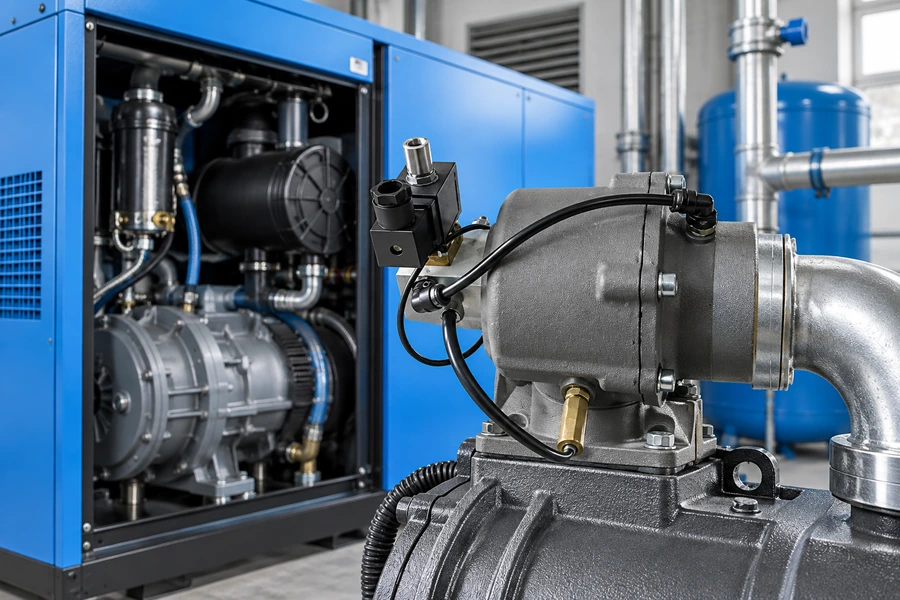
The function of the intake valve in an air compressor is to control the air entering the compression element. In a rotary screw compressor, it opens during loading and closes during unloading. In a piston compressor, it opens during the suction stroke and closes during compression to keep air from flowing backward.
I see the intake valve as the gate between atmospheric air and the compression element. It looks simple, but it has a direct effect on compressor capacity, load control, pressure regulation, and energy use. If the valve does not open or close correctly, the rest of the compressor cannot operate as designed.
How Does an Air Compressor Intake Valve Work?
The compressor cannot make compressed air until atmospheric air enters the compression chamber. The intake valve controls when that air can enter and, on many industrial screw compressors, how the compressor moves between loaded and unloaded operation.
In a rotary screw compressor, filtered atmospheric air passes through the intake valve before entering the airend. When the compressor needs to produce air, the control system opens the intake valve. When system pressure reaches the unload setting, the valve closes or restricts intake so the compressor stops producing useful compressed air.
I think of the valve as the airend's front gate
The airflow path is easy to understand.
Atmospheric air first passes through the compressor's intake air filter. The filter removes dust and other contaminants. The cleaned air then reaches the inlet or intake valve.
When the valve is open, air enters the rotary screw element.
The male and female rotors trap this air. The available space between the rotors becomes smaller as they rotate. This reduction in volume increases the pressure. The compressed air then travels toward the separator and downstream air system.
I can summarize the basic path like this:
| Stage | Main function |
|---|---|
| Intake air filter | Removes dirt from atmospheric air |
| Intake valve | Controls air entering the compressor |
| Screw airend | Compresses the incoming air |
| Separator system | Separates lubricant from compressed air in oil-injected machines |
| Aftercooler | Reduces compressed-air temperature |
| Air system | Delivers compressed air to the application |
This position explains why an inlet-valve problem can have such a large effect on compressor output.
The motor can still rotate.
The airend can still rotate.
The cooling fan can still operate.
However, if the inlet valve remains closed, the compressor cannot draw the normal amount of atmospheric air into the airend.
The controller tells the valve when to operate
On many fixed-speed rotary screw compressors, the intake valve works as part of a load/unload control system.
The compressor controller monitors system pressure.
When pressure falls to the loading setpoint, the system commands the intake valve to open. The compressor then draws in air and produces compressed air.
When pressure reaches the unloading setpoint, the control system causes the inlet valve to close. The drive motor may continue turning, but the compressor stops producing normal useful airflow.
Atlas Copco describes the inlet valve as the primary gate that decides whether the compressor is actively producing compressed air.
This is why I see the intake valve as both an airflow component and a control component.
What Is the Difference Between an Intake Valve and an Unloader Valve?
These terms can become confusing because compressor manufacturers use different designs. Some screw compressors combine several functions in one inlet or unloading assembly.
The intake valve directly controls air entering the compression element. The unloader or solenoid control system tells the compressor when to load or unload and may operate the intake valve pneumatically or electrically. On some screw compressors, the complete assembly is commonly called an inlet valve, suction valve, or load/unload valve.
I do not assume every valve name means the same part
This is important when I source compressor spare parts.
A buyer may ask me for an “unloader valve.”
Another buyer may call the same general assembly an “intake valve.”
Another manual may use the term “suction valve.”
Atlas Copco, for example, describes the suction valve or load/unload valve as the component responsible for drawing raw air into the rotary screw element. It opens when the system needs the compressor to load and closes when unloading is required.
The control arrangement can include several separate components.
| Component | Main job |
|---|---|
| Intake/inlet valve | Opens or closes the air path into the airend |
| Solenoid valve | Sends a control signal or control air to operate the inlet valve |
| Pressure sensor or switch | Detects system pressure |
| Blowdown/venting system | Releases internal package pressure during unloading on applicable designs |
| Minimum pressure/check valve | Performs a different downstream pressure-control function |
I therefore prefer to identify the compressor model, serial number, valve assembly, and OEM part number before ordering a replacement.
An unloader can mean something different on a piston compressor
The terminology changes again when I move from a screw compressor to a small reciprocating compressor.
On many piston compressors, the unloader valve releases trapped pressure after the compressor stops. This reduces the pressure against which the motor must restart. Quincy describes this type of unloader as a valve that vents trapped air so the motor can restart more easily.
That part is not the same as the inlet valve inside the piston compressor's valve plate.
This difference matters.
If I use the phrase “unloader valve” without identifying the compressor technology, I can easily order the wrong component.
How Does the Intake Valve Work in a Piston Air Compressor?
A reciprocating compressor does not normally use its cylinder intake valve in exactly the same way as a rotary screw compressor uses a load/unload inlet valve.
In a piston air compressor, the intake valve acts mainly as a one-way suction valve. As the piston moves downward, cylinder pressure falls and the inlet valve opens so atmospheric air enters. As the piston moves upward, the intake valve closes so the trapped air can be compressed instead of flowing back through the inlet.
Pressure difference operates many piston-compressor valves
Many reciprocating compressors use self-acting valves.
This means the pressure difference across the valve causes it to open and close.
During the intake stroke, the piston moves down.
Cylinder volume increases.
Pressure inside the cylinder falls below the pressure at the intake.
The inlet valve opens, and air enters.
During the compression stroke, the piston moves upward.
Cylinder volume becomes smaller.
The pressure inside the cylinder rises.
The intake valve closes.
The compressed air cannot escape backward through the inlet. When cylinder pressure becomes high enough, the discharge valve opens and air flows toward the receiver or the next compression stage.
The cycle can be shown simply:
| Piston position | Intake valve | Discharge valve | Result |
|---|---|---|---|
| Piston moves down | Open | Closed | Air enters cylinder |
| Piston begins moving up | Closed | Closed | Air is compressed |
| Cylinder pressure reaches discharge level | Closed | Open | Compressed air leaves |
| Cycle repeats | Opens again | Closes | New air enters |
I therefore consider the piston-compressor inlet valve primarily a one-way flow-control component.
The rotary screw inlet valve has a broader control role because it commonly participates directly in loading and unloading the compressor.
A leaking piston intake valve reduces compression
If the piston intake valve cannot seal correctly during the compression stroke, some air can move back toward the intake.
The compressor then loses effective capacity.
The machine may run longer to fill the receiver.
It may have difficulty reaching normal pressure.
Valve condition therefore has a direct effect on volumetric efficiency and compressor performance. Atlas Copco notes that reciprocating-compressor performance depends in part on valve timing and that these valves prevent backflow during compression.
For this reason, valve plates and valve assemblies are normal service components on many reciprocating machines. Ingersoll Rand currently supplies valve kits for its reciprocating compressors and identifies valve replacement as part of recommended maintenance for applicable models.
What Happens if an Air Compressor Intake Valve Fails?
An intake-valve problem does not always mean the compressor stops completely. The exact symptom depends on whether the valve sticks open, sticks closed, leaks, or receives the wrong control signal.
If a rotary screw compressor intake valve stays closed, the machine may run but fail to load or produce normal airflow. If the valve fails to close, the compressor may fail to unload correctly. Sticking, leakage, damaged seals, solenoid problems, or control-air faults can also cause unstable loading and reduced performance.
If the valve stays closed
This is one of the easiest failures to understand.
The compressor starts.
The motor runs.
The airend turns.
But the inlet valve does not open.
The airend cannot take in its normal airflow.
Atlas Copco's troubleshooting guidance identifies a stuck-closed inlet valve as one possible reason a compressor starts running but does not load. It also identifies solenoid failure and control-air leakage as possible causes of the same symptom.
This is why I would not automatically replace the intake valve when a compressor fails to load.
The control signal must also be checked.
If the valve does not close
The opposite fault can also cause trouble.
When system pressure reaches the unloading point, the inlet valve should respond according to the compressor's control design.
If it remains open, the machine may continue compressing air when it should unload.
Atlas Copco lists an inlet valve that does not close as one possible reason a compressor does not unload and the safety valve activates.
This condition needs proper diagnosis.
I would not keep operating the compressor while simply changing pressure settings to hide the symptom.
Symptoms can overlap with other faults
This point is important during troubleshooting.
Low compressor output does not automatically mean the intake valve has failed.
A clogged air filter can restrict intake air.
A faulty solenoid can prevent correct valve operation.
A control-air tube can leak.
A separator element can become restricted.
The plant may simply consume more air than the compressor can deliver.
Kaeser also identifies a developing inlet-valve problem as one possible reason a compressor struggles to reach its pressure setting, alongside other system faults.
I use a simple comparison during diagnosis:
| Symptom | Intake-related possibility | Other areas I also check |
|---|---|---|
| Compressor runs but will not load | Valve stuck closed | Solenoid and control air |
| Low air delivery | Valve not opening fully | Intake filter, leaks, demand |
| Compressor will not unload | Valve not closing | Solenoid and controller |
| Unstable loading | Sticking valve | Pressure signal and control circuit |
| Unusual inlet noise | Valve or seal issue | Intake filter and connections |
| Repeated valve contamination | Dirty intake environment | Filter condition and maintenance |
I therefore diagnose the entire intake and control system rather than replacing one component based only on a symptom.
My insights: What Is the Function of the Intake Valve in an Air Compressor
The intake valve is sometimes described as a simple door that lets air into the compressor. I think that description explains only part of its value.
The function of the intake valve in an air compressor is to manage the flow of atmospheric air into the compression element. In rotary screw compressors, it also plays a central role in load/unload control and therefore affects capacity, pressure regulation, and part-load operation. In piston compressors, it works mainly as a one-way suction valve that allows intake while preventing backflow during compression.
I see the intake valve as the connection between air demand and compression
A compressor should produce air because the system needs it.
This sounds obvious, but it is the reason the intake valve is so important on many fixed-speed screw compressors.
When factory pressure falls, the control system recognizes demand.
The intake valve opens.
The airend receives atmospheric air.
The compressor loads.
When pressure reaches the upper setpoint, the machine no longer needs to deliver its full airflow.
The intake valve closes during conventional load/unload control, and the machine transitions to unloaded operation.
That means the valve connects three important parts of the system:
air demand → pressure control → compressor airflow
Without correct inlet-valve operation, those three parts no longer respond to each other correctly.
The intake valve also affects part-load efficiency
Some lubricant-injected screw compressors use inlet modulation rather than only fully open and fully closed control.
In a modulating system, the inlet valve can partly close to restrict incoming air and reduce compressor capacity.
Kaeser explains that modulation uses a proportional inlet valve to regulate airflow based on discharge pressure. However, throttling the inlet increases the compression ratio, which limits the energy savings available from this control method.
This gives me an important purchasing insight.
An intake valve can control compressor capacity, but controlling airflow by throttling is not necessarily the most efficient way to operate for long periods at low demand.
For applications with strongly varying air consumption, I also compare variable-speed compressors. VSD systems change motor speed to adjust airflow instead of relying mainly on inlet throttling.
So I do not evaluate the intake valve in isolation.
I evaluate it as part of the compressor's complete control strategy.
I distinguish airflow control from air filtration
The air filter and intake valve sit close together, but their purposes are different.
The intake filter cleans the incoming air.
The intake valve controls whether and how much of that air enters the compression element.
Kaeser's compressor flow diagrams show filtered air moving through the intake filter and then through the inlet valve before reaching the screw airend.
For maintenance, I therefore inspect both parts.
A new inlet valve cannot solve a severely clogged filter.
A new air filter cannot solve a valve that is mechanically stuck.
Good compressor maintenance requires me to understand which component is causing the restriction.
I also distinguish the intake valve from the check valve
This is another common spare-parts mistake.
The intake valve controls air at the entrance to the compression element.
A check or non-return valve is used elsewhere to stop compressed air from flowing backward.
Atlas Copco specifically distinguishes these components. It describes the intake valve as the part that controls airflow entering the compressor element, while the check valve retains downstream pressure when the compressor unloads or stops producing air.
They solve different problems.
This matters when a buyer sends me a message such as “compressor valve broken.”
I need the machine model and exact valve position before I can identify the correct spare part.
For spare-parts sourcing, I identify the whole valve assembly
Industrial screw-compressor inlet valves can contain more than one wear component.
The exact design depends on the compressor.
When I source a replacement, I want the compressor model, serial number, valve part number, clear photos, and information about the fault.
I also check the related control components.
A good inlet valve may fail to operate if the solenoid valve does not send the correct control signal. A leaking control line can create the same type of loading problem. Atlas Copco lists both of these faults alongside inlet-valve problems in its compressor troubleshooting guidance.
For me, this is the main practical lesson.
The intake valve is not only a mechanical opening. It is one of the main control points between atmospheric air and the compression process.
On a rotary screw compressor, it determines when the airend takes in air and commonly determines whether the machine is loaded or unloaded.
On a piston compressor, it allows air into the cylinder during suction and closes so the piston can compress that air without pushing it back toward the inlet.
Both designs serve the same basic purpose: they make sure air enters the compression chamber at the correct time and in the correct direction.
That is why a relatively small valve can have such a large effect on compressor capacity, pressure control, efficiency, and reliability.
Conclusion
The intake valve controls air entering the compressor. I rely on it for correct airflow, loading and unloading in screw compressors, and one-way suction control in piston compressors.