
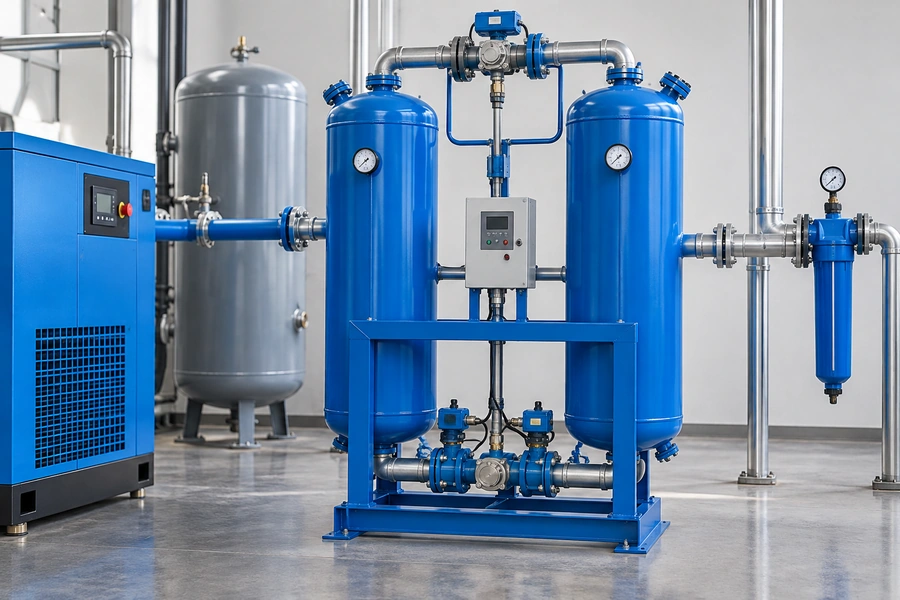
](https://kaishanpro.com/wp-content/uploads/2026/09/How-Does-a-Heatless-Dryer-Work.webp)
Water vapor can damage pneumatic tools, freeze in outdoor lines, corrode piping, and disrupt sensitive processes. A heatless dryer removes that moisture without using an external heater.
A heatless dryer works by passing wet compressed air through one desiccant-filled tower while a second tower regenerates. The desiccant adsorbs water vapor from the air. A portion of the dried compressed air is then expanded to near atmospheric pressure and used to purge moisture from the saturated tower before the towers switch roles.
I think the easiest way to understand a heatless desiccant dryer is to see it as two moisture-removal vessels working in turns. One tower is always responsible for drying the main compressed-air flow. At the same time, the other tower is being prepared for its next drying cycle. This alternating operation allows the dryer to provide a continuous supply of low-dew-point compressed air.
What Is a Heatless Desiccant Air Dryer?
The word “heatless” can be confusing because regeneration still requires energy. The dryer simply does not use an electric heater, steam heater, or heated blower to regenerate the desiccant.
A heatless desiccant dryer is a twin-tower adsorption dryer that removes water vapor from compressed air using a hygroscopic desiccant. It regenerates the wet desiccant by depressurizing one tower and passing a portion of already-dried compressed air through it. This pressure-swing process allows regeneration without supplemental heat.
I separate adsorption from absorption
One important detail is the word adsorption.
A heatless dryer does not normally remove moisture by absorbing water into the body of a liquid or material. Instead, water molecules attach to the surface of the desiccant.
Common desiccant materials include:
- Activated alumina
- Silica gel
- Molecular sieve
Atlas Copco describes activated alumina as a common choice for approximately -40°C pressure dew point service, while molecular sieves can be used when very low dew points such as -70°C are required.
Inside the dryer, the desiccant is placed in two pressure vessels or towers.
I can summarize the basic arrangement like this:
| Main component | Function |
|---|---|
| Tower A | Dries compressed air while online |
| Tower B | Regenerates while offline |
| Desiccant | Adsorbs water vapor |
| Inlet valves | Direct wet air to the active tower |
| Outlet/check valves | Deliver dry air downstream |
| Purge orifice/valve | Meters regeneration air |
| Exhaust valve | Releases moisture-laden purge air |
| Controller | Changes the towers between drying and regeneration |
| Muffler | Reduces exhaust noise |
During normal operation, wet compressed air enters the active drying tower and passes through the desiccant bed.
The desiccant attracts water vapor.
Dry compressed air then leaves the tower and travels toward the plant or process.
However, the desiccant cannot hold moisture forever.
Once it approaches its design moisture capacity, the dryer must regenerate that bed. This is why two towers are used. One can remain online while the other is being dried out.
The process repeats automatically for thousands of cycles before the desiccant eventually requires service or replacement.
What Are the Stages of a Heatless Dryer Cycle?
The two dryer towers do not simply switch instantly from wet to dry. A complete heatless regeneration cycle normally includes drying, depressurization, purge regeneration, repressurization, and tower switching.
A heatless dryer cycle has four main phases: adsorption, regeneration, repressurization, and switching. One tower dries the compressed air while the other is depressurized and purged with dry expanded air. Before the towers exchange functions, the regenerated tower is repressurized to operating pressure to reduce pressure shock and protect the desiccant bed.
Stage 1: The active tower dries the air
I start with Tower A online.
Wet compressed air enters from the bottom of the vessel on many conventional designs.
The air passes upward through the desiccant.
Water vapor attaches to the surface of the desiccant particles.
The resulting dry air leaves the top of the tower and flows downstream.
Parker describes its heatless dryers as directing compressed air upward through the drying bed while moisture is adsorbed by the desiccant.
At this moment, Tower B is offline.
Stage 2: The wet tower is depressurized
Before Tower B can regenerate effectively, it is reduced from line pressure toward atmospheric pressure.
This pressure reduction is a key part of pressure swing adsorption.
When dry compressed air is expanded to a much lower pressure, its relative humidity becomes very low and its ability to carry moisture increases.
Parker describes the initial blowdown from line pressure toward atmosphere as helping moisture detach from the desiccant before the purge stage continues the regeneration process.
Stage 3: Dry purge air regenerates the desiccant
A portion of the dry air leaving Tower A is diverted through a purge orifice.
This air is expanded toward atmospheric pressure.
It then flows through the saturated desiccant in Tower B.
Because the purge air is very dry at the lower pressure, it picks up water from the desiccant surface.
The moisture-laden air then exits through an exhaust valve and muffler to atmosphere.
The flow pattern can be simplified as:
Wet compressed air → Tower A drying → dry outlet air
At the same time:
Small portion of dry outlet air → pressure expansion → Tower B regeneration → moisture exhausted
Stage 4: The regenerated tower is repressurized
After regeneration is complete, Tower B cannot always be switched immediately into the main airflow while it remains at atmospheric pressure.
It is normally repressurized toward system pressure first.
Atlas Copco notes that repressurization helps prevent pressure shock and damage to the desiccant before switching.
Once Tower B is ready, the valves switch.
Tower B begins drying the process air.
Tower A begins regeneration.
Then the same process repeats.
| Tower A | Tower B |
|---|---|
| Drying | Regenerating |
| Regenerating | Drying |
| Drying | Regenerating |
| Cycle continues | Cycle continues |
This alternating design is what allows continuous dry-air production without stopping the compressed-air supply every time the desiccant needs regeneration.
How Much Purge Air Does a Heatless Dryer Use?
Heatless dryers are mechanically simple, but they pay for that simplicity by consuming some of the compressed air that has already been produced and dried.
A conventional heatless desiccant dryer commonly uses about 15% of its rated compressed-air flow for regeneration, although actual purge demand varies by manufacturer, pressure, required dew point, and controls. Some designs and operating conditions can require roughly 15–20% or more of dryer capacity for purge air.
I include purge air when sizing the compressor
This is one of the most important practical points for me.
Suppose a factory requires 1,000 cfm of usable dry compressed air downstream.
If the dryer consumes 15% of its inlet flow for regeneration, I cannot simply install a compressor that produces exactly 1,000 cfm and assume 1,000 cfm will reach production.
Some of that compressed air is consumed by the dryer.
Parker's TW heatless dryer documentation describes approximately 15% of dry compressed air being directed through a purge valve and orifice for regeneration.
Kaeser also describes cold-regenerative heatless dryers as using around 15% of dry outlet air to regenerate the wet desiccant bed, while noting that some heatless systems can have purge losses in the 15–20% range.
This affects the complete system.
| Item | Why I check it |
|---|---|
| Required plant airflow | Determines actual useful air demand |
| Dryer purge percentage | Air consumed by regeneration |
| Operating pressure | Influences purge requirement |
| Required pressure dew point | Lower PDP may affect operating demand |
| Compressor capacity | Must support both production and treatment losses |
| Pressure drop | Adds another system requirement |
Purge air is not free
Compressed air is one of the more expensive industrial utilities because the compressor uses electricity to produce it.
When a heatless dryer takes 15% of the dry compressed air and exhausts it to atmosphere, that air has already passed through the compressor and usually through upstream filtration.
The plant paid to produce it.
This is the main operating-cost disadvantage of heatless technology.
Atlas Copco gives a typical heatless purge range of approximately 16–19% for some current dryer designs, while Kaeser notes heatless dryer purge losses can reach approximately 15–20% depending on the system and target dew point.
For smaller flow systems, that trade-off may be acceptable because the equipment itself is simple and relatively economical.
For a very large compressed-air installation, however, losing 15% or more of compressor output continuously can become expensive.
This is why I compare heatless dryers with heated purge, blower purge, and heat-of-compression designs when airflow becomes large.
What Dew Point Can a Heatless Dryer Achieve?
Heatless dryers are used when a refrigerated dryer cannot make the compressed air dry enough. This is especially important when pipes are exposed to freezing temperatures or a process is sensitive to moisture.
A heatless desiccant dryer commonly delivers a -40°C (-40°F) pressure dew point and can be designed for lower dew points, with some systems reaching approximately -70°C to -73°C (-94°F to -100°F). Actual performance depends on dryer design, airflow, pressure, inlet temperature, desiccant condition, and regeneration settings.
-40°C PDP is a common industrial target
I see -40°C pressure dew point frequently in industrial compressed-air specifications.
A -40°C PDP provides much drier air than the approximately +3°C PDP commonly associated with refrigerated dryers.
This makes heatless desiccant dryers suitable for applications such as:
- Outdoor compressed-air piping
- Instrument air
- Cold climates
- Pneumatic controls
- Electronics
- Laboratory applications
- Pharmaceutical processes
- Moisture-sensitive manufacturing
- Remote industrial systems
Parker's heatless dryer manual states that its twin-tower system is designed to provide -40°F or better dew point performance.
Kaeser states that regenerative desiccant technology can produce dew points down to approximately -100°F on applicable systems.
I protect the desiccant with upstream filtration
A desiccant dryer needs clean inlet air.
This is particularly important with oil-lubricated compressors.
Oil aerosols can coat the desiccant surface and reduce its ability to adsorb moisture.
Atlas Copco recommends upstream coalescing filtration to protect conventional desiccant beds from oil aerosols and other contamination. It also notes that downstream particulate filtration is commonly used with bead-type desiccant to capture fines created by desiccant wear.
A typical arrangement may therefore look like:
Compressor → aftercooler/separator → prefilter → heatless dryer → afterfilter → receiver or distribution system
The exact arrangement depends on the compressor and air-quality requirement.
I do not choose -70°C unless the process needs it
A lower pressure dew point sounds better, but it is not always better economically.
Producing extremely dry air can increase purge consumption and place greater demands on the dryer.
Kaeser notes that shorter or more frequent heatless regeneration cycles can produce lower dew points but can increase maximum purge demand and reduce usable dryer outlet flow.
My selection approach is therefore simple.
If -40°C is sufficient, I do not automatically buy a -70°C system.
I first define the real application requirement.
My insights: How Does a Heatless Dryer Work
A heatless dryer looks mechanically simple, but its real operating principle depends on the relationship between pressure, adsorption, regeneration, and compressed-air consumption.
A heatless dryer works through pressure swing adsorption. One desiccant tower removes water vapor from the main compressed-air stream while the second tower is depressurized and regenerated using a portion of dry compressed air. The towers periodically switch roles, allowing continuous delivery of low-dew-point air without an external heat source.
My main insight is that “heatless” does not mean “energy-free”
This is the most important point I would explain to an industrial buyer.
A heatless dryer does not use an external heater.
However, it uses valuable compressed air for regeneration.
That compressed air required electrical energy to produce.
So the dryer still has an energy cost.
I see the real trade-off like this:
| Dryer type | Regeneration method | Typical compressed-air loss | General trade-off |
|---|---|---|---|
| Heatless | Dry expanded purge air | About 15–20% in many designs | Simple equipment, higher purge loss |
| Heated purge | Heated dry compressed air | Lower, often around 6–8% | More equipment, lower purge consumption |
| Blower purge | Heated ambient air | Very low or near zero in some designs | Higher equipment complexity |
| Heat of compression | Compressor waste heat | Minimal additional regeneration energy | Efficient but application-dependent |
Atlas Copco describes heatless dryers as using compressed air alone for regeneration and gives purge consumption of roughly 15–20% in typical pressure-swing designs. Heated and blower systems use heat to reduce the amount of compressed air needed for regeneration.
I choose heatless dryers when simplicity matters
Despite the purge loss, heatless dryers have several practical strengths.
They do not require a regeneration heater.
They do not need a regeneration blower.
Their basic operating principle is straightforward.
They can be compact.
They are suitable for remote or demanding installations.
Atlas Copco specifically identifies heatless desiccant dryers as mechanically robust and suitable for applications where simplicity and reliability are important, including some hazardous or remote sites.
For smaller and medium compressed-air flows, I often find the trade-off reasonable.
Parker similarly describes heatless pressure-swing dryers as simple, reliable, and particularly suitable for small-to-medium flow systems.
I pay more attention to purge cost as airflow increases
Imagine two systems.
One heatless dryer handles 50 cfm.
Another handles 5,000 cfm.
Even if both consume the same percentage of compressed air for purge, the financial value of the lost air is completely different.
At larger flows, I therefore calculate:
- Compressor input power
- Annual running hours
- Purge percentage
- Electricity price
- Required pressure dew point
- Dryer pressure drop
- Maintenance cost
- Capital cost difference between dryer types
A heatless dryer may have the lowest purchase price and still have the highest lifecycle cost.
Kaeser describes heatless desiccant dryers as generally having lower initial cost but potentially higher operating cost than heated regenerative alternatives because of purge-air losses.
I also check the inlet temperature
Desiccant capacity is affected by moisture load.
Hot compressed air carries more water vapor than cooler compressed air.
If the air entering the dryer is hotter than the rated design condition, the dryer may have to handle a much larger moisture load.
For this reason, I check the aftercooler, moisture separator, condensate drain, and inlet temperature before sizing the dryer.
I do not expect the desiccant dryer to compensate for a badly performing aftercooler.
The less liquid water and bulk moisture that reaches the dryer, the easier it is for the desiccant to maintain the required dew point.
I see prefiltration as part of the dryer, not an optional extra
For an oil-injected air-compressor system, I want effective coalescing filtration upstream.
Oil contamination can coat the desiccant and permanently reduce its adsorption capacity. Atlas Copco recommends upstream coalescing filtration for this reason.
I also consider downstream particulate filtration when conventional desiccant beads can generate fines.
So when I quote or specify a heatless dryer, I prefer to think about the complete treatment package:
compressor → cooling → water separation → prefiltration → heatless dryer → afterfiltration → dry-air system
This gives me a better chance of maintaining the specified pressure dew point in real operation.
My practical selection rule
When someone asks me whether a heatless dryer is the right choice, I work through this sequence:
required airflow → required pressure → required dew point → inlet temperature → operating hours → purge-air cost → filtration → installation environment → maintenance support
If the application needs around -40°C PDP, has small or moderate airflow, and values simple reliable equipment, I often consider a heatless desiccant dryer a strong option.
If the required airflow is very large and the system operates continuously, I compare the cost of purge air against heated, blower-purge, or heat-of-compression alternatives.
So when someone asks me, “How does a heatless dryer work?”, my practical answer is:
It dries compressed air in one desiccant tower while using a portion of that dry compressed air to regenerate a second tower at low pressure. The towers then switch. This repeated pressure-swing cycle creates a continuous supply of very dry compressed air without using an external regeneration heater.
Conclusion
A heatless dryer uses twin desiccant towers, pressure swing adsorption, and dry purge air to remove moisture continuously. I choose it when low dew point, simplicity, and reliable operation justify the purge-air cost.