
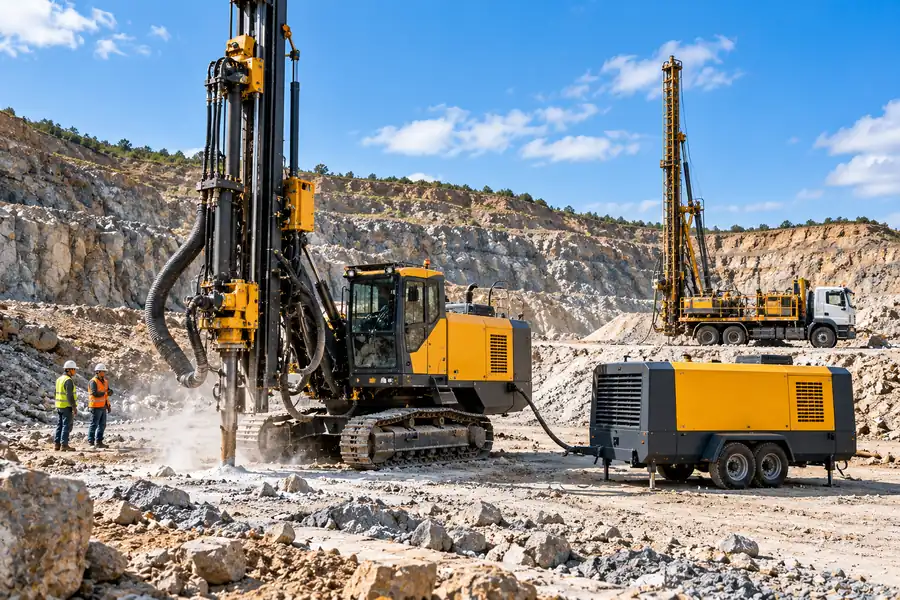
](https://kaishanpro.com/wp-content/uploads/2026/10/8-Types-of-Drilling-Rigs-But-Which-One-Is-Right-for-You.webp)
Choosing the wrong drilling rig can increase project costs, delay construction, and damage drilling tools. Different geological conditions require different drilling methods and equipment configurations.
The eight common types of drilling rigs are rotary, down-the-hole (DTH), top hammer, auger, core, reverse circulation (RC), cable-tool, and horizontal directional drilling (HDD) rigs. Each serves different purposes. The best choice depends on rock hardness, drilling depth, hole diameter, sample requirements, site conditions, and operating costs.
I recommend selecting drilling rigs based on drilling methods, equipment compatibility, maintenance, and supporting tools to improve productivity, minimize downtime, and reduce long-term operating costs.
What Are the 8 Main Types of Drilling Rigs?
Drilling rigs are used across mining, construction, water well drilling, and geological exploration. Each drilling method offers different advantages and limitations depending on the ground conditions.
The eight main drilling rig categories include rotary, DTH, top hammer, auger, core, reverse circulation, cable-tool, and horizontal directional drilling systems. Rotary and auger rigs use rotational cutting, DTH and top hammer rigs use percussion, core rigs recover geological samples, and HDD rigs create steerable underground boreholes.
These categories describe common drilling methods and equipment configurations. They are not completely separate: some multipurpose rigs support several methods, while reverse circulation describes a way of returning drilling material to the surface.
1. Rotary Drilling Rigs
I consider rotary drilling rigs among the most versatile machines for water wells, geological investigation, and construction projects.
A rotary drilling rig uses a rotating drill bit to cut, grind, or break underground formations.
The drill string transfers rotation and feed force to the bit.
Many rotary drilling systems also circulate drilling fluid or compressed air to remove cuttings from the borehole.
Mud rotary drilling uses drilling fluid to transport cuttings and help stabilize the borehole.
This makes it useful in many unconsolidated formations where the borehole walls require support.
Rotary drilling rigs are commonly used for:
- Water well drilling
- Geothermal boreholes
- Geological investigation
- Construction foundation projects
- Selected mining applications
I would consider rotary drilling when the project involves changing formations and requires flexible drilling configurations.
However, the correct bit, circulation system, and casing arrangement must match the geological conditions.
Main advantage: Flexible drilling configurations for many types of formations.
Main limitation: Drilling-fluid management can increase cost, complexity, and environmental requirements.
2. Down-the-Hole (DTH) Drilling Rigs
I generally consider DTH drilling rigs a strong option for drilling into hard rock.
A DTH rig uses a pneumatic hammer positioned directly behind the drill bit at the bottom of the borehole.
Compressed air drives an internal piston that repeatedly strikes the bit.
The drill string rotates while the hammer delivers impact energy directly into the rock.
Compressed air also carries rock cuttings to the surface.
DTH drilling is commonly used for:
- Hard-rock water wells
- Mining blastholes
- Quarry drilling
- Construction rock drilling
- Selected geothermal projects
I consider compressor matching particularly important.
The compressor must deliver sufficient pressure to operate the hammer and enough airflow to remove rock cuttings.
A powerful drilling rig can still perform poorly if the compressor and hammer are incorrectly matched.
Main advantage: Effective rock breaking and good drilling performance in suitable hard-rock formations.
Main limitation: Requires a properly sized compressed air system and specialized hammer components.
3. Top Hammer Drilling Rigs
I consider top hammer drilling rigs particularly useful for many relatively shallow rock drilling applications.
Unlike DTH drilling, a top hammer rig places the percussion unit at the top of the drill string.
The percussion mechanism generates impact energy that travels through the drill rods to the bit.
The bit breaks the rock while the drilling system rotates and applies feed force.
Top hammer equipment is commonly used for:
- Quarry bench drilling
- Road and railway construction
- Rock anchoring
- Underground development
- Smaller-diameter blastholes
I normally evaluate top hammer drilling when the holes are relatively short and frequent rig movement is required.
These rigs can provide excellent productivity when the drilling diameter and depth match the equipment design.
However, impact energy transmission through the drill string becomes more challenging as drilling depth increases.
Rod and coupling wear can also influence operating costs.
Main advantage: Efficient production drilling for suitable shallow and medium-depth rock holes.
Main limitation: Percussion energy losses and drill string wear can increase with depth.
4. Auger Drilling Rigs
I generally recommend considering auger drilling rigs for relatively shallow holes in suitable soil formations.
An auger uses a rotating helical cutting tool to penetrate the ground.
The spiral flights transport soil toward the surface as the tool rotates.
Auger drilling is commonly used for:
- Geotechnical investigation
- Soil sampling
- Shallow foundation work
- Environmental monitoring wells
- Selected construction projects
I find hollow-stem augers particularly useful because they can provide temporary support for the borehole while allowing sampling tools or well materials to pass through the center.
However, auger drilling has limitations.
Large rocks, hard bedrock, boulders, and unstable ground conditions can reduce drilling efficiency or make the method unsuitable.
I would also evaluate groundwater conditions and borehole stability before choosing an auger system.
Main advantage: Practical and economical drilling in suitable unconsolidated soil.
Main limitation: Limited effectiveness in hard rock, boulders, and some unstable formations.
5. Core Drilling Rigs
I consider core drilling rigs essential when the project requires detailed geological information rather than simply creating a borehole.
Core drilling uses a specialized cutting bit and core barrel to recover cylindrical samples of underground material.
Diamond core drilling is commonly used in mineral exploration and geological investigation.
The recovered core allows geologists to examine:
- Rock composition
- Geological structures
- Fractures and faults
- Mineralization
- Formation boundaries
- Rock quality
I would normally prioritize core drilling when intact geological samples are necessary for engineering or mineral resource evaluation.
Wireline core drilling systems can retrieve core samples through the drill string without removing the entire drill string for each recovery.
This can improve efficiency during deeper exploration projects.
However, core drilling can be slower and more expensive than methods designed mainly to produce rock chips.
Main advantage: Produces detailed, often continuous geological samples.
Main limitation: Higher sampling costs and potentially slower production compared with chip-sampling methods.
6. Reverse Circulation (RC) Drilling Rigs
I consider reverse circulation drilling particularly useful in mineral exploration and mine grade-control programs.
RC drilling commonly uses specialized dual-wall drill pipes and compressed air.
In air-based RC drilling, air passes through the outer channel of the drill string to operate the drilling tool.
Rock chips travel upward through the inner tube and are collected at the surface.
The samples can then be analyzed to evaluate mineral content and geological conditions.
RC drilling is widely used for:
- Mineral exploration
- Mine grade control
- Geological sampling
- Resource evaluation
- Selected production planning activities
I would consider RC drilling when a project needs numerous rock-chip samples within a relatively short period.
It can offer economical sampling compared with diamond coring for suitable exploration objectives.
However, RC drilling does not normally provide intact cylindrical cores.
I would therefore choose core drilling when geological structure and continuous rock samples are essential.
Main advantage: Efficient collection of rock-chip samples with good sample-depth control.
Main limitation: Does not preserve intact geological structures like diamond core drilling.
7. Cable-Tool Drilling Rigs
Cable-tool drilling is a traditional percussion method that remains useful in selected water well and geological applications.
The machine raises and drops a heavy drilling tool to break the material at the bottom of the borehole.
The broken material is periodically removed with a bailer.
I consider this method useful to understand because it does not depend on the same continuous rotary circulation system used by many modern drilling machines.
Cable-tool drilling has historically been used for:
- Water well construction
- Drilling in selected unconsolidated formations
- Certain difficult borehole conditions
- Geological investigation
One advantage is that the method can operate with relatively simple downhole tools.
It can also provide certain benefits where minimizing drilling-fluid introduction is important.
However, I would generally expect slower penetration and more repetitive handling operations than with suitable modern rotary equipment.
Main advantage: Proven percussion method with relatively simple drilling principles.
Main limitation: Slower production in many applications and labor-intensive cuttings removal.
8. Horizontal Directional Drilling (HDD) Rigs
I consider horizontal directional drilling rigs different from conventional vertical drilling equipment because their main purpose is to create a controlled underground drilling path.
HDD rigs are commonly used for trenchless underground utility installation.
A directional drill creates a steerable pilot bore along a planned route.
The borehole can then be enlarged with a reamer.
Pipes or conduits are pulled through the completed path.
HDD equipment is commonly used for:
- Water pipeline installation
- Gas pipeline installation
- Electrical conduits
- Telecommunications cables
- Underground utility crossings
I would consider HDD when the project needs to cross roads, rivers, or other obstacles without excavating a continuous trench.
However, HDD requires careful route planning and subsurface investigation.
Existing underground utilities, ground conditions, drilling fluid management, and bore-path geometry are important factors.
Main advantage: Enables underground installations with less continuous surface excavation.
Main limitation: Requires accurate planning, directional control, and suitable ground conditions.
How Do Different Drilling Rig Types Compare?
Each drilling rig type uses a different drilling mechanism or operational configuration. Comparing these differences helps buyers identify the most appropriate equipment for their projects.
DTH and top hammer rigs are suitable for many rock drilling applications, while auger rigs work best in suitable soils. Rotary rigs provide versatile borehole construction, core rigs recover intact samples, RC rigs collect rock chips, cable-tool rigs use repeated percussion, and HDD rigs support directional underground installations.
Comparison of the 8 Types of Drilling Rigs
| Drilling Rig Type | Main Application | Primary Advantage | Main Limitation |
|---|---|---|---|
| Rotary | Water wells and construction | Flexible drilling methods | Fluid and cuttings management |
| DTH | Hard rock and quarrying | Effective downhole percussion | Compressor requirements |
| Top Hammer | Quarry benches and rock construction | Efficient smaller-diameter rock drilling | Depth-related energy losses |
| Auger | Soil investigation | Efficient in suitable shallow soil | Limited hard-rock capability |
| Core | Mineral exploration | Intact geological samples | Higher sampling costs |
| Reverse Circulation | Exploration and grade control | Fast collection of rock chips | No intact core recovery |
| Cable-Tool | Selected water well applications | Simple percussion principle | Slower production |
| HDD | Underground utility installation | Steerable trenchless construction | Complex site planning |
Which Drilling Rig Is Better for Hard Rock?
I normally compare DTH and top hammer drilling systems first.
For relatively shallow holes with suitable diameters, top hammer drilling may provide excellent productivity.
For harder formations, larger boreholes, and greater drilling depths, DTH drilling may offer better overall performance.
However, the decision depends on rock strength, drill bit selection, hole diameter, and the actual cost per meter.
I would not assume that one percussion method is always superior.
Which Rig Is Better for Geological Sampling?
I distinguish core drilling from reverse circulation drilling based on sample requirements.
Core drilling provides intact cylindrical rock samples.
RC drilling provides rock chips that can be collected and analyzed by depth interval.
For detailed structural geology, I normally prefer core samples.
For rapid exploration and grade-control sampling, I would consider RC drilling.
Both methods can be valuable within the same mineral exploration program.
Can One Drilling Rig Use Several Methods?
I also consider multipurpose drilling rigs when the project involves different ground conditions.
Some drilling machines support mud rotary, air rotary, DTH, auger, or core drilling configurations.
A multipurpose machine can provide greater flexibility, but compatibility must be verified.
Changing the drilling method may require additional pumps, compressors, tools, casing systems, or control arrangements.
I would never assume that a rig supports a method simply because it has a hydraulic rotary head.
How Do I Choose the Right Drilling Rig for My Project?
Selecting drilling equipment requires more than understanding the available machine types. Project conditions determine which drilling method can achieve the required performance.
I choose a drilling rig by evaluating geological conditions, borehole diameter, drilling depth, project purpose, site accessibility, and supporting equipment. I also compare compressor capacity, drilling tools, maintenance requirements, and total operating costs to determine which machine offers reliable performance for the intended application.
1. Identify the Geological Conditions
I begin with the expected formations.
Hard rock, loose sand, gravel, clay, and mixed ground conditions can require different drilling approaches.
For example, I would consider DTH drilling for competent hard rock.
For loose formations that require borehole support, I would evaluate mud rotary methods.
For shallow soil investigations, auger drilling may be suitable.
| Ground Condition | Drilling Method to Evaluate |
|---|---|
| Competent hard rock | DTH or suitable rotary rock drilling |
| Shallow rock blastholes | Top hammer or DTH |
| Loose soil and clay | Auger or mud rotary |
| Unstable sand and gravel | Rotary with suitable fluid or casing support |
| Mineralized rock requiring intact samples | Diamond core drilling |
| Mineral exploration requiring chip samples | RC drilling |
| Mixed formations | Multipurpose drilling system |
| Underground utility crossings | HDD with project-specific tooling |
These are starting points. Final selection requires site-specific geological information.
2. Confirm the Required Diameter and Depth
I consider borehole diameter and drilling depth essential technical parameters.
A rig may have sufficient power but lack the required pullback force, rod handling capacity, or drilling tools.
I therefore verify:
- Required hole diameter
- Expected and maximum hole depth
- Rotary torque and speed
- Feed force
- Pullback force
- Drill pipe dimensions
- Casing requirements
- Borehole deviation tolerance
I also distinguish maximum rated drilling depth from efficient working depth.
The two may differ significantly under actual geological conditions.
3. Evaluate the Required Supporting Equipment
I consider the complete drilling system rather than the rig alone.
A DTH drilling package may require a compressor, hammer, bits, drill pipes, and dust collection equipment.
A mud rotary package requires suitable drilling-fluid circulation and solids-control equipment.
A core drilling project requires core barrels, bits, sample handling equipment, and appropriate flushing arrangements.
For HDD, the equipment package may include guidance technology, reamers, drilling-fluid mixing, recycling, and underground utility detection.
I prefer confirming every required component before requesting a final quotation.
4. Evaluate Mobility and Site Conditions
I also compare how easily the rig can reach and move around the worksite.
Crawler rigs can be useful for rough terrain and quarry operations.
Truck-mounted rigs may provide efficient transportation between accessible water well sites.
Compact equipment may be necessary when available working space is limited.
For remote projects, I consider fuel availability, access roads, transport dimensions, and service support particularly important.
I believe mobility should be evaluated together with drilling performance.
A powerful rig may become impractical if it cannot reach the required drilling location.
What Should I Consider Before Buying a Drilling Rig?
Drilling equipment represents a substantial capital investment. Incorrect specifications, incomplete accessories, or limited spare-parts support can increase project costs after delivery.
Before purchasing a drilling rig, I compare technical specifications, drilling method compatibility, equipment condition, maintenance requirements, spare-parts availability, safety features, and total ownership costs. I also confirm the delivery scope, inspection records, warranty terms, and after-sales support to reduce purchasing risks.
1. Compare Equipment Specifications
I request detailed specifications before comparing quotations.
I prioritize the parameters that directly affect the drilling project.
These include working depth, hole diameter, rotary torque, feed force, pullback force, engine power, and drilling method.
For pneumatic DTH equipment, I also verify compressor airflow and pressure.
A compressor that cannot meet the hammer's operating requirements may reduce drilling productivity.
2. Check Equipment Compatibility
I believe compatibility is one of the most important purchasing considerations.
The drilling rig, tools, and supporting systems must work together.
For example, I confirm that the drill rods fit the rotary head and hammer connection.
I also check whether replacement bits and consumables are available in the destination market.
For integrated drilling systems, I examine whether the installed compressor meets the expected operating requirements.
For split-type drilling packages, I evaluate the separate compressor and rig configurations.
3. Calculate Total Drilling Costs
I prefer comparing drilling equipment using total operating costs rather than purchase price alone.
My basic calculation is:
Drilling Cost per Meter = Total Drilling Operating Cost ÷ Completed Drilling Meters
The calculation may include fuel, labor, drilling tools, maintenance, machine ownership, transportation, and downtime.
For example, a lower-priced drilling rig may consume more fuel or require frequent bit replacement.
A higher-priced rig may reduce operating costs when it is correctly matched to a demanding workload.
However, I do not assume that more expensive equipment always provides better value.
4. Review Maintenance and Spare Parts
I evaluate whether critical replacement components are readily available.
Important items may include:
- Hydraulic pumps and valves
- Drill bits and DTH hammers
- Drill rods and adapters
- Air compressor service parts
- Engine filters and lubricants
- Rotary head components
- Control system components
- Safety guards and emergency equipment
I also consider access to technical support.
For remote mining and drilling operations, unexpected delays in spare-parts delivery can affect the entire project schedule.
5. Confirm the Equipment Delivery Scope
I recommend confirming what is included in the quotation.
Some drilling rigs are supplied as complete packages, while others require additional accessories.
I request clear documentation covering the main machine, drilling tools, optional equipment, operating manuals, warranty conditions, and spare-parts supply.
For international purchases, I also consider pre-shipment verification and equipment inspection.
Purchasing Evaluation Checklist
| Purchasing Factor | What I Evaluate |
|---|---|
| Application | Mining, construction, water well, or exploration |
| Drilling method | Compatibility with geological conditions |
| Drilling capacity | Hole diameter and depth |
| Power system | Diesel, electric, or hydraulic configuration |
| Compressor | Pressure and airflow requirements |
| Mobility | Crawler, truck, trailer, or compact design |
| Safety | Guarding, controls, and suitable protection systems |
| Maintenance | Service intervals and repair accessibility |
| Spare parts | Availability and supply arrangements |
| Operating costs | Fuel, labor, drilling tools, and downtime |
I believe a well-matched drilling package with dependable maintenance support can provide more value than a larger machine selected only by advertised specifications.
My Insights: Which of the 8 Types of Drilling Rigs Is Right for You
I believe there is no single drilling rig that provides the best performance for every application.
The correct choice depends on the purpose of the borehole, geological conditions, technical requirements, and project economics.
I summarize the eight drilling methods through their primary strengths:
Rotary Drilling → Versatile borehole construction for water wells and selected construction applications.
DTH Drilling → Effective rock drilling with pneumatic percussion directly behind the bit.
Top Hammer Drilling → Productive drilling for suitable smaller-diameter rock holes and quarry benches.
Auger Drilling → Practical soil drilling and sampling in suitable unconsolidated formations.
Core Drilling → Recovery of intact geological samples for exploration and engineering investigation.
Reverse Circulation Drilling → Efficient collection of rock chips for mineral exploration and grade control.
Cable-Tool Drilling → Traditional percussion drilling for selected well construction conditions.
Horizontal Directional Drilling → Steerable underground drilling for pipelines and utility installation.
My Practical Recommendation
For hard-rock water wells and many quarry projects, I generally consider DTH drilling a strong option.
For shallow rock blastholes, I would compare top hammer and DTH performance.
For loose soil formations, I evaluate auger or mud rotary drilling according to the required depth and borehole stability.
For geological exploration, I distinguish between the need for intact core samples and rock-chip samples.
I also believe buyers should consider whether a multipurpose drilling rig can support their expected project range.
However, I would not recommend purchasing a complex multipurpose machine unless the additional functions provide a practical business advantage.
I prefer assessing the total drilling package, including the rig, compressor, tools, consumables, maintenance, and logistical requirements.
The lowest purchase price does not necessarily provide the lowest cost per completed borehole.
My recommendation is to select drilling equipment based on the required drilling method, geological conditions, technical compatibility, and long-term operating reliability rather than machine size or engine power alone.
Conclusion
I believe the right drilling rig depends on geology, depth, hole diameter, sampling needs, and cost. Matching equipment to the project improves productivity and reliability.