Maintenance requirements vary according to equipment type, operating hours, working environment and application conditions.
Our support covers routine inspection, maintenance planning and commonly serviced components across different Kaishan equipment families.
A fault code alone may not explain the complete cause of an equipment problem.
Operating pressure, temperature, abnormal noise, maintenance history, environmental conditions and recent component replacement can all affect troubleshooting.
Identify issues and analyze possible causes.
Provide guidance for safe and efficient operation.
Recommend maintenance items and service intervals.
Help identify correct parts and confirm compatibility.
Offer installation recommendations and best practices.
Provide manuals, diagrams and technical information when available.
A structured troubleshooting process helps reduce unnecessary part replacement and improves communication between operators and technical personnel.
Send the equipment model, serial number, nameplate, fault information and a description of the problem.
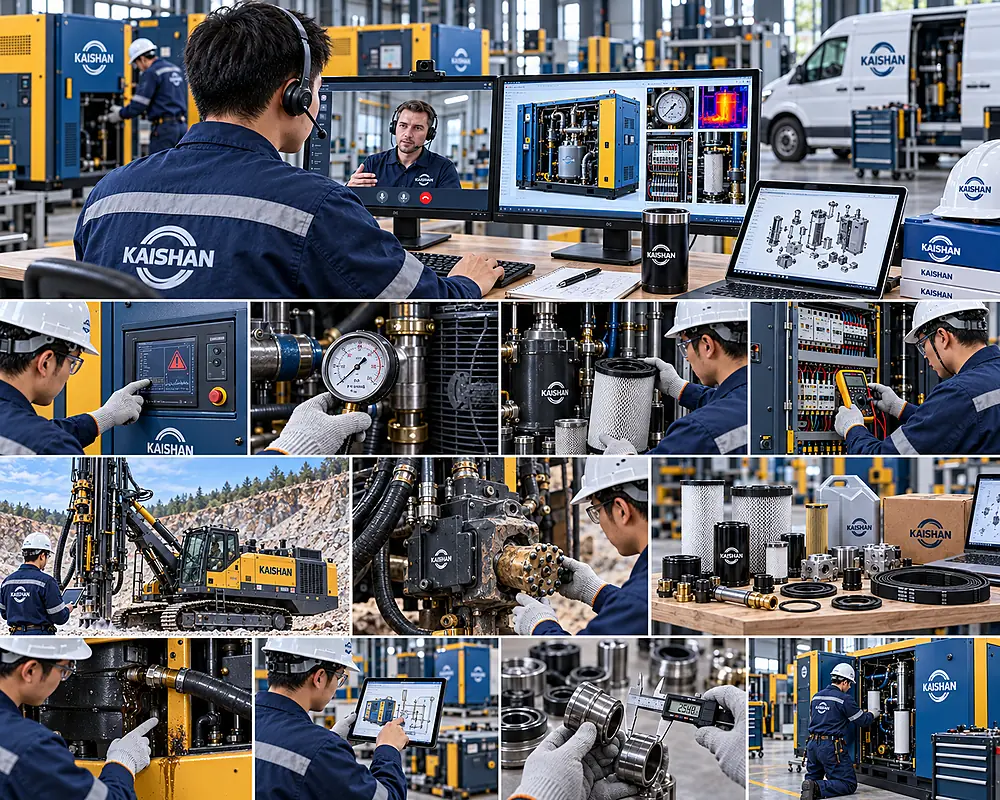
Photos, controller displays, videos and operating parameters can help our technical team understand the equipment condition.
The available information is reviewed together with the equipment configuration, operating condition and maintenance history.
We may recommend inspection steps, operating checks, maintenance actions or further information required for diagnosis.
When a component requires replacement, suitable spare parts or maintenance items can be identified according to the equipment information.
Additional technical guidance may be provided as troubleshooting or maintenance work progresses.
Remote support can assist with preliminary evaluation of many common equipment conditions.
When a damaged or worn component needs replacement, part identification can be included in the troubleshooting process.
Kaishan Group Co., Ltd. was founded in Quzhou, Zhejiang Province, China, in 1956 and has developed into a global manufacturer of compressed-air systems, drilling equipment and green-energy solutions.
Today, Kaishan operates 14 production and R&D centers, has more than 70 subsidiaries, and employs more than 4,500 people, including over 2,000 technical professionals.
Founded in 1956, with products and industrial solutions serving more than 90 global markets.
Kaishan equipment is used across mining, infrastructure construction, tunnels and bridges, slope stabilization, photovoltaic projects and industrial manufacturing.
This manufacturing and application experience supports our ability to provide equipment-related maintenance guidance, spare-parts identification and technical assistance.
Troubleshooting industrial equipment may involve rotating machinery, electrical systems, hydraulic pressure, compressed air, hot surfaces and other hazards.
Stop the equipment when required and follow applicable lockout, isolation and stored-pressure release procedures before inspection or maintenance.
Electrical, hydraulic, pressure-bearing or other safety-critical work should be carried out by trained and qualified personnel.
If continued operation may cause injury or serious equipment damage, stop the machine and arrange inspection by qualified personnel before restarting.
Maintenance intervals depend on the equipment model, operating hours, application and working environment. Refer to the applicable maintenance documentation and provide the equipment model when requesting specific guidance.
Provide the equipment model, serial number, nameplate photo, fault code, problem description, operating hours and clear photos or videos of the issue.
Many common operating and maintenance issues can be reviewed remotely using equipment information, operating data, fault codes, photos and videos. Complex problems may require an on-site inspection.
Yes. Provide the equipment model, serial number, original part number if available and clear photos. Dimensions and installation-position photos can also help when the part number is unavailable.
Maintenance items can be reviewed according to the equipment model, operating hours and service requirements.
Remote guidance may be available for suitable maintenance and replacement procedures. Complex mechanical, electrical, hydraulic or safety-related work should be completed by qualified personnel.
Stop operation if continued use may create a safety risk or cause serious equipment damage. Record the fault information and arrange inspection by qualified technical personnel before restarting.
For faster troubleshooting: provide the equipment model, serial number, nameplate photo, fault code, operating hours and clear photos or videos when submitting your request.