
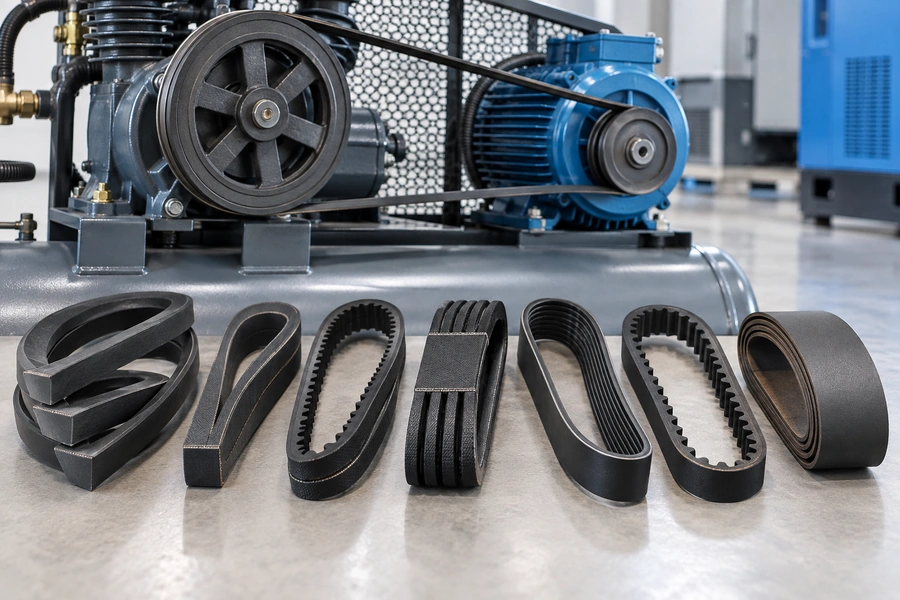
](https://kaishanpro.com/wp-content/uploads/2026/09/What-Are-the-Different-Types-of-Compressor-Belts.webp)
A compressor belt may look like a simple rubber part, but choosing the wrong profile can cause slipping, heat, vibration, poor power transfer, and unexpected compressor downtime.
The main types of compressor belts are classical V-belts, narrow or wedge V-belts, cogged V-belts, banded V-belts, Poly-V or multi-rib belts, and synchronous timing belts. Some older or special compressors also use flat or link belts. I select the correct type by matching the pulley profile, power requirement, speed, belt length, and compressor design.
I see the drive belt as the mechanical connection between the motor and the compressor pump or airend. If the belt cannot transmit power efficiently, the motor may be running normally while the compressor still fails to deliver its expected performance. For this reason, I never replace a compressor belt simply by finding another belt that looks approximately the same.
What Type of Belt Does an Air Compressor Use?
Different air compressors use different belt-drive designs. Piston compressors commonly use traditional V-belts, while some rotary screw compressors use V-belt sets or Poly-V belts. Specialized machines can use synchronous belts.
Most belt-driven air compressors use V-belts because the V-shaped profile grips matching pulley grooves and transfers substantial power with a relatively simple design. Depending on the compressor, I may also find narrow wedge belts, cogged V-belts, multiple matched V-belts, Poly-V belts, or synchronous timing belts. The original pulley design determines which family is correct.
Classical V-belts
Classical V-belts are among the most common compressor drive belts.
They have a trapezoidal cross-section. The belt runs inside a matching V-shaped pulley groove. When the belt is tensioned, its sidewalls grip the pulley and transfer torque from the motor to the compressor.
Traditional industrial classical belt sections include A, B, C, D, and E. Gates identifies these as classical heavy-duty V-belt cross-sections.
For compressor service, I commonly see A- and B-section belts on smaller and medium reciprocating compressors. Larger industrial machines may use larger profiles or several belts together.
Classical V-belts are attractive because they are:
- Simple
- Widely available
- Easy to inspect
- Relatively economical
- Suitable for many industrial drives
- Tolerant of some normal installation variation
They are still very common on piston compressors because the pulley arrangement is simple and easy to service.
Narrow or wedge V-belts
A narrow V-belt has a deeper and narrower cross-section than a traditional classical belt.
Common imperial narrow sections include 3V, 5V, and 8V. Metric-style wedge profiles include SPZ, SPA, SPB, and SPC.
I normally encounter wedge belts where the designer needs to transfer more power without making the belt drive excessively wide.
This can be useful in compact industrial compressors.
The important point is that a narrow wedge belt is not simply a thinner replacement for a classical V-belt. Its pulley groove is different.
I therefore never replace an A, B, or C belt with an SP or 5V belt merely because the dimensions appear close.
Cogged or notched V-belts
A cogged V-belt is still a friction-drive V-belt.
The difference is that the inner surface has molded notches.
These notches allow the belt to bend more easily around smaller pulleys. Gates explains that molded notches reduce bending stress and allow belts to operate on smaller sheaves than comparable non-notched designs.
Common markings include:
| Belt family | Common examples |
|---|---|
| Classical smooth V-belt | A, B, C |
| Classical cogged V-belt | AX, BX, CX |
| Narrow wedge V-belt | 3V, 5V, 8V |
| Narrow cogged wedge belt | 3VX, 5VX, 8VX |
| Metric narrow V-belt | SPZ, SPA, SPB, SPC |
| Metric cogged version | XPZ, XPA, XPB, XPC |
I find cogged belts useful when heat, flexibility, or smaller pulley diameter is important. However, I still follow the compressor manufacturer's specified belt profile.
Banded V-belts
A banded V-belt joins several individual V sections under a reinforced top band.
This construction keeps the individual ribs working together.
Gates describes banded belts as designs intended to resist wear, tensile forces, flexing, fatigue, and shock loads.
I consider banded construction when a drive is exposed to:
- Pulsating loads
- High torque
- Strong vibration
- Belt whipping
- Heavy industrial operation
Heavy compressors can benefit from the additional stability.
However, a banded belt requires the correct multi-groove pulley arrangement. I cannot substitute one automatically for several ordinary individual belts.
What Is the Difference Between a V-Belt and a Poly-V Compressor Belt?
These two belts can both use V-shaped contact surfaces, but their construction and pulley systems are very different.
A traditional V-belt has one large V-shaped cross-section that runs in one pulley groove. A Poly-V belt is wider and contains many small longitudinal ribs that engage several shallow grooves. Poly-V belts provide high power density, compact drive dimensions, and smooth operation, while conventional V-belts remain simpler and widely used.
Poly-V belts use many small ribs
A Poly-V belt may look almost flat from a distance.
When I inspect the inside surface, however, I can see multiple narrow ribs running along its length.
These ribs engage matching grooves on the motor and compressor pulleys.
Poly-V belts are also described as:
- Multi-rib belts
- Ribbed belts
- Micro-rib belts
- Poly-groove belts
Air-compressor replacement suppliers currently list both conventional V-belts and Poly-V or ribbed belt sets for compressor applications.
The multiple ribs allow a relatively wide contact area while keeping the belt flexible.
I normally associate Poly-V systems with compact modern drive arrangements where the manufacturer wants good power transmission in limited space.
I do not interchange the two systems
A V-belt pulley and a Poly-V pulley are fundamentally different.
| Feature | V-belt | Poly-V belt |
|---|---|---|
| Cross-section | One large V | Many small ribs |
| Pulley | One or several deep V grooves | Multiple shallow grooves |
| Flexibility | Good | Very good |
| Power density | Good | High |
| Drive width | Can increase with multiple belts | Compact |
| Replacement | Often straightforward | Exact rib count and length are critical |
| Alignment sensitivity | Moderate | Usually more sensitive |
For example, current compressor-parts catalogs list Poly-V belts separately from classical V-belts because they are not interchangeable components.
When I source a Poly-V replacement, I check:
- Belt length
- Rib count
- Rib profile
- Belt width
- Pulley condition
- Compressor model
- OEM part number
A belt that is correct in length but wrong in rib profile may physically go around the pulleys while still being unsuitable for the drive.
Synchronous or timing belts are another category
A synchronous belt is different from both V-belts and Poly-V belts.
It uses teeth that engage matching toothed pulleys.
This creates a positive drive. The belt does not depend only on friction to transmit power, so it can maintain a fixed speed relationship without normal belt slip.
These are often called:
- Timing belts
- Toothed belts
- Synchronous belts
Current compressor-drive guidance identifies timing belts as a less common but real compressor belt type, especially on certain oil-free and specialty machines.
I pay special attention when servicing these systems because the tooth profile, pitch, width, and length must match exactly.
A cogged V-belt and a timing belt are also not the same thing.
A cogged V-belt has flexible notches but still drives through its V-shaped sidewalls. A timing belt uses actual teeth that engage a toothed pulley. Gates specifically distinguishes synchronous belts from belts that are merely notched or cogged.
How Do I Know What Size Compressor Belt I Need?
A belt can have the correct general shape and still be wrong for the compressor. I therefore identify the profile and size before I compare materials or brands.
I identify a replacement compressor belt from the compressor make and model, OEM part number, belt markings, cross-section, length, width, rib count, and number of belts in the drive. I also inspect the pulleys because installing a correct new belt on worn or misaligned pulleys can cause rapid failure.
I read the markings first
The easiest situation is when the old belt still has readable markings.
For example, a classical belt may carry a marking such as:
A44
The letter identifies the profile, while the number relates to belt length according to that sizing system.
An automotive or fractional-horsepower-style belt may instead use a code such as:
4L460
These numbers do not necessarily use exactly the same measurement method.
Master Tool Repair notes, for example, that a 4L-series belt commonly uses outside length in its designation, while traditional A-series belt numbers use another length reference.
This is why I do not order a replacement from one measurement alone.
I check the complete specification
My replacement checklist looks like this:
| Check | Why it matters |
|---|---|
| Compressor model | Helps identify original specification |
| Serial number | Some models change parts between production versions |
| OEM belt number | Usually the safest reference |
| Belt profile | Must match pulley groove |
| Belt length | Determines fit and adjustment range |
| Belt width | Must match the drive |
| Number of ribs | Critical for Poly-V belts |
| Number of individual belts | Important on multiple-belt drives |
| Pulley condition | Worn grooves can destroy a new belt |
| Alignment | Misalignment causes uneven wear |
| Required tension | Too loose or too tight reduces belt life |
Current compressor maintenance guidance also recommends checking the existing part number, belt profile, length, drive arrangement, and pulley condition before ordering a replacement.
Matched belt sets matter
Some industrial compressors use two, three, or more V-belts side by side.
When I service this type of drive, I normally replace them as a matched set rather than putting one new belt beside several worn belts.
The old belts have already stretched and worn.
A new belt can therefore carry a different share of the load.
That creates uneven tension and can shorten the life of the entire drive.
I also make sure all pulley grooves are in comparable condition.
Replacing belts without checking worn pulley grooves can make a new set start slipping almost immediately.
Why Do Air Compressor Belts Wear Out?
Belts are wear components, but premature belt failure often tells me something else is wrong with the compressor drive.
Air compressor belts can wear prematurely because of incorrect tension, pulley misalignment, worn pulley grooves, excessive heat, contamination, overloading, unsuitable belt selection, or normal aging. Cracking, glazing, fraying, squealing, repeated tension loss, and belt slippage are common signs that I inspect before the belt fails completely.
Incorrect tension is one of the first things I check
A belt that is too loose can slip.
Slippage generates heat.
Heat damages the rubber and contact surfaces.
The compressor may also lose speed, so the machine produces less air than expected.
A belt that is too tight creates another problem.
Excess tension adds unnecessary load to motor bearings, compressor bearings, and shafts.
For this reason, I do not tighten a compressor belt according to feel alone. I use the manufacturer's specified tension method.
There is no single universal deflection or tension figure for all compressor belts because the correct value depends on:
- Belt type
- Belt width
- Belt length
- Pulley diameter
- Center distance
- Motor power
- Compressor design
Current 2026 compressor-maintenance guidance also warns that both insufficient and excessive tension can create problems and recommends using the compressor or drive manufacturer's specification.
Pulley alignment matters just as much
If the motor pulley and compressor pulley do not run in the same plane, the belt is forced sideways as it rotates.
I may then see:
- Fraying along one edge
- Uneven sidewall wear
- Belt tracking problems
- Vibration
- Heat
- Frequent belt replacement
Replacing the belt alone does not solve misalignment.
I inspect the root cause first.
I read the old belt before throwing it away
The worn belt often tells me what happened.
| Belt condition | What I investigate |
|---|---|
| Shiny or glazed sides | Slippage or heat |
| Cracks | Age, heat, or excessive bending |
| Frayed edge | Pulley misalignment |
| Missing rubber sections | Severe deterioration |
| Oil-soaked belt | Oil leak or contamination |
| Uneven wear | Alignment or pulley problem |
| Repeated stretching | Wrong belt, excessive load, or drive problem |
| Squealing | Possible slippage or alignment problem |
A current compressor service guide similarly identifies cracking, fraying, glazing, slipping, and unusual noises as warning signs that the belt or drive system needs attention.
I therefore treat belt replacement as an inspection opportunity rather than only a consumable-parts job.
My insights: What Are the Different Types of Compressor Belts
The term “compressor belt” sounds like one standard spare part, but I see it as an entire family of power-transmission components.
The different types of compressor belts include classical V-belts, narrow wedge V-belts, cogged or notched V-belts, banded V-belts, Poly-V multi-rib belts, synchronous timing belts, and less-common flat or link belts. In practical compressor maintenance, the most important distinction is not which belt type sounds better, but which belt exactly matches the original pulley and drive design.
I divide compressor belts into friction drives and positive drives
This is the simplest way I understand the different belt types.
Most compressor V-belts and Poly-V belts are friction drives.
They depend on belt tension and contact with the pulley to transfer torque.
Synchronous timing belts are positive drives.
Their teeth engage the pulley directly.
That gives me this practical structure:
| Main family | Common subtype | How power is transferred |
|---|---|---|
| V-belt | Classical A/B/C | Friction and wedge action |
| V-belt | Narrow 3V/5V/8V or SP profiles | Friction and wedge action |
| V-belt | Cogged AX/BX/CX or XP profiles | Friction and wedge action |
| V-belt | Banded | Multiple joined V sections |
| Multi-rib | Poly-V | Friction through multiple ribs |
| Synchronous | Timing/toothed | Positive tooth engagement |
| Flat belt | Traditional flat | Surface friction |
| Link belt | Segmented V-style replacement | Friction in V pulley |
V-belts dominate many traditional air-compressor drives. Compressor-parts suppliers currently list smooth V-belts, cogged V-belts, metric wedge belts, and Poly-V systems across a wide range of compressor applications.
Classical V-belts are the straightforward choice
When the compressor was designed around a classical V-belt, I usually prefer to stay with that specified profile.
They are common.
They are easy to source.
Their pulley systems are simple.
They are familiar to maintenance technicians in most markets.
For many piston compressors, I see little reason to redesign a functioning drive only because another belt technology is newer.
Cogged belts can improve flexibility
If the drive was designed for a cogged profile, the notches allow easier bending and can help the belt operate around relatively small pulleys.
Gates uses an X in several belt families to identify molded-notch construction, including AX, BX, CX, 3VX, and 5VX examples.
I still avoid thinking of “cogged” as automatically better.
The pulley and belt specification must remain compatible.
Narrow wedge belts help when power density matters
Narrow belts allow substantial power transfer with compact drive dimensions.
That can make them attractive on modern industrial machinery where space is limited.
However, I make sure a narrow wedge belt actually matches the pulley section.
A belt that rides too high, too low, or bottoms out in the groove will not perform correctly even if its circumference seems right.
Poly-V belts make compact drives possible
Poly-V belts combine many small longitudinal ribs in one flexible belt.
I like them where the machine designer needs a compact, smooth drive with considerable contact area.
However, their replacement is specification-sensitive.
I check rib profile and rib count carefully.
Banded belts help stabilize demanding drives
Banded V-belts can be useful when individual belts may whip, vibrate, or turn over under difficult loads.
This does not mean that every multi-belt compressor should be converted to a banded belt.
The pulley system and manufacturer design still decide the correct configuration.
Flat and link belts are less common
Flat belts were historically important in industrial power transmission, but modern compact compressors usually use other belt types.
Link belts are assembled from individual removable sections and can be useful in certain repair or special industrial situations.
I see these as secondary categories rather than the standard answer when somebody asks about modern air compressor belts.
My replacement rule is more important than the belt ranking
When I source a belt for a compressor, I follow this order:
compressor model → OEM part number → belt type → profile → length → rib or belt count → pulley condition → alignment → tension
I do not begin with price.
A low-cost belt that does not match the drive can slip and waste power. It can also damage pulleys, create heat, and stop the compressor.
I also avoid assuming that a belt from another application is acceptable just because its dimensions appear similar.
Industrial belt manufacturers use different constructions for different loads, temperatures, operating speeds, and environments.
A compressor belt may operate for thousands of hours under repeated startup and continuous mechanical loading. I therefore want a belt designed for industrial power transmission and suitable for the specific compressor.
For overseas industrial equipment, I would also include spare belts in the normal spare-parts package when the compressor uses a belt drive. A spare belt is relatively small and inexpensive to ship, but belt failure can stop the complete compressor.
This matters even more when the compressor is installed at:
- A remote mine
- A quarry
- A drilling project
- A construction site
- A factory far from local compressor distributors
For those projects, I prefer to confirm the exact belt part number before shipment and keep at least the required service spares available.
So when someone asks me, “What are the different types of compressor belts?”, I give a broader answer than simply saying V-belts.
The main compressor belt families are classical V-belts, narrow wedge belts, cogged V-belts, banded V-belts, Poly-V belts, and synchronous timing belts. Flat and link belts exist in more specialized applications. The best belt is always the belt profile and construction that the compressor drive was engineered to use.
Conclusion
Compressor belts come in several designs, but I choose them by the original pulley system, power requirement, profile, length, alignment, and tension rather than appearance or price alone.