
](https://kaishanpro.com/wp-content/uploads/2026/09/How-Does-a-Regenerative-Desiccant-Dryer-Work.webp)
Moisture can freeze air lines, damage instruments, corrode equipment, and disrupt sensitive production. I use regenerative desiccant dryers when ordinary refrigerated drying is not dry enough.
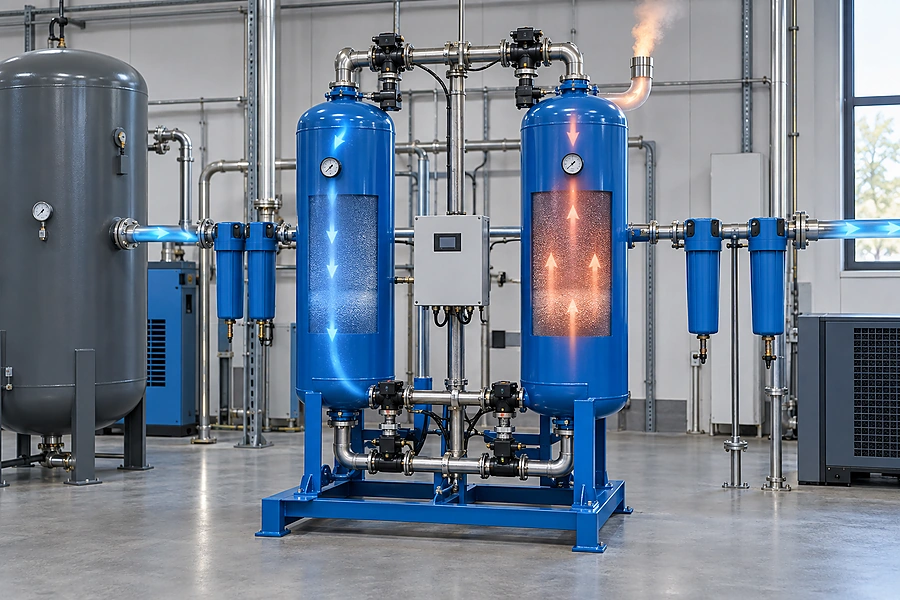
A regenerative desiccant dryer works by alternating two desiccant-filled towers. One tower adsorbs water vapor from compressed air while the other tower removes previously collected moisture through regeneration. The towers then switch roles. Regeneration can use dry purge air, heated purge air, heated ambient air, or recovered compressor heat.
I see the regenerative dryer as a continuous adsorption system. The desiccant can hold only a limited amount of moisture. Instead of replacing it every time it becomes wet, the dryer repeatedly dries the desiccant so it can be used again. This regeneration process is what separates a regenerative desiccant dryer from simpler disposable drying methods.
What Is a Regenerative Desiccant Dryer?
A refrigerated dryer removes moisture by cooling compressed air. A regenerative desiccant dryer uses a different principle. It attracts water vapor onto the surface of a drying material.
A regenerative desiccant dryer is normally a twin-tower compressed-air dryer filled with adsorbent material. Wet compressed air passes through one tower, where the desiccant removes water vapor. At the same time, the second tower is regenerated so it can return to service. This repeating cycle provides a continuous supply of very dry compressed air.
I separate adsorption from absorption
I think this distinction helps explain how the dryer works.
The process is called adsorption.
Water molecules attach to the surface of the desiccant instead of being absorbed throughout the complete material.
Common desiccants include:
- Activated alumina
- Silica gel
- Molecular sieve
The exact material depends on the dryer design, required pressure dew point, inlet conditions, and regeneration method. Atlas Copco notes that different desiccant types and combinations can be selected according to dew-point requirements and operating conditions.
Most regenerative dryers use two pressure vessels because one bed cannot dry air continuously without eventually becoming saturated.
I think of the arrangement like this:
| Component | Main function |
|---|---|
| Tower A | Dries compressed air |
| Tower B | Regenerates desiccant |
| Desiccant | Adsorbs water vapor |
| Inlet valves | Direct wet air into the active tower |
| Outlet valves | Direct dry air into the plant |
| Exhaust valves | Release regeneration air and moisture |
| Heater | Used on heated designs |
| Blower | Supplies regeneration air on blower-purge designs |
| Controller | Coordinates tower switching |
| Dew-point sensor | Can help control regeneration on advanced systems |
During normal operation, one tower stays pressurized and receives the main compressed-air flow.
The other tower is taken offline for regeneration.
When regeneration is complete, it is prepared for service again.
Then the dryer changes towers.
This cycle can repeat thousands of times before the desiccant itself requires replacement. Kaeser notes that adsorption and desorption cycles can be repeated many thousands of times in regenerative systems.
What Are the Steps in a Regenerative Desiccant Dryer Cycle?
The tower switch is only one part of the process. I normally break a regenerative dryer cycle into drying, depressurization, regeneration, cooling where required, repressurization, and tower switching.
A regenerative desiccant dryer cycle starts with adsorption in one tower. The saturated second tower is then depressurized and regenerated. Heated designs may add a heating and cooling phase. The regenerated tower is repressurized before the valves switch, allowing it to begin drying while the previously active tower starts regeneration.
Stage 1: One tower dries the compressed air
Suppose Tower A is online.
Wet compressed air enters Tower A and flows through the desiccant bed.
The desiccant attracts water vapor.
The air leaves the tower with a much lower moisture content and flows toward the downstream air system.
The target pressure dew point depends on the dryer design.
Regenerative dryers are commonly used when the application needs a dew point below freezing. Atlas Copco describes adsorption dryers as the normal choice when compressed-air applications require a pressure dew point below 0°C.
At the same time, Tower B is offline.
Stage 2: The wet tower is depressurized
Tower B contains desiccant that became wet during its previous drying cycle.
I first need to prepare it for regeneration.
On pressure-swing designs, the tower pressure falls from line pressure toward atmospheric pressure.
This pressure reduction helps release moisture from the desiccant and makes the regeneration process more effective.
Kaeser's heatless cycle description shows the offline vessel exhausting toward atmosphere before dry purge air continues the regeneration process.
Stage 3: The dryer removes moisture from the desiccant
This is where regenerative dryer types begin to differ.
The dryer must move water away from the wet desiccant bed.
It can do this with:
- Expanded dry compressed air
- Heated dry compressed air
- Heated ambient air from a blower
- Heat recovered from the compressor
Atlas Copco identifies these as the main regeneration approaches used across modern desiccant dryers.
The moisture leaves the desiccant and exits the dryer through the regeneration exhaust stream.
Stage 4: Heated dryers may require cooling
If I use heat to regenerate the desiccant, the tower may be too hot to return immediately to normal drying service.
The bed must cool.
The cooling method depends on the dryer.
Some systems use a small amount of dry compressed air.
Some advanced zero-purge systems use ambient air.
This cooling phase matters because hot desiccant does not adsorb moisture as effectively as cooler desiccant.
Stage 5: The regenerated tower is repressurized
Before I return the regenerated tower to service, I raise its pressure back toward system pressure.
This reduces the pressure difference between the two vessels.
Kaeser's heatless cycle description shows the offline tower repressurizing before the inlet and outlet valves transfer the main airflow to it.
Stage 6: The towers change roles
Tower B is now ready.
The control valves direct wet compressed air through Tower B.
Tower B becomes the drying tower.
Tower A begins its regeneration cycle.
The dryer continues alternating like this:
| Cycle period | Tower A | Tower B |
|---|---|---|
| First period | Drying | Regenerating |
| Changeover | Preparing to regenerate | Repressurizing |
| Second period | Regenerating | Drying |
| Next changeover | Repressurizing | Preparing to regenerate |
This twin-tower arrangement gives me continuous dry compressed air while still allowing the desiccant to recover its adsorption capacity.
What Are the Different Types of Regenerative Desiccant Dryers?
The drying principle is similar across regenerative dryers, but the regeneration method can make a large difference in compressed-air loss, electricity use, purchase price, and operating cost.
The main regenerative desiccant dryer types are heatless, heated-purge, blower-purge, zero-purge, and heat-of-compression dryers. Heatless models use dry compressed air for regeneration. Heated designs reduce purge demand, blower systems use heated ambient air, and heat-of-compression dryers recover heat that the compressor already produces.
Heatless regenerative dryers
A heatless dryer is the simplest regenerative design.
It takes a portion of the dry compressed air leaving the active tower.
The dryer expands this air toward atmospheric pressure and sends it through the wet tower.
The low-pressure dry air carries moisture away.
Atlas Copco gives a typical heatless purge range of about 12–18% in one current guide, while other Atlas Copco documentation gives approximately 16–19% depending on system design. Kaeser states that heatless purge losses can reach roughly 15–20%.
I therefore treat 15–20% as a useful practical range, not as one fixed number for every dryer.
Heated-purge regenerative dryers
A heated-purge dryer adds a heater to the regeneration stream.
Heating the purge air reduces its relative humidity and increases its ability to remove water from the desiccant.
Because the air carries more moisture, I need less compressed air for regeneration.
Kaeser states that externally heated dryers commonly use around 6–7% purge air under rated conditions. Its current heated-purge product information cites about 7% purge.
The trade-off is clear.
I save compressed air, but I add:
- A heater
- Electrical consumption
- More controls
- Additional maintenance
Blower-purge regenerative dryers
A blower-purge dryer uses ambient air instead of relying primarily on dry compressed air.
A blower draws atmospheric air through a heater.
The hot regeneration air then passes through the wet desiccant bed.
Kaeser describes current blower-purge dryers as using heated ambient air and operating with about 1% or even zero process-air loss, depending on the configuration.
Atlas Copco gives about 0–2% compressed-air demand for heated blower systems in some current designs.
I normally consider blower-purge technology more seriously as system airflow increases because the financial value of saved compressed air becomes much larger.
Zero-purge dryers
Some blower dryers also use ambient air for both heating and cooling.
This can eliminate compressed-air consumption during regeneration.
Atlas Copco currently describes zero-purge variants that avoid compressed-air losses during both heating and cooling so the compressor output remains available for production.
These systems can offer strong lifecycle efficiency, but the equipment is normally more complex and expensive than a basic heatless dryer.
Heat-of-compression dryers
A compressor produces large amounts of heat during compression.
Instead of rejecting all that heat through an aftercooler, a heat-of-compression dryer uses it to regenerate the desiccant.
Kaeser describes HOC systems as among the most energy-efficient regenerative designs because they recycle compressor heat instead of producing new regeneration heat.
Atlas Copco also describes heat-of-compression regeneration as using available compressor heat instead of rejecting it.
These systems usually require specific compressor configurations and are not suitable for every compressed-air plant.
My practical comparison
| Dryer type | Regeneration source | Typical purge impact | Where I consider it |
|---|---|---|---|
| Heatless | Dry compressed air | ~15–20% in many systems | Smaller flows, simple installations |
| Heated purge | Heated dry compressed air | ~6–8% | Medium flows |
| Blower purge | Heated ambient air | ~0–2% in some systems | Larger continuous systems |
| Zero purge | Heated and cooled ambient air | Near 0% process air | Large energy-focused plants |
| Heat of compression | Recovered compressor heat | Very low | Compatible continuous oil-free systems |
I do not choose the most sophisticated technology automatically.
I compare lifecycle cost.
What Dew Point Can a Regenerative Desiccant Dryer Achieve?
I use regenerative dryers when ordinary refrigerated drying cannot meet the required moisture level. This usually means outdoor piping, instrumentation, or moisture-sensitive production.
Regenerative desiccant dryers commonly produce pressure dew points of -20°C or -40°C, while some designs reach approximately -70°C to -73°C (-94°F to -100°F). A -40°C (-40°F) PDP is one of the most common industrial specifications for dry instrument and process air.
I see -40°C PDP as an important industrial target
A -40°C pressure dew point provides a large margin against condensation and freezing.
Parker's twin-tower regenerative systems identify -40°F / -40°C as a standard target for both heatless and externally heated designs.
Kaeser also offers regenerative dryer designs down to -40°F and heatless systems reaching as low as -94°F.
Typical low-dew-point applications include:
- Instrument air
- Outdoor winter piping
- Pharmaceutical production
- Electronics
- Chemical processes
- Pneumatic controls
- Laboratory systems
- Cold storage
- Moisture-sensitive conveying
- Critical manufacturing
I still do not choose -70°C simply because it sounds better.
The process should justify it.
Lower dew-point targets can increase energy demand or regeneration requirements.
I protect the desiccant from liquid water and oil
A regenerative desiccant bed is designed mainly to remove water vapor.
I do not want large quantities of liquid water entering the towers.
Bulk water should be removed upstream.
I also pay close attention to oil contamination in systems using oil-lubricated compressors.
Atlas Copco warns that oil can coat the desiccant and damage its adsorption capacity. It recommends suitable upstream filtration and notes that conventional bead-type desiccant systems also commonly need downstream particulate filtration to catch desiccant dust.
I therefore often think about the complete air-treatment arrangement as:
compressor → aftercooler → water separator → prefilter → regenerative desiccant dryer → afterfilter → air system
The exact arrangement depends on the application and dryer design.
My insights: How Does a Regenerative Desiccant Dryer Work
A regenerative dryer can look like two simple tanks connected with valves, but the important engineering question is how efficiently the dryer restores the moisture-removal capacity of the desiccant.
A regenerative desiccant dryer works by continuously alternating adsorption and regeneration. One tower removes water vapor from compressed air while the second tower releases previously adsorbed moisture. Heatless, heated-purge, blower-purge, and heat-of-compression designs all use this same basic cycle but differ in how they regenerate the desiccant and how much energy or compressed air they consume.
I see regeneration method as the main economic difference
All regenerative dryers solve the same fundamental problem.
Desiccant gets wet.
It must become dry again.
The question is what I am willing to spend to make that happen.
A heatless dryer spends compressed air.
A heated-purge dryer uses electricity plus some compressed air.
A blower dryer uses a blower and heater while greatly reducing purge consumption.
A heat-of-compression dryer tries to reuse energy the compressor has already generated.
This gives me a very different operating-cost profile even when two dryers produce the same -40°C PDP.
I do not compare purchase price alone
Suppose one heatless dryer costs much less to buy.
That can make it attractive.
However, if it operates continuously at high airflow and consumes 15% or more of the compressor output for regeneration, the annual cost of that compressed air can become significant. Kaeser specifically describes heatless dryers as relatively inexpensive to purchase but often expensive to operate because of purge-air losses.
At larger flows, heated and blower technologies can justify a higher initial investment.
Kaeser notes that heated regeneration can reduce purge requirements to around 1–7% depending on design and can substantially reduce operating cost in higher-flow applications.
So my dryer comparison normally includes:
- Purchase price
- Compressor power
- Purge percentage
- Heater power
- Blower power
- Annual operating hours
- Electricity cost
- Maintenance
- Required pressure dew point
- Expected equipment life
I want lifecycle cost, not only purchase cost.
I consider heatless dryers strong when simplicity matters
A heatless regenerative dryer has clear strengths.
It has no regeneration heater.
It has no blower.
Its control system can be relatively simple.
This makes heatless technology attractive for:
- Smaller air systems
- Remote locations
- Hazardous areas
- Installations where simplicity matters
- Projects where initial investment matters
Atlas Copco describes heatless dryers as mechanically robust and suitable for simple or remote installations, although their purge-air requirement is higher.
I therefore do not treat heatless technology as outdated.
It is simply one point on the cost and efficiency curve.
I move toward heated or blower regeneration as flow increases
As airflow becomes larger, every percentage of compressed-air loss becomes more expensive.
This is where the economics begin to change.
If a dryer handles several thousand cfm, a 15% purge requirement represents a large amount of compressor capacity.
A blower-purge dryer can use heated ambient air instead.
Kaeser currently lists blower-purge systems from hundreds to several thousand scfm and describes configurations with approximately 1% or zero process-air loss.
For a large plant operating 24/7, I would calculate this difference carefully.
I use dew-point control when the load changes
Traditional dryers often operate on fixed time cycles.
The problem is that actual moisture load can change.
Airflow changes.
Inlet temperature changes.
Humidity changes.
A fixed cycle may regenerate the tower even when the desiccant still has useful drying capacity.
Advanced controls can use dew-point monitoring or demand-based control to delay tower switching until regeneration is actually needed. Kaeser lists optional dew-point monitoring and energy-saving control on current regenerative dryer systems.
I see this as another opportunity to reduce operating cost.
I check inlet conditions before blaming the dryer
A regenerative dryer cannot correct every upstream problem.
If the aftercooler is dirty and the compressed air enters the dryer too hot, the moisture load rises.
If the water separator fails, the dryer may receive liquid water.
If the prefilter is poor, oil can contaminate the desiccant.
If the dryer is overloaded beyond its rated airflow, the air may not remain in contact with the desiccant long enough to reach the required dew point.
Kaeser also warns that channeling through the desiccant bed can reduce drying performance if airflow distribution is poor.
So when a dryer fails to meet dew point, I inspect the complete system rather than automatically replacing desiccant.
My practical selection rule
When I choose a regenerative desiccant dryer, I use this order:
required airflow → operating pressure → required pressure dew point → inlet temperature → operating hours → regeneration method → purge cost → filtration → energy cost → maintenance support
For relatively small systems where simplicity is most important, I often evaluate heatless regeneration first.
For medium or larger systems with high annual running hours, I compare heated-purge and blower-purge technologies.
For very large compatible systems, I also consider zero-purge and heat-of-compression designs.
So when someone asks me, “How does a regenerative desiccant dryer work?”, my practical answer is:
It uses one desiccant bed to dry compressed air while another bed is being restored. The dryer removes moisture from the wet desiccant with low-pressure dry air, heated purge air, heated ambient air, or recovered compressor heat. After regeneration and repressurization, the towers switch, and the same process continues automatically.
Conclusion
I use regenerative desiccant dryers to produce very dry compressed air through repeating adsorption and regeneration cycles. The regeneration method determines the main difference in energy use, purge loss, and operating cost.