
](https://kaishanpro.com/wp-content/uploads/2026/09/How-Does-a-Safety-Valve-Work.webp)
Excess pressure can damage a compressor, receiver, piping, or other pressure equipment. I use a safety valve as an automatic mechanical backup when normal pressure controls fail.
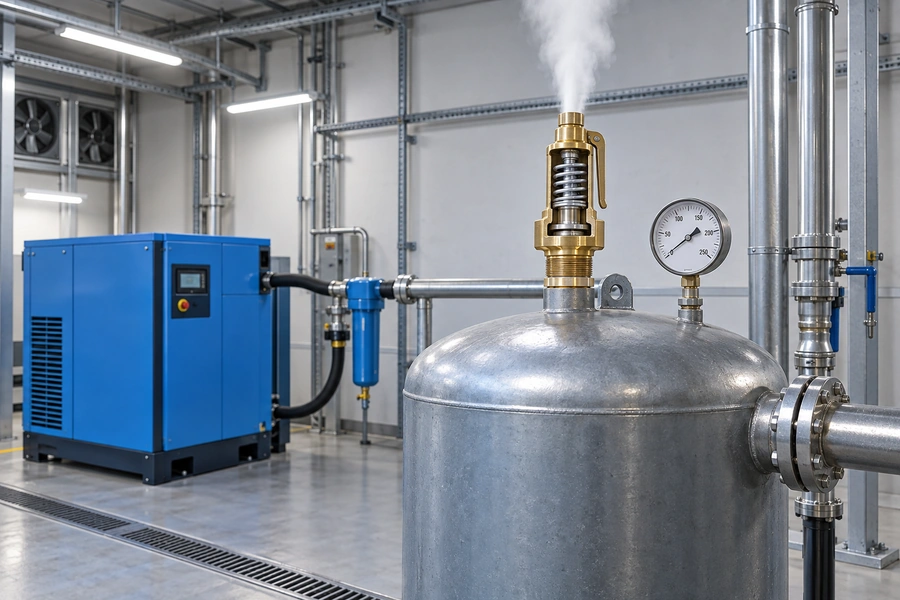
A safety valve works by balancing system pressure against a calibrated spring. During normal operation, spring force keeps the valve closed. When pressure reaches the valve’s set pressure, the force from the compressed air lifts the valve disc. The valve releases excess air and closes again after pressure falls sufficiently.
I think of a safety valve as a simple device with a critical job. It normally stays closed and does not regulate everyday operating pressure. It only acts when pressure becomes high enough to threaten the equipment it protects.
How Does a Spring-Loaded Safety Valve Work?
A spring-loaded safety valve uses mechanical force rather than normal electronic compressor controls. This allows it to provide protection even if a controller, sensor, or pressure switch fails.
A spring-loaded safety valve has a disc or sealing element pressed against a seat by a calibrated spring. System pressure pushes against the disc from the opposite direction. When pressure force becomes greater than the spring force at the set pressure, the disc lifts and creates an opening through which compressed air can escape.
The spring keeps the valve closed
During normal compressor operation, system pressure acts on the underside of the valve disc.
The spring pushes the disc toward the valve seat.
As long as the spring force is greater than the force created by system pressure, the valve remains closed.
I can describe the basic balance like this:
| Condition | Pressure force | Spring force | Valve position |
|---|---|---|---|
| Normal pressure | Lower | Higher | Closed |
| Pressure approaches set point | Increasing | Still holding | Closed |
| Set pressure reached | Sufficient to overcome spring | Overcome | Begins opening |
| Overpressure develops | Higher | Compressed further | Opens rapidly |
| Pressure falls | Decreasing | Pushes disc down | Begins closing |
| Reseating pressure reached | Lower | Dominant again | Closed |
The spring is therefore not simply a return spring.
Its calibration is what establishes the valve's opening pressure.
Sullair describes compressor pressure relief valves in the same way. Spring tension keeps the valve closed during normal operation. When vessel pressure exceeds the valve's rated pressure, the valve opens and vents excess pressure to atmosphere.
The valve is normally independent of the controller
I see this independence as one of the most important safety features.
A compressor may normally rely on:
- A pressure switch
- A pressure transducer
- An electronic controller
- A load/unload system
- A high-pressure shutdown
These devices should prevent the system from reaching the safety valve's opening pressure.
However, controls can fail.
The safety valve provides a mechanical layer of protection that does not normally depend on the main compressor controller telling it to open.
That is why I treat it as the final pressure-protection device rather than a normal compressor-control component.
What Happens When a Safety Valve Reaches Its Set Pressure?
The valve does not simply open at one exact pressure and instantly close at the same pressure. Real safety-valve operation includes set pressure, overpressure, full lift, and reseating pressure.
When inlet pressure reaches the safety valve’s set pressure, the valve disc begins to lift. A small additional pressure rise can drive the valve toward full opening so it can discharge its rated flow. Once pressure decreases, the valve stays open until it reaches a lower reseating pressure. The difference is called blowdown.
Set pressure is the opening reference
The set pressure is the pressure at which the safety valve starts to lift.
This number matters because it must protect the equipment before pressure reaches an unsafe level.
Spirax Sarco defines set pressure as the pressure at which a safety valve starts to lift. It also explains that the set pressure must remain low enough to protect the equipment without being so close to normal working pressure that the valve operates unnecessarily.
I therefore separate three pressures:
Normal operating pressure < safety valve set pressure ≤ allowable equipment limit
The exact relationship depends on the pressure vessel, valve design, applicable code, and manufacturer requirements.
The valve can open rapidly
Once the disc starts lifting, the pressure acts on a larger effective area in many conventional safety-valve designs.
This helps the valve move rapidly toward a larger opening.
That rapid opening is important.
If pressure is rising because a compressor continues producing air, the valve must discharge enough flow to stop pressure from continuing toward a dangerous level.
Spirax Sarco explains that conventional safety valves use disc and chamber geometry to create rapid opening with only a relatively small amount of overpressure.
I therefore care about two specifications:
- Set pressure
- Relieving capacity
A valve with the correct opening pressure but insufficient flow capacity may not provide adequate protection.
Overpressure allows full discharge capacity
The valve may require pressure slightly above its set point before reaching its rated discharge capacity.
This difference is called overpressure.
Spirax Sarco defines relieving pressure as set pressure plus overpressure. For compressible fluids, allowable overpressure is commonly within a relatively small percentage range depending on the applicable standard and application.
For practical compressor selection, I do not calculate this from guesswork.
I rely on the specified safety valve and applicable pressure-vessel requirements.
Why Does a Safety Valve Close Below Its Opening Pressure?
A safety valve needs pressure to fall below its original opening point before it closes securely. This prevents unstable rapid opening and closing around one exact pressure.
A safety valve normally reseats at a pressure below its set pressure. This difference is called blowdown. Blowdown gives the valve enough pressure reduction to close firmly instead of repeatedly opening and closing around the set point. For compressed gases, the reseating differential is commonly expressed as a percentage of set pressure.
I see blowdown as necessary operating margin
Suppose a valve starts opening at 10 bar.
If it immediately closed again the instant pressure dropped to 9.99 bar, the system might still be producing enough air to push pressure above 10 bar again.
The valve could repeatedly open and close.
That unstable operation is undesirable.
Instead, the valve remains open while system pressure falls farther.
It then reseats at a lower pressure.
Spirax Sarco defines the difference between set pressure and reseating pressure as blowdown. For compressible fluids, it notes that blowdown is typically less than about 10% in conventional applications.
I use the concept like this:
Set pressure → valve opens → pressure is relieved → pressure falls → reseat pressure reached → valve closes
Normal pressure needs enough margin
This also explains why the normal system operating pressure should not be extremely close to the safety valve's set point.
If it is too close, pressure fluctuations can cause unwanted lifting.
The valve may also have difficulty closing tightly after discharge.
Spirax Sarco recommends maintaining enough margin between normal working pressure and set pressure to account for blowdown and secure shut-off.
For an air compressor, I normally expect the compressor's normal pressure-control system to respond first.
The safety valve should remain unused during healthy routine operation.
What Is the Difference Between a Safety Valve and a Pressure Switch?
Both devices respond to pressure, but I use them for completely different purposes.
A pressure switch or compressor controller manages pressure during normal operation by stopping or unloading the compressor. A safety valve provides emergency mechanical protection. If normal controls fail and pressure keeps increasing, the safety valve opens and vents compressed air before pressure exceeds the safe limit of the protected equipment.
The pressure switch is part of everyday operation
On a piston compressor, a pressure switch may stop the compressor motor when receiver pressure reaches the normal cut-out setting.
When users consume air and pressure falls, the compressor starts again at the cut-in setting.
On a rotary screw compressor, an electronic controller commonly loads and unloads the machine instead.
Sullair explains that normal compressor pressure is controlled through pressure switches or electronic pressure transducers and controllers. The safety relief valve remains a backup if those systems fail.
I separate the main components like this:
| Component | Main purpose |
|---|---|
| Pressure switch | Normal compressor start/stop control |
| Pressure sensor | Provides pressure information to controller |
| Compressor controller | Controls loading and unloading |
| Regulator | Controls downstream working pressure |
| Check valve | Prevents reverse airflow |
| Unloader valve | Releases pressure during normal control functions |
| Safety valve | Emergency overpressure protection |
This difference matters during troubleshooting.
If the safety valve repeatedly opens, I do not immediately assume that the safety valve is the cause.
It may be doing exactly what it was designed to do.
The real problem can be upstream
If the compressor continues producing air after reaching its normal maximum operating pressure, I investigate the control system.
Possible causes can include:
- Failed pressure switch
- Faulty pressure sensor
- Controller problem
- Failed unloading system
- Solenoid valve problem
- Intake valve problem
- Incorrect pressure settings
Sullair notes that a relief valve opening because pressure has exceeded its set point means the valve itself is performing its safety function.
Atlas Copco likewise lists safety-valve operation after compressor loading as a condition requiring pressure-setpoint and service checks.
I therefore diagnose the reason pressure became excessive instead of disabling the valve.
What Happens if a Safety Valve Fails?
Safety valves are simple devices, but they can still suffer from contamination, corrosion, wear, incorrect replacement, or other problems.
A safety valve can fail open or fail closed. If it fails open, compressed air escapes and the system may not reach operating pressure. If it fails closed during an overpressure event, pressure can continue rising inside the protected vessel, creating a much more serious risk of equipment damage or vessel rupture.
A valve stuck open causes air loss
If the valve cannot reseat correctly, air can leak continuously.
I may notice:
- Constant hissing
- Difficulty building pressure
- Longer compressor running time
- Higher energy consumption
- Air loss
- Reduced system capacity
This does not mean I should plug the valve.
The correct action is to identify why it is leaking and follow the manufacturer's repair or replacement procedure.
A valve stuck closed is more dangerous
A closed valve normally looks normal from the outside.
That is why inspection matters.
If the valve cannot open when system pressure becomes excessive, the final mechanical pressure-protection layer is lost.
Sullair warns that if a compressor's relief valve fails closed and normal pressure controls also fail, pressure can continue rising until the pressure vessel is damaged or ruptures.
For this reason, I never recommend:
- Blocking the valve
- Wiring it shut
- Plugging its outlet
- Installing a higher-pressure valve just to stop nuisance opening
- Adjusting its set pressure without authorization
- Adding an isolation valve that can separate it from the protected vessel
The correct valve needs the correct pressure setting and relieving capacity.
My insights: How Does a Safety Valve Work
A safety valve looks simple because it may contain only a few main mechanical parts. I think the important point is how those parts create an independent pressure limit.
A safety valve works by converting excessive system pressure into mechanical valve movement. Pressure pushes against a disc while a calibrated spring pushes in the opposite direction. When pressure exceeds the spring-controlled set point, the disc lifts and releases compressed air. After sufficient pressure reduction, spring force returns the disc to its seat.
I see it as a force balance
The simplest explanation is:
air pressure pushes up → spring pushes down
During normal operation:
spring force wins → valve stays closed
At excessive pressure:
pressure force wins → valve opens
After pressure is released:
spring force wins again → valve closes
That basic mechanical relationship gives the valve its independence.
It does not need the compressor controller to decide that pressure has become excessive.
Set pressure alone does not define the valve
When I select or identify a replacement safety valve, I do not look only at the pressure stamped on it.
I also consider:
- Protected equipment
- Maximum allowable working pressure
- Required set pressure
- Relieving capacity
- Connection size and type
- Operating medium
- Temperature
- Certification
- Backpressure conditions
- Manufacturer requirements
Spirax Sarco emphasizes that a safety valve's set pressure must be coordinated with the maximum allowable working pressure and that the valve must provide enough capacity at its relieving pressure.
This means two valves with the same thread size are not automatically interchangeable.
The opening pressure and closing pressure are deliberately different
This is one of the most useful concepts for understanding safety-valve operation.
The valve may begin opening at its set pressure.
It may then reach greater lift as pressure rises slightly further.
After enough air has escaped, system pressure falls.
However, the valve does not normally close at exactly the original set pressure.
It closes at the lower reseating pressure.
The gap is blowdown.
For me, this explains why a safety valve behaves differently from a simple electrical on/off switch.
I treat unexpected opening as a warning
Under normal compressor operation, the safety valve should usually stay closed.
If it suddenly opens, I ask two questions.
Is the pressure genuinely too high?
Or:
Is the safety valve opening incorrectly?
If the pressure gauge confirms excessive pressure, I investigate the compressor's normal pressure-control and unloading systems.
If the valve opens while system pressure remains below its proper setting, I investigate the valve, its specification, and the pressure measurement itself.
I do not increase the safety valve setting as a troubleshooting shortcut.
Atlas Copco states that pressure vessels should use the appropriate pressure safety valve with relief pressure below the maximum rated pressure of the vessel and associated piping.
My practical explanation is simple
When someone asks me, “How does a safety valve work?”, I explain it in five steps:
- Normal pressure: The spring holds the valve disc tightly against its seat.
- Pressure rises: Compressed air creates increasing force against the disc.
- Set pressure is reached: Air pressure overcomes the calibrated spring force and the valve begins to open.
- Excess air escapes: The valve releases enough compressed air to control the dangerous pressure rise.
- Pressure falls: Once pressure reaches the lower reseating point, the spring closes the valve again.
The valve therefore turns excessive pressure into an automatic mechanical response.
That is why I see a correctly selected and maintained safety valve as one of the most important protective components on an air compressor or compressed-air pressure vessel.
Conclusion
A safety valve uses a calibrated spring to stay closed at normal pressure, opens automatically during overpressure, releases excess air, and reseats after pressure returns to a safe level.