
](https://kaishanpro.com/wp-content/uploads/2026/09/What-Is-a-Rotary-Drilling-Rig-and-How-Does-It-Work.webp)
Large holes in soil and rock require more than a rotating bit. The rig must apply controlled torque, downward force, flushing, and drill-string handling continuously.
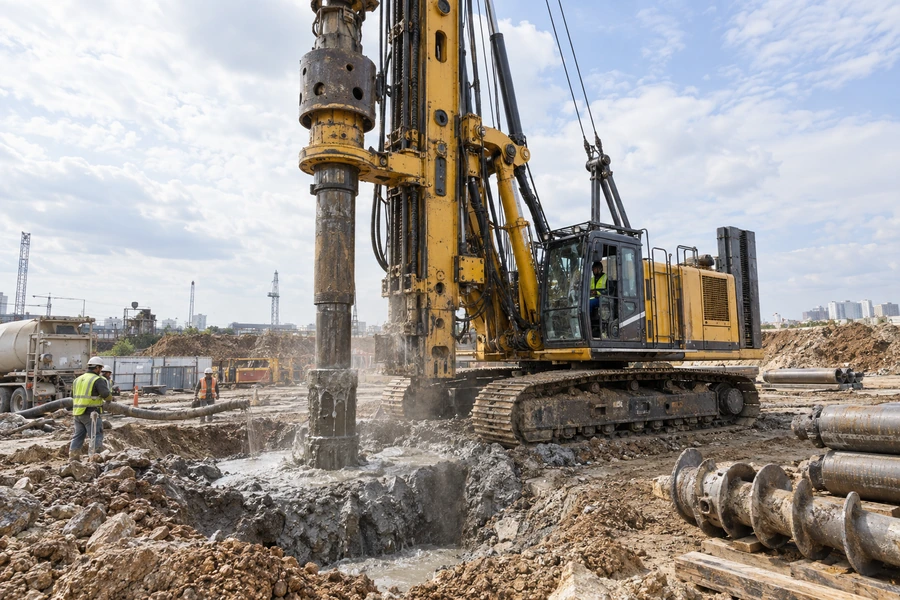
A rotary drilling rig is a machine that creates boreholes by rotating a drill bit while applying downward force through a drill string. The bit cuts, crushes, or grinds the formation, while compressed air, water, or drilling fluid removes cuttings from the hole. Rotary rigs are widely used in mining, water wells, foundations, and exploration.
I think the easiest way to understand rotary drilling is to follow the energy path. The rig creates rotation and feed force, the drill string transfers them to the bit, the bit breaks the formation, and a flushing system removes the broken material so drilling can continue.
How Does a Rotary Drilling Rig Work?
A rotary drilling rig combines rotation, downward force, and flushing. Unlike DTH drilling, conventional rotary drilling does not depend on a percussion hammer directly behind the bit.
A rotary drilling rig works by rotating a drill string and bit while applying controlled weight or pull-down force to the bottom of the hole. The rotating bit cuts or crushes the formation. Compressed air, water, or drilling fluid then carries the resulting cuttings away so the bit can continue attacking fresh material.
Rotation provides the cutting motion
The rotary head sits on the mast and transfers torque to the drill pipe.
As the head turns, the drill string rotates.
The bit at the bottom rotates with it.
Caterpillar describes its rotary-head system as using a gearbox and drive motors to supply controlled rotation and torque to the drilling system. On the current MD6310, for example, the rotary head can operate up to approximately 160 rpm with up to 16,000 N·m of torque, depending on configuration.
The amount of rotation I need depends on:
- Bit type
- Hole diameter
- Formation hardness
- Required penetration rate
- Weight on bit
Soft formations can often use different speeds and cutting structures from hard rock.
I therefore do not set rotation speed independently from the bit and geology.
Feed force pushes the bit into the formation
Rotation alone does not drill efficiently.
The bit must also remain pressed against the bottom of the hole.
A feed or pull-down system moves the rotary head down the mast and applies controlled force through the drill string.
In rotary crushing, this force is particularly important.
Epiroc explains that rotary crushing breaks rock using a high point load. A toothed or button-type bit is pushed downward with substantial force while it rotates.
Modern production rigs can apply very high loads.
Sandvik's current DR410i, for example, supports up to approximately 26,308 kg of weight on bit and about 222 kN of pull-down force for holes in the 152–251 mm range.
This does not mean maximum force should always be used.
Too little force can reduce penetration.
Too much force can:
- Damage the bit
- Increase vibration
- Overload the rotary system
- Reduce tool life
- Create deviation
- Waste energy
I adjust rotation and feed together according to the formation.
The bit breaks the rock
The exact rock-breaking mechanism depends on the bit.
Epiroc divides rotary drilling into two basic mechanisms:
rotary cutting and rotary crushing.
Rotary cutting works mainly through shearing.
A cutting structure removes material as the bit rotates. This is more suitable for relatively soft formations with lower tensile strength.
Rotary crushing relies on high point loads.
The classic example is a tricone roller bit.
The bit has three rotating cones fitted with teeth or tungsten-carbide inserts. As the drill string rotates, the cones roll across the bottom of the hole and crush the formation.
Caterpillar describes its tricone bit as using three independently rotating cone-shaped rollers to pulverize harder formations while distributing the cutting load across the bit.
Flushing removes the cuttings
Breaking the rock is only half of drilling.
The fragmented material has to leave the bottom of the hole.
Otherwise, the bit begins grinding already broken material instead of attacking fresh rock.
Epiroc describes flushing as the process of removing drill cuttings from the hole bottom using air or water. For surface drilling, compressed air is commonly used.
A simplified rotary drilling cycle therefore looks like this:
| Stage | What happens |
|---|---|
| 1. Rotary head turns | Torque reaches the drill string |
| 2. Feed system pushes down | Weight is applied to the bit |
| 3. Bit attacks formation | Rock or soil is cut or crushed |
| 4. Flushing medium reaches bit | Air, water, or mud cleans the bottom |
| 5. Cuttings travel upward | Broken material leaves the borehole |
| 6. Feed continues | Bit reaches fresh formation |
| 7. Drill pipe is added if needed | Hole continues to greater depth |
All of these actions need to work together for efficient drilling.
What Are the Main Parts of a Rotary Drilling Rig?
A rotary drilling rig is a complete machine made up of structural, hydraulic, mechanical, electrical, and air or fluid systems.
The main parts of a rotary drilling rig include the crawler or carrier, mast, rotary head, feed system, drill pipes, drill bit, engine or electric power system, hydraulic pumps, compressor or mud system, pipe-handling equipment, leveling system, controls, and dust-management equipment. Each system contributes to drilling performance and uptime.
The mast supports the drilling system
The mast provides the structure along which the rotary head moves.
It carries the feed system and helps keep the drill string aligned with the required drilling angle.
Mast length also affects whether the rig can drill a hole in one pass or needs multiple pipe additions.
Sandvik's DR410i offers a single-pass depth of up to around 14 m, depending on mast configuration, while deeper holes can be drilled using additional pipe.
Epiroc's DML similarly uses a crawler-mounted hydraulic tophead design and can perform multi-pass drilling to depths above 50 m depending on pipe configuration.
For production blasting, single-pass drilling can be valuable because fewer pipe changes mean less non-drilling time.
The rotary head provides torque
I see the rotary head as one of the defining components of the machine.
It normally includes:
hydraulic or electric drive → gearbox → spindle → drill pipe
The head turns the drill string and controls rotational speed.
Its required torque depends heavily on hole diameter, bit type, pipe diameter, and formation.
A larger bit generally requires more torque and higher structural capacity.
The feed system controls downward and upward movement
The feed system moves the rotary head along the mast.
During drilling, it applies downward force.
During pipe handling and extraction, it pulls upward.
Sandvik's DR410i, for example, uses a feed system with twin cylinders and chain drive and provides both pull-down and pull-back capability.
Pullback becomes particularly important when I drill deeper holes because the rig needs to recover increasingly heavy drill strings.
Drill pipes transfer mechanical energy
The drill pipe connects the rotary head to the bit.
It transfers:
torque + feed force + flushing medium
down the hole.
The pipe must therefore withstand torsional loads, axial loads, vibration, and repeated make-and-break cycles.
The threads also matter.
Poor thread condition can cause downtime, air leakage, alignment problems, or pipe failure.
The compressor or mud system removes cuttings
Many surface rotary blasthole rigs use compressed air.
Large production rotary rigs often use high airflow at relatively moderate pressure compared with DTH drilling.
The Cat MD6310 illustrates the difference well.
Its rotary drilling configuration can provide approximately 73.6 m³/min at 7.6 bar or 56.6 m³/min at 8.6 bar, while its DTH configuration can provide 42.2 m³/min at 34.4 bar.
That comparison shows an important principle:
rotary drilling often prioritizes very high flushing airflow
while
DTH drilling needs significantly higher pressure to power the downhole hammer
Some water-well and foundation rigs use drilling mud or water rather than compressed air.
The correct flushing system depends on drilling method and geology.
What Types of Rotary Drilling Are Common?
“Rotary drilling” describes more than one rock-breaking method. I separate rotary cutting from rotary crushing and then select the appropriate bit for the formation.
The two basic rotary rock-drilling mechanisms are rotary cutting and rotary crushing. Rotary cutting uses shear forces and cutting elements to remove softer material. Rotary crushing uses high weight on a roller or button-type bit to crush stronger formations. Tricone bits are widely associated with large rotary blasthole drilling.
Rotary cutting works well in softer formations
Rotary cutting breaks the formation mainly through shear.
The bit continuously removes material as it rotates.
Epiroc notes that rotary cutting is particularly suitable for formations with low tensile strength, such as some soft limestone, salt, and silt formations.
The exact cutter depends on the application.
Water-well, foundation, mining, and geotechnical drilling all use different tools.
I therefore do not refer to one universal “rotary bit.”
Rotary crushing is important in mining
For harder formations and large mining blast holes, rotary crushing is a major method.
A tricone roller bit is pressed against the rock using high weight on bit.
The cones rotate as the entire drill string turns.
Teeth or carbide inserts generate concentrated loads and break the rock.
Caterpillar's current 9-inch tricone, for example, specifies operation with substantial weight on bit and rotational speeds in the approximate 60–90 rpm range for compatible rotary drills.
The correct values depend on the exact bit and rock.
I never transfer one bit's settings blindly to another.
Large rotary rigs are built around weight on bit
Traditional rotary blasthole drilling can require very high downward force.
Epiroc explains that large rotary rigs use the weight of the machine and feed system to generate the thrust required for crushing. It describes common rotary blasthole diameters around 200–440 mm in larger mining applications.
Modern equipment spans a broader range.
Sandvik's current rotary lineup includes machines from around 152 mm holes on the DR410i up to approximately 406 mm holes on the DR416i family.
That range shows why “rotary drilling rig” can describe machines of very different size.
What Is the Difference Between Rotary, DTH, and Top-Hammer Drilling?
All three methods can create rock holes, but they deliver breaking energy differently. I choose between them mainly by hole diameter, depth, geology, required straightness, and production target.
Rotary drilling breaks rock mainly through torque and downward bit load. DTH drilling places a pneumatic percussion hammer directly behind the bit. Top-hammer drilling creates percussion at the surface drill and sends the impact energy through the drill string. Rotary drilling is especially strong for large-diameter production holes.
Rotary drilling relies on rotation and weight
A conventional rotary system follows:
rotary head → drill pipe → rotary bit → formation
There is no pneumatic piston repeatedly striking the bit in conventional rotary drilling.
Rock is broken through cutting or crushing.
The key controllable parameters include:
- Rotation speed
- Rotary torque
- Weight on bit
- Air or fluid flushing
- Penetration rate
Large hole diameter is one reason mining operations use heavy rotary machines.
Sandvik's DR412i, for example, covers holes around 203–311 mm, while the larger DR416i family reaches approximately 270–406 mm.
DTH adds percussion at the bottom of the hole
A DTH system follows:
compressed air → downhole hammer → piston impact → bit → rock
The entire drill string also rotates, but the main impact energy comes from the hammer directly behind the bit.
That makes DTH especially effective in hard rock.
Modern rigs can support both methods.
Sandvik's DR410i is designed for both rotary and DTH drilling and provides separate compressor configurations for the two methods.
Epiroc's DML likewise supports rotary tricone and DTH drilling on one crawler-mounted platform.
This flexibility can be valuable when geology changes across the mine.
Top hammer creates percussion at the rig
Top-hammer drilling places the rock drill above the drill string.
Percussion must travel through the rods and couplings before reaching the bit.
The system is highly effective for suitable smaller-diameter holes.
However, impact-energy transfer and hole deviation become increasingly important as depth increases.
I simplify the comparison like this:
| Factor | Rotary | DTH | Top hammer |
|---|---|---|---|
| Main breaking action | Cutting/crushing | Downhole percussion | Surface percussion |
| Hammer location | None in conventional rotary | Behind bit | On rig |
| Main energy | Torque + weight on bit | Air pressure + impact + rotation | Hydraulic/pneumatic impact |
| Typical hole size | Medium to very large | Medium to large | Small to medium |
| Compressor role | Mainly flushing | Powers hammer + flushing | Mainly flushing/support |
| Large mining holes | Excellent | Good within range | Less typical |
| Hard-rock performance | Depends on bit and load | Excellent | Excellent in suitable range |
| Deep-hole energy loss | Not percussion-dependent | Low percussion loss | Percussion travels through rods |
I do not call one method universally superior.
I choose the system that matches the hole.
My insights: What Is a Rotary Drilling Rig and How Does It Work
A rotary drilling rig is sometimes explained as simply a machine that spins a drill bit. I think that description misses the most important engineering principle: effective rotary drilling depends on several forces working together.
A rotary drilling rig is a drilling system that transfers rotational torque and downward force through a drill string to a cutting or crushing bit. The bit breaks the formation while compressed air, water, or drilling fluid removes the cuttings. Efficient drilling depends on balancing rotation, feed force, bit design, flushing capacity, and geology.
My first insight is that rotation alone does not determine performance
A fast rotary head does not automatically mean fast drilling.
I need the correct combination of:
rotation + torque + weight on bit + flushing
Suppose I increase rotation without providing enough downforce.
The bit may rotate rapidly but fail to penetrate efficiently.
Suppose I apply excessive weight without enough rotation.
I may increase tool stress or cause inefficient drilling.
Suppose rotation and feed are perfect but flushing is weak.
Cuttings accumulate and the bit begins wasting energy on broken material.
This is why modern rotary machines increasingly monitor and control these parameters together.
Caterpillar states that the MD6310 coordinates feed force, rotary torque, and air as part of optimizing drilling performance and fuel consumption.
Sandvik similarly equips current intelligent rotary rigs with automation and real-time machine feedback to improve consistency from hole to hole.
My second insight is that the bit and formation must match
The rig supplies energy.
The bit determines how that energy reaches the rock.
In softer formations, cutting action may be effective.
In hard rock, a tricone with carbide inserts and enough weight on bit may be more appropriate.
Caterpillar's current tricone design illustrates how three independent rolling cones distribute cutting force as the bit rotates and crushes hard formations.
I therefore start bit selection with geology.
Then I determine the required:
bit diameter → weight on bit → rotation range → flushing volume → rig capacity
This is more logical than buying the largest rig and assuming the tool can be chosen later.
My third insight is that flushing should be treated as a drilling parameter
The compressor is sometimes treated like an accessory.
For air-flushed rotary drilling, I see it as part of the rock-removal system.
The bit creates cuttings at the bottom of the borehole.
Those cuttings must travel upward through the annular space around the drill pipe.
Epiroc notes that required flushing velocity changes with the density, size, and shape of the cuttings. Denser material requires higher velocity to lift effectively.
This explains why airflow requirements increase with:
- Hole diameter
- Cuttings volume
- Rock density
- Penetration rate
- Borehole conditions
I therefore compare compressor airflow at operating pressure, not compressor horsepower alone.
My fourth insight is that rotary and DTH can share one rig but remain different methods
Modern equipment can blur the categories.
A single drilling rig may support both rotary and DTH drilling.
For example, the Sandvik DR410i offers rotary and DTH configurations for the same general hole range. Its rotary compressor is approximately 45.3 m³/min at 6.9 bar, while the DTH configuration supplies approximately 41 m³/min at 24.1 bar.
The Cat MD6310 goes even further, providing low-pressure, very-high-flow rotary configurations and a high-pressure DTH configuration.
For me, this demonstrates the fundamental difference:
rotary = torque + weight on bit + strong flushing
DTH = rotation + pneumatic impact + high-pressure air + flushing
The machine may support both, but the rock-breaking mechanism is not the same.
My practical explanation
When someone asks me, “What is a rotary drilling rig and how does it work?”, my answer is:
A rotary drilling rig is a machine that uses a powered rotary head to turn a drill string and bit while a feed system applies downward force. The bit cuts or crushes the formation, and compressed air, water, or drilling fluid removes the broken material. The rig continues feeding and rotating until the required hole diameter and depth are achieved.
For efficient operation, I match five things:
formation → bit → rotation → feed force → flushing
Then I check the machine specifications around them.
For a mining blasthole rig, that means I look closely at:
| Selection parameter | Why I check it |
|---|---|
| Hole diameter | Determines rig and bit class |
| Hole depth | Determines mast and pipe handling |
| Geology | Determines cutting or crushing approach |
| Rotary torque | Turns the bit under load |
| Rotation speed | Must suit bit and rock |
| Weight on bit | Creates penetration force |
| Pull-down force | Controls drilling feed |
| Pullback force | Recovers the drill string |
| Compressor airflow | Removes cuttings |
| Compressor pressure | Supports flushing or DTH option |
| Bit type | Transfers energy to formation |
| Automation | Improves consistency and control |
| Service support | Affects long-term uptime |
This is why I do not judge a rotary drilling rig only by engine horsepower.
A larger engine cannot fix a poorly matched bit, insufficient weight on bit, inadequate airflow, or the wrong drilling method.
The most productive rotary system is the one in which the rig, drill string, bit, flushing system, and geological conditions are matched as one complete drilling package.
Conclusion
A rotary drilling rig rotates and pushes a drill bit into the formation while air or fluid removes cuttings. Its performance depends on matching torque, feed, bit, flushing, and geology.