
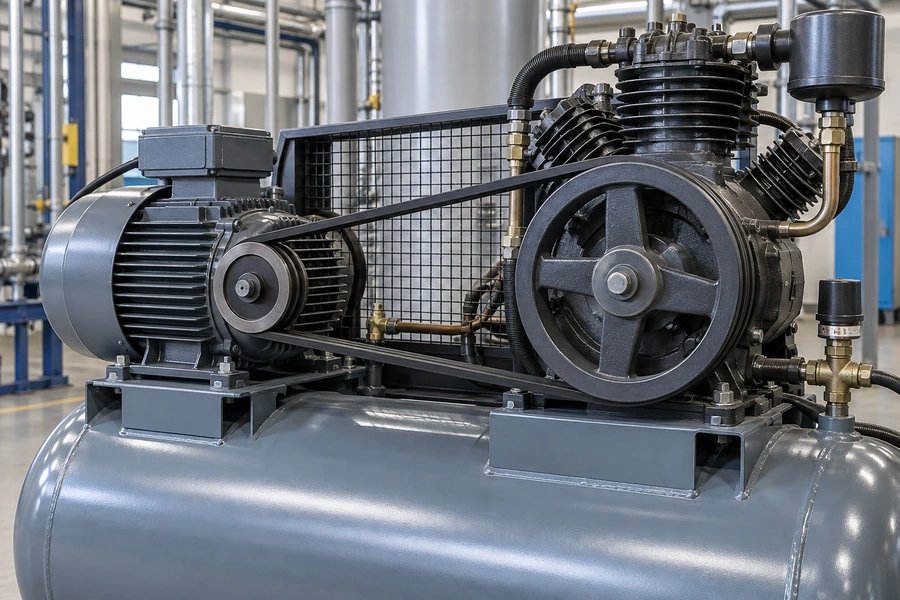
](https://kaishanpro.com/wp-content/uploads/2026/09/How-Long-Does-a-Compressor-Belt-Last.webp)
A compressor belt can look inexpensive, but an unexpected belt failure can stop the entire compressor and create costly production downtime.
A compressor belt often lasts thousands of operating hours, but there is no universal replacement interval. For several current Ingersoll Rand belt-driven rotary screw compressors, the specified interval is two years or 8,000 operating hours. Actual life depends on tension, pulley alignment, heat, load, contamination, starting frequency, and the manufacturer’s maintenance schedule.
I treat operating hours and belt condition as more useful than calendar age alone. A compressor running 24 hours a day puts far more cycles on its belt than a workshop machine used only a few hours each week.
How Many Hours Does an Air Compressor Belt Last?
Compressor belt life varies because belt construction, motor power, compressor speed, operating environment, and drive design are different from one machine to another.
For some industrial rotary screw compressors, an 8,000-hour or two-year replacement interval is a useful reference. However, I never apply that number automatically to every belt-driven compressor. I follow the specific compressor manual because piston compressors, screw compressors, conventional V-belts, Poly-V belts, and maintenance-free belt systems can have different inspection and replacement requirements.
Two years or 8,000 hours is a real OEM example
Ingersoll Rand currently specifies replacement every two years or 8,000 operating hours for several UP6 and UP6S rotary screw compressor Poly-V belts. The same interval appears across multiple 5–30 hp belt-driven models.
I consider this a useful industrial benchmark.
It does not mean every compressor belt should be replaced at exactly 8,000 hours.
Other manufacturers and belt systems may specify different intervals.
Kaeser, for example, uses automatic belt tensioning and describes the V-belt drive on certain AIRTOWER compressor packages as maintenance-free with no re-tensioning required.
The drive design therefore matters.
| Compressor belt situation | How I approach lifespan |
|---|---|
| OEM specifies hours/date | Follow that interval |
| Belt has visible deterioration | Replace before scheduled interval |
| Severe dust or heat | Inspect more frequently |
| Frequent starts/stops | Expect greater belt stress |
| Automatic tensioning system | Follow manufacturer-specific service plan |
| No reliable maintenance history | Inspect drive condition immediately |
Operating hours matter more than years for heavily used compressors
Consider two identical compressors.
Compressor A operates 2,000 hours per year.
Compressor B operates 6,000 hours per year.
After two calendar years:
Compressor A = 4,000 hours
Compressor B = 12,000 hours
The belts have experienced very different operating histories.
This is why I track run hours.
For equipment with an OEM interval such as 8,000 hours or two years, whichever comes first, the hour meter prevents a heavily used machine from running far beyond its planned service point.
I also avoid assuming that an old belt is safe simply because the compressor has low operating hours.
Rubber components can age through heat, ozone, oil exposure, and environmental conditions even while the machine is not operating.
Gates specifically designs industrial belt materials to resist heat, oil, weather, ozone, and aging because these conditions influence belt life.
What Causes a Compressor Belt to Wear Out Early?
A belt should transmit motor power efficiently from the drive pulley to the compressor. Anything that creates excess heat, slippage, bending, or uneven loading can shorten its life.
The most common causes of premature compressor belt wear are incorrect tension, pulley misalignment, worn pulleys, excessive heat, oil contamination, heavy load, frequent starting, incorrect belt size, and poor installation. I investigate the complete belt-drive system whenever a replacement belt fails much earlier than expected.
Incorrect tension is one of the biggest problems
A belt that is too loose can slip.
Slippage generates heat.
It can also reduce the compressor speed and therefore reduce air delivery.
A severely slipping belt may produce squealing, glazing, belt dust, or a burning-rubber smell.
A belt that is too tight creates a different problem.
Excessive tension increases the load on:
- Motor bearings
- Compressor bearings
- Pulley shafts
- Belt tensile cords
I therefore want the correct tension, not the highest possible tension.
Gates identifies installation tension as one of the factors that directly influences belt wear and service life. Its maintenance guidance recommends periodic inspection because correct tension is essential to belt-drive performance.
Kaeser likewise recommends checking compressor belts and couplings for wear and checking belt tension monthly on applicable systems.
Pulley alignment matters
The motor pulley and compressor pulley should operate in the correct plane.
If they are misaligned, the belt may be pulled sideways as it runs.
This produces uneven wear.
I may see:
one damaged belt edge → belt tracking problem → pulley alignment issue
rather than normal belt aging.
Atlas Copco's current belt-drive guidance specifically states that belt-driven compressors require periodic belt and pulley inspection, and that misalignment or incorrect tension can cause premature wear and efficiency loss.
Replacing the belt without correcting pulley alignment can therefore cause the new belt to fail in the same way.
Heat shortens belt life
Air compressors already produce substantial heat.
If the compressor room is poorly ventilated, belt temperature rises with the rest of the machine.
Heat accelerates rubber deterioration.
The problem can become worse when the belt is slipping because friction produces additional local heat.
I therefore inspect compressor ventilation whenever I see repeated heat damage.
Oil contamination is another warning sign
Compressor lubricant should not continuously leak onto the drive belt.
Oil can affect belt materials, attract dirt, and reduce friction between the belt and pulley.
A contaminated belt may begin slipping.
Gates specifically uses oil-resistant compounds in heavy-duty industrial V-belts because oil exposure is an important belt-drive operating challenge.
If I find oil on the belt, I do not simply install another belt.
I locate the leak first.
Frequent starting increases belt stress
Starting requires the belt to transmit motor torque while the compressor accelerates.
A compressor that cycles excessively therefore subjects the belt to more acceleration events.
Gates notes that frequent start/stop duty, high speeds, heavy loads, and extreme temperatures justify more frequent belt-drive inspection.
For a compressor that starts too frequently, I may also investigate:
receiver size → pressure settings → air demand → leakage → control strategy
The belt failure may be a symptom of a broader system problem.
How Do I Know When a Compressor Belt Needs Replacing?
I prefer replacing a deteriorating belt during planned maintenance rather than waiting until it breaks during production.
I replace a compressor belt when it reaches the manufacturer’s scheduled interval or shows significant cracking, fraying, glazing, missing ribs, excessive wear, permanent stretching, contamination, or repeated slipping. I also investigate unusual belt noise, vibration, black belt dust, loss of compressor speed, or difficulty maintaining correct tension.
Visual inspection can reveal many problems
With the compressor isolated and depressurized according to the manufacturer's safety procedure, I inspect the belt condition.
I look for:
| Belt condition | What it may indicate |
|---|---|
| Cracks | Aging, heat or flex fatigue |
| Glazed shiny surface | Slippage and heat |
| Frayed edges | Misalignment or mechanical contact |
| Missing ribs | Severe wear or pulley problem |
| Belt dust | Slippage, misalignment or wear |
| Oil on belt | Compressor or motor-side leak |
| Uneven side wear | Pulley alignment problem |
| Repeated tension loss | Belt stretch or drive issue |
Gates recommends inspecting not only the belt but the complete drive because service life depends on pulley alignment, installation tension, maintenance, load, and environmental conditions.
This is important.
A damaged belt does not always mean the belt itself caused the problem.
Squealing often points to slipping
A brief sound during startup can have several causes, but repeated squealing deserves investigation.
If the belt slips against the pulley, friction produces noise and heat.
I check:
tension → belt condition → pulley condition → alignment → compressor load
I do not solve persistent squealing by simply tightening the belt as much as possible.
Over-tension can damage bearings and shorten drive life.
Black dust can indicate belt wear
Small quantities of normal wear debris may accumulate over time.
Heavy black belt dust is different.
I inspect whether the belt is rubbing, slipping, or running incorrectly in the pulley grooves.
If the pulley groove itself is badly worn, replacing only the belt may provide a short-lived repair.
Multiple belts should be treated as a matched drive
Some compressors use more than one V-belt.
When several belts share the same pulley set, I generally follow the compressor or belt manufacturer's instructions regarding matched replacement.
An old stretched belt and a new belt may not carry load equally.
The new belt can become overloaded because it carries more of the transmitted power.
Gates offers industrial belts in matched sets for applications where uniform loading is important.
For this reason, I inspect the drive arrangement before replacing only one belt in a multi-belt system.
How Can I Make an Air Compressor Belt Last Longer?
A high-quality belt cannot compensate indefinitely for poor alignment, incorrect tension, dirty pulleys, or excessive heat. Long service life comes from the complete drive system.
I extend compressor belt life by using the correct belt, setting the specified tension, keeping pulleys aligned, preventing oil contamination, maintaining compressor ventilation, inspecting the drive regularly, and correcting excessive start-stop cycling. I also replace worn pulleys and follow the compressor manufacturer’s service interval instead of waiting for the belt to break.
I inspect the belt before it becomes an emergency
Kaeser's compressor maintenance guidance recommends monthly belt-tension checks on applicable belt-driven units, together with inspection for cracks and other signs of wear.
Gates gives a broader industrial recommendation to inspect standard V-belt drives roughly every three months, with frequency adjusted for severe duty. Premium or specialized systems can have different requirements.
I therefore create the inspection interval from:
manufacturer recommendation + operating hours + environment + machine criticality
A dusty quarry compressor operating every day deserves more attention than a lightly used compressor in a clean indoor workshop.
I use the specified belt
Belt dimensions are not the only selection criteria.
Construction matters too.
An industrial compressor belt must handle a particular:
- Pulley diameter
- Motor speed
- Compressor speed
- Transmitted power
- Operating temperature
- Starting load
Ingersoll Rand describes its OEM compressor belts as being tested to the exact requirements of the specified compressor and designed to maintain expected performance.
Gates also shows how heavily belt construction affects durability. Some premium V-belt designs use aramid tensile cords, enhanced compounds, and stronger load capacity specifically for demanding industrial duty.
I therefore do not choose a replacement simply because its circumference looks correct.
I inspect the pulleys when replacing the belt
A new belt running on a badly worn pulley can wear quickly.
I check the grooves for:
wear + damage + contamination + alignment
I also inspect the motor and compressor shafts for abnormal movement.
If a bearing is failing, the pulley can run incorrectly and damage the belt.
A belt replacement is therefore a good opportunity to inspect the complete drive.
Automatic tensioning can reduce maintenance
Some modern belt-driven screw compressors use automatic tensioning.
Kaeser's current AIRTOWER systems, for example, use an automatically tensioned V-belt drive that does not require routine re-tensioning.
This can reduce one common maintenance variable.
However, “maintenance-free tensioning” does not mean I ignore the compressor forever.
I still follow the manufacturer's overall inspection and replacement schedule.
My insights: How Long Does a Compressor Belt Last
I do not think compressor belt life should be reduced to one number. The most useful answer combines the OEM interval with the actual condition of the complete belt-drive system.
A compressor belt can often provide several thousand operating hours of service. On several current Ingersoll Rand rotary screw models, the specified replacement interval is two years or 8,000 hours, whichever comes first. I treat that as a useful example, not a universal rule, because belt design, operating load, tension, alignment, heat, and environment determine actual life.
My first rule is to follow the compressor manual
If the manufacturer specifies:
4,000 hours
I do not wait for 8,000.
If it specifies:
8,000 hours or two years
I plan around that interval.
If the machine uses an automatic tensioning or specialized maintenance-free belt system, I follow that system's requirements.
Current compressor designs clearly demonstrate that belt-drive maintenance is not identical across all machines. Atlas Copco notes generally that belt-driven compressors require inspection and eventual belt replacement, while Kaeser offers particular belt systems with automatic tensioning.
The manual therefore has priority over a generic internet lifespan.
My second rule is to replace early when condition demands it
Scheduled maintenance is not permission to ignore visible damage.
Suppose a belt is scheduled for 8,000 hours but at 4,500 hours I find:
severe cracking + glazing + belt dust
I investigate and replace it as required.
I do not continue running simply because the service counter has not reached 8,000.
Likewise, if a replacement belt repeatedly fails after 1,000 or 2,000 hours, I do not assume I have received several bad belts.
I investigate:
tension → alignment → pulley condition → load → temperature → oil contamination → starting frequency
Repeated early failure usually tells me something about the drive system.
My third rule is to monitor hours and calendar time
A continuous-production compressor can reach 8,000 hours in less than a year.
A lightly used compressor may take several years.
Both operating time and aging matter.
That is why the “two years or 8,000 hours, whichever comes first” approach used on several current Ingersoll Rand models makes practical sense.
I record the belt replacement date and run hours in the maintenance log.
Then I can compare the next belt's service life with the previous one.
This creates useful equipment history.
My fourth rule is to treat early belt failure as diagnostic evidence
A compressor belt is part of a power-transmission system.
If it fails early, I ask why.
| Failure pattern | My first checks |
|---|---|
| Belt repeatedly slips | Tension, pulley wear, compressor load |
| Belt edge wears | Pulley alignment |
| Belt becomes glazed | Slippage and heat |
| Belt cracks quickly | Temperature, aging, wrong belt |
| Belt has oil contamination | Leak source |
| Belt repeatedly stretches | Correct part and tension |
| One belt in a set fails | Load sharing and pulley condition |
| New belt fails rapidly | Root cause not corrected |
This approach prevents me from treating belts as disposable symptoms.
My practical answer
When someone asks me, “How long does a compressor belt last?”, my answer is:
There is no single lifespan for every compressor belt. For several modern belt-driven rotary screw compressors, 8,000 operating hours or two years is an OEM replacement interval, but other machines can differ. I follow the compressor's manual and inspect the belt regularly for cracking, glazing, fraying, contamination, tension loss, and abnormal wear.
If a belt reaches its planned interval in good condition, I still follow the manufacturer's preventive-maintenance recommendation rather than waiting for a breakdown.
If it deteriorates early, I replace it and find the cause.
The belt is relatively inexpensive compared with the downtime, damaged pulleys, bearing problems, or lost production that can follow an unexpected drive failure.
For me, the best belt-life strategy is therefore:
correct belt → correct alignment → correct tension → clean drive → controlled temperature → regular inspection → planned replacement
That approach gives the compressor a much better chance of operating reliably throughout its intended service interval.
Conclusion
A compressor belt can last thousands of hours; some OEMs specify two years or 8,000 hours. I follow the model-specific schedule and replace damaged belts earlier.