
](https://kaishanpro.com/wp-content/uploads/2026/09/What-Are-the-Four-Major-Systems-Used-on-All-Rotary-Drilling-Rigs.webp)
A rotary drilling rig contains many components, but understanding every individual valve, motor, pipe, and gearbox becomes much easier when I group them by function.
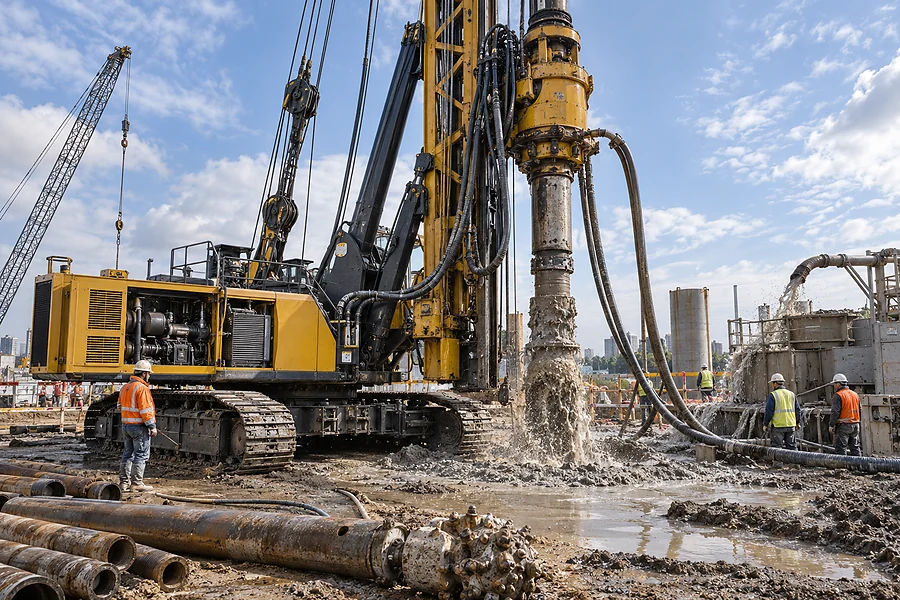
The four major systems traditionally used to describe a rotary drilling rig are the power system, hoisting system, rotating system, and circulating system. The power system supplies energy, the hoisting system raises and lowers the drill string, the rotating system turns the bit, and the circulating system removes cuttings and supports drilling-fluid or air circulation.
I use these four systems as a basic framework for understanding rotary drilling. Modern rigs may use electric drives, hydraulic cylinders, top drives, automated pipe handling, or compressed-air flushing, but the same fundamental functions—power, vertical movement, rotation, and cuttings removal—still need to be performed.
What Does the Power System Do on a Rotary Drilling Rig?
Every other drilling function needs energy. The power system is therefore the starting point for the entire machine.
The power system supplies the energy needed to operate the rotary drive, hoisting or feed system, circulation equipment, hydraulic functions, controls, and auxiliary equipment. Traditional rigs may use diesel engines connected mechanically or through generators, while modern machines increasingly combine diesel-electric, hydraulic, or fully electric drive systems.
I think of the power system as the rig's energy source
A rotary rig cannot turn the bit, raise the drill string, or circulate drilling fluid without power.
In traditional oil-and-gas rotary rigs, diesel engines often drive generators that supply electrical energy to the major rig systems. Historical and engineering descriptions of rotary rigs identify the power system as the source that allows the hoisting, rotation, and circulation equipment to operate.
On a modern surface mining rig, the architecture may look different.
A diesel engine may power hydraulic pumps and an air compressor, while hydraulic or electric motors operate the rotary head, crawler functions, feed system, and auxiliary systems.
Sandvik's current DR416i, for example, uses a 1,118 kW engine and a heavy-duty feed and rotary system for large 270–406 mm production holes.
I separate the main functions like this:
| Power-system function | What it supports |
|---|---|
| Engine or electrical supply | Creates usable energy |
| Hydraulic pumps | Feed, leveling, pipe handling and auxiliary movement |
| Electrical generation/distribution | Controls, motors, lighting and automation |
| Compressor drive | Provides flushing air where required |
| Cooling system | Removes heat from engine, hydraulics and compressor |
| Control system | Coordinates power with drilling demand |
The exact arrangement depends on the drilling rig.
Power demand changes during the drilling cycle
Not every system reaches peak demand at the same moment.
Traditional drilling-engineering references note that hoisting and fluid circulation are among the largest power consumers on rotary rigs.
A surface mining machine has similar changing demands.
During drilling, a large amount of energy may go toward:
rotation + pull-down + compressor
During pipe handling:
feed/hoist + hydraulic handling equipment
During tramming:
crawler drive
Modern control systems manage these demands to improve efficiency.
Sandvik, for example, uses compressor-management technology on its current rotary rigs to control air volume according to drilling conditions rather than operating the compressor unnecessarily at maximum output.
For me, this means engine horsepower alone does not describe drilling performance.
I also check how efficiently the rig distributes that power to the rotary, feed, and flushing systems.
What Does the Hoisting System Do on a Rotary Drilling Rig?
The drilling tools must move vertically. The rig needs to lower them into the hole, control drilling feed, add or remove pipe, and recover the drill string.
The hoisting system raises, lowers, and supports the drill string and related equipment. On traditional rotary rigs, it includes components such as the derrick or mast, drawworks, crown block, traveling block, and drilling line. On modern surface rotary rigs, hydraulic feed cylinders, chains, winches, and pipe-handling systems perform equivalent vertical-movement functions.
Traditional rigs use blocks and drawworks
The classical oilfield hoisting system is easy to recognize.
It includes the mast or derrick, drawworks, drilling line, crown block, traveling block, and associated lifting equipment.
The Government of Canada's drilling-system description explains that the hoisting system supports the drill string, lowers it into the well, pulls it out, and also handles casing and other well equipment.
The drawworks provides controlled lifting and lowering.
The block system gives the mechanical advantage required to handle extremely heavy loads.
This traditional arrangement is one reason the term hoisting system became one of the four standard rotary-rig categories.
Mining rotary rigs use feed and pullback systems
Surface blasthole rigs often do not look like an oilfield rig.
Instead of a tall derrick and traveling block, a crawler-mounted mining rig may use a hydraulic chain-feed system along a mast.
The function remains similar:
move the drill string downward → control force on the bit → pull the string upward
Sandvik's current DR411iE uses a hydraulic-cylinder-driven heavy-duty chain feed to produce pull-down force and weight on bit.
Its D50KX similarly uses a heavy-duty feed system and automated pipe-handling equipment to add and remove drill pipe.
The modern terminology may therefore include:
| Traditional rotary rig | Surface mining rotary rig |
|---|---|
| Derrick/mast | Mast |
| Drawworks | Hydraulic feed/hoist system |
| Traveling block | Rotary head carriage |
| Drilling line | Feed chains/cylinders |
| Pipe handling on rig floor | Carousel/pod loader/automated handling |
| Hoisting drill string | Pullback/extraction |
The hardware has changed, but the rig still needs controlled vertical movement.
Pull-down is as important as lifting
On a mining rotary rig, the vertical system does more than lift.
It also pushes the bit into the formation.
Rotary crushing requires substantial weight on bit.
The current Sandvik DR416i provides up to about 534 kN of pull-down force and up to 65,770 kg of weight on bit for large-diameter rotary drilling.
That force allows the roller-cone or other rotary bit to crush the rock as it rotates.
For me, this means the modern "hoisting" system is better understood as:
lifting + lowering + feeding + pullback + pipe handling
rather than lifting alone.
What Does the Rotating System Do on a Rotary Drilling Rig?
Rotation is the defining action of a rotary drilling rig. The rotating system transfers torque from the power source to the drill string and ultimately to the bit.
The rotating system turns the drill string and bit so the cutting structure can shear, scrape, or crush the formation. Traditional rigs use a rotary table and Kelly or a top drive. Modern mining rigs commonly use a hydraulic or electric rotary head that moves along the mast while transmitting torque directly to the drill pipe.
Traditional rotary systems use a rotary table or top drive
Older rotary rigs often use:
rotary table → Kelly → drill pipe → drill collars → bit
The rotary table turns the Kelly.
The Kelly transfers rotation into the drill string.
The drill string turns the bit at the bottom of the hole.
Government and engineering references describe the rotary system as containing the rotary table, Kelly, drill pipe, drill collars, swivel, and bit in traditional arrangements.
Modern oilfield rigs often use a top drive instead.
The top drive directly rotates the drill string from above.
The engineering principle remains the same:
generate torque → transmit torque through drill string → rotate bit
Surface rigs normally use rotary heads
A mining rotary blasthole rig commonly uses a large rotary head mounted on a carriage.
The head moves up and down the mast while rotating the pipe.
Sandvik's current DR416i uses a two-stage rotary head with internal gear reduction designed to provide high torque while improving reliability and serviceability.
The rotary system must be matched to:
bit diameter + formation + weight on bit + drill-pipe size + desired rotation speed
I do not judge the system from maximum rpm alone.
Large-diameter rotary drilling often needs high torque rather than extremely high speed.
Torque and weight on bit work together
A rotary drill needs both rotation and downward force.
The rotary system provides torque.
The feed system supplies weight on bit.
Together they allow the bit to cut or crush the formation.
For example, Sandvik's DR416i is designed for large 270–406 mm rotary holes and combines high rotary capability with substantial pull-down and weight on bit.
If the rotary head turns but the feed force is too low, penetration may be poor.
If feed force is excessive but rotation is incorrect, tool wear and vibration can increase.
This is why I see the rotating and hoisting/feed systems as closely connected.
What Does the Circulating System Do on a Rotary Drilling Rig?
Drilling creates cuttings continuously. If those cuttings remain at the bottom of the hole, the rig wastes energy grinding already broken material.
The circulating system carries a flushing medium down to the bit and returns cuttings toward the surface. Traditional well-drilling rigs usually circulate drilling mud through pumps, tanks, drill pipe, and solids-control equipment. Surface mining rotary rigs commonly use compressed air to clean the hole and transport broken rock upward.
Mud circulation is the classical rotary-rig system
In traditional rotary well drilling, mud pumps move drilling fluid from surface tanks into the drill string.
The fluid travels down through the pipe.
It exits near the bit.
Then it returns toward the surface carrying cuttings.
The circulating system can also help cool the bit, control wellbore conditions, and transport drilled solids.
The traditional four-system description specifically identifies the circulating system as one of the essential rotary-rig functions.
Typical components may include:
mud tanks → mud pump → standpipe/hose → drill string → bit → annulus → solids-control equipment
Mining rotary rigs commonly circulate compressed air
A surface blasthole rig does not usually need a conventional oilfield mud system.
Instead, a large compressor delivers air through the drill string.
The air exits near the bit and travels upward through the space around the drill pipe.
Its job is to lift cuttings out of the borehole.
Current mining rigs show how important this airflow can be.
Sandvik's DR416i uses a compressor delivering approximately 109 m³/min at 5.9 bar for large rotary blast-hole drilling.
The D50KX offers several compressor configurations, including up to approximately 45.3 m³/min at 6.9 bar for rotary drilling, with separate high-pressure choices for DTH operation.
Caterpillar's MD6200 also demonstrates the difference between the two methods. Its rotary configuration provides roughly 32.6 m³/min at 8.6 bar, while its DTH configuration uses approximately 29.7 m³/min at 24.1 bar.
This illustrates an important point:
rotary drilling often needs high airflow for flushing
while
DTH drilling additionally needs high pressure to power the hammer
Poor circulation reduces drilling efficiency
If cuttings are not removed efficiently, they accumulate around the bit.
Then the drill may spend energy regrinding broken material.
Poor hole cleaning can contribute to:
lower penetration → higher tool wear → more heat → difficult pipe movement → poor hole condition
For me, this is why the circulating system deserves equal attention with the rotary head.
A powerful rig with inadequate flushing is still a poorly matched drilling system.
My insights: What Are the Four Major Systems Used on All Rotary Drilling Rigs
The standard four-system classification comes from traditional rotary drilling, but I still find it useful for understanding modern equipment because every rotary drilling operation needs the same basic functions.
The four major systems are the power system, hoisting system, rotating system, and circulating system. I think of them as four questions: What supplies the energy? What moves and supports the drill string? What rotates the bit? What removes the cuttings? Different rig designs answer those questions with different hardware, but the functions remain fundamental.
My first insight is that the four systems must work together
I do not treat these systems as independent.
The power system drives the rotating, hoisting, and circulating systems.
The hoisting or feed system controls weight on bit.
The rotary system provides torque.
The circulating system removes the material that the bit breaks.
I can summarize the drilling process as:
power → feed and rotation → rock breaking → circulation and cuttings removal
If one link is weak, overall drilling performance falls.
For example, installing a stronger engine does not automatically increase penetration if the rotary head cannot transmit additional torque.
Likewise, increasing weight on bit will not help indefinitely if the compressor cannot clean the hole.
My second insight is that modern mining rigs use different hardware for the same functions
This matters because someone looking at a surface rotary blasthole machine may not see a traditional drawworks or mud tank.
That does not mean the rig lacks the underlying functions.
I map them this way:
| Four-system model | Modern surface rotary implementation |
|---|---|
| Power system | Diesel/electric power, hydraulics and controls |
| Hoisting system | Feed cylinders, chains, mast and pipe handling |
| Rotating system | Hydraulic/electric rotary head |
| Circulating system | Compressor, drill pipe and flushing air |
Sandvik's modern rotary fleet clearly demonstrates these functions through high-power engines, chain feed systems, rotary heads, and compressor-management systems.
So I use the classical terminology without assuming that every rig has exactly the same physical components.
My third insight is that well-control equipment can form an additional system
There is an important terminology point.
Some modern oil-and-gas drilling references describe five or more major systems, adding a separate well-control system containing blowout preventers and related pressure-control equipment. IEEE's overview, for example, discusses power, hoisting, rotary, circulation, and well-control functions as separate drilling-rig subsystems.
That does not make the classical four-system answer wrong.
The older and widely taught four-system framework is:
power + hoisting + rotating + circulating
More detailed petroleum-engineering classifications may add:
well control + monitoring + other auxiliary systems
This distinction is useful because the phrase “four major systems” usually refers specifically to the classical rotary-rig classification.
My fourth insight is that system balance matters more than the biggest specification
When selecting a rotary drilling rig, I do not ask only:
How much engine power does it have?
I also ask:
| System | Specification I evaluate |
|---|---|
| Power | Engine/electric power and energy management |
| Hoisting/feed | Pull-down, pullback, mast and pipe handling |
| Rotary | Torque and speed range |
| Circulation | Airflow/pressure or mud-pump capacity |
| Tooling | Bit and drill-pipe compatibility |
| Control | Ability to coordinate the systems |
A machine with an enormous compressor but insufficient rotary torque is unbalanced.
A machine with strong pull-down but weak flushing can also lose productivity.
A machine with large engine power but poor control of that power may simply consume more fuel.
Current intelligent surface rigs increasingly coordinate feed, rotary, and compressor functions because drilling performance depends on the complete system rather than one maximum number. Sandvik's current rigs, for example, combine rotary control, heavy-duty feed, compressor management, and automated drilling functions in one platform.
My practical explanation
When someone asks me, “What are the four major systems used on all rotary drilling rigs?”, my practical answer is:
**1. Power system — supplies the energy required by the rig.
- Hoisting system — raises, lowers, supports, and feeds the drill string.
- Rotating system — provides torque to rotate the drill string and bit.
- Circulating system — sends air or drilling fluid through the hole to cool or clean the bit and carry cuttings to the surface.**
These four systems explain the basic operation of a rotary rig.
In an oilfield rig, I may see diesel-electric power, drawworks and blocks, a top drive or rotary table, and a drilling-mud system.
In a modern mining rotary rig, I may instead see a diesel or electric power package, hydraulic chain feed, a large rotary head, and a high-volume air compressor.
The equipment looks different, but the engineering functions are closely related.
That is why I find the four-system model useful when evaluating a rotary drilling rig: it forces me to examine where the energy comes from, how the tools move, how the bit rotates, and how the hole stays clean.
Conclusion
The four major rotary drilling rig systems are power, hoisting, rotating, and circulating. Together they provide energy, move the drill string, rotate the bit, and remove cuttings.