
](https://kaishanpro.com/wp-content/uploads/2026/09/What-Is-a-Compressor-Filter.webp)
Dust, oil, water, rust, and other contaminants can damage a compressor or contaminate the compressed air used by downstream equipment and production processes.
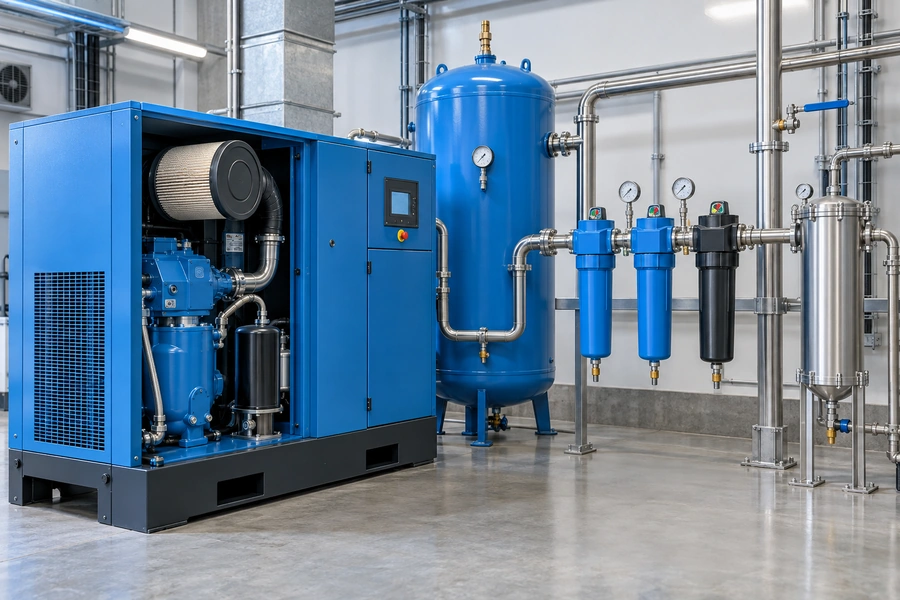
A compressor filter is a filtration component that removes unwanted contaminants from the compressor system. Depending on its location, it may clean incoming atmospheric air, remove particles from compressor lubricant, separate oil from compressed air, or clean the downstream compressed-air stream of particles, water aerosols, oil aerosols, and vapor.
I first identify where the filter is installed. An intake filter protects the compressor itself, while downstream compressed-air filters primarily protect pneumatic equipment, products, and processes.
What Does a Compressor Filter Do?
The exact purpose of a compressor filter depends on its position in the system. There is no single filter element that performs every filtration job.
A compressor filter removes contaminants that could damage the compressor or reduce compressed-air quality. The inlet air filter keeps atmospheric dust out of the compression element, the oil filter cleans circulating lubricant, the separator removes lubricant from compressed air, and downstream line filters remove particles, liquid aerosols, or vapor before the air reaches the application.
The intake air filter protects the compressor
Every compressor draws atmospheric air into the machine.
That air contains contaminants such as:
- Dust
- Dirt
- Pollen
- Fine mineral particles
- Industrial airborne contamination
If these particles enter the compression element, they can accelerate wear.
Atlas Copco states that inlet contamination can damage compressor elements, reduce efficiency, contribute to failure, and accelerate lubricant deterioration.
I therefore think of the intake filter as the compressor's first protective barrier.
The airflow path is approximately:
atmosphere → intake filter → inlet valve → compression element
The filter needs enough efficiency to remove damaging contamination without creating excessive intake restriction.
This balance is important.
A filter that is too restrictive can reduce compressor performance.
A filter that allows excessive dirt through can shorten airend or cylinder life.
The oil filter protects the lubrication circuit
Oil-injected rotary screw compressors continuously circulate lubricant.
That lubricant performs several jobs:
lubrication + sealing + cooling
Contaminants inside the oil can damage bearings and compression-element surfaces.
An oil filter removes dirt, deposits, wear particles, and other foreign material before the lubricant returns to critical compressor components. Atlas Copco specifically identifies bearing and rotor protection as important functions of the compressor oil filter.
I therefore separate the oil filter from the inlet air filter.
The inlet filter cleans air.
The oil filter cleans lubricant.
The oil separator removes oil from compressed air
In an oil-injected screw compressor, air and lubricant are mixed during compression.
After leaving the compression element, they must be separated.
The separator system removes most of the oil from the compressed air and returns recovered lubricant to the compressor circuit.
The simplified process is:
air + oil mixture → separator vessel → separation element → cleaner compressed air
The separator is sometimes called:
air/oil separator
or:
separator element
Although technically different from a normal intake or oil filter, maintenance teams often include it when talking about a compressor's filter set.
Downstream filters protect the application
Even after compression and internal separation, the compressed-air stream may contain:
solid particles + water aerosol + oil aerosol + oil vapor
A downstream line filter removes these contaminants before the air reaches pneumatic tools, instruments, machinery, or production processes.
Atlas Copco describes a compressed-air filter as ancillary equipment designed to remove undesirable contaminants such as particulates, aerosols, and vapors.
That means I distinguish between two basic objectives:
| Filter location | Main objective |
|---|---|
| Compressor intake | Protect compressor |
| Oil circuit | Protect bearings and airend |
| Separator vessel | Separate lubricant from compressed air |
| Downstream line | Protect air system and process |
Understanding this distinction prevents me from ordering the wrong filter.
What Types of Compressor Filters Are There?
The phrase “compressor filter” can refer to filters inside the compressor package or air-treatment filters installed downstream.
The main compressor-package filtration components are the intake air filter, oil filter, and air/oil separator. Downstream compressed-air filtration commonly uses particulate filters, coalescing filters, and activated-carbon filters. Each technology targets a different contaminant, so industrial systems often use several filtration stages rather than relying on one universal filter.
Three important filters inside an oil-injected compressor
Atlas Copco describes a three-stage filtration process for relevant compressor packages:
air filter → oil filter → oil separator.
I summarize their functions like this:
| Compressor component | What it handles | Main purpose |
|---|---|---|
| Intake air filter | Atmospheric air | Stops dust entering compressor |
| Oil filter | Compressor lubricant | Removes contamination from oil |
| Air/oil separator | Compressed air/oil mixture | Recovers oil from compressed air |
These three components work together.
If the intake filter allows excessive contamination into the compressor, more dirt can enter the lubricant circuit.
That places greater stress on the oil filter.
Contaminated oil can also affect other compressor components.
I therefore see compressor filtration as a system rather than three unrelated replacement parts.
Particulate line filters remove solids
A downstream particulate filter targets solid contamination.
Typical contaminants include:
dust + rust + pipe scale + dry desiccant particles
Dry particles can originate not only from outside the compressor but also from the distribution system itself.
Steel piping may corrode.
A desiccant dryer can generate fine desiccant dust.
Maintenance activity can introduce debris.
A particulate filter prevents this contamination from reaching sensitive downstream equipment.
Coalescing filters remove liquid aerosols
Coalescing filters are particularly important in industrial compressed-air treatment.
They capture very small droplets of liquid water and oil suspended in the air stream.
The media causes tiny droplets to combine into larger droplets.
Those larger droplets drain downward and are discharged from the filter housing.
Parker's current compressed-air filter information describes coalescing grades that remove water and oil aerosols along with fine solid particulate.
For me, a coalescing filter is especially important when I need to protect:
pneumatic controls → production equipment → dryers → paint processes → instrumentation
Activated carbon removes oil vapor
Oil vapor is different from liquid oil aerosol.
Vapor exists in gaseous form and can pass through conventional particulate or coalescing filtration.
Activated carbon adsorbs these hydrocarbon molecules.
Atlas Copco specifically notes that activated-carbon filters target vapor and should be used with appropriate upstream filtration.
A higher-purity compressed-air system may therefore use:
water separator → coalescing filter → dryer → particulate/fine filter → activated-carbon filter
The exact arrangement depends on the required air quality.
I do not automatically install every filter type.
Each additional filter adds:
purchase cost + replacement cost + pressure drop
So I match filtration to the process requirement.
How Does a Compressor Filter Work?
Different compressor filters use different physical mechanisms. Some trap particles mechanically, some coalesce liquid droplets, and activated carbon captures vapor by adsorption.
A compressor filter works by forcing air or lubricant through specialized filtration media. Solid particles are trapped in the media, coalescing filters capture tiny liquid droplets and combine them into larger drops for drainage, and activated-carbon media adsorbs hydrocarbon vapor. The design must provide sufficient filtration while keeping pressure drop as low as practical.
The filter media captures contamination
For an intake or particulate filter, contaminated air enters the filter housing and passes through porous media.
The media allows air through while capturing unwanted solid particles.
As contamination accumulates, the filter's resistance can increase.
That is why filtration efficiency and pressure drop must be considered together.
Atlas Copco emphasizes balancing effective filtration, service life, and minimum pressure drop in compressor filter design.
Coalescing works differently
Oil and water aerosols can be much smaller than droplets visible to the eye.
Coalescing media captures these fine droplets.
As more droplets contact the fibers, they combine.
Eventually they become large enough for gravity to move them toward the bottom of the filter.
A drain then removes the collected liquid.
A simplified process is:
aerosol enters → droplets contact media → droplets combine → liquid drains
That is why a functioning drain is important.
A high-quality coalescing element cannot perform properly if collected condensate simply remains inside the housing.
Activated carbon uses adsorption
Activated carbon does not remove oil vapor through the same mechanical process.
The carbon contains a very large internal surface area.
Hydrocarbon molecules attach to that surface.
This process is called adsorption.
Eventually the carbon becomes saturated.
At that point it can no longer provide the same vapor-removal performance and requires replacement.
Pressure drop is a hidden operating cost
Every compressed-air filter creates some resistance.
The goal is to keep that resistance low while still achieving the required air quality.
Atlas Copco's May 2026 filter guidance notes that filter-housing and cartridge design is optimized around high flow, effective contaminant removal, and minimized pressure drop because excess pressure loss increases compressed-air energy cost.
I therefore do not choose a filter only from its micron rating.
I compare:
| Selection factor | Why it matters |
|---|---|
| Rated airflow | Prevents undersizing |
| Operating pressure | Housing must safely handle system pressure |
| Contaminant type | Determines filter technology |
| Filtration grade | Determines delivered air quality |
| Pressure drop | Affects energy cost |
| Drain system | Important for liquid-removal filters |
| Replacement interval | Affects maintenance cost |
| Required ISO air quality | Determines treatment level |
A filter that is too small for the airflow can create unnecessary restriction.
A filter that is unnecessarily fine can also increase system cost without providing a useful process benefit.
How Often Should a Compressor Filter Be Changed?
There is no universal replacement interval covering every filter in every compressor. Internal compressor filters and downstream line filters follow different service schedules.
I replace compressor filters according to the exact manufacturer's maintenance schedule rather than one generic hour figure. Many downstream compressed-air filter elements are specified for replacement at least annually, while compressor intake, oil, and separator elements can have model-specific hour or calendar intervals. Dusty environments and abnormal pressure drop can require earlier service.
Downstream filters are commonly replaced annually
Atlas Copco's August 2026 maintenance guidance recommends replacing compressed-air line-filter elements at least every 12 months, with shorter intervals in severe environments such as high-dust applications.
Parker likewise specifies a 12-month element-change interval for several current coalescing and dry-particulate compressed-air filter products.
I treat that as a useful line-filter reference, not as a universal rule for every compressor filter.
Internal compressor maintenance can use operating hours
The intake air filter, oil filter, and separator follow the compressor manufacturer's service plan.
For example, a current Ingersoll Rand maintenance kit for certain R4i–R11i rotary screw compressors includes:
air filter + oil filter + separator element + package pre-filter
and is specified for maintenance every 2,000 operating hours or annually, whichever comes first for those models.
Another compressor can have a different service interval.
That is why I do not take the 2,000-hour figure from one model and apply it to every compressor.
I inspect filters more frequently in severe environments
A compressor operating in a clean factory has a very different intake environment from one working in:
- Cement production
- Quarrying
- Mining
- Sandblasting
- Construction
- Dusty workshops
High dust loading can shorten intake-filter service life.
Atlas Copco's current line-filter guidance similarly notes that dirty or demanding environments can require replacement more frequently than the normal annual interval.
I therefore adjust inspection frequency to the site.
I watch for symptoms but do not rely on symptoms alone
Possible signs of filter trouble include:
lower airflow → increased differential pressure → reduced downstream pressure → oil carryover → water downstream → abnormal compressor temperature
But waiting for an obvious symptom is risky.
By the time oil, water, or excessive dust reaches production equipment, the filtration problem may already have caused damage.
For critical compressed-air line filters, Atlas Copco specifically warns that differential-pressure indicators should not simply replace scheduled maintenance because a physically damaged element can sometimes have low restriction while no longer maintaining the required air quality.
Preventive replacement is therefore more reliable than waiting for failure.
My insights: What Is a Compressor Filter
I think the most important point is that “compressor filter” does not describe one component. I first identify what needs protection and which contaminant needs to be removed.
A compressor filter is a component that removes contamination either before, inside, or after the compression process. The intake filter protects the compressor from atmospheric dust, the oil filter protects the lubrication system, the separator removes oil from compressed air, and downstream particulate, coalescing, or activated-carbon filters protect the air system and production process.
My first insight is to ask where the filter is installed
If someone tells me:
“My compressor filter needs replacing.”
My first question is:
Which filter?
It could mean:
intake air filter
oil filter
air/oil separator
downstream compressed-air filter
These components are not interchangeable.
They protect different parts of the system and use different filtration technologies.
My second insight is to identify the contaminant
For downstream air treatment, I select filtration from the contamination problem.
| Contaminant | Filtration I evaluate |
|---|---|
| Atmospheric dust before compressor | Intake filter |
| Dirt in compressor lubricant | Oil filter |
| Oil mist leaving screw airend | Air/oil separator |
| Dry dust/rust downstream | Particulate filter |
| Water/oil aerosol | Coalescing filter |
| Oil vapor/odor | Activated carbon |
Atlas Copco's current compressed-air treatment guidance similarly distinguishes solids, aerosols, and vapor because different contaminants require different removal mechanisms.
This is much more useful than asking for the “best compressor filter.”
My third insight is that filtration should be staged
I do not expect one very fine filter to solve every air-quality problem.
A properly designed industrial compressed-air system may remove contaminants in stages.
For example:
intake filtration → compression → air/oil separation → aftercooling/water separation → coalescing filtration → drying → fine particulate filtration → activated carbon if required
Each stage reduces a different contamination load.
That also helps protect expensive downstream filters.
Activated carbon, for example, should not be expected to handle large amounts of liquid oil because appropriate upstream filters should remove liquid contamination first.
My fourth insight is that a dirty filter costs more than the replacement element
A clogged filter does not only create a maintenance problem.
It can create an energy problem.
On the compressor intake side, restriction can reduce compressor performance.
On the compressed-air side, pressure drop reduces the pressure available to production equipment.
Operators may compensate by increasing compressor discharge pressure.
That raises energy consumption.
This is why modern filter design puts significant emphasis on maintaining low pressure drop throughout the element's service life.
For me, filter cost therefore includes:
element price + pressure-loss energy + maintenance + downtime + contamination risk
The cheapest replacement element is not automatically the lowest-cost choice.
My fifth insight is that compressor filtration protects both the machine and the product
When someone asks me, “What is a compressor filter?”, my practical answer is:
A compressor filter removes contamination from the air, lubricant, or compressed-air stream so the compressor and downstream equipment can operate reliably. Intake air filters stop atmospheric particles, oil filters clean the lubricant, separators remove oil from compressed air, and line filters remove downstream particles, water/oil aerosols, or vapor.
I therefore divide filtration into two objectives:
Protect the compressor
and:
Protect the compressed-air user
For the compressor, I focus on:
clean intake air + clean lubricant + effective air/oil separation
For the production process, I focus on:
particles + moisture + oil aerosol + oil vapor + required air-quality class
The final filter arrangement should be based on the actual application.
A quarry compressor working outdoors needs strong intake protection.
A general manufacturing plant may need particulate and coalescing filtration.
A paint, food, pharmaceutical, or electronics application may require much stricter downstream air treatment.
My selection sequence is therefore:
application → contaminant → required air quality → filter type → airflow → operating pressure → acceptable pressure drop → maintenance interval
That approach gives me cleaner compressed air without adding unnecessary filtration stages and energy loss.
Conclusion
A compressor filter removes harmful contamination from intake air, lubricant, or compressed air. Correct filtration protects the compressor, downstream equipment, product quality, and system efficiency.