
](https://kaishanpro.com/wp-content/uploads/2026/09/What-Is-the-Purpose-of-an-Intake-Valve.webp)
An air compressor cannot compress air efficiently unless the correct amount of atmospheric air enters the compression chamber at the correct time.
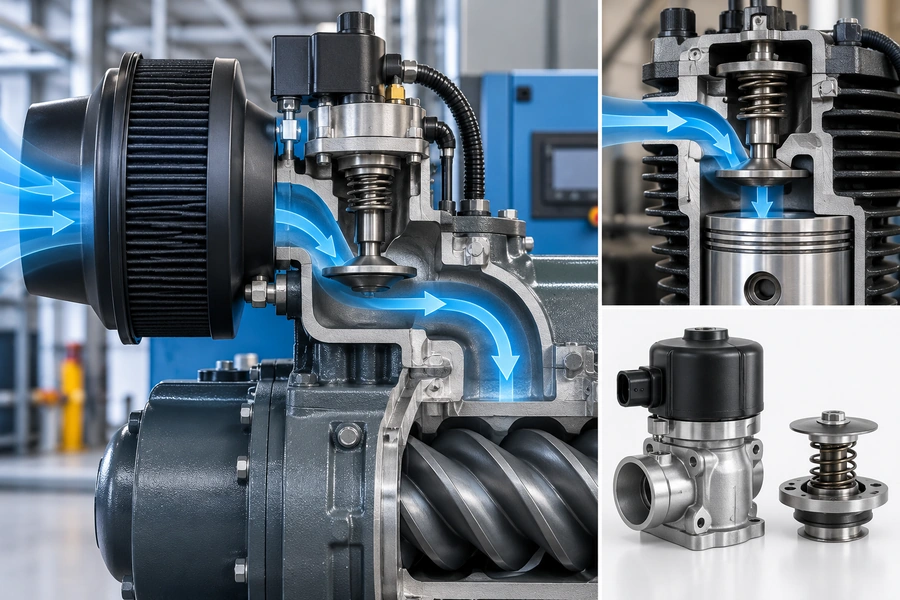
The main purpose of an intake valve is to control air entering the compressor. On a rotary screw compressor, it opens when the machine loads and closes or modulates when air demand falls. On a piston compressor, the intake valve opens during the suction stroke and closes during compression to prevent air from flowing backward.
I think of the intake valve as the gateway between atmospheric air and the compression element. Its exact operation changes with compressor design, but its fundamental job is controlling incoming airflow so compression can occur efficiently.
What Does an Intake Valve Do on an Air Compressor?
The intake valve sits upstream of the compressor's compression element. Air normally passes through an intake filter before reaching this valve.
An intake valve controls the flow of atmospheric air into the compressor. It allows air to enter when compression is required and restricts or stops airflow when the compressor unloads or reaches its pressure target. Depending on compressor design, the valve may also help prevent reverse airflow when the compressor stops.
The intake valve is the entrance to the compression process
The basic airflow path on a rotary screw compressor is:
atmosphere → intake air filter → intake valve → screw airend → separator → compressed-air system
Kaeser shows the same fundamental sequence on its current rotary screw equipment: incoming air passes through the air filter and inlet valve before entering the screw airend.
Sullair likewise describes compressor intake as the first major stage of compression, with air entering through the inlet valve after passing through filtration.
The intake valve therefore determines whether the compression element can receive air.
If it is fully open, the compressor can normally draw in the volume of air required for loaded operation.
If it closes, the compressor's effective air intake drops dramatically.
The intake filter and intake valve have different jobs
These two components are located close together, so they are sometimes confused.
The intake air filter removes contamination.
The intake valve controls airflow.
I separate them like this:
| Component | Main job |
|---|---|
| Intake air filter | Removes atmospheric dust and particles |
| Intake valve | Allows, restricts, or stops incoming airflow |
| Screw airend/piston cylinder | Compresses the incoming air |
| Discharge system | Moves compressed air downstream |
Atlas Copco currently describes the inlet filter as the component that protects the compressor stage from dust and harmful particles, while the suction/load-unload valve controls raw air entering the screw element.
A clean filter cannot compensate for a stuck intake valve.
Likewise, a perfectly operating intake valve cannot protect the compressor if its filter allows excessive contamination through.
Both components need to work correctly.
How Does an Intake Valve Work on a Rotary Screw Compressor?
A fixed-speed rotary screw compressor often uses its inlet valve as part of its capacity-control system. The valve responds to compressor pressure and control commands.
On a typical fixed-speed rotary screw compressor, the intake valve opens when the compressor loads and needs to produce air. When system pressure reaches the upper control limit, the compressor unloads and the inlet valve closes or substantially restricts incoming air. Some systems can also modulate the valve to partially reduce compressor capacity.
Loaded operation requires an open inlet
Suppose compressed-air demand causes system pressure to fall below the compressor's load setting.
The control system commands the compressor to load.
The intake valve opens.
Air follows this path:
intake filter → open inlet valve → screw rotors
The rotors trap the incoming air in the spaces between their lobes and compressor housing.
As they rotate, the volume available to the trapped air decreases.
Pressure rises.
The compressed air then leaves through the discharge side of the airend. Atlas Copco describes the same positive-displacement process in its current rotary screw guidance.
During full-load operation, I therefore expect the intake system to provide minimal unnecessary restriction.
An intake valve that does not open completely can limit airflow.
That can contribute to:
reduced compressor capacity → longer loaded operating time → difficulty maintaining system pressure
The valve closes when the compressor unloads
Suppose demand falls.
The compressor continues producing air until system pressure reaches its unload setting.
The controller then unloads the compressor.
Atlas Copco describes the screw compressor's suction/load-unload valve as opening fully when system pressure falls below the lower setting and closing when system pressure reaches its upper setting.
So the sequence is approximately:
pressure falls → compressor loads → intake valve opens
then:
pressure rises → unload setpoint reached → intake valve closes
The motor may continue running during an unloaded period on many fixed-speed industrial screw compressors, but the machine is no longer producing its normal full airflow.
This avoids repeatedly starting and stopping a large motor during short changes in air demand.
Some intake valves modulate instead of only opening or closing
An inlet valve does not always operate as a simple ON/OFF device.
A modulating compressor can partially close the inlet valve as demand decreases.
Quincy describes modulating control as reducing compressor output by progressively restricting inlet airflow while the motor continues operating at constant speed.
The sequence may look like:
100% demand → inlet fully open
75% demand → inlet partly restricted
50% demand → inlet further restricted
This can help maintain stable pressure.
However, throttling intake air is not necessarily the most energy-efficient way to match a widely varying demand profile.
That is one reason variable-speed compressors are widely used in applications where demand changes substantially.
Some designs use the inlet valve as a non-return function too
Certain rotary screw inlet valves perform more than intake regulation.
A Sullair compressor manual, for example, describes a poppet-type inlet valve that both controls compressor intake and acts as a check valve to prevent reverse rotation when the machine shuts down.
This function depends on the compressor design.
I therefore do not assume every intake valve is identical.
The exact assembly may contain:
- Valve body
- Piston or diaphragm
- Butterfly plate or poppet
- Spring
- Solenoid control
- Pneumatic control line
- Seals
- Check-valve functionality
When troubleshooting, I use the compressor's specific pneumatic schematic rather than relying only on a generic intake-valve diagram.
How Does an Intake Valve Work on a Piston Compressor?
A reciprocating compressor uses an intake valve differently. Instead of a controller intentionally loading and unloading a rotary screw airend, piston motion itself creates the pressure difference that operates the suction valve.
On a piston compressor, the intake or suction valve opens automatically when the piston moves downward and cylinder pressure falls below inlet pressure. Atmospheric air enters the cylinder. When the piston moves upward for compression, the intake valve closes so the trapped air cannot escape backward through the inlet.
The downward piston stroke draws air in
A reciprocating compressor works through repeating piston movement.
During the intake stroke:
piston moves downward → cylinder volume increases → cylinder pressure decreases → intake valve opens → air enters
Quincy describes this process as the piston creating a vacuum as it moves downward, causing the inlet valve to open and atmospheric air to enter the cylinder.
No electronic controller needs to time every individual suction-valve opening.
The pressure difference across the valve causes it to operate automatically.
The valve must close during compression
The piston then reverses direction.
During the compression stroke:
piston moves upward → cylinder volume decreases → pressure increases → intake valve closes
Now the trapped air cannot escape through the inlet.
As pressure continues rising, the discharge valve eventually opens and allows compressed air to leave the cylinder.
The cycle can be simplified as:
| Piston position | Intake valve | Discharge valve |
|---|---|---|
| Moving downward | Open | Closed |
| Beginning compression | Closed | Closed |
| Discharge pressure reached | Closed | Open |
This is why Quincy describes compressor inlet and outlet valves as one-way gatekeepers controlling the direction of air through the compression cycle.
A leaking piston intake valve reduces compression efficiency
Suppose the intake valve does not seal correctly when the piston rises.
Some of the air being compressed can escape backward toward the intake.
The piston still moves.
The motor still consumes power.
But less useful compressed air reaches the receiver.
That is why valve condition is important on reciprocating compressors.
A damaged suction valve can contribute to:
reduced airflow → longer compressor run time → poor pressure build-up → increased operating temperature
The underlying problem is different from a screw compressor whose inlet valve fails to load.
But the result can look similar: the compressor does not produce its expected air capacity.
What Happens When a Compressor Intake Valve Fails?
An intake-valve problem can affect compressor output, loading, unloading, starting, or shutdown. The exact symptoms depend on whether the valve is stuck open, stuck closed, leaking, or failing to respond correctly to its control signal.
A faulty intake valve can cause low airflow, failure to load, failure to unload, slow pressure build-up, excessive unloaded power consumption, air leakage, or abnormal shutdown behavior. Before replacing the valve, I also inspect the intake filter, control solenoid, pneumatic lines, pressure sensor, seals, and compressor controller because they can produce similar symptoms.
If the valve stays closed, the compressor cannot load correctly
Consider a rotary screw compressor whose motor is running normally.
The controller requests loaded operation.
But the intake valve remains closed.
The airend cannot receive normal incoming airflow.
The result can be:
motor running + little air intake = low or no useful compressor output
I would first check:
control signal → solenoid → actuator → valve movement → inlet restriction
before deciding the valve assembly itself is defective.
Atlas Copco identifies the suction valve as the component that responds to the compressor's programmed stages and controls intake to the rotary screw element.
If the valve does not open fully, airflow can be restricted
A valve can move without reaching its correct full-open position.
Deposits, damaged seals, actuator problems, or mechanical sticking may restrict movement.
The compressor may still build pressure under light demand but struggle when plant consumption rises.
That makes partial inlet restriction easy to mistake for:
- Worn airend
- Dirty intake filter
- Air leak
- Incorrect pressure setting
- Undersized compressor
I therefore troubleshoot the entire intake path.
If the valve fails to close, unloading can be affected
The opposite problem can also occur.
If the inlet valve does not respond correctly when the compressor should unload, the compressor may continue taking in more air than intended.
The exact consequence depends on the control design.
This is why I distinguish the inlet valve from the safety valve.
The intake valve is part of normal capacity control.
The safety valve is a separate overpressure protection device.
I never treat the safety valve as the normal method for correcting an unloading fault.
Control components can imitate a bad intake valve
The intake valve itself is only one part of a control chain.
On a screw compressor, the operating sequence can involve:
pressure sensor → controller → solenoid valve → pneumatic signal → intake-valve actuator
If the solenoid does not energize, the intake valve may never receive the correct command.
If a pneumatic hose leaks, control pressure may be insufficient.
If a pressure sensor reports incorrect system pressure, the controller may command the wrong state.
Ingersoll Rand's current rotary compressor controllers include manual and automatic load/unload functions, demonstrating that inlet/capacity operation is coordinated by the broader compressor control system rather than being an isolated mechanical event.
So I do not immediately replace the inlet valve whenever the compressor fails to load.
I diagnose the complete control circuit.
My insights: What Is the Purpose of an Intake Valve
I think the simplest way to understand an intake valve is to ask what would happen if the compressor had no way to control the air entering its compression chamber.
The purpose of an intake valve is to control when and how much atmospheric air enters the compressor. In rotary screw compressors, it supports loading, unloading, and sometimes modulation. In reciprocating compressors, it acts as an automatic one-way suction valve, opening during the intake stroke and closing during compression to prevent backflow.
My first insight is that screw and piston intake valves should not be confused
Both are called intake valves.
Their operation is different.
| Feature | Rotary screw compressor | Piston compressor |
|---|---|---|
| Main function | Control compressor intake/capacity | Control air entering cylinder |
| Opens when | Compressor loads | Piston creates suction |
| Closes when | Compressor unloads/stops as designed | Piston begins compression |
| Typical actuation | Pneumatic/electronic control system | Automatic pressure differential |
| Can regulate capacity? | Yes, depending on design | Normally not in the same way |
| Prevents backward flow? | Some designs | Yes during compression |
This distinction helps me troubleshoot correctly.
If a piston compressor has a faulty suction reed, I inspect the valve plate and cylinder system.
If a screw compressor will not load, I inspect the inlet-valve control circuit.
They are different problems.
My second insight is that the intake valve controls capacity before compression occurs
This is an important efficiency principle.
The compressor does not always need to compress maximum airflow.
By controlling what enters the compression element, the machine can reduce capacity when system demand falls.
Quincy's current explanation of modulating control makes this especially clear: capacity can be reduced by partially closing the inlet valve and restricting the volume entering the compressor.
I therefore see the intake valve as more than a door.
On a fixed-speed screw compressor, it can form a major part of the capacity-control strategy.
My third insight is that the intake valve is not the same as an inlet air filter
This confusion comes up frequently.
The filter answers:
Is the incoming air clean?
The valve answers:
Should the air enter, and how much?
The screw airend then answers:
How will that air be compressed?
The functions form a sequence:
filter → valve → compression element
Kaeser's current rotary screw diagrams show the same physical order: air passes through the intake filter, then inlet valve, and then into the compressor airend.
If airflow is low, I check all three stages rather than assuming the airend is worn.
My fourth insight is that valve problems often originate outside the valve
Before replacing an intake valve, I inspect:
air filter → solenoid → control tubing → actuator → pressure signal → controller → valve body
Suppose the valve is mechanically perfect but the solenoid does not supply control pressure.
Replacing the inlet valve will not solve the problem.
Likewise, a badly restricted air filter can make the compressor behave as though its inlet valve is not fully open.
A structured diagnostic process prevents unnecessary parts replacement.
My fifth insight is that the intake valve is one of the key control points of the compressor
When someone asks me, “What is the purpose of an intake valve?”, my practical answer is:
The intake valve controls air entering the compressor. On a rotary screw compressor, it opens when the compressor needs to make air and closes or modulates when demand falls. On a piston compressor, it automatically opens as the piston draws air into the cylinder and closes when compression begins. Its purpose is to make sure air enters at the correct time and does not flow backward improperly.
For a rotary screw machine, my simplified operating sequence is:
system pressure falls → controller requests load → intake valve opens → airend draws air → compression occurs
Then:
system pressure reaches unload setting → controller unloads compressor → intake valve closes/restricts → air production falls
For a piston machine:
piston moves down → suction valve opens → cylinder fills
then:
piston moves up → suction valve closes → air compresses → discharge valve opens
That is the fundamental purpose of the component.
It controls the compressor's relationship with the air entering the compression chamber.
When it works correctly, the compressor can load, unload, compress, and stop as designed.
When it fails, I can see poor airflow, slow pressure build-up, incorrect loading behavior, excess energy consumption, or other operational problems.
My troubleshooting sequence is therefore:
identify compressor type → verify intake filter → observe valve operation → verify control signal → inspect actuator/solenoid → inspect valve condition → confirm loading and unloading pressure
That gives me a much more reliable diagnosis than replacing the intake valve based only on one symptom.
Conclusion
The intake valve controls air entering the compressor. It supports load control in screw compressors and one-way suction during the intake stroke of piston compressors.