
](https://kaishanpro.com/wp-content/uploads/2026/09/Why-Use-a-Contactor-Instead-of-a-Switch.webp)
A compressor motor may draw tens or hundreds of amps. Sending that power directly through a small pressure switch or control switch would create unnecessary electrical and mechanical stress.
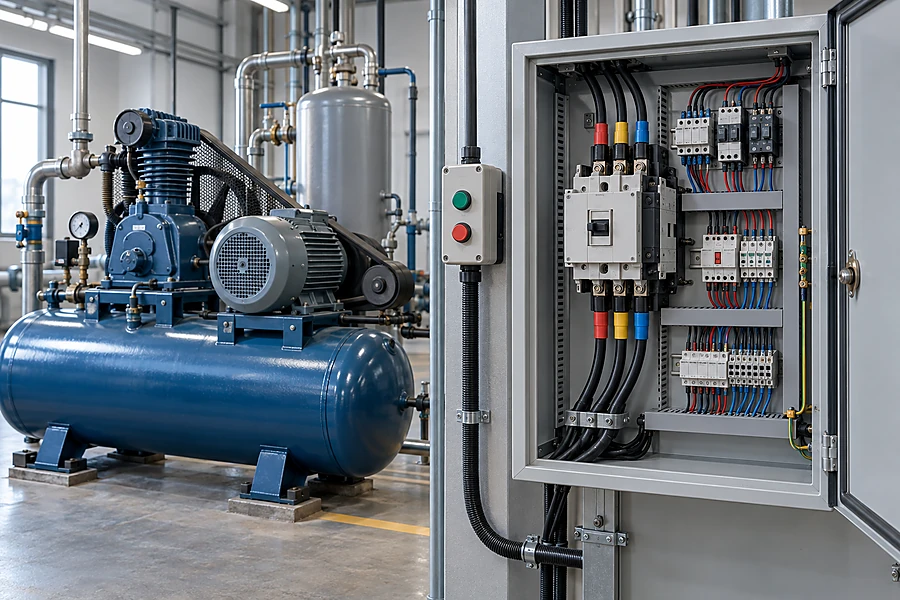
A contactor is used instead of an ordinary switch because it allows a low-power control circuit to switch a much higher-power motor circuit safely and repeatedly. It supports remote and automatic operation, handles motor starting current, provides auxiliary contacts for interlocks, and keeps high motor current out of pressure switches, pushbuttons, PLC outputs, and controllers.
I think of a contactor as an electrically operated heavy-duty switch. The operator, pressure switch, or compressor controller only energizes the contactor coil; the contactor's main contacts carry the motor current.
What Is the Difference Between a Contactor and a Normal Switch?
A switch and a contactor can both open or close an electrical circuit, but they are designed for different operating methods and loads.
A normal switch is typically operated directly by a person or mechanism, while a contactor is electrically operated by a coil. The contactor separates the low-power control circuit from the high-power load circuit, allowing a small control signal to start or stop a much larger motor repeatedly and remotely.
A normal switch directly carries the load
Consider a simple small electrical appliance.
A manual switch can be wired directly in series with the load:
power supply → switch → load
When I operate the switch, its contacts carry the full load current.
For a small resistive load, that arrangement can be simple and practical.
An industrial compressor motor is different.
Its circuit may be:
400 V, three phase, 30 A
or substantially larger.
It can also draw several times its normal current during starting.
Schneider Electric states that an AC-3 motor contactor may have to make approximately five to seven times the motor's full-load current when a squirrel-cage motor starts.
That is why I do not expect an ordinary pushbutton or small pressure switch to carry the compressor motor current directly.
A contactor uses two circuits
A contactor separates the system into:
control circuit
and:
power circuit
A simplified compressor starter looks like:
Control circuit:
pressure switch/controller → contactor coil
Power circuit:
three-phase supply → contactor main contacts → overload relay → motor
The pressure switch or controller only handles the relatively small coil current.
The contactor handles the large motor current.
Eaton defines a contactor as an electrically controlled switch that uses a lower-power control circuit to switch a power circuit.
That principle is one of the main reasons contactors are so common in industrial compressor panels.
A contactor can be controlled from many devices
Because the contactor coil requires only a control signal, I can operate the same motor from:
- Pushbuttons
- Pressure switches
- PLCs
- Compressor controllers
- Float switches
- Temperature controls
- Remote stations
- Safety interlocks
- Automatic sequencing systems
I do not need each of those devices to carry the compressor motor's full current.
That greatly simplifies industrial automation.
Why Does an Air Compressor Use a Contactor
An air compressor often starts and stops automatically according to pressure. A contactor lets the pressure-control system command the motor without carrying the motor's starting and running current.
An air compressor uses a contactor so its pressure switch or electronic controller can start and stop the motor through a low-power control signal. The contactor's main contacts carry the high motor current, while the control device operates only the coil. This provides automatic control and protects small control components from heavy motor-switching duty.
The pressure switch should control the coil
Consider a typical reciprocating compressor.
The receiver pressure falls.
The pressure switch closes its control contact.
Instead of sending the motor's entire current through that small pressure switch, the circuit can work like this:
pressure falls → pressure switch closes → contactor coil energizes → main contacts close → motor starts
When receiver pressure reaches cut-out pressure:
pressure switch opens → contactor coil de-energizes → main contacts open → motor stops
This allows the pressure switch to perform its real job:
sense system pressure and command the starter
rather than serving as the main high-current motor-switching device.
Large motors create high starting current
Motor starting is electrically demanding.
Schneider Electric's AC-3 guidance states that a squirrel-cage motor contactor is designed to close on starting current of approximately five to seven times motor full-load current and then interrupt normal running current when stopping.
Suppose a compressor motor has:
full-load current = 30 A
Its starting current might briefly be roughly:
150–210 A
depending on motor and starting method.
A device switching this motor must be designed for that motor duty.
That is why I choose a contactor by its motor utilization rating, such as AC-3 or the applicable AC-3e rating, rather than simply looking at a general current number.
Contactors are designed for motor starting
ABB describes its magnetic contactors as devices predominantly used to control the start and stop of AC motors. Its NEMA contactors are designed for demanding motor applications, while overload protection is normally provided separately.
That last point is important.
A contactor switches the motor.
It does not normally provide complete motor protection by itself.
A compressor starter usually also requires:
short-circuit protection + overload protection
The complete system may therefore be:
breaker/fuse → contactor → overload relay → motor
Each component has a different function.
| Component | Main function |
|---|---|
| Circuit breaker/fuse | Short-circuit protection |
| Contactor | Starts and stops motor |
| Overload relay | Protects against sustained overload |
| Pressure switch/controller | Commands compressor operation |
| Motor | Drives compressor |
I do not expect one component to replace all the others.
What Advantages Does a Contactor Have Over a Manual Switch?
The biggest advantages are remote control, automation, motor-duty switching capacity, high operating endurance, auxiliary-control capability, and easier integration into motor-protection systems.
Compared with a basic manual switch, a contactor allows automatic and remote operation, can be selected specifically for motor starting duty, handles frequent switching, and provides auxiliary contacts for control logic and interlocking. It can also use a lower-voltage coil, allowing operators and control equipment to work with a lower-power circuit instead of directly switching motor power.
Remote control is a major advantage
A manual switch usually requires someone or something physically operating it.
A contactor can be installed inside the electrical panel while the control station is somewhere else.
For example:
contactor in compressor cabinet
while:
start/stop buttons on control-panel door
or:
remote signal from central compressor controller
This is especially useful in large factories where compressors are automatically sequenced according to system demand.
The control voltage can differ from motor voltage
Suppose the compressor motor runs on:
400 V three phase
The contactor coil might run on:
24 VDC
The control devices can therefore operate at a lower voltage while the contactor switches the high-power motor circuit.
ABB's AF contactors, for example, use electronically controlled coils across broad AC/DC control-voltage ranges, including low-voltage control options.
This separation provides flexibility in panel design.
But I still verify the exact contactor coil voltage.
A:
24 V coil
cannot simply be substituted for a:
230 V coil
without changing the control circuit.
Contactors support auxiliary contacts
A contactor can have auxiliary contacts that change state when the main contactor operates.
I can use those contacts for:
holding circuits + indication + interlocking + PLC feedback + timers + sequencing
ABB's current NEMA contactor range specifically provides auxiliary contacts and accessories such as mechanical interlocks and additional control-contact kits.
For example, an auxiliary contact can tell the compressor controller:
main contactor commanded ON
or can prevent two incompatible contactors from energizing together.
This becomes essential in circuits such as:
reversing starters
and:
star-delta starters
Contactors are intended for repeated operation
Motor-control devices may perform thousands of switching operations over their working life.
Contactors are specifically engineered for this type of repeated switching.
Eaton's medium-voltage comparison illustrates the principle strongly: in the cited application, contactor-based starters provide substantially greater mechanical and electrical endurance than breaker-based motor switching, because contactors are constructed for frequent motor operations.
I would not transfer Eaton's specific medium-voltage endurance numbers directly to every low-voltage contactor.
But the engineering principle still applies:
a motor contactor is designed as a repetitive switching device
while many other electrical devices are intended mainly for isolation or protection.
Contactors make automation possible
A modern compressor may need to respond automatically to:
- Pressure
- Temperature
- Emergency stop
- Low oil pressure
- High discharge temperature
- Motor overload
- Phase failure
- Remote shutdown
- Compressor sequencing
A contactor makes it easy to put all these conditions in the control circuit.
If any required condition is lost:
coil de-energizes → contactor opens → motor stops
That is much more practical than expecting a person to manually operate a large power switch whenever the compressor controller detects a fault.
Can I Use a Switch Instead of a Contactor?
Sometimes. A properly rated manual motor starter or motor-duty switch can directly switch certain motors, but an ordinary light-duty switch should not be treated as a replacement for a correctly selected contactor.
A motor-rated manual starter can be used instead of a contactor where manual local operation is acceptable and the device is correctly rated for the motor. ABB, for example, offers manual motor starters specifically for manually switching motors while providing overload, short-circuit, and phase-failure protection. A basic general-purpose switch is not equivalent to such a device.
Manual motor starters are different from ordinary switches
This distinction matters.
If someone asks:
“Why not just use a switch?”
I need to know what type of switch they mean.
A household wall switch is obviously not an industrial motor starter.
But an industrial manual motor starter can be designed specifically to switch and protect motors.
ABB describes manual motor starters as electromechanical main-circuit devices used to manually switch motors ON and OFF while providing protection against short circuits, overloads, and phase failures.
That makes them appropriate for some applications.
When a manual starter can make sense
I may consider a manual motor starter for:
small motor + local operation + infrequent switching + no automatic pressure control requirement
For example, a small machine that an operator intentionally starts at the beginning of a shift and stops afterward may not require the same control architecture as an automatically cycling industrial compressor.
However, once I need:
automatic pressure operation
or:
remote control
or:
PLC sequencing
the contactor becomes much more useful.
A contactor itself is not an isolating switch
The reverse distinction is also important.
I do not use the contactor as the only means of safely isolating electrical power for maintenance unless the applicable system and standard specifically provide for that function.
A compressor panel normally has a disconnect, breaker, or other isolation device upstream.
The contactor is primarily for operational switching.
The upstream disconnect provides safe electrical isolation according to the required procedure.
So a typical industrial compressor may contain both:
disconnect switch + breaker + contactor
because each performs a different function.
My insights: Why Use a Contactor Instead of a Switch?
I think the clearest explanation is that industrial compressor control needs to separate decision-making current from motor power current.
I use a contactor instead of an ordinary switch because the contactor allows a small control signal to safely operate a large motor circuit. The pressure switch, pushbutton, PLC, or controller only energizes the contactor coil, while the main contacts handle motor starting and running current. This enables automatic operation, remote control, interlocking, and repeated motor switching.
My first insight is that the pressure switch should not be treated as the motor contactor
Suppose I have a:
22 kW compressor motor
The motor current may be tens of amps, with substantially higher inrush at startup.
I prefer:
pressure switch → small coil current
instead of:
pressure switch → full motor current
This reduces the electrical duty placed on the pressure-control device.
The contactor is selected specifically for motor switching.
Schneider's AC-3 definition illustrates why this matters: the contactor must tolerate the large current produced when a squirrel-cage motor starts.
My second insight is that the contactor makes automatic compressor operation possible
A compressor needs to respond automatically to system pressure.
I want this sequence:
pressure low → controller requests start/load
then:
contactor energizes → motor runs
and eventually:
stop condition reached → coil de-energizes → motor stops
The person operating the plant does not need to stand beside the compressor switching the motor manually.
This is especially important when compressors run unattended or are controlled by a central sequencing system.
My third insight is that auxiliary contacts are part of the advantage
The contactor does more than close three large power contacts.
Its auxiliary contacts can be used to:
confirm operation → seal in start circuits → trigger timers → interlock other contactors → provide PLC status
ABB specifically offers auxiliary contacts, mechanical interlocks, surge suppression, and other accessories around its contactor platform.
That makes a contactor a building block for industrial control logic.
My fourth insight is that a contactor must still be protected
Using a contactor does not mean the motor is fully protected.
I normally coordinate:
short-circuit protection → contactor → overload relay → motor
ABB's current motor-control portfolio treats manual protection devices, contactors, and overload relays as coordinated elements in motor-starting systems.
If a motor becomes mechanically overloaded, I want the overload relay to detect the sustained excessive current.
If a severe short circuit occurs, I want the breaker or fuse to interrupt the fault.
The contactor's job is normal switching.
My fifth insight is that I use the right switching device for the duty
When someone asks me, “Why use a contactor instead of a switch?”, my practical answer is:
Because an industrial motor needs a switching device designed for high starting current and repeated operation, while the compressor's pressure switch or controller should only handle the much smaller control signal. A contactor provides that separation and makes automatic, remote, and interlocked operation possible.
My basic compressor circuit is:
three-phase power → breaker/fuse → contactor → overload → motor
while the control side is:
control power → safety circuit → pressure/controller signal → contactor coil
This arrangement gives me several advantages:
| Requirement | Ordinary basic switch | Contactor |
|---|---|---|
| Manual local operation | Yes | Yes, through controls |
| Remote operation | Limited | Excellent |
| Automatic pressure control | Poor fit | Excellent |
| High motor starting current | Only if specifically motor-rated | Designed for motor duty when correctly selected |
| PLC control | Impractical directly | Straightforward |
| Auxiliary contacts | Usually limited | Common |
| Interlocking | Limited | Easy |
| Frequent switching | Depends on device | Designed for repetitive operation |
| Low-voltage control circuit | Not inherently | Yes |
| Motor protection | Not necessarily | Requires coordinated protection |
There is one important exception:
a proper manual motor starter is not the same as an ordinary switch.
ABB's manual motor starters are specifically designed to switch motors manually and can also provide short-circuit, overload, and phase-failure protection.
So I do not say that every motor must always use a contactor.
I use a contactor when the application needs:
automatic operation + remote control + frequent switching + control-system integration
That describes most medium and larger industrial air-compressor starter systems.
For a compressor, the contactor lets a small electrical command control a much larger motor safely and reliably without forcing the pressure switch, PLC, or operator control to carry the motor's full electrical load.
Conclusion
A contactor lets a low-power control circuit switch a high-power compressor motor repeatedly, remotely, and automatically while keeping heavy motor current out of switches and controllers.