
](https://kaishanpro.com/wp-content/uploads/2026/09/How-Rotary-Drill-Rigs-Work-A-Complete-Overview.webp)
Rotary drill rigs can create enormous boreholes, but productive drilling requires much more than simply spinning a bit against the rock.
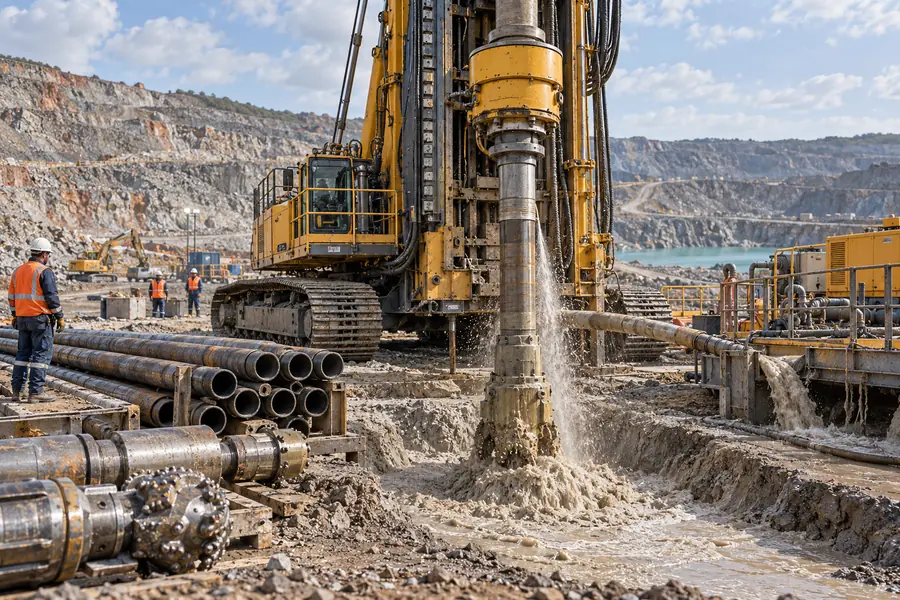
A rotary drill rig works by rotating a drill string and bit while applying controlled downward force. The bit cuts or crushes the formation, while compressed air, water, or drilling fluid removes the broken material. The rig continuously balances torque, rotation speed, weight on bit, feed, and flushing until the required hole depth is reached.
I find rotary drilling easiest to understand by following energy from the machine to the rock. The rig generates power, the rotary head and feed system transmit it through the drill string, the bit breaks the formation, and the flushing system cleans the hole.
What Is a Rotary Drill Rig and What Does It Do?
Rotary drilling is used when a project needs controlled, continuous drilling through soil or rock using a rotating drill string rather than relying primarily on surface percussion.
A rotary drill rig is a machine that uses rotational torque and downward force to advance a drill bit through the formation. Depending on the bit and geology, the cutting structure can shear, scrape, grind, or crush the material. Rotary rigs are widely used for mining blastholes, water wells, foundations, exploration, and other large-hole applications.
Rotation is the defining action
The basic mechanical path is:
power source → rotary head → drill pipe → drill bit → formation
The rotary head creates torque.
The drill pipe transfers that torque down the borehole.
The bit converts the mechanical energy into rock-breaking action.
Epiroc describes the drill string's primary purpose as transmitting rotational torque and weight from the rotary-head power source to the rock-breaking bit while minimizing energy losses and damaging vibration.
That is the fundamental principle behind rotary drilling.
Rotary bits can break the formation differently
Not every rotary bit works in exactly the same way.
A rotary system may use:
- Tricone roller bits
- Drag bits
- PDC bits
- Specialized rotary cutting tools
A tricone bit contains three independently rotating cones.
As the entire bit rotates under load, the cones roll across the bottom of the borehole and crush or dislodge the formation.
Caterpillar describes its tricone design as combining weight and rotary motion to crush and remove rock.
Epiroc currently offers both tricone and PDC rotary bits, reflecting how bit selection changes with formation and application.
I therefore do not think of “rotary drilling” as one universal bit mechanism.
The overall rig provides rotation and feed.
The bit determines exactly how that energy reaches the formation.
Large mining rotary rigs apply enormous bit loads
Mining blasthole rigs demonstrate rotary drilling at its largest scale.
Sandvik's current DR416i drills approximately 270–406 mm holes, applies up to 534 kN of pull-down force, and supports up to about 65,770 kg of weight on bit.
Epiroc's Pit Viper 351 similarly provides approximately 56,700 kg of weight on bit and up to 534 kN of pull-down capacity.
These numbers explain an important principle:
rotary drilling depends on both torque and force
The bit cannot efficiently crush hard rock merely by spinning rapidly.
It also needs sufficient controlled load against the bottom of the hole.
How Does a Rotary Drill Rig Drill a Hole Step by Step?
Although modern rigs contain sophisticated electronics, hydraulics, automation, and pipe-handling systems, the basic drilling sequence remains straightforward.
A rotary drill rig first positions and levels itself over the hole. The rotary head then turns the drill string while the feed system pushes the bit downward. The bit breaks the formation, flushing air or fluid carries the cuttings upward, and the feed advances continuously. Additional drill pipe is added when necessary until final depth is reached.
Step 1: The rig positions over the hole
Before drilling starts, the operator or automation system moves the machine to the planned collar location.
The rig must be positioned correctly because hole location affects later operations such as blasting.
On a large mining drill, hydraulic leveling jacks stabilize and level the machine.
The mast is then positioned at the required angle.
Modern equipment increasingly uses navigation and automation to improve hole location, depth, and consistency.
Caterpillar says its current rotary-drill technology can automate functions of the drilling cycle to improve drilling precision and speed.
Epiroc's current rotary blasthole platforms can also support remote and autonomous drilling, including configurations with minimal direct operator interaction.
Step 2: The rotary head turns the drill string
Once positioned, the rotary head starts rotating.
The head may use:
hydraulic motors
or:
electric motors
depending on machine design.
The gearbox converts motor power into the torque and rotation speed required by the drill string.
A large machine does not necessarily need extremely high rpm.
It often needs substantial torque.
Sandvik's DR416i, for example, uses a two-stage rotary-head design with internal gear reduction specifically to deliver the torque required for large-hole rotary drilling.
Torque travels through:
rotary head → drill pipe → bit
The drill string therefore behaves like a long mechanical transmission shaft.
Step 3: The feed system applies downward force
Rotation alone is not enough.
The feed system moves the rotary head down the mast and creates downward force on the drill string.
This produces:
weight on bit
or WOB.
The required WOB depends on:
- Bit diameter
- Bit type
- Rock strength
- Rock structure
- Desired penetration rate
- Rotary speed
Too little weight can produce poor penetration.
The bit turns, but it does not engage the formation aggressively enough.
Too much weight can cause:
excessive bit wear → vibration → bearing damage → drill-string stress → reduced drilling efficiency
I therefore treat WOB as a controlled drilling parameter, not simply something to maximize.
Step 4: The bit breaks the formation
At the bottom of the hole, the drill bit converts rotary torque and feed force into rock breaking.
For a tricone bit:
rig rotates bit → cones roll → inserts/teeth load rock → rock fractures and crushes
Caterpillar's current rotary drilling tools include tricone bits for low-pressure rotary applications and DTH tools for high-pressure drilling, showing the distinction between conventional rotary and pneumatic-percussive drilling.
The correct bit depends strongly on geology.
Soft formations may favor cutting or shearing action.
Hard formations can require high WOB and carbide-insert roller cones.
I therefore select:
formation → bit → rotary parameters
rather than selecting the bit after all other rig specifications are fixed.
Step 5: The flushing system removes cuttings
Every meter of drilled hole creates broken material.
That material must leave the borehole.
In surface mining rotary drilling, compressed air is commonly sent through the drill string.
It reaches the bit and exits through openings near the cutting structure.
The air then travels upward through the annular space between the drill pipe and the borehole wall, carrying rock cuttings to the surface.
The process is:
compressor → drill pipe → bit → bottom-hole cleaning → annulus → surface
This is why large rotary rigs can have enormous compressors.
Sandvik's DR416i uses approximately 109 m³/min at 5.9 bar for rotary drilling.
Caterpillar's MD6310 offers rotary configurations of approximately 56.6 m³/min at 8.6 bar or 73.6 m³/min at 7.6 bar, depending on configuration.
The goal is not primarily to power a hammer.
In conventional rotary drilling, the air is mainly needed to clean the hole efficiently.
Step 6: The rig keeps feeding as the hole deepens
As the bit removes fresh rock, the rotary head travels down the mast.
The rig continuously coordinates:
rotation + feed + flushing
If the mast and drill pipe are long enough, the complete hole may be drilled in one pass.
Otherwise, additional pipe is required.
Sandvik's DR416i has a current single-pass capacity up to approximately 21 m and maximum drilling depth up to 42.4 m with the relevant configuration.
Epiroc's Pit Viper 351 provides approximately 19.8 m single-pass depth and up to about 41.1 m maximum depth.
Single-pass drilling reduces the time spent adding pipe.
That can improve production in mines drilling thousands of holes.
Step 7: The drill string is withdrawn
Once target depth is reached:
rotation/feed drilling stops → hole is cleaned → rotary head pulls upward → pipe is recovered
The feed system now works in the opposite direction.
Instead of applying pull-down, it provides pullback.
The drill string must be recovered safely and efficiently.
Pipe-handling systems can automate much of this process on modern rigs.
The machine can then lower its mast as required, retract leveling jacks, and move to the next hole.
What Are the Main Systems on a Rotary Drill Rig?
A rotary rig contains many individual components, but I find it more useful to understand them as interconnected functional systems.
The major systems on a rotary drill rig include the power system, rotary system, feed or hoisting system, mast and drill-string system, flushing/circulation system, hydraulic system, crawler and leveling system, and control system. Together they generate energy, rotate and feed the bit, remove cuttings, position the rig, and control the drilling cycle.
Power system
The entire machine starts with a source of power.
That may be:
diesel engine
or:
electric power
Large modern rotary rigs can use either.
Sandvik currently offers an electric DR416iE using a 1,044 kW electric motor, while its diesel DR416i uses a 1,118 kW Cummins engine.
The power source drives major loads such as:
- Rotary head
- Feed system
- Compressor
- Hydraulic pumps
- Crawler drive
- Cooling system
- Pipe handling
- Controls
I do not judge drilling capability from engine kW alone.
The machine must distribute that energy efficiently to the systems that actually create the hole.
Rotary system
The rotary system contains the motor, gearbox, spindle, and associated controls needed to turn the drill string.
Its important specifications include:
maximum torque + usable torque at drilling rpm + speed range
Higher speed is not always better.
Different rock and bits require different combinations of rpm and WOB.
Modern rigs can automatically control these parameters to maintain drilling performance as geology changes.
Feed and hoisting system
The feed system moves the rotary head along the mast.
It performs two opposite functions:
pull-down during drilling
and:
pullback during drill-string recovery
On modern surface rotary rigs, heavy-duty chains, hydraulic motors, cylinders, or rack-and-pinion systems can perform this function.
The feed system strongly influences maximum WOB and drilling depth.
Mast and drill-string system
The mast guides the rotary head and drill string.
It also supports:
pipe loaders → centralizers → winches → pipe handling → angle drilling
The drill pipe carries both mechanical load and flushing air.
As Epiroc notes, the drill string must transmit rotary torque and weight efficiently while controlling vibration.
For me, drill pipe is not merely a tube.
It is a structural power-transmission component.
Flushing and compressor system
The compressor supplies the airflow needed to clear broken material from the bottom of the borehole.
Insufficient airflow can cause:
cuttings accumulation → recutting → increased bit wear → lower penetration → poor hole cleaning
Too much unnecessary airflow wastes energy.
Modern rotary machines therefore increasingly manage compressor output according to drilling requirements.
The difference between conventional rotary and DTH compressor requirements can be dramatic.
Caterpillar's MD6310 offers up to 73.6 m³/min at 7.6 bar for rotary drilling, but its DTH configuration supplies 42.2 m³/min at 34.4 bar.
That comparison captures the fundamental distinction:
rotary drilling emphasizes strong flushing volume
while:
DTH needs high pressure to operate the hammer
Control and automation system
Modern rotary rigs are increasingly computerized.
Sandvik's DR416i uses its intelligent control architecture to provide real-time information about machine performance and health, while its automation platform supports drill planning and automated operation.
Epiroc similarly offers its Rig Control System across current Pit Viper platforms and supports remote and autonomous drilling.
Automation can control or assist with:
hole positioning → leveling → drilling parameters → depth → pipe handling → navigation → reporting
For me, this does not change the fundamental drilling physics.
The bit still needs:
rotation + feed + flushing
Automation simply manages these variables more consistently.
What Determines How Fast and Efficiently a Rotary Rig Drills?
A large rig can still drill poorly if the bit, geology, feed force, rotation, and flushing are mismatched.
Rotary drilling performance depends on matching bit design, weight on bit, rotary torque, rotation speed, flushing airflow, hole diameter, and geology. Productivity should be measured by usable penetration and cost per drilled meter—not maximum torque, rpm, compressor flow, or engine power considered individually.
Geology comes first
The same rig can behave very differently in:
soft sedimentary rock
versus:
hard competent iron ore
The formation affects:
- Required bit type
- WOB
- Rotation speed
- Bit wear
- Penetration rate
- Cuttings size
- Flushing requirement
This is why Caterpillar offers tricone configurations designed for different ground conditions from soft to hard rock.
I always start with geological information before selecting operating parameters.
Bit selection converts machine power into penetration
The rig can generate enormous power, but it reaches the rock through a relatively small cutting structure.
Epiroc emphasizes that bits are a critical part of increasingly powerful and costly rotary drilling systems and that cutting structure and bearing design affect penetration and bit life.
This is why I evaluate:
penetration rate + bit life + cost per meter
rather than simply using the most aggressive bit available.
WOB and rpm must be balanced
If penetration is poor, increasing rpm is not automatically the answer.
Likewise, applying maximum pull-down is not automatically productive.
I adjust:
weight on bit ↔ rotational speed
according to the bit and geology.
The objective is controlled penetration without excessive:
vibration + bearing load + cutter wear + drill-string stress
Flushing capacity must match the hole
As penetration increases, cuttings generation increases too.
The compressor must remove those cuttings quickly enough to expose fresh formation to the bit.
Large hole diameter also increases the space through which air must travel.
That is why a 400 mm mining drill may require airflow exceeding 100 m³/min.
Sandvik's current DR416i pairs its 270–406 mm hole range with 109 m³/min at 5.9 bar compressor capacity.
The rig, bit, and compressor therefore have to be sized together.
Hole quality matters alongside penetration
A drill that penetrates extremely quickly but produces badly deviated holes may reduce overall mine performance.
Hole location, depth, angle, and straightness affect blasting.
Modern equipment therefore uses guidance, centralizers, automation, and drilling-data systems to improve consistency.
Sandvik's DR416i uses a traveling centralizer intended to reduce pipe wobble and improve hole straightness.
For mining buyers, I therefore evaluate:
meters per hour + hole quality + bit life + fuel/energy + availability
rather than meters per hour alone.
My insights: How Do Rotary Drill Rigs Work
The complete mechanism can be reduced to a simple energy chain, but productive drilling depends on every link in that chain being correctly matched.
A rotary drill rig works by generating rotational torque and downward force, transferring both through the drill string to a rotary bit, breaking the formation through cutting or crushing, and using air or drilling fluid to remove the resulting cuttings. The drilling cycle succeeds only when power, bit, WOB, rpm, feed, and flushing are balanced for the geology.
My first insight is that a rotary rig does not simply “spin a bit”
That description leaves out half the process.
I think of rotary drilling as:
rotation + force + flushing
Rotation creates bit movement.
Feed creates contact force.
Flushing keeps the bottom of the hole clean.
Remove any one of those three and drilling performance collapses.
A bit spinning without enough WOB may barely penetrate.
High WOB without suitable rotation can overload the tools.
Good rotation and feed without enough flushing can leave the bit regrinding old cuttings.
My second insight is that the drill string is an energy-transmission system
The drill pipe has to carry:
torque downward
axial load downward
pullback load upward
and often:
compressed air internally
That is why drill-string condition matters.
Worn threads, bent pipe, poor connections, or excessive vibration do not only create maintenance issues.
They interfere with energy transmission.
Epiroc's rotary-tool guidance specifically emphasizes that each drill-string component affects how effectively rotary power and bit load reach the formation.
My third insight is that the compressor is part of the drilling process
For a large surface rotary rig, I never treat the compressor as a secondary accessory.
The bit creates cuttings continuously.
Those cuttings must leave continuously.
So the real process is:
bit breaks rock → air lifts rock → bit reaches fresh rock
If hole cleaning falls behind penetration, drilling efficiency falls.
That makes compressor airflow part of the rock-breaking system even though the air itself may not directly power the conventional rotary bit.
My fourth insight is that large numbers must be interpreted as a system
A current Sandvik DR416i can combine approximately:
270–406 mm hole diameter
534 kN pull-down
65,770 kg weight on bit
109 m³/min flushing air at 5.9 bar
up to 42.4 m hole depth
Those are not independent marketing numbers.
They describe a machine engineered around a particular hole and mining application.
The same applies to the Epiroc Pit Viper 351, which combines a large bit load, high pull-down capacity, deep-hole capability, and a large rotary platform for major blasthole production.
This is how I evaluate a rotary rig:
Does the entire package match the borehole?
My fifth insight is to select the rig from the hole backward
When someone asks me, “How do rotary drill rigs work?”, I explain the mechanism first:
1. The rig positions over the planned hole.
2. The rotary head turns the drill string.
3. The feed system applies weight to the bit.
4. The bit cuts or crushes the formation.
5. Compressed air or drilling fluid removes the cuttings.
6. The feed continues as fresh rock is exposed.
7. Additional pipe is added if the hole exceeds single-pass depth.
8. At final depth, the hole is cleaned and the drill string is withdrawn.
But for equipment selection, I reverse the logic:
application → geology → hole diameter → depth → bit → drill pipe → WOB → torque/rpm → flushing requirement → rig
That approach prevents me from choosing a machine simply because it has the biggest engine, highest torque, or largest compressor.
A current Cat MD6200 covers roughly 140–200 mm holes, while the much larger electric MD6640 is designed for approximately 270–406 mm holes.
Both are rotary drills.
They are designed for different boreholes.
That is why I consider the hole specification the starting point for rotary-rig selection.
My complete operating model
I summarize a rotary drilling rig with this table:
| System | What it does |
|---|---|
| Power source | Supplies energy |
| Rotary head | Produces torque and rpm |
| Feed system | Produces pull-down and pullback |
| Mast | Guides head and drill string |
| Drill pipe | Transfers torque, force, and flushing medium |
| Drill bit | Cuts or crushes formation |
| Compressor/circulation | Removes cuttings |
| Pipe handler | Adds and removes drill pipe |
| Crawler/jacks | Positions and stabilizes rig |
| Control system | Coordinates drilling functions |
| Automation/navigation | Improves consistency, positioning, and data collection |
For me, the most important relationship remains:
geology + bit + weight on bit + rotation + flushing = drilling performance
The operator or automation system continuously manages those variables.
The machine may weigh tens or hundreds of tonnes and contain sophisticated electronics, but the objective at the bottom of the hole is straightforward:
keep the correct bit engaged with fresh formation, apply the correct mechanical energy, and remove broken material quickly enough for drilling to continue efficiently.
That is how a rotary drill rig turns machine power into a finished borehole.
Conclusion
Rotary drill rigs create holes by combining rotation, controlled weight on bit, and continuous cuttings removal. Efficient drilling comes from matching the bit, feed, torque, airflow, and geology.