
](https://kaishanpro.com/wp-content/uploads/2026/10/What-Is-a-Heatless-Air-Dryer-System.webp)
Moisture in compressed air can freeze, corrode piping, damage pneumatic equipment, and disrupt sensitive production processes when ordinary condensate removal is not dry enough.
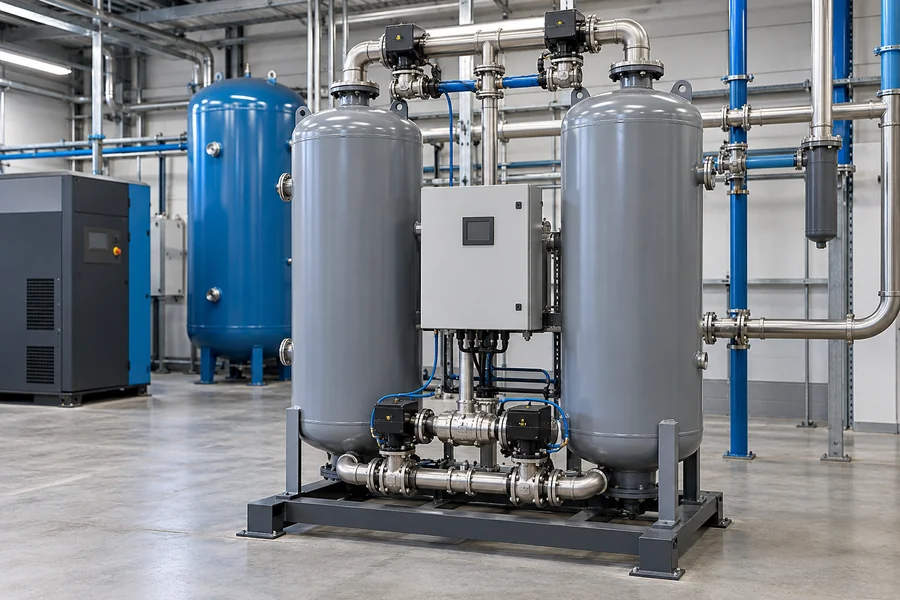
A heatless air dryer system is a twin-tower regenerative desiccant dryer that removes water vapor from compressed air by adsorption. One tower dries the process air while the other is depressurized and regenerated with a portion of already dried compressed air. No external regeneration heater is used, which is why the system is called “heatless.”
I usually consider heatless technology when the plant needs compressed air well below freezing, commonly around -40°C pressure dew point, while also valuing simple construction and reliable operation.
How Does a Heatless Air Dryer System Work?
The system depends on two desiccant towers that continuously exchange jobs. One adsorbs moisture at line pressure while the other regenerates at low pressure.
A heatless air dryer operates through pressure-swing adsorption. Wet compressed air passes through one desiccant tower, where water vapor is adsorbed. Part of the dry outlet air is then expanded to near atmospheric pressure and routed through the second tower to remove stored moisture. The regenerated tower is repressurized, and the towers switch roles automatically.
Step 1: Compressed air enters the online tower
The compressed air should normally reach the dryer after:
aftercooling → liquid separation → appropriate prefiltration
The inlet valve directs that air into one of the two pressure vessels.
For example:
Tower A = drying
Tower B = regeneration
Inside Tower A, the air flows through a bed of desiccant.
Common adsorption materials include:
- Activated alumina
- Molecular sieve
- Other engineered adsorbents
Atlas Copco identifies activated alumina as a common choice for approximately -40°C PDP applications and molecular sieve for more demanding dew-point targets such as -70°C.
Step 2: The desiccant adsorbs water vapor
The correct term is:
adsorption
rather than:
absorption
Water molecules attach to the surface of the desiccant.
Dry compressed air then exits the online vessel and moves toward the plant.
Kaeser describes regenerative desiccant systems as using twin towers so one can remain in drying service while the other is regenerated.
The drying process continues until the active desiccant bed approaches its designed moisture-loading limit.
Step 3: The second tower is depressurized
While Tower A is drying, Tower B is taken offline.
The regeneration process begins by reducing its pressure from system pressure toward atmospheric pressure.
Parker describes this as pressure-swing adsorption: the saturated vessel is blown down, allowing accumulated moisture to detach more readily from the desiccant.
This pressure reduction is fundamental.
At line pressure:
desiccant adsorbs water
At low pressure:
desiccant can release water
That is why heatless dryers are also called:
pressure-swing dryers
or:
PSA dryers
Step 4: Dry purge air regenerates the tower
A portion of the dry compressed air produced by Tower A is diverted.
This becomes:
purge air
The purge air is expanded to approximately atmospheric pressure before passing through the saturated Tower B.
Parker describes a representative heatless design using about 15% of dry compressed air as purge, while Atlas Copco gives a typical range around 12–18% and Kaeser notes that conventional systems can reach roughly 15–20% depending on design and operation.
The process becomes:
dry compressed air → expansion → low-pressure purge air → wet desiccant → moisture removal → exhaust
The purge air carries moisture out of the tower and releases it to atmosphere.
Step 5: The regenerated tower is repressurized
After regeneration:
exhaust valve closes
and:
the regenerated vessel is gradually brought back toward system pressure
This prepares it to become the next drying tower.
Atlas Copco describes the sequence as desorption followed by closing the purge silencer valve and repressurizing the vessel before the tower functions reverse.
Step 6: The towers switch
Now:
Tower B = drying
and:
Tower A = regeneration
A controller automatically coordinates:
inlet valves + outlet check valves + purge valves + exhaust valves + cycle timing
Parker describes PLC-controlled systems that continuously alternate airflow between the drying and regenerating vessels.
The complete operating cycle is therefore:
adsorption → depressurization → purge regeneration → repressurization → switching
Then it repeats continuously.
What Are the Main Components of a Heatless Air Dryer System?
A complete heatless dryer is more than two pressure vessels. Its valves, filtration, purge controls, exhaust system, instrumentation, and desiccant all affect dew-point stability and operating cost.
The main components of a heatless air dryer system are two desiccant towers, switching valves, outlet check valves, purge controls, exhaust valves and silencers, a controller, prefilters, and usually downstream particulate filtration. Reliable performance depends on maintaining clean inlet air, correct purge flow, healthy desiccant, and properly operating valves.
Twin desiccant towers
The towers provide enough desiccant capacity to allow one bed to dry compressed air while the other regenerates.
Their physical design matters.
Kaeser notes that:
bed diameter influences air velocity
while:
bed length influences contact time and dew-point consistency.
If air velocity becomes too high, the desiccant can fluidize or degrade.
If contact time is insufficient, the required PDP may not be achieved.
Desiccant material
The desiccant is the working moisture-removal medium.
For common -40°C duties, activated alumina is widely used.
For even lower PDP requirements, molecular sieve may be used alone or in layered designs depending on the manufacturer.
The desiccant eventually degrades because of:
- Attrition
- Dusting
- Oil contamination
- Liquid-water exposure
- Repeated thermal and pressure cycling
Therefore, it is not a permanent lifetime component.
Switching valves
Heatless systems cycle frequently.
The switching valves repeatedly direct compressed air into one tower and regeneration flow through the other.
Valve reliability is critical because a leaking or slow valve can cause:
pressure instability + excessive purge + wet outlet air + incomplete regeneration
A dryer that appears to have “bad desiccant” may actually have a valve-control problem.
Purge valve or purge orifice
The purge device controls how much dry air is sacrificed for regeneration.
Too little purge:
desiccant not fully regenerated → PDP rises
Too much purge:
dryer wastes compressed air → compressor energy rises
This makes the purge system one of the most important efficiency components.
Modern heatless systems can improve this with load-sensitive or dew-point-dependent controls.
Kaeser's KAD systems, for example, offer optional automatic purge savings that match purge use more closely to reduced air demand.
Exhaust valves and mufflers
During blowdown and purge:
compressed air exits the offline tower
This can be noisy.
Heatless dryers therefore normally use:
exhaust silencers / mufflers
These components also need maintenance because contamination or desiccant dust can increase restriction.
Prefiltration
The dryer should not be used as a separator for large amounts of liquid water or compressor oil.
The desiccant is intended primarily to adsorb:
water vapor
not bulk liquid.
Appropriate pretreatment can include:
moisture separator + particulate filtration + coalescing filtration
depending on the compressor and dryer requirements.
Protecting the desiccant helps maintain:
capacity + PDP + desiccant life
Afterfilter
Desiccant beds can produce fine particulate material as they age.
A downstream particulate filter is therefore commonly used to protect the distribution system and process.
The exact filter configuration should follow the dryer manufacturer and required air-quality class.
Controller
The controller determines:
tower timing
valve sequencing
repressurization
purge cycle
and, on more advanced machines:
dew-point-based regeneration
Kaeser offers fixed-cycle and purge-saving control options, while other suppliers similarly offer demand-dependent switching.
The controller can therefore influence both:
dew-point reliability
and:
energy cost
What Pressure Dew Point Can a Heatless Air Dryer Achieve?
Heatless systems are selected primarily when conventional refrigerated drying cannot provide sufficiently dry air.
A heatless air dryer commonly produces about -40°C (-40°F) pressure dew point, while properly designed systems can reach approximately -70°C (-94°F) for more demanding applications. Actual performance depends on inlet temperature, pressure, flow, desiccant condition, cycle design, purge rate, and the manufacturer's rated operating conditions.
-40°C PDP is the common target
A -40°C PDP is widely used for:
- Instrument air
- Outdoor compressed-air piping
- Cold-weather systems
- Electronics
- Process controls
- Moisture-sensitive production
Kaeser's standard KAD fixed-cycle design is offered around -40°F/-40°C PDP at rated conditions.
For many industrial projects, this is the practical benchmark.
-70°C PDP is possible
Some systems can reach approximately:
-70°C / -94°F PDP
Kaeser's current heatless range publishes pressure dew points down to -94°F.
That degree of dryness may be required for:
highly sensitive instrumentation
specialized process air
very cold environments
or:
specific ISO air-quality requirements
But I do not automatically specify -70°C just because the dryer can achieve it.
Lower PDP usually requires more drying effort and can increase purge consumption or reduce net delivered airflow.
Compare heatless with refrigerated dryers
A refrigerated dryer normally operates in a much warmer PDP range.
Kaeser describes typical refrigerated air as approximately 35°F to 50°F PDP, while its desiccant systems can reach around -100°F depending on design.
The practical distinction is:
| Dryer | Typical capability |
|---|---|
| Refrigerated | Positive-temperature PDP |
| Heatless desiccant | Commonly around -40°C |
| High-performance heatless | Down to approximately -70°C |
| Heated/blower desiccant | Similar low PDP with lower purge losses depending on design |
The heatless system is therefore chosen primarily when:
subfreezing dew point is required
Pressure dew point is not ambient dew point
PDP means:
the temperature at which water begins condensing at the compressed-air operating pressure
It should not be confused with ordinary atmospheric dew point.
That distinction matters because compressed air can contain much more water per unit volume than the same air after it expands to atmosphere.
For equipment selection, I always specify:
required pressure dew point
not simply:
“dry air.”
What Are the Advantages and Disadvantages of a Heatless Air Dryer System?
Heatless technology is popular because it is mechanically straightforward and can deliver very dry air, but purge-air consumption becomes increasingly important as system size and annual operating hours rise.
The main advantages of a heatless dryer are simple construction, no external regeneration heater, strong low-dew-point capability, relatively low initial cost, and suitability for remote or demanding sites. Its main disadvantage is compressed-air purge loss, which can make operating cost high on large 24/7 systems.
Advantage 1: simple regeneration
The system does not need a large:
electric heater
or:
regeneration blower
This reduces mechanical complexity.
Atlas Copco describes heatless systems as particularly suitable where simplicity and reliability are important, including remote or demanding operating environments.
Advantage 2: very low PDP
Heatless technology can reach:
-40°C
and, in suitable systems:
approximately -70°C
This is far below standard refrigeration drying.
Advantage 3: lower capital cost
Among regenerative desiccant technologies, heatless designs tend to have a relatively low purchase price because they avoid:
heater + blower + related high-temperature controls
Kaeser notes that heatless designs are typically among the least expensive regenerative dryers to purchase.
Advantage 4: good fit for smaller systems
When flow is relatively small, purge loss may be economically acceptable.
That makes heatless technology attractive for:
small instrument systems
small production plants
remote compressed-air packages
and:
intermittent applications
Disadvantage 1: high purge-air consumption
This is the major downside.
Atlas Copco cites approximately 12–18% as a typical heatless purge range, while Kaeser notes that purge losses can reach 15–20% of dryer capacity.
That lost air represents compressor energy.
For example:
dryer inlet flow = 1,000 cfm
purge rate = 15%
Approximate purge:
150 cfm
That 150 cfm has already been compressed before being exhausted.
Disadvantage 2: net outlet flow is lower than inlet flow
This creates an important sizing issue.
A dryer rated for:
1,000 cfm inlet
does not necessarily deliver:
1,000 cfm net to production
if part of its flow is being used for purge.
So I distinguish:
dryer inlet capacity
from:
usable dry outlet capacity
Disadvantage 3: purge cost grows rapidly with plant size
For a small dryer, purge cost can be manageable.
For a 24/7 plant with several thousand cfm, it can become substantial.
That is why heated alternatives exist.
Atlas Copco notes that heated regeneration reduces purge-air demand, while blower-purge designs can reduce compressed air loss to very low levels.
Kaeser publishes about 7% process air for its heated-purge systems and approximately 1% or zero process-air loss for certain blower-purge configurations.
Disadvantage 4: it still requires maintenance
Heatless does not mean:
maintenance-free
I still inspect:
prefilters
drains
switching valves
exhaust mufflers
desiccant
purge controls
dew-point performance
and:
pressure drop
If a heatless dryer begins delivering wet air, I diagnose the complete system rather than replacing the desiccant automatically.
My insights: What Is a Heatless Air Dryer System
The simplest definition focuses on the two towers, but from an engineering perspective the system is really a controlled pressure-swing process that exchanges compressed-air energy for low dew point.
A heatless air dryer system is a regenerative twin-tower desiccant system that dries compressed air by adsorption and regenerates its saturated desiccant without an external heater. It uses expanded dry compressed air as purge, making the design simple and reliable but creating an operating-energy penalty because part of the compressor's output is consumed during regeneration.
My first insight is that “heatless” does not mean “energy-free”
This is the most important economic point.
The dryer does not have a regeneration heater.
But the purge air was created by the air compressor.
That means electrical energy has already been used to:
compress → cool → filter → dry
that air.
Then some of it is exhausted.
I therefore consider:
purge cfm
as an energy cost.
My second insight is to size the system by net airflow
Suppose the plant needs:
1,000 cfm of usable dry air
If the selected dryer uses approximately 15% purge, choosing a dryer with only 1,000 cfm inlet capacity may not provide 1,000 cfm net to production.
I therefore calculate:
plant demand + regeneration demand
before final compressor and dryer sizing.
This is one of the most important practical differences between heatless and non-purge technologies.
My third insight is that -40°C is usually the practical benchmark
Heatless systems can reach approximately -70°C, but many applications only need:
-40°C PDP
That is already extremely dry compressed air.
I do not specify -70°C unless:
process requirement + ambient conditions + air-quality specification
justify it.
Over-drying compressed air can increase operating cost without improving production.
My fourth insight is to treat filtration as part of the dryer system
A heatless dryer is not just:
two towers + desiccant
A reliable system includes:
upstream liquid removal + prefiltration + dryer + downstream particulate protection
as required.
If oil or liquid water damages the desiccant, the dryer may lose capacity and fail to maintain dew point.
That is why I design the:
compressed-air treatment system
rather than buying a dryer in isolation.
My fifth insight is to compare lifecycle cost before choosing heatless technology
When someone asks me, “What is a heatless air dryer system?”, my practical answer is:
It is a twin-tower adsorption dryer that uses dry compressed purge air instead of an external heater to regenerate the desiccant.
My selection sequence is:
1. Define required PDP.
Do I need:
+3°C
-20°C
-40°C
or:
-70°C?
If +3°C is sufficient, I would usually compare refrigerated drying first.
2. Define plant airflow.
Use:
actual maximum simultaneous cfm or m³/min
not compressor horsepower alone.
3. Add purge-air requirement.
I want to know:
inlet flow + purge flow + net outlet flow
4. Check operating pressure.
Dryer capacity changes with pressure.
5. Check maximum inlet temperature.
Hotter air increases moisture load.
6. Protect the dryer with correct upstream treatment.
Do not expect the desiccant to handle uncontrolled bulk liquid.
7. Choose control strategy.
For stable full load:
fixed cycle may be acceptable
For varying flow:
purge-saving or dew-point-demand control can reduce waste
8. Compare dryer technologies.
For small/simple projects:
heatless can be very attractive
For large continuous projects:
heated purge or blower purge deserves evaluation
9. Compare lifecycle energy.
Heatless:
lower first cost + higher purge cost
Heated:
higher first cost + lower purge
Blower purge:
higher complexity + potentially very low compressed-air loss
10. Monitor actual PDP.
For critical air, I want measured performance rather than assuming that tower switching alone proves the dryer is working correctly.
My simplified selection table is:
| Application | Dryer I would evaluate |
|---|---|
| Normal indoor plant air | Refrigerated |
| Small system requiring -40°C | Heatless |
| Remote low-PDP system | Heatless |
| Instrument air | Heatless or other regenerative type |
| Outdoor freezing conditions | Desiccant |
| Large 24/7 high-flow plant | Heated/blower comparison |
| Need very low purge loss | Blower purge / alternative regeneration |
| Need approximately -70°C PDP | Confirm dedicated low-PDP desiccant design |
The key purchasing principle is:
heatless dryers exchange compressed air for regeneration simplicity.
That can be an excellent trade when:
flow is modest + reliability matters + low PDP is required
It can be a poor trade when:
flow is very large + operation is continuous + electricity is expensive
because purge air can become a major hidden load on the compressor room.
So the best heatless air dryer system is not simply the one with the lowest advertised dew point.
It is the system that delivers the required net dry airflow at the required PDP with acceptable purge consumption and the lowest reliable lifecycle cost.
Conclusion
A heatless air dryer system uses twin desiccant towers and dry purge air to achieve low pressure dew points without an external heater, trading simplicity for compressed-air consumption.