
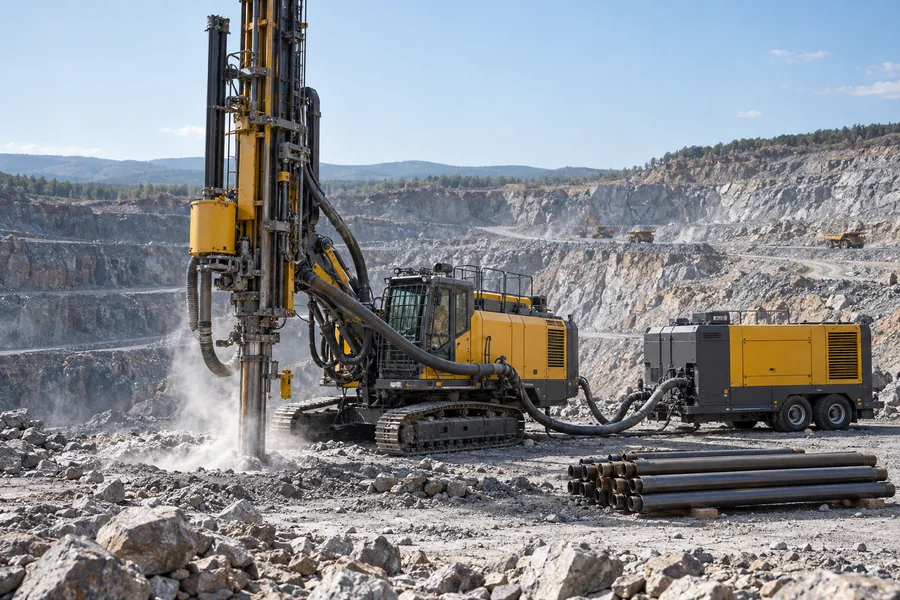
](https://kaishanpro.com/wp-content/uploads/2026/10/How-to-Choose-a-DTH-Drilling-Rig.webp)
Choosing a DTH drilling rig by engine power or maximum depth alone can lead to poor penetration, excessive fuel use, unstable holes, and an undersized compressor.
To choose a DTH drilling rig, I start with the application, required hole diameter, drilling depth, geology, and production target. I then match the DTH hammer and bit, compressor pressure and airflow, drill-pipe size, rotary torque, feed and pullback force, rod handling, mobility, and after-sales support as one complete drilling system.
Choose a DTH drilling rig by starting with hole requirements: application, diameter, depth, geology, hammer, compressor, drill pipe, rig, target productivity, and total lifecycle cost.
What Application, Hole Diameter, and Depth Should the DTH Rig Handle?
The first selection step is defining the hole. Hole diameter determines the hammer family, while depth determines drill-string requirements, rod handling, pullback, and overall rig class.
I first specify the normal and maximum hole diameter, typical and maximum drilling depth, and the actual application. Current DTH rigs show how strongly these variables affect equipment size: Epiroc’s FlexiROC D50 covers 90–130 mm holes, while larger D55 and D60 platforms extend to approximately 152 mm and 178 mm respectively.
Start with the application
I first classify the job:
- Quarry blasting
- Open-pit mining
- Construction
- Water-well drilling
- Geothermal drilling
- Foundation drilling
- Exploration
Each application changes the rig specification.
A quarry contractor drilling:
115 mm holes to 20 m
does not need the same machine as a water-well contractor drilling:
165 mm holes to 300 m.
For a quarry, I may prioritize:
mobility + holes per shift + compressor efficiency
For a water well:
depth + pullback + rod handling + groundwater conditions
become more important.
Hole diameter determines hammer class
The hole diameter normally establishes the practical DTH hammer family.
A simplified starting guide is:
| Hole diameter | Hammer class to investigate |
|---|---|
| ~76–105 mm | 3" |
| ~90–130 mm | 4" |
| ~127–152 mm | 5" |
| ~152–190 mm | 6" |
| ~165–203 mm | 6–8" |
| 203 mm+ | Larger DTH systems |
I treat this as a starting point only.
The exact hammer manufacturer's approved bit range determines the final match.
Kaishan's current selection guidance follows the same engineering logic: hole diameter defines the hammer and bit family, while rock strength and depth then determine the air and rig requirements.
Do not oversize the rig unnecessarily
Suppose the project requires:
90–115 mm blastholes
to:
18 m depth.
Buying a rig designed around:
200 mm holes
may provide more capacity than the project needs.
That extra capacity can mean:
higher purchase price + more fuel + heavier transport + larger compressor + more expensive tooling
without improving useful production.
The right question is:
What is the smallest rig that reliably covers my real operating envelope with reasonable reserve?
Depth affects more than the mast
Maximum drilling depth affects:
rod count
pipe diameter
rod weight
pressure loss
pullback force
rod handling
and:
tool retrieval.
Epiroc's current DTH surface lineup illustrates this. FlexiROC D50 and D55 models list maximum hole depths around 45 m, while D60 and D65 platforms extend to approximately 55.5 m depending on configuration.
For deep water wells, the depth requirements can be much greater.
Comacchio's current crawler-mounted water-well range includes configurations designed for depths exceeding 1,000 m, with pullback capacities from compact rigs through 50-tonne-class machines.
So I never compare:
“maximum depth”
without asking:
At what hole diameter, pipe size, drilling method, and geological condition?
Production target matters too
Two rigs may technically drill the same hole.
But one project requires:
30 m per day
while another requires:
250 m per shift.
That changes how I evaluate:
compressor size
hammer performance
rod changer
automation
travel speed
and:
maintenance support.
Kaishan's current DTH selection guide recommends converting the production target into holes or meters per operating period before finalizing rig and air-package size.
How Do Geology, Hammer Size, and Compressor Capacity Affect DTH Rig Selection?
A DTH rig is only the carrier and control platform. Penetration depends heavily on the hammer, bit, and compressed-air package working correctly in the actual rock.
I match the DTH rig to geology by selecting the hammer and bit first, then verifying the required working pressure and air consumption. Hard, abrasive rock generally demands more impact energy and stronger tooling, while larger holes need much more airflow for both hammer operation and cuttings removal. The compressor must satisfy pressure and FAD simultaneously.
Geology determines impact requirement
I want to know whether the formation is:
soft
medium-hard
hard
very hard
abrasive
fractured
or:
water-bearing.
Hard competent rock normally needs stronger impact energy.
Abrasive granite also increases:
bit wear + hammer wear + fuel cost
Fractured formations can create:
air loss + unstable cuttings return + hole collapse.
The rig therefore needs enough flexibility to maintain stable drilling conditions rather than simply maximum force.
Hammer size should follow the hole
Kaishan's current guidance describes the relationship clearly: its smaller hammer classes serve roughly 90–110 mm holes, while increasingly larger hammer families require progressively greater air demand as diameter grows.
That means I do not decide:
“I want a 5-inch hammer.”
I decide:
“I need a 140 mm hole in hard granite.”
Then I select the hammer family that produces it efficiently.
Pressure powers the hammer
Compressed-air pressure drives the piston.
Kaishan's current water-well compressor guidance distinguishes approximately:
lower-pressure drilling for shallow/softer work
from:
higher-pressure packages for deeper and harder-rock drilling.
The exact pressure must come from the selected hammer's technical data.
I do not assume that:
35 bar is always better than 22 bar.
Running above the required operating range can increase:
fuel use + heat + wear
without producing an economical improvement.
Flow is equally important
Airflow performs two functions:
1. Operate the hammer
2. Flush cuttings from the hole
A rig can have sufficient pressure and still drill poorly if airflow is too low.
Kaishan's compressor guidance emphasizes that pressure and FAD must be matched together; pressure without enough volume gives poor hole cleaning, while flow without sufficient pressure cannot drive the hammer correctly.
This is one of the most common DTH sizing mistakes.
Large holes increase flushing demand rapidly
As hole diameter increases, the volume of broken rock also increases.
The compressor therefore has to move more material through the annulus.
Kaishan's published examples illustrate this effect: smaller 3-inch-class hammers use a fraction of the airflow required by 8- or 10-inch-class systems.
This is why the compressor often becomes one of the most expensive parts of a large-hole DTH drilling package.
Check FAD at working pressure
Do not compare compressors by:
maximum flow at an unrelated pressure.
I need:
FAD at the hammer's operating pressure.
A compressor producing:
25 m³/min at 10 bar
may not produce the same flow at:
22 bar.
The correct selection is:
required hammer pressure + required airflow at that pressure + practical margin
Kaishan currently recommends adding margin for factors such as leakage, hose losses, filter restriction, and altitude rather than sizing exactly to the catalog hammer requirement.
Integrated or separate compressor?
This is an important purchasing decision.
An integrated rig carries its own compressor.
Advantages can include:
one machine + faster relocation + simpler setup + less hose handling
A split rig uses an external mobile compressor.
Advantages can include:
lower rig weight + compressor sharing + easier air-package customization
Kaishan's current surface DTH lineup includes both approaches, with lighter carrier-style rigs relying on external air packages and larger integrated models carrying onboard compressor systems.
I choose based on:
site layout + transport + fleet size + compressor sharing + production pattern.
What Rig Specifications Should I Compare Besides Hole Diameter and Compressor Size?
Once the hammer and air package are correct, the rig itself must control the drill string, keep the hole straight, and safely retrieve the tools.
The rig specifications I compare most closely are rotary torque and rpm, feed force, pullback force, feed stroke, drill-pipe diameter and length, mast capacity, rod handling, climbing ability, transport weight, stability, and control system. For deep drilling, pullback and rod handling can be more important than headline engine power.
Rotary torque
The rig must rotate:
hammer + bit + drill pipe
against formation resistance.
Too little torque can make drilling unstable.
But DTH drilling does not normally require the same huge torque levels as large foundation rotary drilling because the hammer performs much of the rock-breaking work through percussion.
So I want:
enough torque + controllable rpm
rather than maximum torque for its own sake.
Feed force
Feed keeps the bit correctly loaded against the bottom.
Too little feed:
poor energy transfer + vibration
Too much feed:
hammer choking + excessive wear
A good DTH rig therefore needs:
smooth, controllable feed
not simply high maximum thrust.
Epiroc's FlexiROC D55 emphasizes controlled cylinder feeding as part of its DTH drilling system for quarrying and mining.
Pullback force
This specification becomes increasingly important with depth.
The rig must pull out:
hammer + bit + full drill string
under real downhole resistance.
Water-well rigs demonstrate the importance clearly.
Comacchio's current CA 1010 provides approximately 9 tonnes of retract force, the CA 1012 about 12 tonnes, and the heavier CA 1520 approximately 20 tonnes.
That progression reflects increasing depth and tool-handling demands.
For deep water wells, I would never choose a rig based only on:
maximum advertised drilling depth
without checking:
actual pullback.
Drill pipe
Drill-pipe specifications influence:
depth
air pressure loss
string strength
rod handling
and:
hole clearance.
I verify:
OD
ID
length
thread
and:
wall thickness.
Larger/deeper DTH drilling generally requires stronger and often larger drill pipe.
Feed stroke
Longer feed stroke can reduce the number of rod changes.
That improves productivity.
For example, Comacchio's CA 1520 lists a 7,000 mm feed stroke, while smaller CA 1010 and CA 1012 platforms use 4,000 mm strokes.
The best feed length depends on:
rod length + transport dimensions + drilling method.
Rod handling
Manual drill-pipe handling can become a major productivity and safety issue.
For high-production or deep-hole work, I strongly consider:
rod carousel
automatic rod changer
hydraulic breakout
and:
pipe handling arms.
Fraste's current water-well range explicitly offers automatic drill-pipe loading across multiple rig configurations.
Rig weight and transport
A heavier machine may provide:
better stability + larger compressor + more pullback
but it also creates:
transport cost + road limits + lowbed requirements + slower relocation.
Kaishan's current selection guide shows rigs covering similar hole ranges on significantly different carrier weights depending on whether the air system is integrated.
For contractors moving often between smaller sites, mobility can be worth more than maximum capacity.
Crawler, truck, trailer, or skid?
For quarrying and mining:
crawler rigs
are normally attractive because they move efficiently across benches.
For water wells:
truck-mounted
may provide excellent road mobility.
Fraste's current water-well product range supports:
truck + crawler + trailer + skid
configurations depending on project requirements.
The best carrier depends on where the rig spends most of its time:
on the road
or:
on rough ground.
How Should I Compare DTH Drilling Rigs Before Buying?
The final purchase decision should compare the complete drilling package, not only one specification or the rig's factory price.
Before buying, I compare each DTH rig using the same project data: hole diameter, depth, rock, hammer, compressor pressure and FAD, drill pipe, torque, feed, pullback, production target, transport limits, fuel use, rod handling, maintenance access, spare parts, and local service. I then estimate total cost per drilled meter rather than choosing the lowest quotation.
Build one technical RFQ
I send every supplier the same information:
application
hole diameter
maximum depth
rock type
site altitude
production target
preferred drilling method
and:
destination country.
Then I ask each supplier to propose:
rig + hammer + bit + drill pipe + compressor
as one package.
That makes quotations easier to compare.
Require the compressor data
If the rig has an onboard compressor, I ask for:
FAD + operating pressure
not simply:
compressor model.
Epiroc's current DTH range provides this kind of information openly. For example, the FlexiROC D55 lists approximately 354 l/s FAD, 90–152 mm hole capability, and 4- or 5-inch hammer configurations.
That lets me compare the air package with the intended hammer.
Compare rig/hammer compatibility
The rig should state which hammer classes it is designed to handle.
Epiroc's current lineup provides useful examples:
| Example rig | Hole range | Hammer class |
|---|---|---|
| FlexiROC D50 | 90–130 mm | 4", 5" |
| FlexiROC D55 | 90–152 mm | 4", 5" |
| FlexiROC D60 | 110–178 mm | 4", 5", 6" |
| FlexiROC D65 | 110–203 mm | 4", 5", 6" |
This is the kind of transparent matching information I want from every supplier.
Verify service support
Before purchase I ask:
Who services this rig locally?
Which parts are stocked?
What is the technician response procedure?
Can the controller be diagnosed locally?
I also request a recommended stock of:
filters
seals
hoses
sensors
feed components
hammer consumables
and:
rod-handling wear parts.
A rig that drills quickly but waits weeks for parts is not productive.
Check actual field evidence
I ask for projects with:
similar rock
similar hole diameter
similar depth
and:
similar climate.
A machine performing well in:
115 mm limestone blastholes
does not automatically prove performance in:
165 mm abrasive granite.
Evaluate maintenance access
I look at:
filter access
compressor service access
hydraulic hoses
cooling package
rod changer
mast guides
and:
greasing points.
Fast service contributes directly to availability.
Calculate cost per meter
My simplified project calculation is:
ownership + fuel + compressor energy + hammer/bit wear + maintenance + labor + downtime
divided by:
productive drilled meters.
That is a more useful decision metric than purchase price alone.
My insights: How to Choose a DTH Drilling Rig
The most important DTH rig selection mistake is starting with the machine instead of starting with the hole. The drilling requirement should define the rig.
I choose a DTH drilling rig by first defining the application, hole diameter, depth, geology, and production requirement. I then match the hammer and bit, compressor pressure and airflow, drill pipe, torque, feed, pullback, mobility, controls, and service support. The final choice should deliver reliable drilling at the lowest sustainable cost per meter.
My first insight is that hole diameter, depth, and rock define almost everything else
These are my first three technical questions:
What diameter?
How deep?
What rock?
Kaishan's current DTH rig guidance uses the same core logic: diameter determines the hammer/bit family, depth determines the rod and rig class, and geology influences the hammer energy and air-pressure requirement.
Once those are defined, the rest of the system becomes much easier to size.
My second insight is that the compressor can limit the entire rig
A large crawler does not automatically drill faster.
If the hammer is:
air-starved
the rig cannot use its full potential.
The engineering sequence should be:
hole → hammer → pressure/airflow → compressor
Kaishan explicitly recommends sizing the compressor from the hammer rather than from the rig, because both pressure and FAD determine hammer and flushing performance.
For DTH drilling, this is one of the most important purchasing principles.
My third insight is that deep drilling changes the importance of pullback
At shallow depth:
feed + mobility + air
may dominate.
At large depth:
pullback + drill pipe + rod handling + air losses
become increasingly important.
Comacchio's current water-well range demonstrates this progression, with retract capacities increasing from compact 9-tonne machines to 20-tonne and larger platforms as drilling demands increase.
So I do not buy a deep-hole rig because the brochure says:
“300 m maximum depth.”
I verify the mechanical system that must retrieve 300 m of drill string.
My fourth insight is to choose integrated versus split air according to operations
I choose an integrated rig when I value:
fast relocation + one-machine setup + compact site logistics.
I consider a split rig when:
the compressor can be shared
or:
I need more flexibility in air-package selection.
There is no universal winner.
The correct choice depends on:
fleet size + drilling pattern + transport + utilization.
My fifth insight is to choose the whole DTH system, not the rig alone
When someone asks me, “How do I choose a DTH drilling rig?”, this is my complete sequence:
1. Define the application.
Quarry?
Mine?
Water well?
Geothermal?
Construction?
2. Define the required hole diameter.
Use normal and maximum values.
3. Define drilling depth.
Record typical and maximum depth.
4. Describe the geology.
Include:
hardness + abrasiveness + fractures + water.
5. Set the production target.
Meters per hour?
Meters per shift?
Holes per day?
6. Select the DTH hammer family.
Match it to the hole and rock.
7. Select the DTH bit.
Verify:
shank + diameter + face + carbide.
8. Determine hammer working pressure.
Use the exact manufacturer's performance data.
9. Determine required airflow.
Include:
hammer demand + cuttings flushing.
10. Select the compressor.
Verify:
FAD at operating pressure
plus practical site losses.
11. Check altitude.
Correct the air package if necessary.
12. Select drill pipe.
Verify:
OD + ID + length + thread + strength.
13. Check rotary torque and rpm.
Ensure stable rotation across expected geology.
14. Check feed force.
The rig must keep the hammer correctly loaded.
15. Check pullback.
Especially for deep drilling.
16. Check feed stroke and rod handling.
Longer rods and automation may improve productivity.
17. Choose integrated or split compressor.
Match the choice to site logistics.
18. Check carrier type.
Crawler, truck, trailer, or skid.
19. Verify transport weight and dimensions.
Do not discover road restrictions after purchasing.
20. Check service support.
Confirm:
parts + technicians + warranty + training.
My practical selection table is:
| Project condition | What I prioritize |
|---|---|
| Small quarry holes | Compact rig, mobility, fuel economy |
| High-production quarry | Air package, rod handling, uptime |
| Hard granite | High-pressure hammer, sufficient FAD |
| Large holes | Larger hammer, strong flushing |
| Deep water well | Pullback, rod handling, air reserve |
| Wet hole | Pressure/airflow and hole cleaning |
| High altitude | Corrected compressor capacity |
| Remote site | Reliability, easy maintenance, spare parts |
| Frequent relocation | Integrated rig or light transport |
| Large fleet | Service network and fleet economics |
My final rule is simple:
Do not buy the rig first and try to make the drilling system fit afterward.
Start with:
the hole.
Then build outward:
hole → hammer → bit → air → pipe → rig.
A correctly matched mid-sized rig can outperform a larger machine when the hammer, compressor, and drill string are properly matched.
The best DTH drilling rig is therefore not the one with:
the biggest engine
the deepest brochure rating
or:
the highest purchase price.
It is the rig that delivers the required hole size and depth in the actual rock while maintaining:
stable penetration + effective flushing + safe tool handling + acceptable fuel use + reliable uptime
at the lowest sustainable cost per drilled meter.
Conclusion
Choose a DTH rig from the hole backward: define diameter, depth, geology, hammer, airflow, pipe, torque, feed, and pullback before comparing brands or prices.