
](https://kaishanpro.com/wp-content/uploads/2026/10/Where-to-Put-an-Air-Compressor-Filter.webp)
Installing a compressed-air filter in the wrong location can shorten dryer life, increase pressure drop, leave water downstream, or fail to protect sensitive pneumatic equipment.
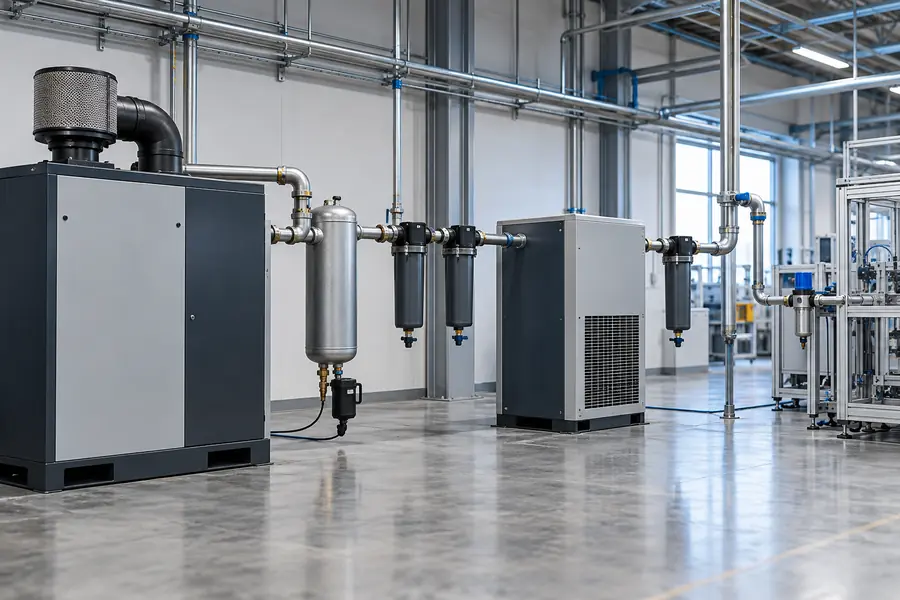
An air-compressor filter should be installed according to its function. The intake filter belongs before the compressor. In the compressed-air line, bulk water should be removed first, followed by a coalescing prefilter before the dryer. Desiccant dryers normally need a particulate afterfilter downstream, while critical equipment may require additional point-of-use filtration.
Filter placement depends on the contaminant being removed, not simply whether the filter goes before or after the dryer. Each filter serves a specific purpose.
Should an Air Compressor Filter Go Before or After the Dryer?
The correct location depends on the filter type. Some filters protect the dryer, while others remove contamination generated or remaining after the dryer.
A coalescing filter normally belongs upstream of the dryer to remove fine liquid water and oil aerosols. A particulate filter may be installed downstream, especially after a conventional desiccant dryer, to catch desiccant dust. Refrigerated-dryer systems may also use downstream particulate filtration depending on the required air-quality class and system design.
Start with the compressor intake filter
The first filter is not actually in the compressed-air line.
It is the:
compressor intake filter.
Its job is to prevent atmospheric contaminants such as:
dust + dirt + larger particles
from entering the compression element.
Donaldson notes that compressor inlet filtration protects the compressor from larger particles, although smaller particles, oil vapors, and other contaminants can still travel downstream and require additional treatment.
So the first position is:
ambient air → intake filter → compressor
This filter protects the machine.
It does not replace downstream air treatment.
After the compressor, remove bulk liquid first
Compression generates heat.
After compressed air leaves the compressor and cools in the:
aftercooler
large amounts of moisture can condense.
Donaldson notes that cooling hot compressed air can condense out a large portion of its water, after which a mechanical separator can remove bulk liquid before finer coalescing filtration.
A practical sequence becomes:
compressor → aftercooler → moisture separator
This is important because a fine filter should not be expected to handle unnecessarily large volumes of bulk liquid.
Put the coalescing filter before the dryer
After bulk water removal, very small liquid droplets may remain.
These can include:
water aerosols
and, on oil-injected compressors:
oil aerosols.
A coalescing filter combines tiny droplets into larger droplets that can drain from the filter housing.
Donaldson specifically recommends coalescing filtration ahead of drying to remove remaining liquid aerosols and protect dryer components.
So my general layout is:
compressor → aftercooler → water separator → coalescing filter → dryer
This is especially important for:
desiccant dryers.
Desiccant dryers need strong upstream protection
A desiccant dryer removes:
water vapor
through adsorption.
It is not intended to receive large amounts of:
liquid water + compressor oil.
Atlas Copco states that upstream moisture separation and oil-removal filtration are essential for protecting desiccant because liquid water or oil contamination can shorten desiccant life and reduce drying performance.
Therefore I protect the desiccant with:
separator + appropriate prefiltration
before the dryer.
Install a particulate afterfilter after conventional desiccant drying
Traditional desiccant beads can generate:
desiccant dust
through movement and wear.
That dust should not be sent into:
instrument valves
pneumatic cylinders
process equipment
or:
products.
Parker's heatless dryer installation guidance calls for particulate and coalescing prefiltration upstream and a downstream afterfilter to remove desiccant dust that may migrate from the towers.
So a typical desiccant arrangement is:
prefilter → coalescing filter → desiccant dryer → particulate afterfilter
Some newer structured-desiccant technologies may produce less dust, so I still follow the exact dryer manufacturer's requirements rather than treating the afterfilter as universally identical.
What Is the Correct Compressed Air Filter Installation Order?
There is no single universal layout for every compressor room, but most systems remove contamination progressively from large liquid loads to finer aerosols, vapor, particles, and application-specific contaminants.
A practical industrial treatment sequence is compressor intake filter → compressor → aftercooler → moisture separator → wet receiver where applicable → coalescing prefilter → dryer → particulate afterfilter → dry receiver or distribution → point-of-use filtration. Activated-carbon or sterile filters are added only when the application requires oil-vapor, odor, or microbiological control.
Typical general industrial system
For ordinary plant compressed air, I often work from:
1. Compressor intake filter
Protects the compressor.
2. Compressor
Generates compressed air.
3. Aftercooler
Reduces compressed-air temperature.
4. Water separator
Removes bulk condensate.
5. Receiver, where system design places it here
Provides storage and can assist condensate separation.
6. Coalescing filter
Removes fine water and oil aerosols.
7. Refrigerated dryer
Reduces water vapor to the required PDP.
8. Downstream particulate/general-purpose filter
Protects the distribution system and equipment.
Kaeser's compressed-air installation guidance shows configurations using a filter upstream of a receiver/dryer and further filtration downstream of the refrigerated dryer.
Typical desiccant dryer system
For low-dew-point air, the sequence becomes more demanding:
compressor
↓
aftercooler
↓
separator
↓
particulate/coalescing prefiltration
↓
desiccant dryer
↓
particulate afterfilter
↓
distribution
Parker specifically recommends upstream particulate and coalescing filters plus a downstream particulate filter on its heatless desiccant dryer installations.
Where does the air receiver go?
The receiver can be installed:
before the dryer
or:
after the dryer
depending on system objectives.
Kaeser notes that installing the dryer after the receiver is the traditional configuration, while installing the dryer before the receiver is also used and has different operating advantages.
A wet receiver before the dryer can:
store air + cool compressed air + collect additional condensate
and can reduce peak demand through the dryer.
A dry receiver after the dryer stores:
already treated compressed air
and can support downstream demand without introducing additional wet storage.
Some systems use both.
So I do not tell buyers:
“The receiver must always be before the filter.”
The system designer should consider:
load profile + dryer size + condensate management + required air quality.
Use staged filtration instead of one extremely fine filter
One common mistake is installing one very fine filter and expecting it to remove everything.
Donaldson recommends progressive filtration because a coarse prefilter can remove larger contamination before air reaches more restrictive final filters, helping extend element life and manage pressure drop.
The logic is:
bulk contamination → coarse removal → fine removal → final polishing
rather than:
everything → one tiny filter.
Where Should Point-of-Use Air Filters Be Installed?
Central filtration protects the whole compressed-air network, but long piping can generate new rust, scale, condensate, or other contamination before air reaches the final machine.
Point-of-use filters should be installed close to the equipment or process they protect. They are especially useful when a machine requires cleaner air than the main plant network provides or when long piping can introduce additional particles and condensate. Final filters should be selected for the specific equipment and required ISO 8573-1 air quality.
Put final filtration near critical equipment
Examples include:
precision pneumatic valves
instrumentation
paint systems
electronics manufacturing
food packaging
medical/process equipment
and other moisture- or contamination-sensitive applications.
Donaldson recommends point-of-use filtration where the final application requires a higher purity level than the main distribution system.
The sequence may become:
main air line → isolation valve → final filter → regulator → machine
depending on the application.
Filter before the pressure regulator when liquid aerosols are present
This is a useful installation detail.
Donaldson recommends placing a coalescing filter upstream of a pressure regulator when liquid water or aerosols are present, because allowing condensate through the regulator can create downstream moisture problems.
A particulate filter may additionally be used downstream where the application needs protection from particles.
Critical process air may need final sterile filtration
Food, beverage, pharmaceutical, and other direct-product-contact applications can require additional treatment.
Donaldson gives food-processing examples using:
prefilter → coalescing filter → adsorption dryer → point-of-use final filtration
with high-efficiency final filtration located at the process where required.
That filter does not replace the central treatment system.
It is the final barrier before the critical use point.
Activated-carbon filters have a different job
Coalescing filtration removes:
liquid oil aerosols.
It does not necessarily remove all:
oil vapor + odors.
Activated-carbon filtration can be added where the process requires additional vapor removal. Donaldson describes activated-carbon filtration as an optional treatment stage for oil vapor and odor reduction.
This usually belongs after adequate:
liquid removal + drying
and before the final critical use, according to the required air-quality design.
What Mistakes Should I Avoid When Installing an Air Compressor Filter?
Poor placement can shorten filter life, increase pressure drop, damage dryers, or create moisture problems even when high-quality filter elements are used.
The most common mistakes are placing fine filtration before bulk-water separation, sending liquid water or oil directly into a desiccant dryer, omitting the desiccant afterfilter, installing the filter backward, ignoring drains, undersizing the filter, placing final filtration too far from the process, and allowing excessive pressure drop through dirty elements.
Do not use the filter as a bulk-water separator
If large volumes of liquid water continuously reach a fine coalescing element, the system upstream needs attention.
I first want:
effective cooling + condensate separation + functioning drains.
Then the coalescing filter handles:
fine aerosols.
Do not send oil directly into the desiccant bed
Oil can foul adsorption media.
Therefore:
oil-injected compressor → appropriate oil-removal filtration → desiccant dryer
is a much safer design than:
oil-injected compressor → unprotected desiccant.
Atlas Copco specifically identifies liquid-water and oil contamination as threats to desiccant performance and life.
Do not forget filter drains
A coalescing filter separates liquid from the airflow.
That liquid must leave the housing.
If the:
automatic drain blocks
the filter can eventually accumulate condensate and reduce treatment effectiveness.
I include:
filter drain inspection
in regular compressor-room maintenance.
Do not install filters backward
Compressed-air filter housings have a defined:
inlet → outlet direction.
Installing against the flow arrow can affect:
separation + drainage + element performance.
Always follow the filter manufacturer's installation direction.
Do not undersize the filter
A filter should be sized for:
actual maximum flow at actual operating pressure.
An undersized filter can create excessive:
velocity + pressure drop.
Pressure drop matters because the compressor must work harder to maintain the required downstream pressure.
Replace elements based on condition and specification
A dirty filter creates:
increasing differential pressure.
I monitor:
pressure drop + operating hours + manufacturer service recommendations
rather than waiting until the filter is completely blocked.
My insights: Where to Put an Air Compressor Filter
The best filter location depends on the contaminant. The correct answer is therefore a treatment sequence rather than one universal position before or after the dryer.
I place the compressor intake filter before the compression element, bulk water separation immediately after cooling, coalescing filtration before the dryer, particulate filtration after conventional desiccant drying, and final filters close to sensitive points of use. I select each position according to whether I need to remove particles, liquid aerosols, vapor, or process contamination.
My first insight is to ask what the filter is protecting
If the goal is:
protect the compressor
the filter belongs:
at the compressor intake.
If the goal is:
protect the dryer
the coalescing filter belongs:
upstream of the dryer.
If the goal is:
catch desiccant dust
the particulate filter belongs:
downstream of the dryer.
If the goal is:
protect one critical machine
the filter belongs:
near that point of use.
That simple logic solves most placement questions.
My second insight is to remove water in stages
I do not ask a single filter to remove all moisture.
My preferred sequence is:
cool → separate bulk liquid → coalesce aerosols → dry vapor
Donaldson describes essentially this progression: cooling condenses water, a separator removes bulk liquid, a coalescing filter removes smaller droplets, and the dryer removes remaining vapor.
Each component does a different job.
My third insight is that the dryer type changes the filtration arrangement
For a refrigerated dryer, the installation may use:
separator + prefilter + refrigerated dryer + downstream filter
depending on target air quality.
For a conventional desiccant dryer, I normally expect:
strong prefiltration + dryer + dust afterfilter.
That difference matters because desiccant media must be protected against:
liquid + oil
while downstream equipment must be protected against:
desiccant particles.
My fourth insight is that one central filter is not always enough
A long distribution network can introduce:
rust + scale + condensate
after central treatment.
Therefore a critical machine at the far end of the factory may still need:
point-of-use filtration.
Donaldson gives examples where final particulate filtration is installed immediately before downstream equipment to remove contamination generated or accumulated in the distribution network.
My fifth insight is to choose air compressor filter placement from the process backward
When someone asks me, “Where to put an air compressor filter?”, I use this sequence:
1. Start with the compressor intake.
Install the correct:
air-intake filter
to protect the compression element.
2. Cool the compressed air.
Use:
aftercooler
or the compressor's built-in cooling system.
3. Remove bulk water.
Install an effective:
moisture separator + drain.
4. Decide where the wet receiver belongs.
Match receiver position to:
load profile + dryer configuration + condensate strategy.
5. Install coalescing prefiltration.
Remove:
fine water + oil aerosols
before they enter the dryer.
6. Install the dryer.
Use:
refrigerated
or:
desiccant
according to required pressure dew point.
7. Add a particulate afterfilter where required.
This is particularly important after conventional bead-type desiccant drying.
8. Add activated-carbon treatment if the process requires it.
Use this for appropriate:
oil-vapor/odor control.
9. Distribute the treated air.
Keep pressure drop under control.
10. Install point-of-use filters for critical equipment.
Place them as close as practical to the protected process.
My basic industrial arrangement is:
intake filter
↓
compressor
↓
aftercooler
↓
water separator
↓
wet receiver, where appropriate
↓
coalescing prefilter
↓
air dryer
↓
particulate afterfilter
↓
dry receiver/distribution
↓
point-of-use filter
↓
regulator/process equipment
For a desiccant dryer, the critical section is:
coalescing prefilter → desiccant dryer → particulate afterfilter
For general refrigerated drying, I may use:
separator → appropriate prefilter → refrigerated dryer → general-purpose downstream filtration
depending on the required ISO air-quality class.
The correct layout should minimize:
water + oil + particles + pressure drop
without installing unnecessary filtration everywhere.
That is why my rule is:
put each filter immediately upstream of the component or process it is intended to protect, while removing larger contaminants before finer filtration.
Conclusion
Place intake filtration before the compressor, coalescing filtration before the dryer, desiccant dust filtration after the dryer, and final filters near sensitive points of use.