
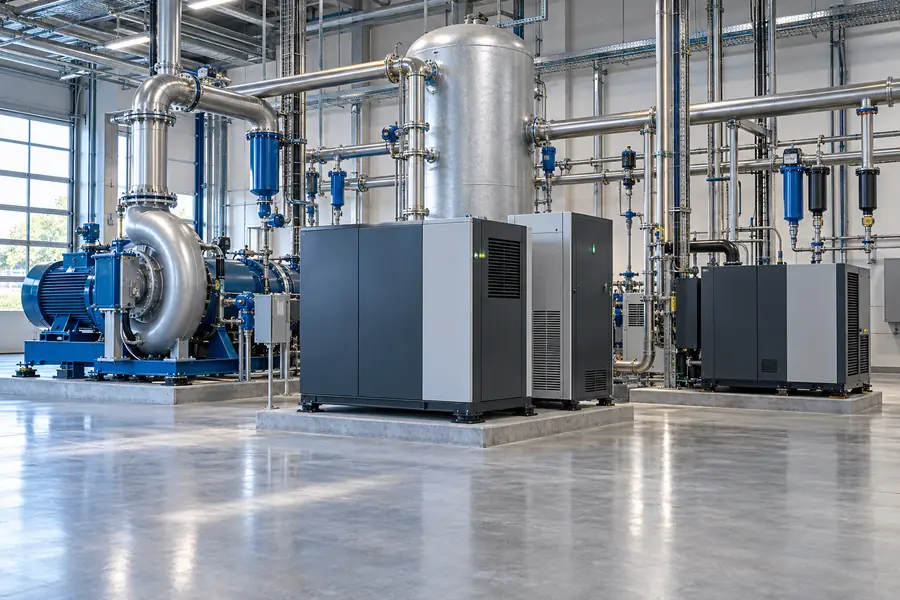
](https://kaishanpro.com/wp-content/uploads/2026/10/Which-Air-Compressor-Is-Most-Efficient.webp)
Energy can dominate an air compressor's lifetime cost, so choosing the wrong compressor type or control method can waste far more money than the original purchase price.
The most efficient air compressor depends on the load profile. For large, stable industrial airflow, a centrifugal compressor can be extremely efficient near its design point. For variable industrial demand, a VSD rotary screw compressor is usually the strongest practical choice. For stable mid-range demand, a correctly sized fixed-speed screw compressor may be more efficient.
I evaluate airflow, pressure, demand, operating hours, specific power, controls, and overall efficiency to select the most suitable compressor for each specific industrial application.
Which Type of Air Compressor Is the Most Energy Efficient?
There is no universal efficiency winner because centrifugal, rotary screw, and reciprocating compressors perform best under different airflow, pressure, and duty conditions.
For very large and stable compressed-air demand, I investigate centrifugal technology first. For medium industrial demand that fluctuates, I usually investigate VSD rotary screw compressors. For constant mid-range demand, fixed-speed rotary screw can be very efficient, while reciprocating compressors remain practical for smaller intermittent applications where the machine can stop when air is not needed.
Centrifugal compressors: highly efficient for large steady demand
For a large industrial plant consuming thousands of CFM continuously, centrifugal compressors deserve serious attention.
Current Atlas Copco centrifugal systems cover approximately:
2,696–20,744 CFM
with working pressures from:
35–190 psig
and motor sizes from:
500–4,000 hp.
The key phrase is:
large and steady demand.
Centrifugal machines operate most effectively when the air requirement remains reasonably close to their designed operating range.
Atlas Copco describes centrifugal technology as especially suited to:
large + constant compressed-air demand, while noting that a highly variable plant can be better served by rotary screw compressors.
I therefore see centrifugal compressors primarily as:
base-load machines.
Typical applications can include:
automotive manufacturing
large textile plants
air separation
PET production
food and beverage
and other facilities requiring large continuous volumes of compressed air.
VSD rotary screw: excellent for variable industrial demand
Most production facilities do not use exactly the same airflow throughout the day.
Demand may change when:
machines cycle
production lines start and stop
shifts change
or:
pneumatic processes operate intermittently.
A Variable Speed Drive compressor changes motor speed according to actual demand.
Atlas Copco explains that rotary screw compressors are particularly well suited to VSD because flow and power consumption respond closely to compressor speed.
Instead of:
full-speed → unload → full-speed → unload
the compressor can more closely follow:
actual plant demand.
This can greatly reduce unloaded energy.
For a factory with fluctuating demand, this is often my first technology to investigate.
Fixed-speed screw can still be more efficient at full load
This point is often missed.
A VSD compressor is not automatically more efficient under every condition.
Atlas Copco notes that if a VSD machine operates continuously at full speed, inverter losses can make it less efficient than an otherwise equivalent fixed-speed compressor operating at full load.
Therefore:
highly variable demand → VSD is attractive
while:
stable demand near full compressor capacity → fixed-speed deserves comparison.
This is why I want an actual:
24-hour or 7-day demand profile
before selecting compressor controls.
Rotary screw is the practical industrial benchmark
For many factories, rotary screw remains the most versatile technology because it combines:
continuous duty
steady airflow
relatively low vibration
broad capacity range
and:
fixed- or variable-speed options.
Kaeser describes current rotary screw designs as using optimized rotor profiles and properly sized drive systems to reduce internal leakage and specific power, with optional variable-speed control to reduce off-load waste.
For most medium-sized industrial buyers, this is therefore where I start my comparison.
Reciprocating compressors still have an efficiency role
Piston compressors should not automatically be dismissed as inefficient.
For:
small airflow
and:
intermittent demand
a reciprocating compressor can stop between air demands instead of remaining unloaded.
Atlas Copco's technology comparison places reciprocating compressors primarily in:
small or intermittent demand
while rotary screws are aimed at continuous mid-range demand.
There are also specialized large reciprocating designs with excellent specific performance, although these are very different from a typical small workshop compressor. Kaeser notes that some water-cooled, two-stage, double-acting reciprocating machines can achieve particularly strong specific power.
So compressor efficiency must always be compared within the correct:
size + pressure + duty category.
Practical technology comparison
| Operating condition | Technology I would evaluate first |
|---|---|
| Small intermittent demand | Reciprocating |
| Continuous medium demand | Rotary screw |
| Variable medium industrial demand | VSD rotary screw |
| Stable medium industrial demand | Fixed-speed rotary screw |
| Very large steady industrial demand | Centrifugal |
| Large oil-free base load | Oil-free centrifugal |
| Highly variable multi-compressor plant | VSD screw + system controls |
The most efficient compressor is therefore:
the compressor that operates efficiently at the plant's actual load profile.
How Should I Measure Air Compressor Efficiency?
Horsepower alone tells me almost nothing about how efficiently a compressor produces useful compressed air.
I compare compressor efficiency using airflow, package input power, discharge pressure, specific power, and where available isentropic efficiency. CAGI performance datasheets provide a standardized basis for comparing rotary compressors. Lower specific power means less electrical input is required to produce the same compressed-air flow at comparable operating conditions.
Specific power is one of the most useful numbers
CAGI defines specific power as a measure of compressor energy consumption relative to delivered airflow.
It is commonly expressed as:
kW per 100 acfm
or an equivalent unit.
Suppose:
Compressor A = 18 kW/100 cfm
and:
Compressor B = 20 kW/100 cfm
at comparable pressure and test conditions.
Compressor A requires less power to deliver the same amount of compressed air.
That makes it the more efficient machine at that operating point.
Compare the same pressure
This is critical.
A compressor delivering:
100 psi
cannot be fairly compared directly against one delivering:
145 psi
using specific power without considering pressure.
Higher pressure requires more compression energy.
CAGI introduced isentropic efficiency partly to make comparisons between similar compressors at different rated pressures more meaningful.
For serious industrial purchasing, I therefore request:
CAGI data sheet or equivalent standardized performance data
rather than relying only on marketing statements.
Look at the whole operating range for VSD compressors
A VSD machine does not have one meaningful efficiency point.
Its power consumption changes with:
flow + speed + pressure.
A compressor may be excellent at:
50–80% flow
but another model may perform better near:
90–100% flow.
Atlas Copco specifically recommends comparing VSD machines over their operating curves rather than from one FAD number because the best choice depends on the customer's demand profile.
This is why I combine:
compressor efficiency curve
with:
plant demand profile.
Annual energy matters more than one nameplate number
CAGI notes that energy commonly costs several times more than the compressor's purchase price over its operating life.
For a compressor operating:
8,000 hours per year
even a small specific-power difference can become financially significant.
My comparison therefore includes:
average kW × operating hours × electricity price
rather than only:
purchase price.
What Makes a Compressed Air System More Efficient Than the Compressor Alone?
Buying an efficient compressor does not guarantee an efficient compressed-air system. Pressure, leaks, piping, storage, dryers, filters, and controls can waste substantial energy after the compressor is installed.
The most efficient compressed-air system uses the lowest practical pressure, minimizes leaks and pressure drop, matches compressor output to real demand, uses proper storage and controls, and avoids inappropriate compressed-air uses. The U.S. Department of Energy identifies pressure reduction, leak repair, storage/control improvements, and appropriate equipment as major system-efficiency measures.
Do not run pressure higher than necessary
This is one of the simplest energy rules.
CAGI states that approximately every:
2 psig of excess operating pressure
can increase compressor power consumption by around:
1%.
Suppose the process requires:
90 psi
but the compressor room operates at:
110 psi
because of poor piping and filters.
The better solution may be to reduce:
pressure drop
rather than permanently compressing all air to unnecessarily high pressure.
Fix leaks before buying another compressor
A leak produces:
zero useful production
but still consumes compressor power.
Kaeser describes leakage as wasted demand and notes that increasing system pressure to compensate for leaks makes the problem worse because leakage flow rises as pressure increases.
If a plant is short of air, I therefore ask:
Do you need another compressor—or do you need to repair the network?
Reduce pressure drop
Pressure drop can occur through:
undersized pipe
dirty filters
poor dryers
restrictive valves
long hoses
and:
bad distribution design.
CAGI recommends minimizing pressure loss because the compressor must operate at a higher discharge pressure to overcome it, consuming additional energy.
This means filter maintenance is also:
energy maintenance.
Use storage and controls intelligently
A receiver is not simply an accessory.
Correct storage helps manage:
short demand peaks
without immediately loading another compressor.
For multi-compressor plants, master controls can select the most efficient machine combination.
A Kaeser case study of an automotive supplier reported large annual energy savings after replacing an inefficient compressor arrangement with properly selected rotary screw compressors and master controls matched to the site's fluctuating demand.
The exact savings from one site should not be applied universally, but the lesson is important:
system controls can matter as much as compressor efficiency.
Compressed air itself is energy-intensive
The U.S. Department of Energy notes that more than:
80% of the input energy
to compressed-air production can be lost as heat, making compressed air inherently energy-intensive.
That means the most efficient compressed-air use may sometimes be:
not using compressed air at all
for a task that could be performed more efficiently by:
electric drives
blowers
or another technology.
How Do I Choose the Most Efficient Air Compressor for My Factory?
The answer starts with measured demand rather than compressor horsepower. A technically efficient machine can still waste energy if it is oversized or operated far from its optimal load.
I choose the most efficient compressor by measuring required airflow and pressure over time, identifying whether demand is steady or variable, and comparing verified specific power over the actual operating range. I then include annual operating hours, air quality, cooling, dryer losses, maintenance, local service, and the complete system pressure profile.
Start with an air audit
I want to know:
minimum flow
average flow
peak flow
working pressure
and:
time spent at each flow level.
One number such as:
500 cfm
is not enough.
A plant may consume:
300 cfm overnight
500 cfm normally
and:
800 cfm for short production peaks.
That profile may make a VSD trim compressor much more efficient than one oversized fixed-speed unit.
Stable demand favors a different machine
Suppose the plant consumes:
900–950 cfm
almost continuously.
A correctly sized fixed-speed compressor may operate efficiently at full load.
Atlas Copco notes that VSD inverter losses can make an otherwise equivalent VSD unit less efficient when it continuously runs at full speed.
At much larger stable flows, I would also evaluate:
centrifugal technology.
Variable demand favors VSD
Suppose demand changes between:
200 and 700 cfm
throughout each shift.
Now I want a compressor that can efficiently:
follow demand.
VSD rotary screw becomes a strong candidate because motor speed changes according to required air output.
Large plants may need a base-load/trim strategy
A large compressed-air system does not necessarily need every compressor to be variable speed.
An efficient arrangement can use:
efficient fixed-speed or centrifugal base load
plus:
VSD rotary screw trim capacity.
The base compressor handles the stable portion.
The VSD machine follows:
fluctuations.
This is often more efficient than asking several poorly coordinated compressors to:
load + unload + vent + cycle
independently.
My insights: Which Air Compressor Is Most Efficient
The most efficient compressor cannot be selected from compressor type alone. Efficiency depends on matching the machine's best operating range to the plant's actual demand profile.
For variable industrial demand, I usually consider a VSD rotary screw compressor the most practical high-efficiency option. For large, stable base-load demand, centrifugal compressors can be more efficient. For steady mid-range demand, fixed-speed screw deserves comparison. I make the final decision from verified specific power and annual energy use—not technology labels alone.
My first insight is that “most efficient compressor” is really a load-profile question
My first question is not:
Which brand?
It is:
How does the plant use air throughout the day?
The answer may point toward:
VSD screw
fixed-speed screw
or:
centrifugal.
Without a demand profile, efficiency comparisons are incomplete.
My second insight is to use verified performance data
I prefer:
CAGI performance data
or equivalent standardized testing.
CAGI's verification program checks published performance for participating rotary compressors using recognized test procedures and provides standardized datasheets for comparison.
I look at:
package input power
FAD
specific power
and:
isentropic efficiency.
This is more useful than statements such as:
“high-efficiency compressor.”
My third insight is that VSD is not automatically the winner
For variable demand:
VSD can be excellent.
For constant 100% load:
fixed speed may be more efficient.
For very large constant demand:
centrifugal may be stronger.
That is why the answer changes with:
load shape.
My fourth insight is that system pressure can erase compressor efficiency
A highly efficient compressor running at unnecessarily high pressure can waste more energy than a slightly less efficient compressor in a well-designed system.
CAGI estimates compressor power consumption rises roughly 1% for every 2 psig of excess pressure.
So I treat:
pressure drop + leaks + filters + piping
as part of compressor selection.
My fifth insight is to choose the most efficient air compressor using this sequence
When someone asks me, “Which air compressor is most efficient?”, I use this process:
1. Measure airflow demand.
Record:
minimum + average + peak CFM.
2. Define working pressure.
Use the lowest pressure that reliably serves the process.
3. Measure the demand profile.
Is it:
steady
or:
highly variable?
4. Define operating hours.
A compressor operating 500 hours per year requires different economics from one operating 8,000 hours.
5. Choose the technology category.
My starting point is:
| Demand | Technology to evaluate |
|---|---|
| Small/intermittent | Reciprocating |
| Medium/continuous | Rotary screw |
| Medium/variable | VSD rotary screw |
| Medium/stable | Fixed-speed rotary screw |
| Very large/stable | Centrifugal |
6. Compare specific power.
Use standardized performance data at comparable pressure.
7. Check the entire efficiency curve.
Especially for VSD equipment.
8. Calculate annual kWh.
Do not stop at compressor horsepower.
9. Evaluate unloaded power.
A compressor spending hours unloaded can waste substantial energy.
10. Check pressure drop.
Inspect:
dryer + filters + piping + valves.
11. Find and repair leaks.
Do this before adding compressor capacity.
12. Optimize storage.
Use receiver capacity to handle short demand events where appropriate.
13. Optimize controls.
Multi-compressor plants benefit from coordinated sequencing.
14. Check heat recovery.
A significant portion of compressor input energy becomes heat; suitable facilities may be able to recover some of it for useful purposes.
15. Compare lifecycle cost.
Use:
purchase + electricity + treatment + maintenance + downtime.
My practical conclusion is:
Variable industrial demand:
Start with a VSD rotary screw compressor.
Stable medium industrial demand:
Compare a fixed-speed rotary screw compressor against VSD using actual performance data.
Very large stable industrial demand:
Evaluate a centrifugal compressor.
Small intermittent demand:
A reciprocating compressor may still be the most economical choice.
The best engineering metric is not:
horsepower
or:
compressor type.
It is:
how many kWh are required to deliver the compressed air the plant actually uses at the pressure it actually needs.
That is why I consider specific power, demand profile, and complete-system efficiency more important than a general claim that one compressor technology is always the most efficient.
Conclusion
VSD rotary screw is often most efficient for variable industrial demand, while centrifugal excels at large stable loads. Compare specific power and actual demand before deciding.