
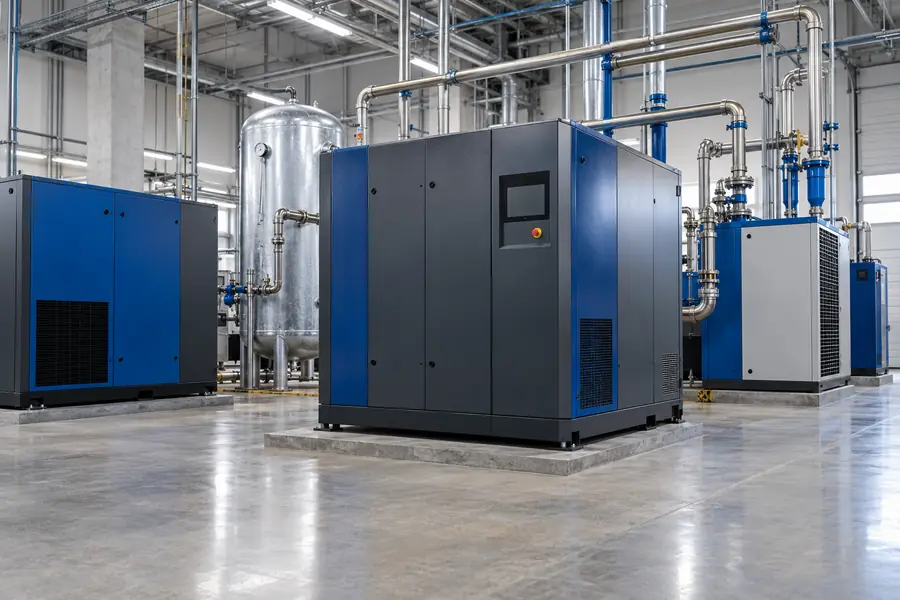
](https://kaishanpro.com/wp-content/uploads/2026/10/Which-Brand-of-Air-Compressor-Is-Best-for-Commercial-Use.webp)
Choosing the wrong commercial air compressor can increase electricity costs, interrupt production, and create maintenance problems. The best-known brand is not always the best fit.
Atlas Copco is a strong overall choice for commercial and industrial compressed air because it offers extensive rotary screw, variable-speed, and oil-free compressor ranges. Kaeser is a compelling alternative for energy efficiency and continuous operation. Ingersoll Rand suits many automotive and repair businesses, while ELGi and Kaishan deserve consideration for value-focused industrial purchasing.
I do not select a commercial compressor by brand name alone.
My evaluation begins with:
Application → required CFM → pressure → duty cycle → compressor technology → energy efficiency → service support → total ownership cost
Which Air Compressor Brands Are Best for Commercial and Industrial Use?
Several established manufacturers produce commercial-grade compressors, but each offers a different combination of equipment types, efficiency features, maintenance requirements, and application coverage.
My commercial shortlist includes Atlas Copco, Kaeser, Ingersoll Rand, ELGi, Kaishan, and Sullair. Atlas Copco is an all-round industrial benchmark, Kaeser emphasizes system efficiency, Ingersoll Rand covers professional workshops and factories, ELGi and Kaishan provide additional value-oriented choices, and Sullair offers heavy-duty industrial screw compressors.
1. Atlas Copco — strong overall commercial choice
Best suited for: businesses seeking a broad industrial product range and advanced efficiency options
Atlas Copco manufactures multiple types of compressors, including:
- Oil-injected rotary screw compressors
- Oil-free rotary screw compressors
- Variable Speed Drive compressors
- Fixed-speed compressors
- Industrial piston compressors
- Large centrifugal compressors
Its G Series is aimed at smaller workshops and commercial businesses.
The GA Series serves a wider range of industrial applications, including continuous manufacturing and high-demand production.
According to the Atlas Copco GA Series specifications, the broader family spans approximately 5.5–500 kW in installed motor power, depending on configuration.
The manufacturer also offers advanced VSD systems that adjust output to changing demand.
I would consider Atlas Copco when a commercial business values:
broad equipment choice
advanced compressor controls
integrated air treatment
remote monitoring
and:
long-term energy management.
However, I still compare its initial price, local service costs, and verified performance against competing machines.
2. Kaeser — strong for efficiency and continuous operation
Best suited for: factories, workshops, and facilities with substantial annual operating hours
Kaeser specializes in compressed-air systems and is widely associated with rotary screw compressor technology.
Its current industrial lineup includes approximately:
3–700 HP
with published capacities ranging from:
9–3,044 CFM
and operating pressures reaching:
217 PSIG
depending on model.
Source: Kaeser Rotary Screw Compressors.
Key product characteristics include:
SIGMA PROFILE airends
fixed- and variable-speed options
integrated dryer configurations
compressor monitoring and controls
and:
service-friendly cabinet designs.
I would prioritize Kaeser in a commercial comparison when the compressor operates for:
one shift
two shifts
or:
24-hour production.
Its potential advantage becomes more meaningful when energy consumption and scheduled maintenance are significant operating expenses.
That said, the most efficient Kaeser model must still be compared with the correct competing models at equivalent pressure and airflow.
3. Ingersoll Rand — strong for automotive and professional commercial workshops
Best suited for: garages, repair shops, fleet maintenance, and general industry
Ingersoll Rand offers both:
reciprocating compressors
and:
industrial rotary screw compressors.
This makes it especially useful when a buyer has not yet decided between piston and screw technology.
Its commercial reciprocating range includes:
two-stage electric compressors
designed for:
automotive repair
body shops
machine shops
fleet maintenance
and:
general workshop operations.
For example, its 10–15 HP two-stage reciprocating range is rated for continuous-duty operation and includes models providing approximately 38–51 CFM at 90 PSI, depending on configuration.
Source: Ingersoll Rand Two-Stage Compressors.
For factories, Ingersoll Rand also offers:
R-Series
UP6
and other oil-flooded rotary screw models.
I would shortlist this brand when the business needs:
professional workshop equipment
a choice between piston and screw systems
or:
continuous-duty industrial compressed air.
4. ELGi — strong value-oriented industrial option
Best suited for: small and medium factories focused on balancing investment, reliability, and maintenance
ELGi manufactures a broad range of commercial and industrial compressors.
Its current U.S. rotary screw lineup includes:
EN Series: 3–50 HP
EQ Series: 25–60 HP
EG Series: 15–300 HP
Source: ELGi Rotary Screw Air Compressors.
The EN Series targets industrial operations where:
cost
equipment footprint
and:
efficiency
matter.
The EQ Series is also marketed for businesses seeking dependable industrial performance with manageable equipment costs.
ELGi publishes extended warranties on qualifying U.S. compressor models, including coverage for the compressor package and airend.
However, warranty duration and coverage depend on:
series
country
model
maintenance conditions
and:
contract terms.
I would investigate ELGi when the purchasing goal is:
commercial-grade equipment with competitive lifetime economics.
I would not assume it is automatically the cheapest brand without collecting comparable local quotations.
5. Kaishan — strong for commercial and industrial screw-compressor comparisons
Best suited for: businesses evaluating multiple compressor architectures and ownership-cost options
Kaishan produces industrial rotary screw compressors in several configurations.
Its current U.S. lineup includes:
KRSB Belt Drive Series: 5–50 HP
KRSD Direct Drive Series: 15–200 HP
KRSP Premium Series: 40–300 HP
KRSP2 Two-Stage Series: 30–600 HP
Source: Kaishan USA Rotary Screw Compressors.
Available configurations include:
belt drive
direct drive
fixed speed
variable speed
and:
two-stage compression.
This range makes Kaishan relevant for commercial and industrial buyers comparing different capital and efficiency requirements.
I would pay particular attention to:
specific power
compressor configuration
airend warranty terms
local parts availability
and:
authorized service support.
A Kaishan package may be commercially attractive, but the result must be established through a model-to-model comparison.
6. Sullair — strong for demanding industrial production
Best suited for: larger factories and high-use industrial compressed-air systems
Sullair is especially associated with industrial rotary screw compressors.
Its LS Series is designed for demanding production applications.
Current published LS Series specifications include:
125–350 HP
459–1,875 CFM
and:
100–200 PSI
across the listed range.
Source: Sullair LS Series Industrial Compressors.
The series emphasizes:
airend durability
maintenance accessibility
filtration
capacity control
and:
industrial operating performance.
I would investigate Sullair for:
large manufacturing plants
continuous industrial demand
and:
facilities requiring substantial compressed-air capacity.
For a small commercial workshop, however, its large industrial compressor range may be unnecessary.
Commercial air compressor brand comparison
| Brand | Main strength | Commercial applications |
|---|---|---|
| Atlas Copco | Broad portfolio and advanced controls | Workshops, factories, oil-free processes |
| Kaeser | Energy-focused rotary screw systems | Continuous manufacturing |
| Ingersoll Rand | Piston and screw compressor options | Garages, repair shops, factories |
| ELGi | Industrial value and warranty options | Small and medium manufacturing |
| Kaishan | Broad screw-compressor configurations | Workshops and industrial plants |
| Sullair | Heavy-duty industrial screw equipment | Larger production facilities |
These are application-based recommendations, not an independently audited ranking of brand reliability.
Which Air Compressor Brand Is Best for Different Commercial Applications?
The best commercial compressor brand changes with the job. A busy automotive garage and a pharmaceutical production facility do not need the same machine.
For automotive workshops, I would investigate Ingersoll Rand and compact screw systems from Atlas Copco or Kaeser. For continuous manufacturing, Atlas Copco, Kaeser, ELGi, and Kaishan deserve comparison. For larger heavy-duty installations, Sullair is relevant. For contamination-sensitive production, I prioritize an appropriate certified oil-free compressor and complete air-treatment system.
Automotive repair shops
Common compressed-air applications include:
impact wrenches
tire inflation
tire changers
air ratchets
blow guns
and:
spray equipment.
Many smaller garages can operate with a properly sized:
two-stage piston compressor.
Ingersoll Rand is a strong starting point because its two-stage commercial range is designed for professional shop use.
However, if multiple technicians use air continuously, a rotary screw system may become more appropriate.
I would then compare:
Ingersoll Rand
Atlas Copco G Series
Kaeser compact screw systems
and:
ELGi EN or Kaishan KRSB configurations.
Small manufacturing businesses
Small factories often use compressed air for:
pneumatic cylinders
machine automation
assembly tools
packaging equipment
and:
CNC-related functions.
The compressor may operate for many hours every day.
That makes rotary screw technology attractive.
My starting shortlist would include:
Atlas Copco G or GA
Kaeser compact rotary screw
ELGi EN
and:
Kaishan KRSB or KRSD.
The final choice depends on:
actual airflow + pressure + demand variation.
Medium and large manufacturing plants
A larger factory may need:
continuous airflow
redundancy
advanced monitoring
and:
low energy cost.
I would investigate:
Atlas Copco GA
Kaeser ASD/BSD/CSD or larger series
Ingersoll Rand R-Series
ELGi EG
Kaishan KRSD/KRSP
and:
Sullair industrial screw compressors.
For these applications, the purchase decision should be based on measured compressor demand rather than nominal horsepower alone.
Food, pharmaceutical, and electronics manufacturing
These industries may have strict compressed-air quality requirements.
Some processes require:
very low oil content
dry compressed air
fine particle filtration
and:
microbiological controls.
I would investigate suitable oil-free systems from manufacturers such as:
Atlas Copco
Ingersoll Rand
and:
Kaeser.
Ingersoll Rand, for example, offers oil-free rotary screw models certified to ISO 8573-1:2010 Class 0 for oil, including its E-Series products.
Source: Ingersoll Rand Oil-Free Air Compressors.
Importantly, an oil-free compressor does not eliminate the need to control:
moisture + particles + ambient contaminants.
The complete system must meet the required air-quality class at the actual point of use.
Businesses with variable air demand
Some factories operate with changing air consumption.
For example:
morning startup → peak production → reduced afternoon demand → overnight standby.
A VSD rotary screw compressor can adjust motor speed to match changing demand.
Atlas Copco, Kaeser, Ingersoll Rand, ELGi, and Kaishan offer variable-speed technologies across relevant product lines.
However, VSD is not universally the best choice.
A factory with nearly constant full-load demand may achieve better economics using a properly sized fixed-speed compressor.
Quick application guide
| Business type | Brands to investigate | Compressor technology |
|---|---|---|
| Small automotive garage | Ingersoll Rand | Two-stage piston |
| Busy repair shop | Ingersoll Rand, Atlas Copco, Kaeser | Piston or screw |
| Small factory | ELGi, Kaishan, Atlas Copco, Kaeser | Rotary screw |
| Continuous manufacturing | Atlas Copco, Kaeser, Ingersoll Rand | Industrial screw |
| Value-focused industrial plant | ELGi, Kaishan | Industrial screw |
| Large heavy-duty factory | Sullair, Atlas Copco, Kaeser | Large screw systems |
| Sensitive production | Atlas Copco, Ingersoll Rand, Kaeser | Suitable oil-free systems |
| Variable-demand factory | Several established industrial brands | VSD screw |
My rule is:
Choose the compressor technology and capacity before choosing the brand.
What Specifications Matter More Than Air Compressor Brand?
Brand reputation helps build a shortlist, but technical specifications determine whether the compressor will actually support the business.
The most important commercial air-compressor specifications are delivered airflow at operating pressure, duty cycle, daily operating hours, compressor type, specific power, demand profile, air-quality requirements, and service conditions. Horsepower and receiver size are not enough to judge performance. I compare complete compressor packages under equivalent operating conditions.
1. CFM at working pressure
The first number I check is:
CFM at the required PSI.
For industrial compressors, manufacturers may report:
FAD — Free Air Delivery
under standardized reference conditions.
If a commercial process requires:
80 CFM at 100 PSI
the compressor must supply that demand at the intended operating pressure.
A machine delivering 80 CFM under a different pressure condition may not be equivalent.
I also check how the flow specification is defined, such as:
ACFM
SCFM
or:
FAD.
These numbers are not automatically interchangeable without reference conditions.
2. Duty cycle
Duty cycle tells me how the compressor is intended to operate.
For intermittent applications, a piston compressor may be suitable.
For continuous plant demand, a rotary screw compressor is often more practical.
However, some industrial reciprocating models are rated for continuous operation.
Therefore:
Piston does not automatically mean intermittent duty.
I verify the manufacturer's rating for the exact machine.
3. Fixed speed versus variable speed
If air demand is relatively stable, a fixed-speed machine may perform efficiently.
If demand changes significantly, VSD can reduce unnecessary energy use.
But I do not select VSD from marketing claims alone.
I compare:
flow versus input power
across the expected operating range.
4. Specific power
Specific power is one of the most useful efficiency measurements.
It indicates how much electrical power is needed to deliver a specified volume of compressed air at a given pressure.
A common unit is:
kW per 100 CFM.
The Compressed Air & Gas Institute (CAGI) provides a performance-verification program and standardized datasheets for comparing eligible rotary compressors.
Source: CAGI Performance Verification.
I prefer verified specific-power figures over broad claims such as:
“best efficiency in the industry.”
5. Operating pressure
Commercial systems should operate at the lowest pressure that reliably supports production.
Unnecessarily high pressure can increase:
compressor power consumption
air leaks
and:
wear on downstream equipment.
For example, a workshop that needs 90 PSI at the tool may require a higher compressor discharge pressure to overcome distribution losses.
However, the better solution may be to reduce:
filter restriction + hose losses + undersized piping
rather than permanently increase compressor pressure.
6. Air treatment
A complete commercial compressed-air system may include:
aftercooler
moisture separator
receiver
dryer
coalescing filters
automatic drains
and:
point-of-use filtration.
The compressor's price does not always include these components.
This matters particularly for:
painting
instrumentation
food packaging
and:
electronics manufacturing.
I compare the cost of the complete system—not just the compressor cabinet.
7. Electrical and installation requirements
Before purchasing, I verify:
available voltage
single-phase or three-phase power
frequency
maximum ambient temperature
ventilation
noise
and:
installation space.
A compressor that is technically excellent but incompatible with the building's electrical supply is not the right commercial choice.
How Do I Compare Commercial Compressor Reliability, Price, and Ownership Cost?
The lowest purchase price is rarely enough to determine the best commercial compressor. Electricity, servicing, repair delays, and air-treatment costs can dominate the ownership calculation.
I compare commercial compressors using total cost of ownership: purchase and installation, electricity, preventive maintenance, consumables, repairs, air treatment, and downtime. I also examine dealer location, spare-parts availability, warranty exclusions, and verified efficiency. A more expensive machine may offer better value if it reliably delivers the required air at lower lifetime cost.
Compare annual electricity costs
For commercial compressors operating several thousand hours each year, electricity deserves close attention.
Consider this illustrative example:
Average electrical demand: 30 kW
Operating hours: 4,000 hours/year
Electricity price: $0.15/kWh
The annual electricity cost is:
30 × 4,000 × $0.15 = $18,000
Now consider another compressor package performing the same useful work at an average of:
28 kW.
Its annual electricity cost becomes:
28 × 4,000 × $0.15 = $16,800
The difference is:
$1,200 per year
or:
$6,000 over five years
before considering electricity price changes.
This is a hypothetical comparison, not a claim that one named brand always saves 2 kW.
It demonstrates why efficiency matters when evaluating commercial compressors.
Compare maintenance expenses
Common expenses include:
compressor oil
oil filters
intake filters
separator elements
belts or couplings
dryer maintenance
and:
service labor.
I request an estimated maintenance schedule and consumables cost for the first five years.
A low-priced compressor with expensive or difficult-to-source parts may have a higher total ownership cost.
Compare local service support
This is one of the most important commercial buying factors.
I ask each supplier:
Is there an authorized technician near the business?
Are common service parts stocked locally?
What is the normal response time for emergency service?
Can the controller be diagnosed without overseas assistance?
Is commissioning included in the quotation?
A well-supported brand may be more valuable than a machine with slightly better specifications but no practical service network.
Compare warranty coverage carefully
Warranty length is useful, but the terms matter more.
I check:
airend coverage
motor coverage
electrical components
labor
travel charges
required maintenance
and:
claim exclusions.
For example, ELGi and Kaishan advertise extended airend warranties on qualifying product ranges.
However, coverage depends on the exact model and market.
I do not assume that a warranty offered in the United States applies automatically to a machine purchased in another country.
Account for air leaks and poor system design
A very efficient compressor can still waste energy in a poorly maintained facility.
The U.S. Department of Energy identifies several major opportunities to improve compressed-air system performance, including:
reducing leaks
lowering unnecessary pressure
improving storage and controls
and:
upgrading maintenance practices.
Source: U.S. DOE — Compressed Air Systems.
This leads to an important purchasing lesson:
Do not buy a larger compressor before investigating excessive air demand or system leakage.
My commercial ownership-cost formula
I calculate:
Total cost of ownership = purchase + installation + energy + maintenance + repairs + air treatment + downtime − residual value
Then I compare the result against:
productive operating hours
or:
useful compressed-air output.
When quotes are available, I use a consistent comparison period, such as:
five years.
My insights: Which Brand of Air Compressor Is Best for Commercial Use
A brand can be excellent overall without being the best choice for every business. I make the final recommendation only after comparing the compressor's real operating conditions and local support.
If I need one overall commercial-industrial benchmark, I start with Atlas Copco because of its extensive fixed-speed, VSD, and oil-free product range. For energy-focused industrial operations, Kaeser is a strong alternative. Ingersoll Rand is particularly relevant for professional workshops, while ELGi and Kaishan deserve value comparisons and Sullair suits larger industrial systems.
My first insight: Atlas Copco is a useful overall benchmark
When a buyer asks for one brand, Atlas Copco is a reasonable starting point.
It covers:
small workshop machines
industrial rotary screw systems
VSD technology
and:
oil-free applications.
However, I use it as a benchmark rather than declaring it an unbeatable winner.
The best Atlas Copco model must still be compared with equivalent competing compressors.
My second insight: Kaeser deserves attention when operating hours are high
I would investigate Kaeser especially when:
continuous operation
efficient compression
low pressure drop
and:
long-term maintenance planning
are important.
Its broad rotary screw range makes it relevant for both small and large industrial facilities.
However, the final decision should use specific power and service quotations rather than brand reputation alone.
My third insight: Ingersoll Rand can be the better commercial-shop answer
Not every commercial business is a factory.
A small automotive shop may need:
intermittent high-pressure air
rather than continuous industrial flow.
In that case, an Ingersoll Rand two-stage piston compressor may be a better practical choice than a large screw package.
I choose the most appropriate technology first.
My fourth insight: ELGi and Kaishan should be part of value comparisons
For industrial buyers balancing:
capital investment
efficiency
warranty
and:
maintenance
I would request quotations from ELGi and Kaishan where authorized support is available.
ELGi's EN, EQ, and EG models cover several useful industrial size ranges.
Kaishan's KRSB, KRSD, KRSP, and KRSP2 models offer different mechanical and compression arrangements.
Neither brand should be ranked purely from advertised warranty duration or unverified pricing assumptions.
The result depends on the exact quoted package.
My fifth insight: Which brand of air compressor is best for commercial use?
My answer depends on how the business operates.
I use this selection sequence:
1. Define the commercial application.
Automotive?
Manufacturing?
Packaging?
Painting?
Food production?
2. Calculate required airflow.
Use actual simultaneous demand.
3. Define working pressure.
Verify PSI or bar at the point of use.
4. Identify operating hours.
Intermittent?
One shift?
Two shifts?
24/7?
5. Select compressor technology.
Piston for suitable workshop duty.
Rotary screw for many continuous industrial applications.
Oil-free technology where the air-quality requirement justifies it.
6. Measure demand variation.
Steady load or fluctuating load?
7. Choose fixed speed or VSD.
Compare efficiency under the real operating profile.
8. Define air quality.
Specify required:
particles + water + oil limits.
9. Include the complete treatment system.
Compressor, dryer, receiver, filters, and drains.
10. Compare verified performance.
Use CAGI or equivalent standardized data when available.
11. Check electrical and site conditions.
Power, temperature, ventilation, and noise.
12. Evaluate local service.
Parts, technicians, and response time.
13. Review warranty terms.
Confirm actual coverage.
14. Calculate five-year ownership cost.
Include energy, maintenance, and downtime.
15. Choose the best-supported model that meets the requirements.
My final commercial brand shortlist
| Buyer requirement | Brands I would investigate first |
|---|---|
| Strong overall industrial benchmark | Atlas Copco |
| Continuous-duty and energy-focused systems | Kaeser |
| Automotive and professional workshops | Ingersoll Rand |
| Small and medium factory value | ELGi, Kaishan |
| Larger heavy-duty industrial systems | Sullair, Atlas Copco, Kaeser |
| Advanced variable-speed applications | Atlas Copco, Kaeser, Ingersoll Rand |
| Oil-sensitive production | Suitable oil-free models from Atlas Copco, Ingersoll Rand, or Kaeser |
| Lowest practical lifetime cost | Whichever qualified model wins the measured comparison |
My final recommendation is:
Atlas Copco is a strong overall commercial brand to benchmark, but the best purchasing decision is application-specific.
A small repair shop may obtain better value from Ingersoll Rand.
A high-hours factory may favor Kaeser.
An industrial buyer focused on capital cost and maintenance may find a competitive package from ELGi or Kaishan.
A large plant may also benefit from Sullair.
The decisive question is not:
“Which brand is most famous?”
It is:
“Which compressor delivers the required air quality, pressure, and airflow at the lowest reliable long-term cost?”
That is how I choose the best commercial air compressor.
Conclusion
Atlas Copco is a strong overall benchmark, but Kaeser, Ingersoll Rand, ELGi, Kaishan, and Sullair may fit specific businesses better. Compare performance, service, and ownership cost.