
](https://kaishanpro.com/wp-content/uploads/2026/10/Is-a-refrigerated-air-dryer-a-dehumidifier.webp)
Moisture in compressed air can damage equipment, corrode pipelines, and interrupt production. However, many buyers confuse refrigerated air dryers with ordinary room dehumidifiers.
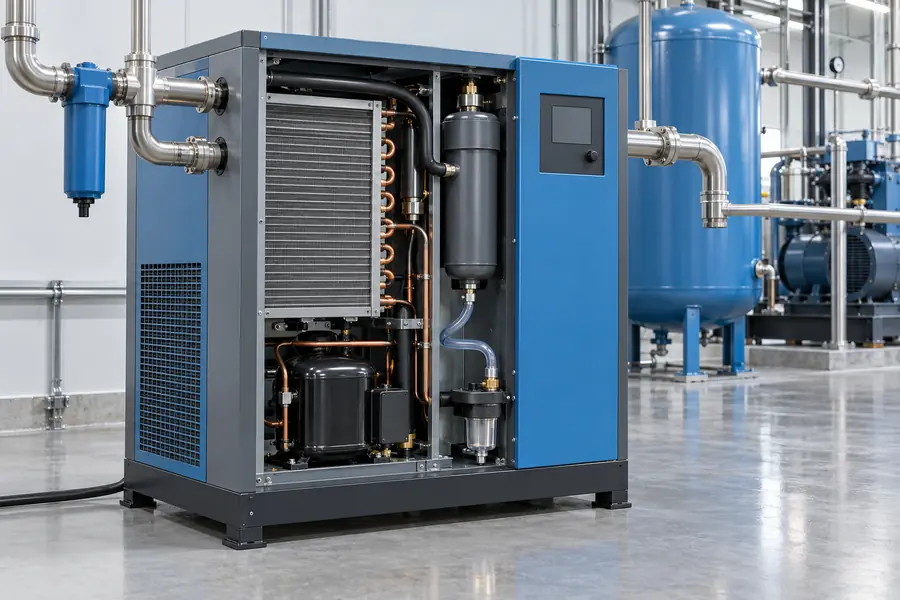
Yes, a refrigerated air dryer is a type of dehumidifying equipment, but it is specifically designed for pressurized compressed air. It cools compressed air until water vapor condenses, separates the liquid water, and drains it from the system. Unlike a household dehumidifier, it controls compressed-air pressure dew point rather than room relative humidity.
I consider both devices moisture-removal systems, but their operating conditions, performance specifications, and applications are very different.
How Does a Refrigerated Air Dryer Remove Moisture From Compressed Air?
A refrigerated air dryer uses refrigeration to lower the temperature of compressed air, allowing water vapor to condense into liquid that can be separated and discharged.
A refrigerated compressed-air dryer passes warm, moisture-laden compressed air through heat exchangers and a refrigeration circuit. Cooling reduces the air's capacity to retain water vapor, causing condensation. A separator and condensate drain remove the liquid water. Most industrial designs then reheat the dried compressed air before it enters the distribution system.
Step 1: Warm compressed air enters the dryer
Atmospheric air naturally contains water vapor.
When air is compressed, its pressure increases and its temperature rises.
As the compressed air subsequently cools, some water vapor condenses.
This explains why compressed-air systems need:
aftercoolers
water separators
receivers
and:
air dryers.
The aftercooler and separator remove a substantial amount of bulk liquid water.
However, the remaining compressed air can still contain enough water vapor to create condensation farther downstream.
An air dryer provides additional moisture removal.
Step 2: The dryer precools the incoming air
Many refrigerated dryers contain an:
air-to-air heat exchanger.
Warm incoming compressed air passes through one side of the exchanger.
Cool, already dried compressed air passes through the other.
This arrangement reduces the temperature of the incoming air before it reaches the refrigeration stage.
The benefit is:
lower refrigeration load + improved energy efficiency.
Atlas Copco describes this precooling and reheating process in its refrigerated air dryer operating guide.
Step 3: Refrigeration causes moisture to condense
The compressed air passes through an:
air-to-refrigerant heat exchanger.
A closed refrigeration system removes heat from the compressed air.
The air temperature approaches a controlled value, commonly around:
+3°C (37°F).
At this temperature, water vapor condenses into liquid droplets.
The basic process is:
Warm, wet compressed air → cooling → condensation → liquid-water separation
Donaldson describes industrial refrigerated dryers with stable pressure dew points typically around +3°C to +5°C, depending on the system.
Source: Donaldson — Refrigerated Air Dryers.
Step 4: Condensed water is separated and drained
Condensing moisture is not enough.
The liquid water must be physically removed from the compressed-air stream.
A refrigerated dryer therefore contains a:
condensate separator
and:
drain system.
The collected water exits the dryer through an automatic or otherwise specified drain.
If the drain fails, liquid water can accumulate or become carried downstream.
For this reason, I consider the separator and drain essential components of the drying process.
Step 5: The dry compressed air is reheated
Many refrigerated dryers pass the cold, treated air through the air-to-air heat exchanger before discharge.
The air absorbs heat from the incoming compressed air.
This raises its outlet temperature.
Importantly:
Reheating does not return the removed water to the air.
The amount of water vapor remains lower than it was before treatment.
As the air warms, its relative humidity decreases.
Reheating also helps prevent external condensation forming on the outside of downstream piping.
What is pressure dew point?
Pressure dew point, or PDP, is the temperature at which water vapor begins to condense while the air remains at its specified operating pressure.
This is the most important moisture-performance measurement for a compressed-air dryer.
For example:
+3°C PDP
means that, at the relevant system pressure, the air begins reaching its condensation condition around +3°C.
It does not mean the air must leave the dryer at exactly +3°C.
The air may be reheated after moisture removal.
Atlas Copco explains that pressure dew point differs from atmospheric dew point because compressed air is evaluated under elevated pressure.
Source: Atlas Copco — Choosing an Air Dryer.
Does a refrigerated dryer remove all moisture?
No.
It removes enough water vapor to reach its specified pressure dew point.
A properly sized industrial refrigerated dryer commonly provides approximately:
+3°C to +7°C PDP.
That is suitable for many ordinary factory applications.
However, moisture remains in vapor form.
If downstream compressed air is cooled below its PDP, condensation can occur again.
Therefore:
Refrigerated drying reduces moisture; it does not make compressed air completely moisture-free.
What Is the Difference Between a Refrigerated Air Dryer and a Dehumidifier?
Both devices use refrigeration to remove moisture, but a refrigerated compressed-air dryer operates inside a pressurized pipeline while a conventional dehumidifier treats atmospheric air in a room or building.
A refrigerated air dryer is designed for compressed-air systems and is specified by airflow, operating pressure, and pressure dew point. A conventional dehumidifier circulates room air through cooling coils and is generally specified by daily moisture-removal capacity and relative-humidity control. They share a similar condensation principle but are not interchangeable.
Refrigerated air dryer: designed for compressed-air pipelines
A refrigerated compressed-air dryer is connected to:
an air compressor
or:
an industrial compressed-air distribution system.
Its operating conditions may include:
100 PSI
125 PSI
150 PSI
or another specified compressed-air pressure.
The equipment must therefore use:
pressure-rated compressed-air passages
suitable heat exchangers
industrial connections
and:
reliable condensate removal.
The buyer usually specifies dryer capacity in:
SCFM
ACFM
or:
m³/min
under stated reference conditions.
Its drying performance is primarily evaluated through:
pressure dew point.
Room dehumidifier: designed for atmospheric air
A conventional dehumidifier draws humid room air through its cooling system using a fan.
Moisture condenses on the cold surface.
The collected water drains into:
a bucket
or:
a condensate outlet.
The treated air returns to the room.
According to ENERGY STAR's dehumidifier guidance, room dehumidifiers are designed for portable or whole-home moisture control.
Their specifications normally include:
water removal in pints per day
relative-humidity settings
energy efficiency
and:
room coverage.
A built-in humidistat may maintain the desired relative humidity.
Pressure dew point vs relative humidity
This distinction matters.
Pressure dew point (PDP) tells me how dry the compressed air is at operating pressure.
Relative humidity (RH) tells me how close the surrounding air is to saturation at its current temperature.
They are related moisture measurements, but they are not the same.
For example:
A compressed-air system may require:
+3°C PDP.
An office or workshop may need:
40%–50% RH.
These are different design targets.
I would not specify a compressed-air dryer using only a room humidity setting.
Likewise, I would not select a home dehumidifier by asking for its PDP at 100 PSI.
Can I use a room dehumidifier instead of a refrigerated compressed-air dryer?
No.
A normal room dehumidifier is not designed to contain and process pressurized compressed air.
Connecting it to a compressed-air line would be inappropriate and potentially dangerous.
It lacks the necessary:
pressure-rated air circuit
compressed-air inlet/outlet connections
and:
dryer-specific pressure controls.
A conventional dehumidifier also cannot guarantee the required compressed-air PDP.
Can a refrigerated air dryer lower room humidity?
Not in the way a conventional room dehumidifier does.
A compressed-air dryer treats only the air flowing through its compressed-air connections.
It does not normally draw in large volumes of surrounding room air and return them to the space.
Therefore, installing a compressed-air dryer in a humid workshop will not function as a practical replacement for:
a room dehumidifier
or:
building HVAC humidity control.
Refrigerated air dryer vs room dehumidifier
| Feature | Refrigerated air dryer | Room dehumidifier |
|---|---|---|
| Main purpose | Dry compressed air | Reduce indoor humidity |
| Air pressure | Pressurized | Atmospheric |
| Main performance metric | Pressure dew point | Relative humidity and water removal |
| Typical drying target | Approximately +3°C PDP | Often 30%–50% RH |
| Airflow measurement | CFM or m³/min at specified conditions | Room airflow and moisture capacity |
| Installation | Compressed-air pipeline | Room or HVAC system |
| Main users | Factories, workshops, industrial plants | Homes, offices, basements |
| Water collection | Industrial condensate drain | Bucket or condensate drain |
| Interchangeable? | No | No |
ENERGY STAR identifies approximately 30%–50% RH as a commonly recommended indoor humidity range, whereas industrial compressed-air dryer performance is specified using pressure dew point.
My conclusion is:
The two devices use similar cooling technology, but they solve different humidity problems.
When Should You Choose a Refrigerated Air Dryer Instead of a Desiccant Dryer?
A refrigerated dryer is often the most economical option when a facility needs reliable moisture removal but does not require extremely low pressure dew points.
I choose a refrigerated air dryer for general indoor compressed-air applications where a pressure dew point around +3°C is sufficient. I consider a desiccant dryer when the system requires −20°C, −40°C, or lower PDP, when downstream piping is exposed to freezing conditions, or when sensitive production processes demand significantly drier air.
General industrial compressed air
Refrigerated dryers are commonly used in:
automotive workshops
general manufacturing
woodworking
metalworking
packaging
and:
pneumatic automation.
These applications often require moisture control to reduce:
pipeline corrosion
water in pneumatic valves
equipment malfunction
and:
maintenance costs.
Kaeser identifies refrigerated dryers as a practical solution for ordinary indoor commercial and industrial compressed-air applications.
Source: Kaeser — Refrigerated Air Dryers.
Why pressure dew point determines dryer selection
The required PDP should be based on the lowest temperature that downstream compressed air may encounter.
Consider two systems.
System A
All distribution piping remains indoors at approximately:
20°C.
A refrigerated dryer providing:
+3°C PDP
may be suitable if the process has no stricter requirements.
System B
Some compressed-air piping runs outdoors and may reach:
−10°C.
A +3°C PDP would not be sufficient to prevent condensation and freezing.
The system would generally require lower-PDP drying technology.
I would investigate:
desiccant adsorption drying
or another technically suitable low-dew-point system.
Refrigerated vs desiccant drying
Refrigerated drying uses:
cooling → condensation → liquid removal.
Desiccant drying uses:
adsorption → regeneration.
Common desiccant dryers contain moisture-adsorbing materials such as:
activated alumina
silica gel
or:
molecular sieves.
Regenerative designs repeatedly restore the desiccant so drying can continue.
Desiccant systems are commonly selected for:
−20°C PDP
−40°C PDP
and:
−70°C PDP
depending on model.
The tradeoff can include:
higher equipment cost
compressed-air purge consumption
heater or blower electricity
and:
additional maintenance.
ISO 8573-1 compressed-air moisture classes
ISO 8573-1 is a widely used standard for compressed-air purity.
For water vapor, the relevant pressure dew point classes include:
| Water class | Maximum pressure dew point | Typical technology |
|---|---|---|
| Class 1 | −70°C | Specialized adsorption |
| Class 2 | −40°C | Desiccant dryer |
| Class 3 | −20°C | Desiccant dryer |
| Class 4 | +3°C | Refrigerated dryer |
| Class 5 | +7°C | Refrigerated dryer |
| Class 6 | +10°C | Suitable drying/treatment system |
For example:
ISO 8573-1 Water Class 4
requires a pressure dew point no higher than:
+3°C.
However, this is only the water-quality classification.
Compressed-air purity also includes:
particle contamination
and:
oil contamination.
A refrigerated dryer alone does not guarantee compliance with every ISO 8573-1 purity requirement.
Can a refrigerated dryer achieve −40°C dew point?
A conventional refrigerated dryer generally cannot provide a −40°C PDP.
Its normal condensation process operates above freezing to avoid ice formation in the cooling and water-removal system.
For very low dew points, I use:
desiccant
or another suitable low-dew-point drying technology.
When is refrigerated drying the better choice?
I normally favor refrigerated drying when:
+3°C PDP is sufficient
all relevant downstream lines stay above the PDP
energy and maintenance costs matter
and:
very low moisture levels are unnecessary.
The key selection principle is:
Do not purchase a lower dew point than the application requires.
Over-drying can increase operating costs without delivering a useful production benefit.
How Do You Size, Install, and Maintain a Refrigerated Compressed-Air Dryer?
A refrigerated air dryer must be sized and installed for actual operating conditions. Incorrect airflow, high temperatures, low pressure, and failed drains can all cause downstream moisture problems.
I size a refrigerated dryer by maximum simultaneous airflow, minimum operating pressure, maximum inlet-air temperature, maximum ambient temperature, and target PDP. I install it with proper cooling, condensate separation, drainage, and filtration. For maintenance, I monitor dew point, inspect drains, clean heat-transfer surfaces, and investigate high-temperature or refrigeration alarms.
Step 1: Determine the maximum compressed-air flow
The dryer must handle the airflow that can actually pass through it.
This may differ from average plant consumption.
If the compressor can supply:
200 CFM
but the plant normally consumes:
120 CFM
the dryer may still need to accommodate 200 CFM during higher-demand periods.
The correct approach depends on:
compressor controls
receiver arrangement
and:
maximum flow through the dryer.
I compare rated capacity under actual conditions rather than relying only on nameplate capacity.
Step 2: Check operating pressure
Dryer capacity changes with pressure.
Low operating pressure can reduce the effective flow capacity of a given dryer.
I therefore specify:
normal pressure
minimum pressure
and:
maximum allowable pressure.
The dryer must also have an appropriate pressure rating for the installation.
Step 3: Measure inlet-air temperature
High inlet temperature increases:
thermal load
and:
moisture load.
A dryer receiving compressed air hotter than its design condition may no longer achieve its rated dew point at the listed airflow.
For example, an inefficient:
aftercooler
can create a moisture problem that appears to originate inside the dryer.
I verify the compressed-air temperature immediately before the dryer.
Step 4: Check ambient temperature and ventilation
Refrigerated dryers must reject heat.
If the surrounding compressor room is very hot or ventilation is poor, condenser performance can deteriorate.
The result can be:
higher PDP
longer refrigeration operating time
and:
reduced drying capacity.
I avoid installing the dryer directly in the compressor's hot exhaust airflow.
Kaeser's refrigerated dryer sizing guide explains how pressure, ambient temperature, and inlet-air temperature correction factors affect usable capacity.
Step 5: Install the correct air-treatment sequence
A typical industrial arrangement may include:
Compressor
↓
Aftercooler
↓
Bulk moisture separator
↓
Wet receiver, where appropriate
↓
Suitable prefiltration
↓
Refrigerated air dryer
↓
Distribution or dry receiver
↓
Point-of-use filtration where required
The exact layout depends on the equipment manufacturer's requirements.
Some installations use integrated dryer packages.
Others use separate air-treatment equipment.
The most important point is that the dryer should not be expected to replace every separator and filter in the system.
Step 6: Monitor the condensate drain
The drain removes condensed water from the dryer.
If it becomes blocked or fails:
liquid water may accumulate.
That water can be carried into downstream piping.
Kaeser's dryer-maintenance guidance specifically identifies condensate-drain inspection as essential for reliable refrigerated drying.
I check:
drain operation
drain tubing
blockages
and:
unusual water carryover.
Condensate containing compressor oil must be managed and disposed of according to applicable requirements.
Step 7: Inspect heat-transfer surfaces
Dirty condenser fins reduce cooling efficiency.
Typical maintenance includes checking:
condenser cleanliness
ventilation airflow
cooling fan operation
and:
heat-exchanger condition.
Cleaning procedures must follow the dryer's maintenance instructions.
I do not open the refrigeration circuit or add refrigerant without proper diagnosis by qualified personnel.
Step 8: Monitor pressure dew point
PDP monitoring is one of the most useful ways to identify drying problems.
For example:
Normal PDP: +3°C
Measured PDP: +12°C
This indicates that drying performance may have deteriorated, assuming the measurement is accurate and taken under the proper conditions.
Possible causes include:
dryer overload
high inlet temperature
high ambient temperature
refrigeration problems
or:
measurement errors.
I verify the reading and operating conditions before replacing components.
Step 9: Choose suitable refrigeration controls
Common refrigerated dryer designs include:
Non-cycling dryers
The refrigeration system runs continuously or uses its designed capacity-control method to maintain drying conditions.
Cycling dryers
The refrigeration compressor cycles as needed, often using thermal storage.
Variable-speed refrigerated dryers
Motor speed changes according to cooling demand.
Atlas Copco and Donaldson both offer refrigerated dryer families with different energy-control arrangements.
For variable production demand, cycling or VSD technology may reduce dryer electricity use.
However, I compare the complete performance and operating conditions rather than assuming one control method is always superior.
Refrigerated dryer troubleshooting table
| Symptom | Possible cause | What I check |
|---|---|---|
| Water downstream | Failed drain or insufficient drying | Drain, separator, PDP |
| PDP rises during peak demand | Dryer overload | Corrected airflow capacity |
| PDP rises in summer | High ambient temperature | Ventilation and condenser |
| High dryer inlet temperature | Compressor cooling problem | Aftercooler |
| Excessive pressure drop | Restriction or icing | Filters and dryer condition |
| Dryer alarm | Refrigeration or control problem | Alarm code and service manual |
| Unexpected moisture after system changes | Increased flow or changed piping temperature | System operating conditions |
| PDP display seems incorrect | Sensor problem | Sensor installation and calibration |
I do not treat every wet-air problem as a refrigeration fault.
Many failures originate from:
incorrect sizing
poor ventilation
or:
condensate drainage.
My insights: Is a refrigerated air dryer a dehumidifier?
The most accurate answer is that a refrigerated air dryer performs dehumidification, but it is a specialized piece of compressed-air treatment equipment.
A refrigerated air dryer is an industrial dehumidifying device that removes water vapor from pressurized compressed air through cooling and condensation. Unlike a room dehumidifier, it is rated by compressed-air flow, working pressure, and PDP. I use it for general industrial moisture control, not for controlling room humidity or achieving extremely low dew points.
My first insight: The working principle is similar, but the application is different
Both devices use:
refrigeration + condensation + drainage.
However:
Room dehumidifier → controls humidity in an occupied or industrial space.
Refrigerated air dryer → controls moisture in a compressed-air pipeline.
That distinction matters more than the similarity in refrigeration components.
My second insight: Pressure dew point is the deciding specification
When evaluating compressed-air dryers, I begin with:
What PDP does the process require?
For ordinary indoor compressed-air applications, a:
+3°C PDP
may be appropriate.
For freezing conditions or critical low-moisture processes, a refrigerated dryer may be insufficient.
I never substitute a room RH measurement for PDP.
My third insight: Cooling alone does not complete moisture removal
The dryer must:
cool the air
condense water vapor
separate the liquid
and:
discharge the condensate.
A failed separator or drain can create downstream moisture problems even when the refrigeration system is working.
I therefore inspect the full drying process.
My fourth insight: The most energy-efficient dryer is not necessarily the driest
Lower PDP generally requires more specialized treatment.
A refrigerated dryer can provide economical moisture control for many general industrial applications.
A desiccant dryer can provide much lower PDP but may consume:
purge air
heater energy
or:
blower energy.
I compare the required air quality against:
equipment cost + electricity + maintenance.
The most suitable system is the one that meets the actual moisture specification at a reasonable lifecycle cost.
My fifth insight: My practical answer to whether a refrigerated air dryer is a dehumidifier
When someone asks me “Is a refrigerated air dryer a dehumidifier?”, I use the following selection process:
1. Identify which air needs drying.
Compressed air or room air?
2. Identify the purpose.
Protect pneumatic equipment or control building humidity?
3. Determine system pressure.
Pressurized pipeline or atmospheric environment?
4. Define the moisture target.
PDP for compressed air or RH for room air?
5. Check the required airflow.
Use appropriate units and reference conditions.
6. Identify the lowest downstream temperature.
Can the compressed air cool below its expected PDP?
7. Select the drying technology.
Refrigerated, desiccant, or room dehumidification equipment?
8. Verify capacity at actual conditions.
Flow, inlet temperature, operating pressure, and ambient conditions.
9. Confirm condensate removal.
Separator and drain operation are essential.
10. Check filtration requirements.
Remove liquid aerosols, particles, or oil contamination as required.
11. Compare energy use.
Non-cycling, cycling, or VSD refrigeration controls.
12. Calculate lifecycle cost.
Purchase, energy, maintenance, and downtime.
My final selection guide
| Requirement | Recommended equipment |
|---|---|
| Reduce humidity in a room | Room dehumidifier |
| Reduce humidity in a building HVAC system | Whole-building dehumidification system |
| Dry general industrial compressed air | Refrigerated compressed-air dryer |
| Achieve approximately +3°C PDP | Properly sized refrigerated dryer |
| Achieve −20°C or −40°C PDP | Suitable desiccant dryer |
| Protect outdoor compressed-air lines below freezing | Low-PDP drying system |
| Remove bulk liquid water after compression | Aftercooler and moisture separator |
| Remove oil aerosols | Suitable coalescing filtration |
| Remove oil vapor | Appropriate adsorption filtration |
| Maintain precise process-air purity | Complete specified air-treatment system |
My final rule is:
A refrigerated compressed-air dryer is a dehumidifier by function, but it is not a substitute for a room dehumidifier.
For industrial compressed-air applications, I choose the dryer according to:
required PDP → actual airflow → system pressure → inlet and ambient conditions → energy cost.
That approach ensures reliable moisture removal without oversizing or purchasing unnecessarily complex drying equipment.
Conclusion
A refrigerated air dryer dehumidifies compressed air through cooling and condensation. Unlike a room dehumidifier, it controls pipeline pressure dew point and protects pneumatic equipment.