
](https://kaishanpro.com/wp-content/uploads/2026/10/What-Is-a-Refrigerated-Air-Dryer.webp)
Moisture in compressed air can damage pneumatic equipment, cause corrosion, and interrupt production. Without proper air drying, water may accumulate inside pipes and affect product quality.
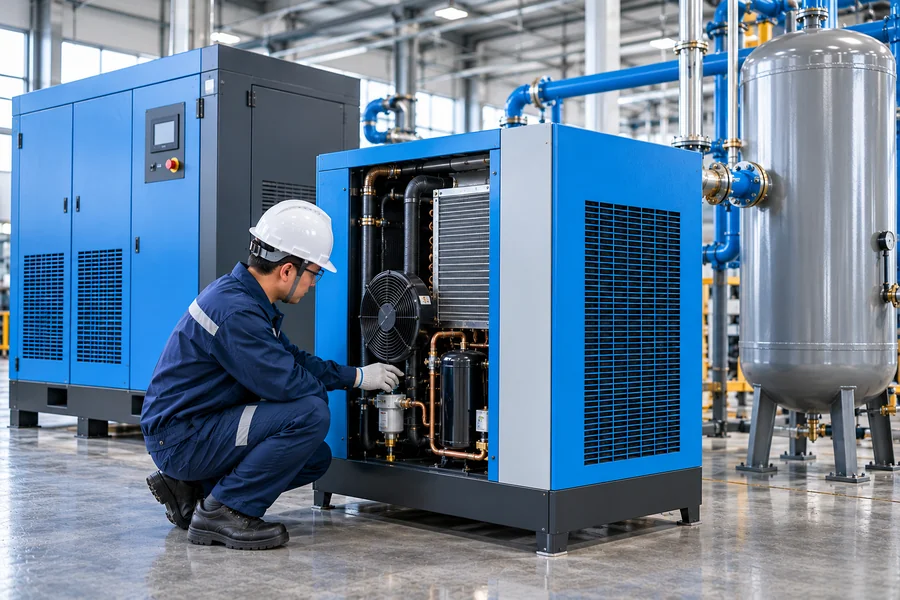
A refrigerated air dryer is a compressed air treatment device that removes moisture by cooling compressed air until water vapor condenses into liquid. The water is separated and drained, and the dried air is reheated before delivery. Most industrial refrigerated dryers achieve a pressure dew point of approximately +3°C (37°F).
Refrigerated air dryers efficiently control moisture in industrial compressed air systems. Proper selection considers airflow, pressure, inlet temperature, air quality, equipment reliability, and operating costs.
How Does a Refrigerated Air Dryer Work?
Compressed air naturally contains water vapor. When compressed air cools inside a distribution system, moisture may condense and damage equipment. Refrigerated dryers remove much of this moisture before it reaches downstream applications.
A refrigerated air dryer works by cooling compressed air through a refrigeration system, typically to around +3°C. This causes water vapor to condense into liquid droplets. A moisture separator and automatic drain remove the water. The dry air is then reheated and delivered to the compressed air distribution system.
1. Compressed Air Enters the Dryer
I consider the first stage of refrigerated air drying important because it determines the moisture load entering the equipment.
Compressed air normally leaves the compressor at an elevated temperature.
An aftercooler reduces the temperature and removes part of the moisture through condensation.
However, the air often remains saturated with water vapor.
When it enters the refrigerated dryer, the remaining moisture must be removed to achieve the required pressure dew point.
I recommend installing appropriate bulk water separation upstream of the dryer.
This reduces unnecessary liquid loading and helps protect the drying system.
2. Heat Exchangers Cool the Compressed Air
Most conventional refrigerated dryers contain an air-to-air heat exchanger and an air-to-refrigerant heat exchanger.
The incoming warm compressed air is first cooled by the outgoing cold air.
I consider this heat recovery process useful because it reduces the refrigeration load.
The compressed air then passes through the refrigeration section, where a refrigerant circuit removes additional heat.
As the compressed air approaches the designed cooling temperature, water vapor begins to condense into liquid water.
3. Moisture Is Separated and Drained
The condensed water must be removed from the compressed air stream.
A moisture separator captures liquid droplets, while an automatic condensate drain discharges the collected liquid.
I consider drain reliability essential for dryer performance.
A blocked or malfunctioning drain may allow condensed water to accumulate and travel into downstream equipment.
Oil-contaminated condensate should be collected and treated according to applicable environmental requirements.
4. Dried Air Is Reheated Before Delivery
After moisture removal, the cold compressed air usually passes through the air-to-air heat exchanger again.
The outgoing air absorbs heat from the incoming warm air.
This raises the discharge air temperature and reduces its relative humidity.
The reheating stage also helps prevent external condensation on downstream piping.
I want to emphasize that the discharge temperature is not necessarily equal to the pressure dew point.
The air may leave the dryer at a warmer temperature while retaining a pressure dew point of approximately +3°C.
Refrigerated Air Dryer Working Process
| Operating Stage | Main Function |
|---|---|
| Compressed air inlet | Receives warm, moisture-containing air |
| Air-to-air heat exchanger | Pre-cools incoming air |
| Refrigeration heat exchanger | Reduces temperature and condenses water |
| Moisture separator | Removes condensed droplets |
| Automatic drain | Discharges collected condensate |
| Air reheating section | Warms outgoing dry air |
| Compressed air outlet | Supplies treated air downstream |
I summarize the process as:
Warm Compressed Air → Cooling → Condensation → Water Separation → Drainage → Reheating → Dry Compressed Air
I believe this relatively simple process explains why refrigerated dryers are widely used in industrial compressed air systems.
What Are the Advantages and Disadvantages of Refrigerated Air Dryers?
Refrigerated air dryers are widely used because they provide practical moisture removal at relatively low operating costs. However, they cannot meet every compressed air purity requirement.
The main advantages of refrigerated air dryers include reliable moisture removal, relatively low energy consumption, simple operation, and moderate maintenance requirements. Their main disadvantages include limited dew point performance, electrical consumption, refrigeration system maintenance, and reduced suitability for applications requiring extremely dry compressed air or exposure to freezing temperatures.
1. Reliable Moisture Removal
I consider moisture control the main advantage of refrigerated air dryers.
The cooling process removes a substantial amount of water vapor from compressed air.
This helps reduce liquid water accumulation inside piping, pneumatic tools, valves, and other equipment.
For general manufacturing operations, a pressure dew point around +3°C often provides sufficient protection when downstream pipe temperatures remain above that value.
However, I do not assume that refrigerated drying completely removes water vapor.
The treated air still contains moisture, and condensation can occur again if the air cools below its pressure dew point.
2. Relatively Low Operating Costs
I generally consider refrigerated air dryers economical for standard industrial applications.
Compared with many regenerative desiccant dryers, they typically require less energy to achieve a moderate pressure dew point.
Conventional refrigerated dryers also do not need continuous compressed air purging to regenerate a desiccant bed.
This can reduce operating costs.
However, I still compare actual electrical consumption, pressure drop, and maintenance expenses before selecting equipment.
3. Simple Operation and Maintenance
I find refrigerated drying attractive because the basic operating process is relatively straightforward.
The system normally operates automatically once it is correctly installed and commissioned.
Routine maintenance may include checking condensate drains, cleaning condensers, inspecting ventilation, and monitoring operating conditions.
Major refrigeration system servicing should be performed by qualified technicians.
4. Limited Low-Dew-Point Capability
The primary limitation is the achievable pressure dew point.
Most standard refrigerated air dryers are designed to maintain pressure dew points around +3°C to +7°C.
They are not suitable for applications requiring -40°C or lower pressure dew points.
Examples may include outdoor instrument-air lines exposed to freezing weather and highly moisture-sensitive industrial processes.
I would normally consider desiccant drying for these applications.
Advantages and Disadvantages Comparison
| Advantages | Disadvantages |
|---|---|
| Reliable liquid moisture removal | Cannot achieve very low dew points |
| Suitable for general industrial air | Limited suitability for freezing conditions |
| Relatively low operating cost | Requires electricity |
| Automatic operation | Refrigeration components need maintenance |
| Compact installation options | Performance depends on inlet conditions |
| Moderate maintenance needs | Condensate requires proper disposal |
I believe refrigerated dryers provide excellent value when their pressure dew point meets the actual requirements of the application.
What Is the Difference Between Refrigerated and Desiccant Air Dryers?
Refrigerated and desiccant dryers both remove moisture from compressed air, but they use different technologies. Selecting the wrong type can increase costs or leave the air insufficiently dry.
Refrigerated air dryers remove moisture by cooling compressed air and condensing water vapor, typically achieving pressure dew points around +3°C. Desiccant air dryers use moisture-adsorbing materials to produce much drier compressed air, often reaching -40°C or lower. Refrigerated dryers suit general industrial applications, while desiccant dryers serve demanding low-dew-point requirements.
1. Different Drying Principles
I distinguish refrigerated and desiccant dryers by how they remove moisture.
A refrigerated dryer lowers the compressed air temperature until water vapor condenses.
The liquid water is then separated and discharged.
A desiccant dryer passes compressed air through a bed of moisture-adsorbing material, such as activated alumina or molecular sieve.
The desiccant captures water vapor from the compressed air.
Many industrial regenerative desiccant dryers use two towers.
One tower dries the compressed air while the other regenerates its desiccant material.
2. Pressure Dew Point Differences
I consider pressure dew point the most important selection parameter.
Pressure dew point is the temperature at which moisture begins to condense when compressed air is maintained at its operating pressure.
A lower pressure dew point means the compressed air contains less water vapor.
Typical targets include:
| Dryer Type | Typical Pressure Dew Point |
|---|---|
| Refrigerated air dryer | Around +3°C |
| Some refrigerated dryer configurations | Around +3°C to +7°C |
| Standard regenerative desiccant dryer | Around -40°C |
| Specialized desiccant dryer | -70°C or lower, depending on design |
These values are representative and depend on the actual product and operating conditions.
I always check the manufacturer's rated performance.
3. Energy Consumption and Maintenance
I usually recommend refrigerated air dryers for general factory air when a moderate pressure dew point is sufficient.
They normally provide a useful balance between equipment cost, energy consumption, and maintenance.
Desiccant dryers can achieve much lower dew points, but regeneration may require purge air, electric heaters, or other energy inputs.
The actual energy consumption depends on the regeneration method and system design.
I therefore avoid assuming that one dryer technology is more economical under every operating condition.
4. Typical Industrial Applications
I select dryer technology according to the moisture sensitivity of the application.
| Application | Dryer Selection Considerations |
|---|---|
| General indoor manufacturing | Refrigerated dryer |
| Pneumatic tools | Refrigerated dryer for normal conditions |
| Automotive workshops | Refrigerated dryer with appropriate filtration |
| Indoor packaging machinery | Refrigerated dryer if air purity requirements are met |
| Outdoor lines exposed to freezing weather | Desiccant dryer may be required |
| Sensitive instrumentation | Select according to specified pressure dew point |
| Pharmaceutical manufacturing | Validated air-treatment system based on process requirements |
| Highly moisture-sensitive production | Desiccant or specialized drying technology |
I also distinguish moisture removal from particle and oil contamination control.
A refrigerated air dryer is not a replacement for all compressed air filters.
Applications requiring low particle or oil concentrations may still need particulate, coalescing, or activated carbon filtration.
I believe the best dryer is the one that meets the required compressed air quality without unnecessary drying costs.
How Do I Choose and Maintain the Right Refrigerated Air Dryer?
An incorrectly sized refrigerated air dryer may struggle to control moisture, especially in hot industrial environments. Poor maintenance can also allow water to enter downstream equipment.
I select refrigerated air dryers by checking actual compressed air flow, working pressure, inlet temperature, ambient temperature, required pressure dew point, and allowable pressure drop. I also evaluate energy consumption, condensate drainage, installation conditions, and service support. Regular inspection helps maintain drying performance and reduce unexpected downtime.
1. Match Dryer Capacity to Airflow
I start by confirming the compressor's actual delivered airflow.
Airflow is commonly measured in CFM or m³/min.
A refrigerated dryer must handle the required compressed air volume under the expected operating conditions.
However, I do not select a dryer only by matching its nominal airflow rating with the compressor's nameplate.
Dryer capacity depends on the conditions used to establish the rating.
I check the actual airflow, maximum inlet temperature, operating pressure, and ambient temperature before finalizing the selection.
2. Consider Inlet and Ambient Temperature
I pay particular attention to inlet temperature.
Compressed air entering the dryer at a higher temperature contains more heat and may carry more moisture.
This increases the refrigeration load.
High ambient temperature can also reduce the cooling capacity of an air-cooled refrigerated dryer.
For example, a dryer rated under standard conditions may deliver less effective capacity when installed in a hot compressor room.
I recommend reviewing the manufacturer's correction factors for actual operating conditions.
3. Choose Between Cycling and Non-Cycling Dryers
Refrigerated dryers are available with different energy-control systems.
Non-Cycling Dryers
These designs generally keep the refrigerant compressor operating during normal service.
I consider them relatively simple and suitable for applications requiring a steady drying load.
Cycling Dryers
Cycling dryers can reduce refrigeration compressor operating time when the compressed air load decreases.
Some use thermal storage to maintain drying performance while the refrigeration compressor is off.
Variable-Speed Refrigerated Dryers
These dryers adjust refrigeration capacity according to system demand.
I consider them for applications with fluctuating compressed air requirements, particularly when energy savings justify the additional investment.
| Dryer Type | Main Characteristic | Suitable Application |
|---|---|---|
| Non-cycling | Simpler continuous refrigeration control | Stable drying demand |
| Cycling | Refrigeration switches according to demand | Variable air demand |
| Variable-speed | Adjusts refrigeration output | Changing industrial workloads |
I recommend comparing verified electrical consumption at realistic load conditions.
4. Select the Correct Installation Position
I prefer evaluating the complete compressed air treatment system before positioning the dryer.
A common arrangement includes:
Air Compressor → Aftercooler → Water Separator → Refrigerated Air Dryer → Required Filters → Distribution System
An air receiver may be installed before or after the dryer, depending on system design and operational requirements.
The actual arrangement should follow the equipment manufacturers' recommendations.
I also confirm that the installation provides adequate ventilation, maintenance access, and reliable condensate drainage.
5. Maintain the Refrigeration and Drainage Systems
I believe regular maintenance is essential for reliable drying.
My inspection priorities include:
- Condenser cleanliness
- Cooling fan operation
- Ambient temperature
- Compressed air inlet temperature
- Refrigeration system alarms
- Condensate separator condition
- Automatic drain operation
- Airflow and operating pressure
- Filter condition and differential pressure
A blocked condensate drain may cause liquid water to pass downstream even when the refrigeration system is operating.
A dirty condenser can reduce cooling performance.
I recommend following the manufacturer's maintenance instructions and using qualified technicians for refrigeration repairs.
Electrical and pneumatic energy must be isolated, and stored pressure must be released safely before applicable maintenance work.
6. Evaluate Total Ownership Costs
I do not recommend selecting a refrigerated air dryer based only on purchase price.
I evaluate:
| Cost Factor | What I Consider |
|---|---|
| Equipment price | Dryer and installation accessories |
| Electrical consumption | Expected energy use |
| Pressure drop | Additional compressor energy demand |
| Maintenance | Cleaning, servicing, and replacement parts |
| Condensate treatment | Collection and disposal requirements |
| Reliability | Risk of moisture-related downtime |
| Service support | Availability of technicians and parts |
I also recommend checking whether performance data are available through recognized verification programs, such as CAGI.
I believe a properly sized refrigerated dryer can reduce moisture-related maintenance problems while keeping compressed air treatment costs reasonable.
My Insights: What Is a Refrigerated Air Dryer
I believe a refrigerated air dryer should be viewed as an important part of a compressed air treatment system rather than a separate accessory.
My recommendation is to choose a refrigerated air dryer when the application requires reliable moisture removal at a moderate pressure dew point, and evaluate the complete compressed air system before purchasing.
Its primary function is to remove water vapor by cooling compressed air, collecting the condensed moisture, and discharging it from the system.
The easiest way to understand refrigerated air drying is:
Compressed Air Cooling → Condenses water vapor into liquid
Moisture Separation → Removes condensed water droplets
Automatic Drainage → Discharges collected condensate
Air Reheating → Reduces relative humidity in outgoing air
Pressure Dew Point → Indicates the remaining moisture level
Refrigerated Drying → Suitable for general industrial moisture control
Desiccant Drying → Suitable for much lower pressure dew points
Proper Dryer Sizing → Supports stable drying performance
Routine Maintenance → Helps prevent moisture-related failures
Complete Air Treatment → Combines drying and filtration according to application requirements
I also believe that compressed air buyers should avoid selecting drying equipment based only on nominal capacity or price.
A dryer may be rated for a certain airflow but perform poorly when compressed air inlet temperatures or ambient temperatures exceed the rated conditions.
I therefore evaluate the actual operating environment before recommending equipment.
I also consider pressure dew point an important distinction.
A refrigerated dryer delivering air at approximately +3°C pressure dew point may be entirely suitable for a factory operating in a warm indoor environment.
However, the same dryer may not be suitable for outdoor compressed air piping exposed to temperatures below freezing.
For these conditions, I would consider a desiccant dryer capable of maintaining the required lower pressure dew point.
I also pay attention to total system performance.
A properly functioning refrigerated dryer cannot compensate for damaged air distribution pipes, unsuitable filtration, or poor condensate management.
Conclusion
I believe refrigerated air dryers provide economical moisture control for general industrial compressed air. Proper sizing, suitable operating conditions, and regular maintenance ensure dependable drying performance.