
](https://kaishanpro.com/wp-content/uploads/2026/10/The-Application-and-Use-of-Heatless-Regenerative-Air-Dryers.webp)
Moisture in compressed air can cause corrosion, frozen pipelines, and production failures. Standard air drying may not provide enough protection for moisture-sensitive industrial processes.
Heatless regenerative air dryers remove water vapor from compressed air through adsorption and pressure-swing regeneration. They typically achieve a pressure dew point of −40°C (−40°F) without external regeneration heaters. These dryers are widely used in manufacturing, instrumentation, electronics, pharmaceuticals, and compressed air systems exposed to freezing conditions.
I recommend heatless regenerative air dryers for industrial applications requiring very dry compressed air, while evaluating purge air consumption, operating costs, reliability, and system compatibility.
How Does a Heatless Regenerative Air Dryer Work?
Compressed air naturally contains water vapor. Even after cooling and water separation, moisture can remain in the air and condense when temperatures decrease.
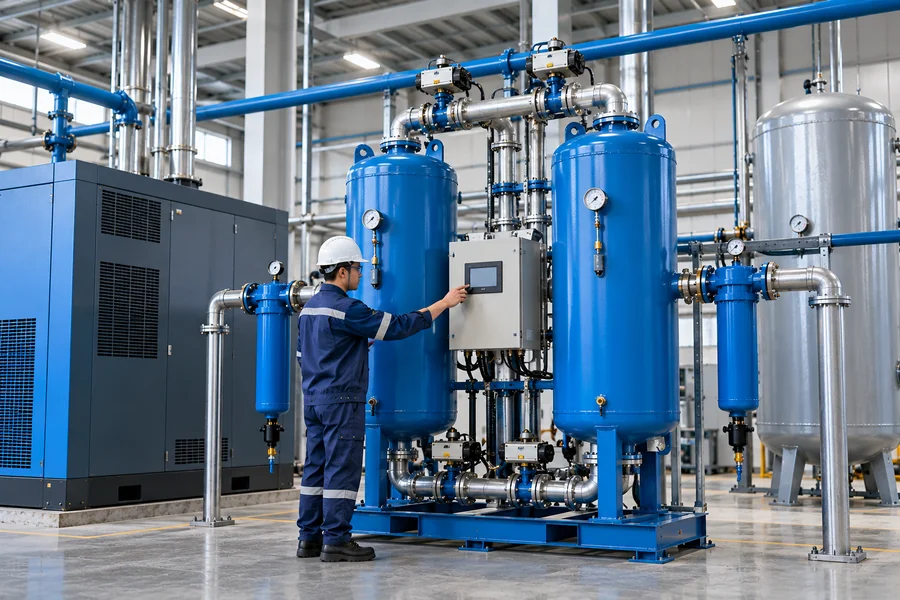
A heatless regenerative air dryer uses two desiccant-filled towers that alternate between adsorption and regeneration. One tower removes water vapor from compressed air while the other uses a portion of the dried air to release captured moisture. The towers switch automatically to maintain a continuous supply of dry compressed air.
1. Moisture Adsorption in the First Tower
I consider adsorption the main drying mechanism.
The incoming compressed air passes through a vessel containing desiccant material.
Common desiccants include activated alumina, silica gel, and molecular sieves.
These materials have porous surfaces that attract and hold water vapor molecules.
As the compressed air moves through the desiccant bed, moisture is adsorbed onto the surface of the material.
The treated compressed air leaves the tower at a much lower pressure dew point.
I normally consider −40°C pressure dew point an important industrial specification.
However, the achievable dew point depends on the dryer design, desiccant condition, inlet temperature, operating pressure, and regeneration process.
2. Regeneration in the Second Tower
While the first tower dries the compressed air, the second tower regenerates.
The regeneration tower is depressurized.
A controlled portion of dry compressed air from the operating tower is expanded to a lower pressure and directed through the saturated desiccant bed.
This low-pressure dry air removes the moisture previously adsorbed by the desiccant.
The moisture-laden purge air is then discharged to the atmosphere through an exhaust valve and silencer.
I want to emphasize that heatless regeneration does not require an electric heater.
However, the dryer consumes compressed air during regeneration.
For conventional fixed-cycle systems, this purge air commonly represents approximately 15%–20% of the dryer's rated airflow under specified operating conditions.
3. Automatic Tower Switching
After regeneration, the offline tower is repressurized.
The controller then switches the drying and regeneration functions between the two towers.
This allows the dryer to supply compressed air continuously.
The control system may use fixed switching intervals or more advanced dew point monitoring.
I consider dew point-dependent control useful when compressed air demand or moisture loading changes significantly.
4. Main Components of a Heatless Dryer
| Component | Main Function |
|---|---|
| Two desiccant towers | Alternate between drying and regeneration |
| Desiccant material | Adsorbs water vapor |
| Switching valves | Direct compressed air between towers |
| Purge control device | Regulates regeneration airflow |
| Exhaust valve and silencer | Release wet purge air |
| Control system | Manages the regeneration cycle |
| Dew point sensor | Monitors drying performance when fitted |
| Pre-filter | Protects the desiccant from contamination |
| After-filter | Captures desiccant particles where required |
I summarize the operating process as:
Wet Compressed Air → Desiccant Adsorption → Dry Air Delivery → Pressure-Swing Regeneration → Tower Switching
This alternating process makes heatless regenerative dryers suitable for continuous industrial compressed air systems that require low moisture levels.
What Are the Main Applications of Heatless Regenerative Air Dryers?
Many industrial processes depend on compressed air for equipment operation, product handling, and automated controls. Moisture contamination can create serious reliability and quality problems.
Heatless regenerative air dryers are commonly used in pneumatic instrumentation, manufacturing, electronics, pharmaceutical production, food processing, chemical facilities, and outdoor compressed air systems. They are particularly valuable when compressed air requires a low pressure dew point or when pipelines may be exposed to freezing temperatures.
1. Industrial Instrumentation and Control Systems
I consider instrument air one of the most important applications for heatless regenerative dryers.
Industrial plants use compressed air to operate pneumatic control valves, actuators, and automated instruments.
Moisture can cause corrosion, sticking components, and unreliable control operations.
In cold environments, condensed water may freeze inside small pneumatic lines.
A low pressure dew point helps reduce these risks.
I would consider a heatless dryer when the instrument air specification requires very dry compressed air and the equipment's flow demand is suitable for the dryer's capacity.
2. Pharmaceutical Manufacturing
Pharmaceutical facilities often require carefully controlled compressed air quality.
Compressed air may be used for equipment operation, material movement, packaging, and certain manufacturing processes.
I consider moisture control important because excess humidity can affect equipment operation and moisture-sensitive materials.
Heatless regenerative dryers can provide the low pressure dew points required by some pharmaceutical systems.
However, dry air alone does not guarantee pharmaceutical air quality.
The complete system may also require oil removal, particulate filtration, microbial control, and validated monitoring.
3. Food and Beverage Processing
Compressed air is used throughout food and beverage production.
Typical applications include:
- Packaging equipment
- Pneumatic actuators
- Filling machinery
- Automated production lines
- Material conveying
- Product handling systems
I recommend evaluating the role of compressed air before specifying a dryer.
Air that contacts food or food-contact surfaces may require additional treatment and verification.
A heatless regenerative dryer can remove water vapor, but it does not independently remove every contaminant.
4. Electronics and Precision Manufacturing
I consider low-moisture compressed air useful in electronics and precision manufacturing.
Sensitive components and processes may be affected by water contamination.
Dry compressed air can help protect pneumatic systems and support controlled manufacturing conditions.
However, the final air purity requirement depends on the process.
Some operations may require additional particulate, oil vapor, or point-of-use filtration.
5. Chemical and Petrochemical Facilities
Chemical facilities use compressed air for instruments, control systems, and various production operations.
I would consider heatless dryers where low pressure dew points are required for dependable pneumatic equipment operation.
Some dryer configurations can also be designed for demanding or hazardous environments.
However, any equipment installed in a hazardous location must have the appropriate protection, certification, and installation approval for that environment.
6. Outdoor Compressed Air Systems
I consider outdoor compressed air lines an important reason to choose desiccant drying.
A refrigerated air dryer commonly provides a pressure dew point near +3°C.
If treated compressed air later enters piping exposed to temperatures below that dew point, moisture can condense.
A heatless regenerative dryer can provide substantially drier compressed air.
For example, a −40°C pressure dew point offers additional protection when compressed air is transported through cold outdoor environments.
I would still evaluate the actual minimum temperature and required safety margin.
Application Comparison
| Industry or Application | Main Moisture Concern | Benefit of Heatless Drying |
|---|---|---|
| Industrial instrumentation | Valve and actuator reliability | Low dew point control air |
| Pharmaceutical manufacturing | Moisture-sensitive processes | Dry compressed air supply |
| Food processing | Moisture and production quality | Improved moisture control |
| Electronics | Sensitive manufacturing operations | Low water vapor content |
| Chemical processing | Instrument reliability | Consistent dry air |
| Outdoor compressed air lines | Condensation and freezing | Protection in cold conditions |
| Precision manufacturing | Equipment and process stability | Controlled moisture levels |
I believe these applications demonstrate why heatless regenerative dryers are valuable when moisture control requirements exceed the capability of conventional refrigerated drying.
What Are the Advantages and Disadvantages of Heatless Regenerative Air Dryers?
Heatless regenerative dryers offer effective moisture removal through relatively straightforward equipment. However, their regeneration process consumes compressed air that could otherwise be used for production.
The main advantages of heatless regenerative air dryers include low pressure dew points, simple construction, no external regeneration heater, and reliable continuous drying. Their disadvantages include purge air consumption, additional compressor energy costs, pressure losses, valve maintenance, and sensitivity to oil or liquid water contamination.
1. Low Pressure Dew Point Performance
I consider low pressure dew point capability the biggest advantage of heatless regenerative dryers.
Many industrial heatless dryers are designed to achieve approximately −40°C.
Some specialized models can achieve lower pressure dew points.
This makes them useful where refrigerated dryers cannot provide sufficiently dry air.
2. Simple Regeneration System
A heatless dryer does not require a separate electric regeneration heater.
The regeneration process mainly uses controlled airflow, valves, and desiccant towers.
I find this design attractive when a business prefers relatively simple equipment.
It can also be useful where heater-based regeneration is undesirable, although the complete equipment must still be evaluated for its installation environment.
3. Continuous Dry Air Supply
The twin-tower design supports continuous drying.
One tower removes moisture while the other regenerates.
Automatic switching maintains the drying cycle without requiring the entire system to stop for each regeneration.
I consider this important for manufacturing facilities where production depends on a continuous compressed air supply.
4. Purge Air Consumption
The main operating disadvantage is purge air usage.
Heatless dryers typically divert part of the compressed air to regenerate the desiccant.
This air is exhausted instead of being delivered to the production system.
For example, consider an illustrative dryer receiving 10 m³/min of compressed air.
If regeneration consumes 15% of its inlet airflow:
Purge Air = 10 × 15% = 1.5 m³/min
The remaining airflow would be approximately 8.5 m³/min before considering other system losses.
Actual flow calculations must follow the manufacturer's definition of rated capacity, operating conditions, and purge control arrangement.
I also recognize that compressed air is not free.
The compressor consumes electricity or fuel to produce the purge air.
5. Maintenance and Desiccant Protection
I consider inlet air quality essential for desiccant dryer reliability.
Liquid water and oil contamination can reduce the adsorption capacity of the desiccant.
For oil-lubricated compressors, suitable upstream oil removal filtration is important.
A downstream particulate filter may also be needed to capture desiccant dust.
Switching valves, exhaust silencers, sensors, and other components require scheduled inspection.
Heatless vs. Heated vs. Refrigerated Air Dryers
| Feature | Heatless Regenerative | Heated Regenerative | Refrigerated |
|---|---|---|---|
| Drying method | Desiccant adsorption | Desiccant adsorption | Cooling and condensation |
| Typical pressure dew point | −40°C | −40°C or lower | Around +3°C |
| Regeneration | Dry compressed air | External heat or heated purge | Not applicable |
| Purge air consumption | Relatively high | Often lower, design-dependent | No desiccant regeneration purge |
| External regeneration heater | Not required | Often required | Not applicable |
| Typical application | Low-dew-point industrial air | Larger low-dew-point systems | General industrial air |
| Main operating consideration | Purge air cost | Heat and regeneration energy | Refrigeration electricity |
I believe the lowest purchase price does not always provide the lowest total operating cost.
Heatless dryers can be economical for smaller systems or intermittent applications, while heated regeneration may become attractive when compressed air demand is large and continuous.
How Do I Choose and Maintain a Heatless Regenerative Air Dryer?
A correctly designed heatless dryer can provide dependable drying performance. Poor equipment sizing, insufficient filtration, and inadequate maintenance may result in high operating costs or moisture problems.
I choose a heatless regenerative air dryer by confirming airflow, working pressure, inlet temperature, required pressure dew point, and purge air requirements. I also evaluate desiccant type, filtration, switching controls, installation conditions, maintenance access, and total operating costs before selecting a dryer for industrial compressed air treatment.
1. Confirm the Required Pressure Dew Point
I begin by identifying the minimum pressure dew point required by the application.
A common target is −40°C.
However, I do not automatically recommend this specification for every compressed air system.
If the application only requires approximately +3°C pressure dew point, a refrigerated dryer may be more economical.
I also refer to ISO 8573-1 when compressed air purity classes must be specified.
For example, ISO 8573-1 water Class 2 corresponds to a pressure dew point limit of −40°C.
The complete compressed air purity specification must also address particles and oil when required.
2. Match the Dryer to Airflow and Operating Pressure
I compare the dryer's rated capacity with the compressed air system's actual operating requirements.
Important selection parameters include:
- Compressor free air delivery
- Normal working pressure
- Maximum dryer inlet temperature
- Required outlet pressure dew point
- Ambient operating conditions
- Expected continuous or intermittent duty
- Available electrical supply
- Purge air requirements
I also check whether the stated dryer capacity represents inlet airflow or net available outlet airflow.
This distinction matters when a portion of the air is used for regeneration.
3. Evaluate Purge Air Costs
I consider purge air consumption essential when comparing heatless dryers.
A conventional heatless dryer may consume approximately 15%–20% of its rated compressed air capacity during regeneration.
The exact value depends on pressure, dryer design, dew point requirements, and control strategy.
I calculate the cost of generating this air rather than assuming that heatless operation has no energy expense.
Some dryers offer dew point-dependent controls that reduce unnecessary regeneration when moisture loading is low.
I consider these controls useful when air demand changes throughout the working day.
4. Install Suitable Filtration
I normally evaluate the following treatment sequence:
Air Compressor → Aftercooler → Water Separator → Coalescing Pre-filter → Heatless Dryer → Particulate After-filter → Distribution System
The actual system arrangement may also include air receivers and additional filtration.
The configuration should follow the equipment manufacturer's installation requirements.
I consider pre-filtration important because oil and liquid water can damage the desiccant bed.
I also recommend checking automatic condensate drains and pressure drop across the filters.
5. Maintain the Desiccant and Switching System
I recommend routine inspections of the dryer and its supporting equipment.
| Maintenance Item | What I Check |
|---|---|
| Desiccant bed | Moisture performance and condition |
| Switching valves | Correct operation and leakage |
| Exhaust silencers | Blockage and excessive restriction |
| Pre-filters | Oil and particulate removal |
| After-filters | Desiccant dust and filter condition |
| Dew point monitoring | Actual drying performance |
| Drainage system | Reliable condensate discharge |
| Controller | Alarms, switching cycles, and settings |
I also recommend recording pressure dew point, operating hours, and maintenance activities.
Desiccant service life varies according to dryer design, air quality, and operating conditions.
I do not replace desiccant solely according to a general industry estimate. I follow the manufacturer's inspection and replacement recommendations.
Maintenance personnel must isolate hazardous energy, release stored pressure, and follow approved procedures before opening pressure vessels or servicing valves.
6. Compare Total Ownership Costs
I evaluate the financial performance of the complete drying system.
My basic approach is:
Total Ownership Cost = Equipment + Installation + Purge Air Energy + Maintenance + Downtime Costs
I compare heatless, heated, and refrigerated dryer options using the same airflow, pressure, and dew point requirements.
I believe this provides a more meaningful comparison than purchase price alone.
A heatless dryer may offer lower installation complexity but higher ongoing purge air costs.
A heated dryer may require greater initial investment but reduce compressed air losses.
The correct choice depends on actual operating hours and project requirements.
My Insights: The Application and Use of Heatless Regenerative Air Dryers
I believe heatless regenerative air dryers provide an effective solution for industrial compressed air systems that require low moisture levels without using external regeneration heat.
Their main value comes from the combination of adsorption drying, automatic tower switching, and a relatively simple mechanical configuration.
However, the decision to use a heatless dryer should depend on the required pressure dew point and long-term operating economics.
I evaluate these dryers through six important factors:
Drying Performance → A pressure dew point around −40°C provides protection for many moisture-sensitive applications.
Industrial Applications → Instrument air, electronics, pharmaceutical manufacturing, and outdoor piping can benefit from low moisture content.
Regeneration Principle → Dry compressed air removes moisture from the offline desiccant tower.
Purge Air Consumption → Regeneration consumes compressed air and creates an indirect energy cost.
Equipment Reliability → Suitable filtration, correct valve operation, and proper desiccant condition support stable performance.
Total Operating Cost → Equipment investment, purge energy, maintenance, and downtime must be evaluated together.
My Practical Recommendation
I would consider heatless regenerative dryers when compressed air must remain dry under conditions that refrigerated drying cannot adequately handle.
For example, industrial instrument air exposed to cold temperatures may require a pressure dew point significantly below freezing.
In this situation, a heatless desiccant dryer can provide an appropriate drying solution.
For general manufacturing systems operating in warm indoor environments, I would first check whether a refrigerated dryer can meet the required air quality.
I also consider system capacity important.
A heatless dryer serving a relatively small or intermittent compressed air load may offer practical advantages because of its simple design.
However, a large facility operating continuously may incur substantial purge air costs.
For those projects, I would compare heatless regeneration with heated purge, blower purge, and other dryer technologies.
I also recommend including the compressor, aftercooler, filters, receiver, dryer, and distribution piping in the equipment evaluation.
A high-quality dryer cannot compensate for poor system design or inadequate maintenance.
My recommendation is to use heatless regenerative air dryers when low pressure dew point performance and simple regeneration provide greater operational value than the compressed air consumed during regeneration.
Conclusion
I believe heatless regenerative air dryers provide reliable low-dew-point drying for demanding industrial applications, but proper sizing, filtration, maintenance, and purge air management determine their long-term value.