
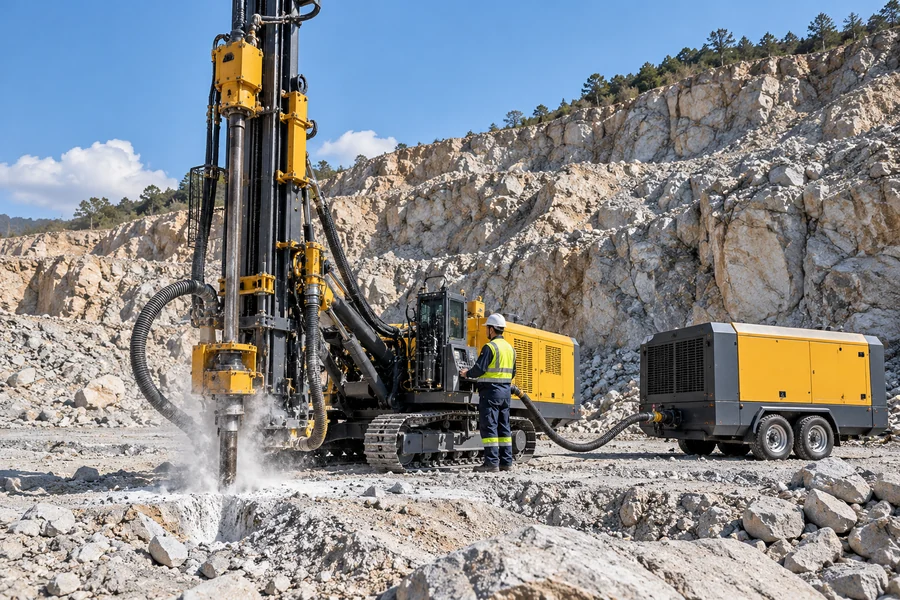
](https://kaishanpro.com/wp-content/uploads/2026/10/DTH-Drilling-Rig-Working-Principle-and-Usage-Rules.webp)
DTH drilling rigs are widely used in mining, quarrying, and construction. However, incorrect drilling parameters, insufficient compressed air, and poor operating practices can reduce productivity and damage equipment.
A DTH drilling rig works by sending compressed air through drill pipes to power a pneumatic hammer positioned directly behind the drill bit. The hammer repeatedly strikes the rock while the drill string rotates. Exhaust air removes rock cuttings from the borehole. Safe operation requires proper equipment inspection, pressure control, lubrication, and maintenance.
Understanding DTH drilling principles improves equipment selection, performance, and safety. Coordinating rigs, compressors, hammers, bits, and pipes reduces wear, prevents failures, and increases drilling efficiency.
What Is the Working Principle of a DTH Drilling Rig?
DTH drilling uses a different impact mechanism from conventional rotary drilling. Understanding how the hammer works helps operators control penetration rates and avoid unnecessary equipment damage.
The working principle of a DTH drilling rig combines pneumatic percussion, controlled rotation, axial feed force, and compressed air flushing. The air compressor drives a piston inside the down-the-hole hammer, which strikes the drill bit directly at the bottom of the borehole. Rotation distributes the impacts while airflow removes the rock cuttings.
1. Compressed Air Powers the DTH Hammer
I consider compressed air the main energy source for conventional pneumatic DTH drilling.
The air compressor supplies pressurized air through an air hose and the drill string to the DTH hammer.
Inside the hammer, an air distribution mechanism directs compressed air to move the internal piston.
The piston repeatedly strikes the drill bit, transferring impact energy directly into the rock.
Unlike top hammer drilling, where impact energy travels through the drill string, DTH drilling generates percussion close to the rock surface.
This configuration helps maintain effective impact energy at greater drilling depths.
2. Rotation Supports Rock Breaking
The drilling rig also rotates the drill string and DTH hammer.
I understand the purpose of rotation as distributing the impact points across the bottom of the borehole.
As the bit rotates, its tungsten carbide buttons strike different areas of the rock.
This repeated combination of impact and rotation breaks the formation into smaller fragments.
The appropriate rotation speed depends on the hammer design, bit diameter, rock properties, and operating conditions.
Excessive rotation may increase wear without improving penetration.
3. Feed Force Maintains Bit Contact
The rig's feeding system applies controlled axial force through the drill string.
This helps maintain suitable contact between the drill bit and the bottom of the hole.
I consider correct feed force important because insufficient feed may produce unstable hammer operation, while excessive feed can increase stress on the drilling equipment.
Operators should follow the manufacturer's recommended feed settings.
4. Compressed Air Removes Rock Cuttings
The compressed air performs another important function after operating the hammer.
Exhaust air travels through passages in the drill bit and enters the borehole.
It carries rock fragments upward through the annular space between the drill string and borehole wall.
Effective cuttings removal prevents excessive material accumulation around the bit.
The complete process can be summarized as:
Air Compressor → Drill Pipes → DTH Hammer → Impact and Rotation → Rock Fragmentation → Air Flushing
| Operating Stage | Main Function |
|---|---|
| Air compression | Supplies pressure and airflow |
| Pneumatic percussion | Drives the hammer piston |
| Drill string rotation | Distributes impact across the rock |
| Axial feeding | Maintains suitable bit contact |
| Air flushing | Removes rock cuttings |
| Drill string extension | Allows drilling to greater depths |
I believe the correct balance between impact energy, rotation, feed force, and flushing is essential for efficient DTH drilling.
What Are the Main Components of a DTH Drilling Rig?
A DTH drilling rig contains several mechanical, hydraulic, and pneumatic systems. Each component performs a different function during drilling.
The main components of a DTH drilling rig include the drilling chassis, mast, rotary head, feeding system, drill pipes, DTH hammer, drill bit, air compressor, and control system. Some machines also include dust collectors, automatic rod handling systems, and integrated compressors. Their combined performance determines drilling capacity and reliability.
1. Drilling Chassis and Mast
I consider the chassis and mast the structural foundation of the drilling rig.
The chassis supports the drilling equipment and allows the machine to move between drilling locations.
Crawler-mounted rigs are commonly used on mines, quarries, and construction sites because they provide mobility over rough ground.
The mast guides the rotary head and drill string during drilling.
Its structural rigidity and alignment influence borehole accuracy.
I always evaluate mast stability, drilling angle capability, and the machine's working conditions before selecting a drilling rig.
2. Rotary Head and Feeding System
The rotary head provides the torque needed to rotate the drill string.
Many DTH rigs use hydraulic motors to control rotation.
The feeding system moves the rotary head along the mast and controls the force applied to the drill bit.
I consider these systems important for maintaining consistent drilling performance.
A properly matched rotary head and feeding system should support the required drill pipe diameter, drilling depth, and geological conditions.
3. DTH Hammer and Drill Bit
The DTH hammer is one of the most important components of the drilling system.
It contains the internal piston and air distribution components responsible for producing repeated impacts.
The drill bit transfers those impacts into the rock.
Common DTH bits use tungsten carbide buttons, with different bit-face designs available for different formations.
I normally match the hammer and bit according to:
- Required borehole diameter
- Rock hardness and abrasiveness
- Hammer shank compatibility
- Air pressure and consumption
- Expected drilling depth
- Tool wear and replacement costs
I do not recommend selecting the largest hammer without checking the compressor capacity.
4. Air Compressor and Control System
The air compressor supplies the compressed air required to operate the hammer and clean the borehole.
Some DTH drilling rigs use an integrated compressor, while others connect to a separate portable compressor.
I select the compressor based on the hammer's required working pressure and air consumption.
The control system allows operators to manage drilling parameters such as rotation speed, feed pressure, and air supply functions.
| Component | Primary Function |
|---|---|
| Crawler chassis | Supports and moves the machine |
| Drilling mast | Guides the drilling assembly |
| Rotary head | Rotates the drill string |
| Feeding system | Controls drilling force and movement |
| Drill pipes | Transmit air, rotation, and feed force |
| DTH hammer | Generates downhole percussion |
| Drill bit | Breaks the rock formation |
| Air compressor | Powers the hammer and removes cuttings |
| Dust collector | Controls airborne drilling dust |
| Control system | Manages drilling functions |
I believe the performance of a DTH drilling rig depends on how effectively these components work together.
What Are the Safety Rules for Operating a DTH Drilling Rig?
DTH drilling equipment operates under high mechanical loads and compressed air pressure. Incorrect operation can cause serious injuries, equipment failures, and project delays.
The most important DTH drilling rig operating rules include completing pre-start inspections, stabilizing the machine, checking compressed air connections, following approved drilling parameters, controlling dust, and keeping personnel away from rotating equipment. Operators must follow the manufacturer's instructions, site safety procedures, and applicable regulations throughout drilling operations.
1. Safety Checks Before Starting
I consider pre-operation inspections essential for preventing avoidable equipment problems.
Before drilling begins, a trained operator should check the condition of the drilling rig and confirm that the machine is suitable for the worksite.
The inspection should cover:
- Ground stability and working area conditions
- Rig positioning and mast alignment
- Hydraulic hoses and visible leakage
- Air hoses, couplings, and restraints
- Drill pipes and threaded connections
- DTH hammer and drill bit condition
- Safety guards and emergency stop systems
- Compressor condition and fluid levels
- Dust collection or suppression equipment
I also recommend confirming that personnel understand the drilling plan and the site's emergency procedures.
Equipment with damaged pressure lines, defective guards, or unsafe control functions should not be used until the problem is corrected.
2. Safety Rules During Drilling
I believe operators should focus on maintaining stable drilling conditions rather than attempting to maximize penetration speed at all times.
During drilling, the operator should monitor the machine's performance and follow the approved operating parameters.
Important rules include:
Maintain a Safe Working Area
Personnel must remain clear of rotating drill strings, moving equipment, suspended loads, and pressurized connections.
Monitor Compressed Air Pressure
The compressor and DTH hammer must operate within their rated limits.
Control Rotation and Feed Force
The operator should use the manufacturer's recommended settings and adjust them according to the formation and observed drilling behavior.
Prevent Dust Exposure
Drilling dust may contain respirable crystalline silica. Suitable dust collection, suppression, enclosure, and respiratory protection measures should be applied according to the site risk assessment.
Stop When Abnormal Conditions Occur
Unexpected vibration, unusual noise, major pressure changes, damaged components, or unstable ground conditions require investigation under safe procedures.
3. Safe Drill Rod Handling
Drill rod connection and removal can present significant mechanical hazards.
I recommend using the manufacturer's approved handling system and keeping personnel away from pinch points and suspended drill strings.
Before manual intervention, the operator must stop relevant machine movements, isolate hazardous energy, and release stored pressure as required by the machine's procedures.
Operators must never handle rotating drill rods or open pressurized air connections.
Only trained personnel should perform rod-handling tasks.
4. Shutdown and Maintenance Rules
I consider proper shutdown procedures just as important as startup inspections.
After drilling, operators should follow the manufacturer's shutdown sequence and secure the drilling equipment.
Maintenance personnel should isolate the machine from hazardous energy sources and verify that stored hydraulic and pneumatic pressure has been safely released before servicing.
Routine maintenance should include:
| Maintenance Item | Main Purpose |
|---|---|
| Hydraulic system inspection | Identify leaks and damaged components |
| Air hose inspection | Detect wear and connection problems |
| DTH hammer servicing | Maintain reliable impact performance |
| Drill bit inspection | Identify worn or damaged buttons |
| Air filter servicing | Protect the compressor and air system |
| Lubrication checks | Reduce tool and component wear |
| Dust collector inspection | Maintain effective dust control |
| Drill pipe inspection | Identify thread damage and deformation |
I recommend documenting equipment inspections, maintenance activities, and operating problems.
These records help identify recurring failures and support preventive maintenance planning.
This discussion provides general operating guidance. The manufacturer's procedures and the site's approved safety system must govern actual machine operation.
How Can I Improve DTH Drilling Efficiency and Choose the Right Equipment?
A DTH drilling rig can have strong technical specifications but still perform poorly when the hammer, compressor, and drilling conditions are not properly matched.
I improve DTH drilling efficiency by selecting a suitable hammer and drill bit, matching compressor pressure and airflow, maintaining correct feed and rotation settings, and ensuring effective cuttings removal. I also evaluate geological conditions, borehole diameter, drilling depth, equipment maintenance, and total operating costs when choosing a DTH drilling rig.
1. Match the Air Compressor With the DTH Hammer
I believe compressor matching is one of the most important factors affecting DTH drilling performance.
The compressor must provide enough pressure to operate the hammer effectively.
It must also deliver sufficient airflow to remove rock cuttings from the hole.
A compressor with inadequate airflow may cause poor hole cleaning, increased bit wear, and reduced penetration rates.
I evaluate the following factors before selecting a compressor:
- Hammer operating pressure
- Hammer air consumption at that pressure
- Borehole diameter
- Expected drilling depth
- Drill pipe dimensions
- Site altitude
- Pressure losses
- Expected groundwater inflow
I do not assume that a compressor's maximum advertised airflow is available at every pressure setting.
2. Select the Correct DTH Hammer and Bit
The hammer and bit should match the planned hole diameter and geological conditions.
I prefer checking technical specifications rather than selecting tools based only on their nominal size.
Different rock formations may require different bit-face designs and button configurations.
For example, hard and abrasive formations may benefit from durable button designs selected for wear resistance.
The manufacturer's recommendations should guide tool selection.
3. Maintain Effective Cuttings Removal
I consider hole cleaning a major factor in drilling productivity.
When cuttings accumulate at the bottom of the hole, the drill bit may repeatedly crush material that should already have been removed.
This wastes impact energy and accelerates wear.
Proper air delivery helps transport cuttings to the surface.
However, increasing pressure beyond the hammer's approved operating range is not an acceptable solution.
I would evaluate the complete air system, hole conditions, and flushing performance before changing equipment settings.
4. Evaluate the Total Drilling Cost
I do not measure drilling efficiency only by the number of meters drilled per hour.
A machine may achieve a high penetration rate but consume excessive fuel or require frequent tool replacements.
I prefer evaluating the total cost per meter drilled.
My basic calculation is:
Drilling Cost per Meter = Total Drilling Operating Cost ÷ Completed Drilling Meters
The calculation should include fuel, labor, drilling consumables, routine maintenance, equipment costs, and downtime.
| Selection Factor | What I Evaluate |
|---|---|
| Hole diameter | Hammer and bit compatibility |
| Drilling depth | Rig capacity and drill string requirements |
| Rock formation | Hardness, abrasiveness, and stability |
| Compressor | Required pressure and airflow |
| Rig mobility | Terrain and transportation requirements |
| Maintenance | Service intervals and replacement parts |
| Operating cost | Fuel, labor, consumables, and downtime |
I believe a properly matched DTH drilling system provides better long-term value than purchasing a powerful drilling rig without evaluating its supporting equipment.
My Insights: DTH Drilling Rig Working Principle and Usage Rules
I believe understanding the working principle of a DTH drilling rig is the foundation of safe and efficient drilling.
DTH technology combines compressed air, direct percussion, controlled rotation, feed force, and cuttings removal.
However, the performance of the drilling rig depends on more than the hammer's impact energy.
I evaluate DTH drilling operations through six practical factors:
Compressed Air Supply → The compressor must deliver the correct pressure and airflow for the selected hammer.
Impact and Rotation → The hammer and rotary system must work together to break the rock efficiently.
Feed Force → Proper axial force helps maintain stable drilling conditions without creating unnecessary mechanical stress.
Cuttings Removal → Effective flushing prevents excessive accumulation of drilling debris.
Operating Safety → Pre-start inspections, machine guarding, safe rod handling, and dust control reduce workplace hazards.
Equipment Maintenance → Regular inspection and timely replacement of worn components help prevent unexpected failures.
I also believe that drilling contractors should avoid evaluating a DTH drilling rig only by its maximum drilling depth or engine power.
A drilling rig may have a strong engine but still provide poor performance if the compressor cannot deliver enough air to the hammer.
Similarly, a high-performance hammer may experience excessive wear when the drill bit is unsuitable for the formation.
I prefer selecting the complete drilling configuration based on the required hole diameter, geological conditions, depth, and project workload.
For international equipment procurement, I also consider transportation requirements, pre-shipment inspection, spare-parts availability, and maintenance support.
These factors can significantly influence equipment reliability after delivery.
My recommendation is to treat the DTH drilling rig, air compressor, hammer, drill bit, and operating procedures as one integrated drilling system. This approach helps balance productivity, safety, reliability, and total operating costs.
Conclusion
I believe DTH drilling efficiency depends on proper hammer operation, matched compressed air, effective flushing, safe operating procedures, and regular maintenance of the complete drilling system.