
](https://kaishanpro.com/wp-content/uploads/2026/09/How-Do-Refrigerated-Air-Dryers-Work.webp)
Moisture in compressed air can corrode pipes, damage pneumatic equipment, and affect production. I use refrigerated dryers to remove this water before it causes problems.
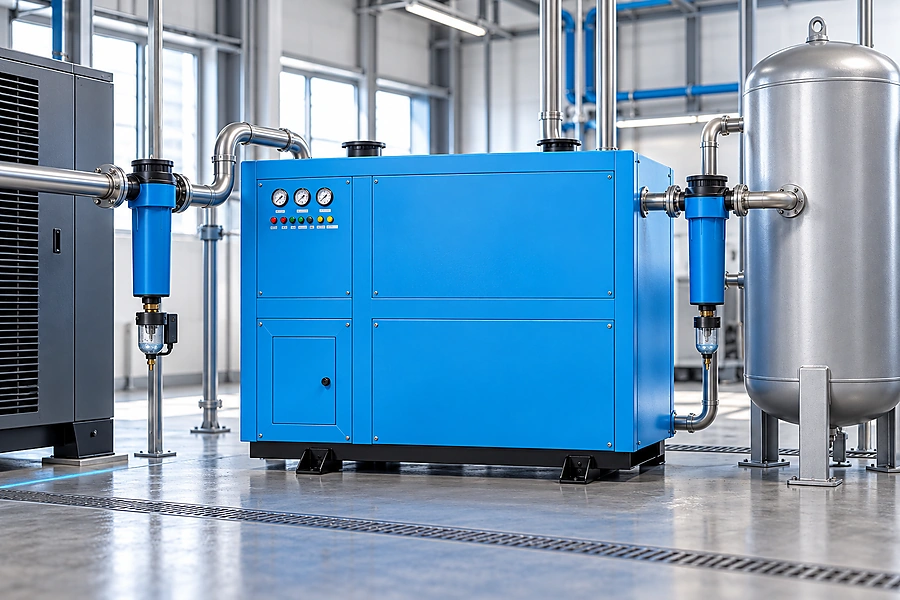
Refrigerated air dryers work by cooling compressed air until water vapor condenses into liquid. I then remove that condensate with a separator and automatic drain. The dryer normally reheats the cold, dry air before it leaves. Most industrial refrigerated dryers provide a pressure dew point around +3°C to +7°C (+37°F to +45°F).
I see a refrigerated dryer as a controlled cooling and water-separation system. It does not chemically absorb moisture. It uses the same basic physical principle that causes water to form on a cold surface. I cool the compressed air, turn part of its water vapor into liquid water, remove that liquid, and send the drier air into the factory air system.
What Is a Refrigerated Compressed Air Dryer?
A compressor increases the concentration of moisture already present in atmospheric air. I need a dryer because that moisture can condense later as the compressed air cools inside the plant.
I use a refrigerated compressed air dryer to reduce moisture by lowering compressed-air temperature. As the air cools, water vapor reaches its dew point and becomes liquid condensate. The dryer separates and drains that water, then usually reheats the dry compressed air before sending it downstream to tools, piping, and production equipment.
I use cooling to turn water vapor into liquid water
I find the operating principle easier to understand when I start with normal atmospheric air.
Atmospheric air always contains some water vapor. A compressor takes in that air and compresses it into a much smaller volume. The amount of water does not simply disappear during compression.
The compression process also heats the air.
Hot air can hold more moisture in vapor form, so much of the water remains as vapor immediately after compression. The aftercooler removes some heat, and some moisture condenses and leaves through the compressor's water separator and drain.
However, the air that leaves the compressor still contains water vapor.
If I send that air directly into the plant, it continues to cool inside receivers, pipes, valves, and pneumatic equipment. More water can then condense downstream.
A refrigerated dryer moves this condensation into a controlled location.
I intentionally cool the compressed air inside the dryer. As its temperature falls, the air loses its ability to hold the same amount of water vapor. The excess water becomes liquid droplets.
The dryer then removes those droplets before they enter the factory air network. Kaeser describes refrigerated dryers in the same basic way: the dryer cools compressed air, condenses the moisture, separates the liquid water, and sends the treated air downstream.
I normally think of the dryer as having these main functions:
| Dryer section | What I expect it to do |
|---|---|
| Air-to-air heat exchanger | Pre-cool hot inlet air |
| Refrigeration heat exchanger | Cool the air to its target temperature |
| Refrigeration circuit | Remove heat from the compressed air |
| Moisture separator | Separate condensed water from airflow |
| Automatic drain | Discharge liquid condensate |
| Reheater | Warm the dry outlet air |
| Controller | Maintain stable operation and monitor conditions |
I see these components working together rather than treating the dryer as only a refrigeration machine.
What Are the Steps in a Refrigerated Air Dryer Cycle?
The compressed air passes through several heat-transfer and water-removal stages. I use each stage to reduce the cooling load, condense moisture, remove liquid water, and return the dried air to a practical outlet temperature.
I divide refrigerated dryer operation into four main steps. First, warm inlet air is pre-cooled. Second, the refrigeration circuit cools it further until moisture condenses. Third, a separator and drain remove the liquid water. Finally, the outgoing dry air is reheated before it enters the compressed-air network.
Step 1: I pre-cool the incoming compressed air
Warm compressed air first enters an air-to-air heat exchanger on many modern refrigerated dryers.
The cold dried air that is leaving the dryer passes on the other side of this heat exchanger.
The two air streams do not mix.
Instead, heat moves from the warmer incoming air to the colder outgoing air.
This gives me two advantages.
The incoming compressed air becomes cooler before it reaches the refrigeration section. This reduces the cooling work required from the refrigeration circuit.
At the same time, the outgoing dry air becomes warmer before it enters the plant.
Atlas Copco explains that this air-to-air heat exchange lowers the refrigeration load while reheating the outlet air.
Step 2: I cool the air with the refrigeration circuit
The pre-cooled compressed air then enters the main cooling heat exchanger.
A refrigerant circuit removes additional heat from the compressed air.
The system operates in a similar basic way to other mechanical refrigeration equipment. It uses a refrigerant compressor, condenser, expansion device, and evaporator or refrigerant-to-air heat exchanger.
I cool the compressed air to a temperature close to its required pressure dew point.
Many general industrial refrigerated dryers operate near approximately +3°C to +7°C PDP. Atlas Copco currently offers refrigerated dryer designs with dew points as low as about +3°C, while other refrigerated product ranges operate around +7°C. Kaeser states that properly sized refrigerated dryers generally achieve dew points close to 40°F, or about +4°C.
As the temperature drops, water vapor condenses.
At this point, I have not completed the drying process because the liquid water is still inside the airflow.
Step 3: I separate and drain the condensed water
The air now contains liquid droplets.
A high-efficiency moisture separator removes these droplets from the compressed-air stream.
The collected condensate travels to an automatic drain.
The drain removes the liquid water from the dryer.
I consider the drain a very important component. A dryer can cool the air correctly, but if the condensate drain fails, the collected water can remain inside the dryer or move downstream.
Kaeser's refrigerated dryer design description shows the same sequence: cooling creates condensate, a separating system removes the liquid, and an automatic condensate drain discharges it.
Step 4: I reheat the dried compressed air
The air leaving the moisture separator is cold.
I normally do not want to send that cold air directly into a warm factory.
Instead, I pass it back through the air-to-air heat exchanger.
The warm incoming compressed air transfers heat to the cold outgoing air.
The dry air becomes warmer before it leaves the dryer.
This reheating helps prevent condensation or “sweating” on the outside of downstream pipes in warm, humid environments. It also improves overall dryer efficiency because the same heat exchanger pre-cools the inlet air.
I summarize the complete airflow like this:
Warm wet compressed air → pre-cooling → refrigeration cooling → water condensation → moisture separation → condensate drainage → reheating → dry compressed air
This simple sequence explains most refrigerated dryer operation.
What Dew Point Does a Refrigerated Air Dryer Produce?
I use pressure dew point to measure dryer performance because it tells me how far the compressed air can cool at operating pressure before its remaining water vapor begins to condense.
I normally expect an industrial refrigerated air dryer to provide a pressure dew point of about +3°C to +7°C (+37°F to +45°F), although some systems operate closer to +10°C. A properly sized dryer near +3°C PDP is commonly suitable for general indoor factory compressed air and ISO 8573-1 Class 4 moisture requirements.
I do not confuse outlet temperature with pressure dew point
This distinction matters when I inspect a dryer.
Pressure dew point is not simply the final temperature of the air leaving the dryer.
The compressed air can be cooled to around +3°C inside the dryer, have liquid water removed, and then be reheated to a much higher outlet temperature.
Its moisture content remains low after reheating.
For example, the air might leave the dryer at approximately 20°C while still having a pressure dew point close to +3°C.
The higher outlet temperature does not mean that the dryer added the removed water back into the system.
Parker also notes another practical point: many refrigeration dryer displays monitor a temperature inside the dryer rather than measuring true outlet pressure dew point with a hygrometer. I therefore check exactly what the displayed value represents when dew-point verification is critical.
I use refrigerated dryers mainly for above-freezing systems
A refrigerated dryer has a natural limitation.
I cannot keep lowering the cooling temperature indefinitely because liquid water would eventually freeze inside the heat exchanger.
Atlas Copco explains that water freezing below 0°C can block airflow inside this type of dryer. Parker similarly states that refrigerated technology cannot practically produce dew points below freezing in the way desiccant dryers can.
This matters when compressed-air piping runs outside in winter.
If my refrigerated dryer supplies air at +3°C PDP and the downstream pipe later reaches -10°C, the compressed air has cooled below its pressure dew point.
Water can condense again.
It may then freeze.
For that reason, I normally move toward a desiccant dryer when:
| Condition | My usual concern |
|---|---|
| Indoor pipes stay above +10°C | Refrigerated dryer is often suitable |
| Pipe temperature approaches +3°C | I need more dew-point margin |
| Pipes fall below 0°C | Refrigerated dryer may not be adequate |
| Required PDP is -20°C | I consider desiccant technology |
| Required PDP is -40°C | I normally use a desiccant dryer |
| Critical ultra-dry air is required | I evaluate lower-PDP desiccant systems |
I therefore choose the dryer from the coldest downstream condition, not simply from the temperature inside the compressor room.
What Is the Difference Between Cycling and Non-Cycling Refrigerated Dryers?
Refrigerated dryers can use the same basic moisture-removal principle while controlling the refrigeration system in different ways. I pay attention to this difference because compressed-air demand can change significantly during a working day.
A non-cycling refrigerated dryer normally keeps its refrigeration system operating continuously, which gives simple and stable operation. A cycling dryer reduces or stops refrigeration when cooling demand falls, often using thermal storage. I also see VSD refrigerated dryers that change refrigeration capacity continuously to match compressed-air demand and reduce part-load energy use.
I use non-cycling dryers when simplicity is valuable
A traditional non-cycling refrigerated dryer keeps the refrigeration compressor operating continuously while the dryer is switched on.
The system controls the refrigerant circuit to maintain stable internal conditions.
I like this approach because it is straightforward.
It can make sense when compressed-air flow stays relatively steady or when initial equipment cost and simplicity are major priorities.
However, a factory does not always consume the same amount of air.
Production may stop during breaks.
Different production lines may start and stop.
Night-shift demand may be much lower than daytime demand.
A non-cycling dryer can therefore continue consuming refrigeration energy even when compressed-air load becomes very low. Atlas Copco describes non-cycling dryers as simple and affordable but less efficient at low loads.
I use cycling dryers to reduce part-load energy use
A cycling dryer responds to changing demand.
Some designs use a thermal mass to store cooling capacity.
When the system has enough stored cooling, the refrigeration compressor can switch off.
The thermal mass continues cooling the compressed air until more refrigeration is needed.
Ingersoll Rand currently describes cycling refrigerated dryers that automatically deactivate refrigeration during low-load periods and use thermal mass to reduce energy consumption.
Kaeser also uses thermal storage systems that store cooling capacity and release it as dryer load changes.
I find this useful for factories with variable airflow.
I also compare VSD refrigerated dryers
A variable-speed refrigerated dryer takes another approach.
Instead of simply operating the refrigeration compressor fully on or fully off, the VSD system adjusts its speed to match actual cooling demand.
Atlas Copco states that its VSD refrigerated dryer systems change output as compressed-air flow and operating conditions change.
My practical comparison looks like this:
| Dryer design | Refrigeration control | Where I consider it |
|---|---|---|
| Non-cycling | Runs continuously | Steady demand, simple systems |
| Cycling | Stores cooling and cycles refrigeration | Variable industrial demand |
| VSD | Adjusts refrigeration speed | Strongly variable demand and energy-focused plants |
I do not assume the most advanced dryer always gives the lowest total cost.
I compare purchase price, annual running hours, load profile, electricity cost, maintenance, and expected ownership period before making the final selection.
When Should I Use a Refrigerated Air Dryer?
Refrigerated dryers are the most common choice for general industrial compressed air because many pneumatic applications need reliable moisture removal but do not require extremely low dew points.
I normally use a refrigerated air dryer for indoor manufacturing, workshops, pneumatic tools, packaging, metalworking, automotive production, and other general industrial systems where approximately +3°C to +7°C pressure dew point is adequate. I choose another dryer technology when the air system reaches freezing temperatures or the process needs much drier air.
I choose the dryer from the actual operating conditions
Flow rate is only one part of dryer sizing.
I also check the temperature and pressure of the air entering the dryer.
Hotter compressed air contains more water vapor and creates a greater cooling load.
Higher ambient temperatures can also make an air-cooled refrigeration system work harder.
Kaeser notes that refrigerated dryer capacity depends strongly on inlet moisture load and temperature. Higher temperatures can significantly reduce the amount of compressed air that a dryer can properly treat.
I therefore check one main set of conditions before I select the dryer: compressor flow, maximum flow demand, operating pressure, inlet compressed-air temperature, ambient temperature, required PDP, lowest downstream temperature, available cooling conditions, and future expansion.
I also look at pressure drop.
Every pressure drop in a compressed-air system has an energy cost because the compressor may need to produce a higher discharge pressure to maintain the required pressure at the point of use.
Atlas Copco specifically identifies low dryer pressure drop as an important part of compressed-air energy efficiency.
I compare refrigerated and desiccant dryers by requirement
I do not see refrigerated and desiccant dryers as direct competitors in every application.
They solve different dryness requirements.
| Requirement | Refrigerated dryer | Desiccant dryer |
|---|---|---|
| General plant air | Strong fit | Often unnecessary |
| Around +3°C PDP | Strong fit | Can achieve it, but usually excessive |
| Below-freezing PDP | Not the normal choice | Strong fit |
| Outdoor winter piping | Limited | Better option |
| -40°C PDP | Cannot normally achieve it | Common specification |
| Investment cost | Generally lower | Generally higher |
| Operating complexity | Relatively simple | More complex |
| Extremely moisture-sensitive process | Usually insufficient | Strong fit |
Parker notes that a desiccant dryer producing -40°C PDP gives air that is dramatically drier than air from a refrigerated dryer around +3°C PDP.
That extra dryness is valuable only when the application needs it.
My insights: How Do Refrigerated Air Dryers Work
A refrigerated dryer looks like a simple cooling device, but I think its real value comes from controlling exactly where moisture condenses and removing that water before it reaches the plant.
Refrigerated air dryers work by deliberately cooling compressed air below its existing dew point so water vapor becomes liquid. I then separate and drain that condensate and reheat the treated air. The process normally produces about +3°C to +7°C pressure dew point and gives an efficient moisture-control solution for general above-freezing industrial systems.
I see the real purpose as controlled condensation
Compressed air will cool sooner or later.
That is the central idea.
If I do not control where it cools, water may condense inside plant piping, pneumatic cylinders, valves, tools, or production equipment.
A refrigerated dryer does not prevent the physical process of condensation.
Instead, I make condensation happen inside the dryer, where I have a separator and drain ready to remove the liquid.
That is why I consider “controlled condensation” one of the simplest explanations of how refrigerated dryers work.
I see reheating as part of the efficiency strategy
Many people understand the cooling stage but overlook reheating.
I think reheating is important for two reasons.
First, the cold dry outlet air absorbs heat from the warm inlet air. This means the refrigeration circuit has less heat to remove from the incoming air.
Second, the treated air enters the plant at a warmer temperature. This helps prevent external pipe sweating in humid rooms.
Atlas Copco and Kaeser both describe this air-to-air heat recovery as a normal feature of efficient refrigerated dryer operation.
So the heat exchanger is doing two useful jobs at once.
I do not expect a refrigerated dryer to make ultra-dry air
This is another key insight.
A refrigerated dryer can remove a large amount of moisture, but it cannot compete with a desiccant dryer when the required pressure dew point falls far below freezing.
The freezing point of water creates the basic technical limit.
If I tried to cool moisture-containing compressed air far below 0°C using a normal refrigerated dryer, ice could form in the heat exchanger and restrict or block airflow.
For general indoor factory air, I usually do not need to reach those low temperatures.
A +3°C or +4°C PDP can be very practical.
For outdoor winter piping or sensitive instrument air, I may need -20°C or -40°C PDP, so I move toward desiccant technology.
I think dryer sizing should include summer conditions
I do not size a refrigerated dryer only around today's airflow.
I pay special attention to the hottest and most humid conditions the system is likely to face.
A compressor taking in hot summer air introduces a much greater moisture load than the same compressor operating in cooler conditions.
The compressed-air inlet temperature at the dryer can also rise when compressor-room ventilation is poor or the aftercooler is dirty.
Kaeser states that rising inlet and ambient temperatures can significantly increase dryer load and reduce available dryer capacity.
I therefore prefer some reasonable sizing margin rather than choosing a dryer that only meets the required flow under ideal rating conditions.
I treat the condensate drain as a critical component
Cooling the air is only half of the job.
I also have to remove the condensed water.
If the drain remains closed, liquid water can accumulate.
If a poorly designed drain stays open, valuable compressed air can escape.
For industrial systems, I therefore pay attention to reliable automatic drains and often prefer zero-loss condensate drainage where it makes economic sense. Atlas Copco lists zero-loss drains as part of current efficient refrigerated dryer designs.
I also remember that compressor condensate can contain lubricant and contaminants, so disposal requirements may apply depending on the compressor system and local rules.
I choose the refrigerated dryer as part of the complete air system
My practical selection sequence is:
air compressor → aftercooling → bulk water separation → filtration → refrigerated dryer → condensate removal → distribution system → point of use
I then check the required air quality.
If the factory only needs reliable general-purpose dry compressed air and the piping remains above freezing, I normally start with a refrigerated dryer.
If the application needs much lower dew point, I consider desiccant technology.
If air demand changes significantly, I compare cycling or VSD refrigerated dryers rather than automatically installing a continuously running non-cycling design.
So when someone asks me, “How do refrigerated air dryers work?”, my practical answer is straightforward:
I use refrigeration to cool compressed air until its moisture condenses, separate and drain the liquid water, and then reheat the dry air before it reaches the plant. This process gives reliable general-purpose dry air without the purge-air losses of a heatless desiccant dryer, as long as the required pressure dew point remains above freezing.
Conclusion
I use refrigerated air dryers to cool compressed air, condense and drain moisture, and reheat the dry air. They are a practical choice for most above-freezing industrial systems.