
](https://kaishanpro.com/wp-content/uploads/2026/10/How-Does-an-Air-Compressor-Filter-Work.webp)
Contaminated compressed air can damage pneumatic tools, block valves, and affect manufacturing quality. Without proper filtration, dust, moisture, and oil may create expensive maintenance problems.
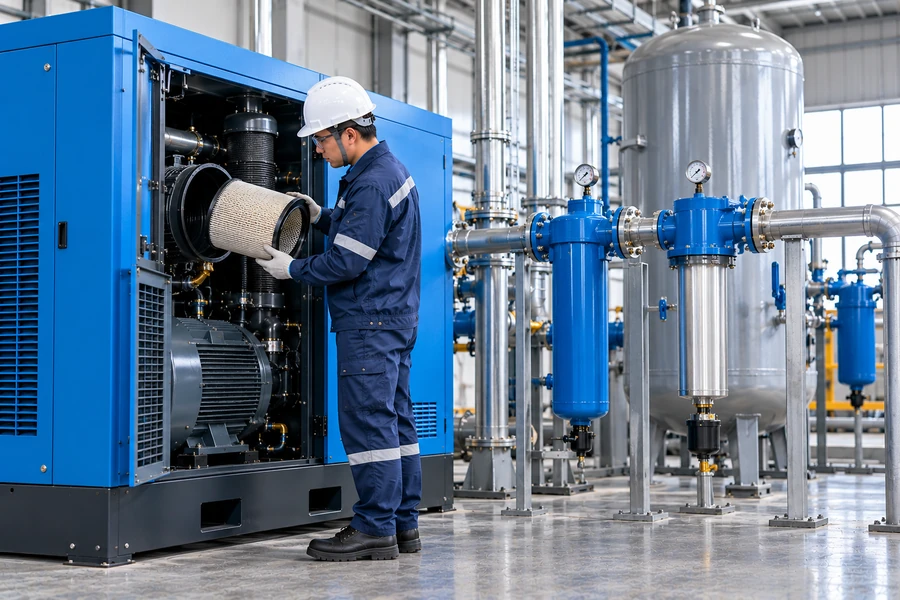
An air compressor filter works by passing air through specialized filtration media that capture solid particles, oil aerosols, and liquid contaminants. Mechanical filters use interception, inertial impaction, and diffusion to collect particles. Coalescing filters combine fine liquid droplets for drainage, while activated carbon filters adsorb oil vapor and certain gaseous contaminants.
I recommend selecting air compressor filters based on application requirements, ensuring effective moisture and particle removal, equipment protection, reduced maintenance, and appropriate compressed air quality.
How Does an Air Compressor Filter Remove Dust, Oil, and Water?
Compressed air can contain several contaminants that require different filtration methods. Understanding how filters capture these contaminants helps explain why a single filter cannot solve every air quality problem.
An air compressor filter removes contaminants through mechanical filtration, coalescence, and adsorption. Fiber filters capture solid particles through interception, inertial impaction, and diffusion. Coalescing filters collect oil and water aerosols into larger droplets that drain away. Activated carbon filters adsorb oil vapor and certain hydrocarbons from the compressed air stream.
1. Mechanical Filtration Captures Solid Particles
I consider mechanical filtration the basic operating principle of many air compressor filters.
When compressed air passes through a filter element, solid particles interact with the filtration fibers.
The filter captures particles through three main mechanisms.
Direct Interception
Larger particles follow the airflow but come into direct contact with filter fibers.
When they touch the fibers, they may be retained by the filtration medium.
Inertial Impaction
Some particles cannot follow the changing airflow paths around the filter fibers.
Their inertia causes them to collide with the filtration material.
Diffusion
Very small particles move randomly through the air because of Brownian motion.
This increases the likelihood that they contact and become trapped by filter fibers.
I believe these mechanisms explain why high-efficiency filters can capture particles smaller than the apparent spaces between their fibers.
2. Coalescing Filters Remove Liquid Aerosols
I consider coalescing filtration especially important for removing fine oil and water droplets.
Compressed air may contain small liquid aerosols that are difficult to separate through gravity alone.
As the air passes through the coalescing filter medium, these droplets are captured.
The collected liquid forms larger droplets.
The droplets then migrate through the medium and drain into the bottom of the filter housing.
An automatic or manual drain removes the accumulated condensate.
I would normally consider coalescing filters when compressed air contains oil aerosols from lubricated compressors.
However, coalescing filters do not remove oil vapor effectively.
3. Activated Carbon Filters Remove Oil Vapor
I use a different filtration principle when dealing with vapor contamination.
Activated carbon contains a porous structure with a large internal surface area.
Oil vapor and certain hydrocarbon molecules attach to the carbon surface through adsorption.
Unlike coalescing filtration, this process does not depend on forming liquid droplets.
I recommend protecting activated carbon filters with suitable upstream filtration and drying.
Excessive liquid oil or water can reduce their effectiveness and shorten their useful life.
4. Different Contaminants Require Different Treatment
| Contaminant | Removal Mechanism | Treatment Equipment |
|---|---|---|
| Dust and solid particles | Interception, impaction, diffusion | Particulate filter |
| Oil aerosols | Coalescence and drainage | Coalescing filter |
| Liquid water droplets | Separation and drainage | Water separator or coalescing filter |
| Oil vapor | Adsorption | Activated carbon filter |
| Water vapor | Cooling or adsorption | Refrigerated or desiccant dryer |
| Rust and pipe scale | Mechanical particle capture | Downstream particulate filter |
I also emphasize that ordinary compressed air filters do not replace air dryers.
A coalescing filter can remove liquid water, but a dryer is needed when the application requires control of water vapor and pressure dew point.
I believe effective compressed air treatment starts by identifying which contaminants must be removed.
What Are the Different Types of Air Compressor Filters?
Air compressor systems contain several types of filters, each designed for a specific purpose. Selecting the wrong filter can increase operating costs without improving compressed air quality.
The main types of air compressor filters include intake air filters, oil filters, air-oil separators, particulate filters, coalescing filters, and activated carbon filters. Intake filters protect the compressor, while downstream filters improve compressed air quality. Oil filters and separators maintain the lubrication system in oil-lubricated compressor designs.
1. Air Intake Filters
I consider the intake filter the first line of protection for an air compressor.
It is installed before the compression element and captures airborne dust, dirt, and other solid contaminants entering with ambient air.
This protection is particularly important for compressors operating in dusty environments.
Examples include cement factories, construction sites, quarries, and woodworking facilities.
I normally check intake filter condition according to the compressor manufacturer's maintenance requirements.
A restricted intake filter can increase airflow resistance and affect compressor performance.
2. Compressor Oil Filters
Oil-lubricated compressors use oil filters to remove contaminants from the circulating lubricant.
The oil protects moving components and, in oil-injected screw compressors, also helps cool and seal the compression process.
I consider oil filtration important for protecting bearings and other lubricated components.
Oil filters are normally replaced during scheduled maintenance based on operating hours, lubricant condition, and manufacturer instructions.
3. Air-Oil Separators
Oil-injected rotary screw compressors use air-oil separators to recover lubricant from the compressed air.
After compression, the air and oil mixture enters a separation system.
Most oil is separated, and the remaining fine oil mist passes through a separator element.
The collected oil returns to the lubrication system.
I monitor separator condition because excessive restriction or separator damage can increase costs and contribute to oil carryover.
An air-oil separator is not a substitute for every downstream filtration requirement.
4. Particulate Filters
Particulate filters remove solid contamination from compressed air.
I consider these filters useful for protecting pneumatic tools, control valves, and other equipment.
They may also be installed after a desiccant dryer to capture dust released from the desiccant material.
The required filtration grade depends on the application and compressed air purity target.
5. Coalescing Filters
Coalescing filters are designed to remove fine liquid aerosols, including oil mist and water droplets.
I recommend these filters when compressed air needs additional liquid contamination control.
They are commonly used in industrial compressed air treatment systems and may be installed upstream of sensitive dryers, depending on the system design.
A suitable condensate drainage system is important for reliable operation.
6. Activated Carbon Filters
Activated carbon filters reduce oil vapor and certain hydrocarbons through adsorption.
I consider them useful when the application requires very low oil vapor concentrations.
These filters are normally installed after suitable liquid aerosol removal and drying equipment.
Their adsorbent material eventually becomes saturated and must be replaced according to the manufacturer's instructions.
Air Compressor Filter Comparison
| Filter Type | Main Purpose | Typical Location |
|---|---|---|
| Intake air filter | Protects compressor from dust | Compressor inlet |
| Oil filter | Cleans circulating lubricant | Lubrication circuit |
| Air-oil separator | Recovers lubricant from compressed air | Oil-injected compressor package |
| Particulate filter | Removes solid contamination | Compressed air distribution system |
| Coalescing filter | Removes liquid aerosols | Air treatment system |
| Activated carbon filter | Reduces oil vapor | After suitable pre-treatment |
| Sterile-grade filter | Controls microorganisms where required | Validated point-of-use system |
I believe the correct filtration combination depends on air purity requirements rather than the number of filters installed.
Where Should Air Compressor Filters Be Installed?
Correct filter placement is essential for effective compressed air treatment. A high-efficiency filter may perform poorly if it is installed in the wrong location or exposed to excessive liquid contamination.
Air compressor filters should be installed according to their functions and the required air quality. Intake filters belong before compression, while water separators, coalescing filters, particulate filters, and activated carbon filters are positioned within the downstream air treatment system. Proper installation depends on the compressor type, dryer technology, contaminant load, and point-of-use requirements.
1. Air Filtration Begins Before Compression
I normally start with the compressor's intake filtration system.
Ambient air carries particles that may damage internal components.
The intake filter reduces contamination before the air enters the compression element.
However, I do not expect an intake filter to provide final downstream compressed air purity.
Compression, cooling, lubrication, and distribution piping can introduce or concentrate additional contaminants.
2. Water Separation After Compression
Compressed air often leaves the compressor at an elevated temperature.
An aftercooler reduces its temperature, allowing some water vapor to condense.
I normally consider a moisture separator after the aftercooler to remove bulk liquid water.
This reduces liquid loading on downstream treatment equipment.
A reliable automatic condensate drain is also important.
Without effective drainage, collected water may be carried into downstream components.
3. Filtration Before and After Air Dryers
I select filter placement according to the dryer technology.
For example, a desiccant dryer commonly needs upstream coalescing filtration to protect the desiccant material from oil contamination.
A particulate filter may be installed downstream to remove desiccant dust.
Refrigerated dryers may use different upstream or downstream filtration arrangements depending on their design and the air purity target.
I always follow the manufacturer's approved filtration configuration.
4. Point-of-Use Filtration
I also consider additional filtration close to sensitive equipment.
Compressed air may pick up rust, pipe scale, or other contaminants as it travels through the distribution network.
For example, a spray painting station may require more stringent oil and particle control than general pneumatic tools elsewhere in the same factory.
I prefer matching point-of-use filtration with the actual manufacturing process.
Example Compressed Air Treatment Arrangement
A possible industrial treatment sequence is:
Ambient Air → Intake Filter → Air Compressor → Aftercooler → Water Separator → Required Prefiltration → Air Dryer → Final Filtration → Point of Use
Additional activated carbon filtration may be included when the required oil vapor limit justifies it.
Air receivers can be positioned according to the compressed air system design.
The exact sequence should be confirmed against the compressor, dryer, and filter manufacturers' instructions.
| System Location | Main Objective |
|---|---|
| Compressor intake | Protect the compression element |
| Lubrication circuit | Protect lubricated components |
| Compressor separation system | Recover lubricant |
| Aftercooler outlet | Remove bulk condensate |
| Before sensitive dryers | Reduce harmful aerosol contamination |
| After desiccant dryer | Remove desiccant particles |
| Before sensitive production equipment | Meet the final air quality requirement |
I believe a correctly designed filtration arrangement improves equipment protection while avoiding unnecessary pressure loss.
I also recommend confirming that each filter housing has an appropriate pressure rating, flow capacity, and safe maintenance arrangement.
How Do I Choose and Maintain an Air Compressor Filter?
A filter that is too small can restrict airflow, while an unsuitable filtration grade may fail to meet process requirements. Poor maintenance can also reduce air quality and increase compressor energy consumption.
I choose air compressor filters by evaluating contaminant type, required air purity, operating pressure, airflow, filtration efficiency, and pressure drop. I maintain them through scheduled inspections, manufacturer-recommended element replacement, condensate drain checks, and operating records. Proper sizing and maintenance protect equipment while reducing unnecessary energy and repair costs.
1. Identify the Required Air Quality
I start by determining what the compressed air will be used for.
Different industrial applications have different contamination limits.
I refer to ISO 8573-1 when compressed air purity requirements need to be specified.
The standard defines air quality classes for:
- Solid particles
- Water
- Oil
I consider these classifications useful for comparing treatment options and confirming the target air quality.
However, the standard itself does not mean that every application requires the cleanest available air.
A general pneumatic workshop and a sensitive pharmaceutical process may require very different treatment arrangements.
2. Match Filter Capacity With Airflow
I compare filter flow capacity with actual compressor output.
Airflow may be expressed in CFM, m³/min, or another standardized unit.
The filter must handle the expected airflow at the actual operating pressure and temperature.
A filter that is too small can create excessive pressure loss.
I also avoid selecting unnecessarily restrictive filtration grades when the application does not require them.
3. Monitor Differential Pressure
Differential pressure is the pressure difference between the filter inlet and outlet.
As solid contaminants accumulate in a filter, resistance to airflow often increases.
I consider pressure drop useful for identifying restrictions.
However, differential pressure alone cannot determine whether a filter element is still providing its required filtration efficiency.
A damaged filter medium may allow contaminants through without producing a high differential pressure reading.
I therefore combine pressure monitoring with manufacturer replacement schedules and air quality requirements.
4. Replace Filter Elements on Schedule
I believe timely element replacement is essential for reliable filtration.
Many industrial compressed air line filter manufacturers recommend replacement at least annually, although actual intervals vary by element type and product.
Some elements must be replaced earlier because of operating conditions or specific manufacturer service-hour limits.
For intake filters, I also consider the surrounding environment.
A compressor working at a dusty construction site may require more frequent filter servicing than one operating in a clean industrial room.
I do not recommend extending replacement intervals without supporting manufacturer guidance.
5. Check Condensate Drainage
I consider condensate drainage particularly important for coalescing filters.
When collected liquid is not discharged correctly, it may accumulate inside the filter housing.
This can increase the risk of liquid carryover.
I recommend checking automatic drains and associated collection systems according to the approved maintenance schedule.
Oil-contaminated condensate should be handled using appropriate treatment and disposal methods.
6. Follow Safe Maintenance Procedures
Compressed air filters operate under pressure.
Before opening a filter housing, maintenance personnel must isolate the relevant energy sources and safely release stored pressure.
I also recommend following the manufacturer's instructions for filter element installation, housing seals, and system restart.
Only suitable replacement components should be used.
7. Consider Total Filtration Costs
I evaluate more than the initial filter purchase price.
My cost comparison includes:
| Cost Factor | What I Evaluate |
|---|---|
| Filter housing | Initial equipment investment |
| Replacement elements | Expected maintenance expense |
| Pressure drop | Additional compressor electricity use |
| Condensate management | Collection and treatment costs |
| Maintenance labor | Service time and accessibility |
| Air quality performance | Protection of downstream processes |
| Equipment reliability | Risk of contamination-related downtime |
I believe the best filter is one that consistently delivers the required air purity with reasonable pressure drop, reliable drainage, and manageable maintenance costs.
My Insights: How Does an Air Compressor Filter Work
I believe an air compressor filter should be understood as part of the complete compressed air treatment system rather than an individual accessory.
My recommendation is to identify the contaminants, select the correct removal technology, and maintain the filtration system according to verified air purity requirements and manufacturer instructions.
Its primary role is to remove specific contaminants before they damage equipment or affect industrial production.
However, different contaminants require different removal mechanisms.
I evaluate air compressor filtration through the following technical principles:
Direct Interception → Filter fibers capture particles that contact their surfaces.
Inertial Impaction → Particles collide with fibers because they cannot follow changing airflow paths.
Diffusion → Random particle movement increases capture of very small particles.
Coalescence → Fine liquid aerosols combine into larger droplets that can drain away.
Adsorption → Activated carbon captures oil vapor and selected gaseous contaminants.
Oil Separation → Oil-injected compressors use internal separators to recover lubricant.
Pressure Drop → Filter resistance affects compressed air system efficiency.
Air Purity → Filtration must match the contamination limits of the intended application.
Maintenance → Filter elements require inspection and scheduled replacement.
System Design → Correct installation, drying, and drainage are essential for reliable treatment.
My Practical Recommendation
I do not recommend selecting air compressor filters based only on their advertised micron ratings.
A very fine particulate filter cannot remove water vapor, and a coalescing filter cannot replace activated carbon when oil vapor removal is required.
Similarly, installing additional filters does not automatically improve compressed air quality if the filters are incorrectly sized or placed.
For general industrial manufacturing, I usually focus on particle removal, suitable moisture control, and reliable condensate drainage.
For oil-sensitive applications, I evaluate coalescing filtration and additional vapor treatment according to the required air quality.
For highly sensitive manufacturing processes, I recommend defining measurable compressed air purity requirements before selecting the treatment equipment.
I also believe maintenance costs should be considered during equipment procurement.
A filter that is inexpensive to purchase may create higher operating expenses if it causes excessive pressure loss or requires frequent replacement.
Conclusion
I believe air compressor filters protect industrial systems through particle capture, liquid coalescence, and vapor adsorption. Correct selection, installation, and maintenance ensure dependable compressed air quality.