
](https://kaishanpro.com/wp-content/uploads/2026/09/How-Much-Does-a-Rotary-Drilling-Rig-Cost.webp)
Rotary drilling rig prices vary enormously. A small water-well machine and a heavy foundation or oilfield rig may both be called rotary rigs but cost completely different amounts.
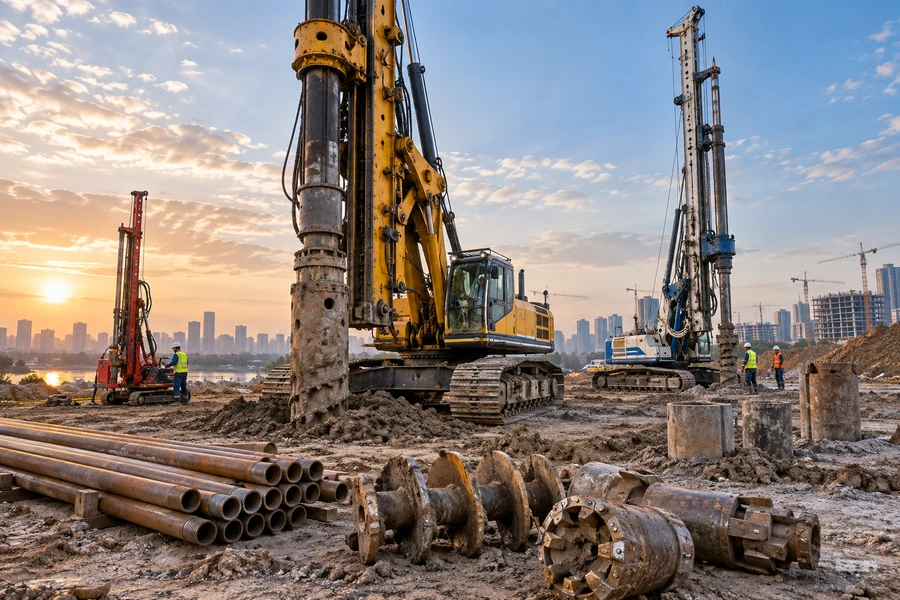
A rotary drilling rig can cost from roughly $3,000 for a small portable unit to $100,000–$500,000 or more for hydraulic crawler and foundation rigs. Large specialized rotary drilling machines can exceed $1 million. I estimate the real price from drilling depth, hole diameter, torque, power, chassis, tooling, and configuration.
The first question I ask is therefore not, “What is the average rotary drilling rig price?” I ask, “What type of rotary drilling project do I need to complete?” Water wells, foundation piles, mining holes, and oil-and-gas wells require very different machines.
How Much Does a Rotary Drilling Rig Cost in 2026?
There is no single market price for a rotary drilling rig because the category covers machines ranging from compact portable rigs to multi-million-dollar drilling systems.
In 2026, small portable rotary water-well rigs may start around $3,000–$8,000. Small hydraulic crawler rigs can be around $14,000–$40,000, compact foundation rotary rigs may exceed $100,000, and used medium piling rigs commonly appear above $100,000. Large premium foundation and specialized rotary rigs can reach hundreds of thousands or millions of dollars.
I separate the market into equipment classes
Current 2026 pricing gives me a useful reference.
A manufacturer of portable water-well rigs currently gives an indicative range of about $3,000–$8,000 for small portable units, depending on configuration.
A current 180 m hydraulic crawler water-well rig is publicly listed around $14,000–$16,000, with both mud-rotary and air-compressor DTH drilling capability depending on setup.
A larger full-hydraulic rotary water-well machine rated above 200 m is listed around $37,000–$39,000 on a current equipment marketplace.
Foundation rotary drilling changes the price dramatically. A compact hydraulic piling rig with an 11 m drilling depth and 500–1,500 mm diameter range is currently offered around $100,000–$120,000, depending on configuration.
The used market is wider again. Current SANY SR155 listings are roughly $112,000–$139,000, while a used Soilmec SR30 is listed around $175,000.
My simplified 2026 price guide looks like this:
| Rotary rig category | Indicative 2026 price |
|---|---|
| Small portable water-well rig | $3,000–$8,000 |
| Small hydraulic crawler water-well rig | $14,000–$40,000 |
| Larger/full-hydraulic water-well rig | $35,000–$100,000+ |
| Compact foundation/piling rotary rig | $100,000–$200,000+ |
| Mid-size used piling rig | $110,000–$300,000+ |
| Large foundation rotary rig | $300,000–$1 million+ |
| Premium/heavy specialized rotary rig | $1 million+ |
I use these numbers as budget ranges, not fixed quotations.
Machine specification, manufacturer, condition, country, accessories, and shipping can change the final cost substantially.
Heavy drilling equipment can move into seven-figure prices
The upper end of the market is very different.
Current MachineryTrader listings for Soilmec drilling equipment span approximately $49,640 to $2.15 million, demonstrating how broad the price range can become even within one equipment family and brand.
Oil-and-gas rotary drilling rigs operate on another scale entirely. Current listings for large 2,000–3,000 hp rotary drilling rigs include asking prices from roughly $2 million to above $20 million, depending on configuration, age, and condition.
I would not compare these machines directly with construction or water-well rigs.
They share a rotary drilling principle, but their engineering, depth capability, power systems, handling equipment, and project requirements are completely different.
What Factors Affect Rotary Drilling Rig Price?
Rig price increases as I demand more drilling depth, larger holes, higher rotary torque, heavier pullback capacity, stronger chassis components, more automation, and additional tooling.
The main factors affecting rotary drilling rig price are drilling depth, hole diameter, rotary torque, engine power, pullback and crowd force, mast and Kelly bar configuration, crawler or truck chassis, hydraulic components, automation, tooling, compressor or mud-system requirements, manufacturer, and after-sales support.
Drilling depth changes the whole machine
A rig designed for a 30 m foundation hole does not need the same structure as a deep drilling system.
As depth increases, I may need:
- Larger mast capacity
- Longer or stronger Kelly bars
- Higher hoisting force
- Greater pullback
- More powerful winches
- Stronger rotary drives
- Larger hydraulic systems
- More stable crawler undercarriage
Each change adds cost.
The same principle applies to water-well rigs.
A 100–200 m contractor rig may be relatively compact, while a 500–1,000 m machine requires much greater pullback force, rod capacity, and structural strength.
Hole diameter increases torque requirements
Large foundation piles require high rotary torque.
A machine drilling a 1,500 or 2,000 mm foundation hole is fundamentally different from a machine drilling a 150 mm borehole.
Current mid-range foundation equipment illustrates this relationship. The XCMG XR240E is rated around 240 kN·m of rotary torque and can be configured for approximately 2,000–2,200 mm maximum drilling diameters. Public pricing for this equipment class can span a very wide range depending on configuration.
I therefore never compare two rig prices before comparing their:
| Specification | Why it affects cost |
|---|---|
| Maximum depth | Determines mast, hoist and structural capacity |
| Hole diameter | Changes rotary torque and tooling requirements |
| Rotary torque | Larger hydraulic components and gearbox |
| Pullback force | Important for deep holes and tool recovery |
| Engine power | Supports hydraulic and drilling load |
| Machine weight | Reflects chassis and structural capacity |
| Automation | Adds sensors, controllers and software |
| Rod/Kelly handling | Adds mechanical complexity |
| Compressor/mud system | May add major equipment cost |
| Tooling package | Bits, buckets, rods and Kelly bars can be expensive |
A quotation with a bigger engine is therefore not automatically better.
The machine needs to deliver the drilling parameters my project actually requires.
Is a New or Used Rotary Drilling Rig Cheaper?
A used rig can reduce initial investment significantly, but I compare remaining component life and repair risk before treating the lower purchase price as a saving.
Used rotary drilling rigs usually cost substantially less than equivalent new equipment. However, I inspect engine hours, rotary head condition, hydraulic pumps, main winch, mast, Kelly bar, crawler system, structural cracks, maintenance records, and available spare parts before buying. A cheap used rig can become expensive when major components require rebuilding.
Current used prices show how wide the range can be
As of September 2026, MachineryTrader shows SANY SR155 rotary drilling rigs from roughly $112,000 to $139,000.
A 2014 Soilmec SR30 with approximately 19,000 hours is currently listed around $175,000.
The broader Soilmec market currently covers listings from roughly $49,640 up to $2.15 million, depending on model, age, capacity, and condition.
Other current used-market examples show smaller truck-mounted mud-rotary equipment around $37,500–$145,000, again demonstrating how configuration and condition change the price.
I do not use listing price alone to judge value.
I calculate the repair reserve
Suppose I compare:
New rig: $300,000
with:
Used rig: $160,000
The $140,000 difference looks attractive.
But I still investigate whether the used machine may soon need:
- Hydraulic pump rebuild
- Rotary-head repair
- Engine overhaul
- Winch overhaul
- Kelly bar replacement
- Crawler repair
- Hydraulic cylinders
- Electrical control components
- Hose replacement
One major rotary-head or hydraulic-system repair can change the economics quickly.
Hours alone are not enough
A high-hour machine with disciplined maintenance can be better than a lower-hour machine that was abused.
I inspect:
hours + maintenance records + application + component condition
For foundation machines, I also want to know what ground conditions the rig worked in.
Years of heavy hard-rock socket drilling can create different wear from light soil piling.
I also inspect weld repairs and mast structures carefully.
The purchase decision should therefore be based on remaining productive life, not simply age.
What Other Costs Should I Include When Buying a Rotary Drilling Rig?
The machine price is only the beginning of the project budget. Tooling, transport, spare parts, commissioning, and operating costs can add significantly to the investment.
When I budget for a rotary drilling rig, I include the rig, drilling tools, Kelly bars or drill rods, compressor or mud pump where required, spare parts, freight, customs duties, insurance, commissioning, operator training, fuel, maintenance, and local service. I compare the total delivered and operating cost rather than the factory machine price alone.
Tooling can change the quotation substantially
A bare rig is not always ready to drill.
Foundation rotary equipment may require:
- Kelly bar
- Drilling bucket
- Auger
- Core barrel
- Casing tools
- Casing oscillator
- Cleaning bucket
- Rock tools
A water-well rotary system may require:
- Drill rods
- Tricone bits
- DTH hammer
- DTH bits
- Air compressor
- Mud pump
- Foam system
- Casing tools
When I compare suppliers, I make sure they quote the same scope.
A $120,000 rig with no tooling is not automatically cheaper than a $145,000 package containing Kelly bars, buckets, spare parts, and commissioning.
Shipping is especially important for large crawler rigs
A heavy foundation rotary rig may require disassembly for international transport.
I may need to ship the main machine, counterweights, Kelly bar, mast components, and tools separately.
The final delivered cost can therefore include:
factory price + inland transport + port charges + ocean freight + insurance + import duty + local transport + assembly
For international buyers, I compare quotations using the same Incoterm.
I do not compare one FOB price directly with another supplier's CIF or delivered price.
Spare parts should be included from the beginning
For an overseas project, I usually budget a startup spare-parts package.
That can include:
- Filters
- Hydraulic hoses
- Seals
- Sensors
- Electrical relays
- Wear parts
- Lubrication components
- Tooling wear parts
- Manufacturer-specific service items
Remote projects need a larger buffer than machines operating close to a dealer.
For me, availability is sometimes more important than the individual component price.
A $300 component that stops a $300,000 machine for two weeks can become extremely expensive.
Operating cost matters more than price over time
I also estimate:
fuel + maintenance + drilling tools + labor + downtime
A more expensive rig can produce a lower cost per drilled meter if it has better productivity, lower fuel consumption, longer component life, and stronger parts support.
This is why I prefer to calculate:
total annual operating cost ÷ productive drilled meters
rather than comparing purchase prices alone.
My insights: How Much Does a Rotary Drilling Rig Cost
The biggest problem with this question is that “rotary drilling rig” describes too many different machines. I first identify the application before I discuss price.
A rotary drilling rig can cost from a few thousand dollars to several million dollars. For common contractor equipment, I would budget roughly $3,000–$40,000 for small water-well rigs, $100,000–$300,000 or more for many foundation and piling rigs, and substantially more for large heavy-duty equipment. The final cost depends on capacity and complete configuration.
My first question is: what kind of rotary drilling?
I divide the market like this:
Water well
The priorities are normally depth, pullback force, drill-pipe handling, mud or DTH capability, and mobility.
Small machines can start below $10,000, while larger hydraulic crawler systems move much higher. Current 2026 listings include approximately $14,000–$16,000 for a 180 m crawler machine and around $37,000–$39,000 for a larger full-hydraulic unit.
Foundation piling
The priorities become rotary torque, Kelly bar, crowd force, winch capacity, large hole diameter, chassis stability, and depth.
Current used examples commonly exceed $100,000, with SANY SR155 machines around $112,000–$139,000 and a Soilmec SR30 around $175,000.
Large specialized rotary drilling
Mining, very large foundation work, and especially oil-and-gas rotary equipment can move into high six-figure or multi-million-dollar territory. Current heavy oilfield listings demonstrate that multi-million-dollar prices are normal for some large drilling systems.
This classification gives me a far more useful budget than one global average.
I build the specification before asking for a quotation
Before I contact suppliers, I prepare:
| Project information | Example |
|---|---|
| Application | Bridge piling |
| Ground | Clay, gravel and weathered rock |
| Hole diameter | 1,500 mm |
| Hole depth | 45 m |
| Required torque | Supplier recommendation |
| Project volume | 400 piles |
| Site access | Crawler suitable |
| Tooling | Kelly + bucket + core barrel |
| Country | Destination market |
| Operating hours | 10 hours/day |
| Required spares | 2,000-hour package |
That allows manufacturers to quote comparable equipment.
Without these requirements, one supplier may quote a lightweight machine while another quotes a much stronger configuration.
Their prices cannot be compared fairly.
I compare price per capability
Instead of asking only:
“Which rig is cheaper?”
I ask:
“What drilling capacity am I buying for that price?”
I compare:
price ÷ torque
price ÷ drilling depth
price ÷ production capability
and most importantly:
total lifecycle cost ÷ drilled meters
I do not use these as perfect mathematical formulas.
They force me to compare machines on useful production capability rather than appearance.
I do not automatically choose the lowest-priced rig
A low factory price can result from:
- Smaller hydraulic components
- Lower torque
- Shorter drilling depth
- Basic engine
- Fewer accessories
- No tooling
- No spare-parts package
- Limited warranty
- Limited overseas service
None of these automatically means the machine is bad.
It simply means I need to understand exactly what the quotation contains.
The cheapest suitable rig can be a good purchase.
The cheapest unsuitable rig is usually expensive.
My practical price rule
When someone asks me, “How much does a rotary drilling rig cost?”, my practical answer is:
Expect anything from about $3,000–$8,000 for very small portable rotary water-well equipment to $100,000–$500,000 or more for serious hydraulic crawler and foundation rigs. Large premium machines can exceed $1 million, while specialized oil-and-gas rigs may cost several million dollars. I determine the real budget only after defining application, depth, diameter, torque, drilling method, tooling, and delivery scope.
The number on the quotation is therefore only one part of the purchase decision.
For an industrial buyer, the better question is:
How much will the complete drilling system cost to purchase, deliver, operate, maintain, and keep productive throughout the project?
That is the number I use to compare rotary drilling rigs.
Conclusion
Rotary drilling rigs range from a few thousand dollars to millions. I set the budget from application, depth, diameter, torque, tooling, configuration, condition, and total lifecycle cost.