
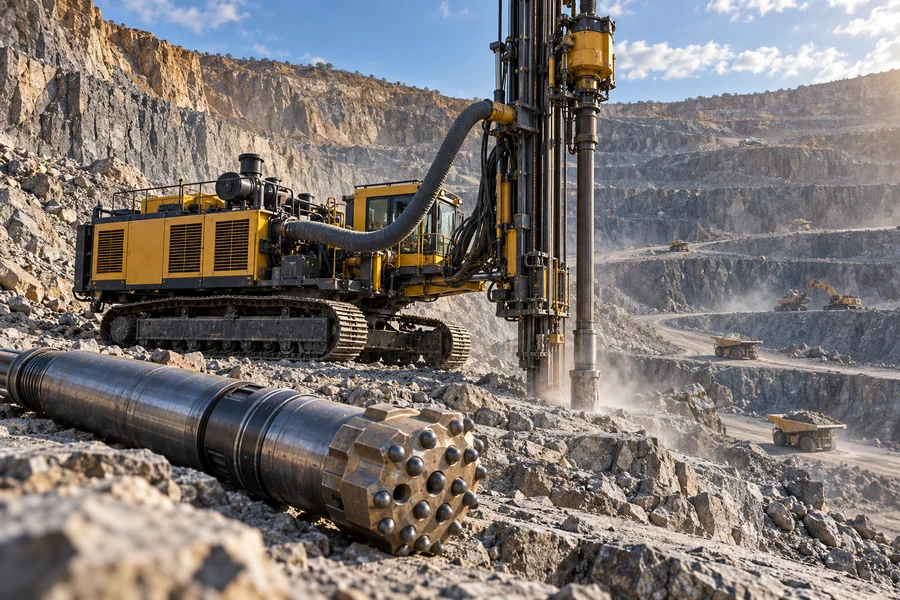
](https://kaishanpro.com/wp-content/uploads/2026/10/How-to-Choose-the-Right-Down-the-Hole-Hammer-for-Different-Drilling-Applications.webp)
How to Choose the Right Down-the-Hole Hammer for Different Drilling Applications?
The wrong DTH hammer can cause slow penetration, poor hole cleaning, excessive fuel use, rapid bit wear, and expensive downtime even when the drill rig is powerful enough.
To choose the right down-the-hole hammer, I start with the drilling application, required hole diameter, geology, and depth. I then match the hammer size and exact bit shank to the hole, verify operating pressure and airflow against the compressor, and confirm that the drill rig can provide the required rotation, feed, pullback, and drill-string capacity.
A DTH hammer should therefore be selected as part of a complete drilling system, not as an isolated component.
What Size DTH Hammer Should I Choose for the Required Hole Diameter?
Hole diameter is normally the first technical constraint because the hammer body, bit diameter, and annular space must work together.
I choose a DTH hammer that fits as closely as practical to the required hole diameter while still leaving enough annular space to evacuate cuttings. Epiroc identifies roughly 90–254 mm as a common DTH production-drilling range and notes that hammer size should closely match the hole size rather than being unnecessarily small.
Start with the finished hole diameter
I first ask:
What hole diameter must the project actually deliver?
Typical examples include:
- 90–115 mm quarry holes
- 115–140 mm presplit holes
- 127–152 mm water-well or production holes
- 165–203 mm mining blastholes
- Larger water-well, foundation, geothermal, or casing applications
The hammer must support a bit capable of producing that finished diameter.
For example, Mincon's current 5-inch-class hammer range supports bit diameters of approximately 127–152 mm, depending on hammer and shank configuration.
Its larger 10–15-inch hammer family supports approximately 254–457 mm bits for heavy large-diameter drilling applications.
That illustrates an important point:
hammer nominal size ≠ exact finished hole diameter
A hammer normally works across a range of bit diameters.
Do not choose an undersized hammer just because the bit fits
An undersized hammer may physically accept a large bit, but that does not mean the combination is productive.
If the hammer is much smaller than the hole:
impact energy per unit hole area falls
and the annular space around the hammer becomes larger.
The result can include:
slower penetration + higher air demand for hole cleaning + poorer energy efficiency
Epiroc's guidance is to match hammer size as closely as possible to the required hole while leaving sufficient space for cuttings evacuation.
This is why I generally avoid:
small hammer + oversized bit
unless the application specifically requires that configuration and the manufacturer approves it.
A useful starting guide
| Required hole diameter | DTH hammer class I would investigate |
|---|---|
| ~85–105 mm | 3" class |
| ~100–130 mm | 4" class |
| ~127–152 mm | 5" class |
| ~152–203 mm | 6–7" class |
| ~203–254 mm | 8–9" class |
| ~254 mm and above | 10"+ specialized DTH |
This is only a starting point.
The exact hammer manufacturer's:
minimum bit diameter + maximum bit diameter + recommended production range
must decide the final selection.
Modern hammer design can change traditional size boundaries
Hammer technology continues to evolve.
Mincon's MP75-MC, introduced in 2025, is a useful example. It is a 7-inch-class hammer designed to drill holes up to roughly 9 inches while operating with air packages associated with many 6-inch hammer installations.
Epiroc has similarly developed 6-, 7-, and 8-inch COP M-series hammers with configurations intended to match different air pressures, airflow availability, and bit sizes.
So I never select only from traditional labels such as:
“203 mm hole = always use an 8-inch hammer.”
I verify the current hammer's actual performance window.
How Do Geology, Depth, and Drilling Application Affect DTH Hammer Selection?
Two projects with the same hole diameter may require different hammers because hard abrasive granite, fractured limestone, deep water wells, and mineral exploration impose different loads.
After hole diameter, I select the DTH hammer around the formation and application. Hard competent rock favors strong impact energy and durable piston/bit systems, abrasive formations require wear-resistant external components, deep holes increase the importance of air efficiency and reliable flushing, and exploration may require specialized reverse-circulation hammers for sample recovery.
Hard competent rock
DTH drilling is particularly attractive in competent hard rock because impact energy is produced directly behind the bit.
The energy path is:
compressed air → hammer piston → bit shank → carbide buttons → rock
Unlike top-hammer drilling, impact energy does not need to travel the full drill string from a surface rock drill.
For hard rock, I look closely at:
impact efficiency
operating pressure range
piston design
bit face
button profile
and:
hammer durability
But I still do not simply choose the hammer offering the highest possible pressure.
It must match the available compressor and rig.
Abrasive rock
Abrasive formations create another problem:
external wear
The hammer body, chuck, wear sleeve, bit gauge, and drill string can all experience accelerated erosion.
Epiroc specifically offers reinforced hammer configurations for harsh abrasive formations with additional wear protection around components such as the chuck, wear sleeve, and top section.
In abrasive ground, I therefore consider:
penetration rate + hammer rebuild life + bit gauge wear + external wear
together.
The fastest hammer for the first 100 meters may not be the cheapest hammer after:
10,000 drilled meters.
Fractured ground
Broken and fractured formations can create:
- Cavities
- Air loss
- Cuttings recirculation
- Hole collapse
- Hammer binding
- Water ingress
A very aggressive high-energy setup may not always produce the most stable hole.
I consider:
hammer diameter
bit face
rotation
air velocity
and:
casing requirement
as one system.
For unstable overburden, a standard open-hole DTH hammer may not be enough.
A casing-advance system may be required instead.
Robit's current DTH casing systems, for example, include configurations across a very broad diameter range and match different casing sizes to specific hammer classes.
Deep water-well and geothermal drilling
Deep holes change the selection logic.
As depth increases, I pay more attention to:
air consumption
hole cleaning
pressure losses
water inflow
drill-pipe diameter
and:
hammer service reliability
Mincon positions its DTH hammer range for geothermal and water-well drilling with emphasis on deep-hole performance, air efficiency, and productivity.
For deep holes, a hammer that uses the available air more efficiently can sometimes be more valuable than a larger hammer with higher theoretical output.
Mining and quarry production
In a production mine or quarry, I emphasize:
meters per shift + bit life + hammer life + fuel consumption + availability
The hammer needs to work repeatedly at high utilization.
Epiroc's current DTH product guidance distinguishes standard quarry/production applications from more demanding abrasive and high-performance drilling conditions.
For a mine, I therefore evaluate:
cost per drilled meter
rather than just:
hammer purchase price.
Mineral exploration and reverse circulation
Exploration can require a specialized system.
Reverse-circulation drilling is designed to bring samples through an internal return path, reducing contamination from the borehole annulus.
That requires an:
RC hammer + compatible RC bit + dual-wall drill string
rather than a standard conventional DTH hammer.
Mincon's current MRXT RC hammer family is specifically designed around exploration and sample-quality applications.
So the first selection question should always be:
What drilling method does the project require?
not:
What hammer size is cheapest?
How Do I Match the DTH Hammer to the Compressor, Bit, and Drill Rig?
A DTH hammer cannot outperform the air and mechanical systems feeding it. Compressor mismatch is one of the most common ways to lose drilling performance.
I match the hammer to its specified operating-pressure and airflow curve, then verify that the compressor can supply that air under actual site conditions. I also confirm the exact bit shank, backhead thread, drill-pipe connection, rig rotation torque, feed force, pullback, and lubrication system. A hammer that does not match the compressor or rig will never deliver its intended performance.
Pressure drives hammer performance
Compressed air performs two jobs:
it cycles the hammer piston
and:
it carries cuttings out of the hole.
Increasing pressure within the hammer's approved operating range generally increases piston energy and/or frequency.
But pressure must match the hammer design.
I never assume:
more pressure = always better.
Operating above the specified range can increase:
wear + heat + component stress
without producing an economical improvement.
The correct reference is the hammer manufacturer's operating chart.
Airflow must satisfy both the hammer and the hole
Airflow has two separate jobs:
hammer operation
and:
hole flushing
This distinction matters.
A compressor can theoretically operate the hammer but still fail to clean the hole adequately.
Poor hole cleaning causes:
cuttings regrinding
slow penetration
bit wear
higher torque
stuck tools
and:
poor hole quality
The required flushing volume depends on factors including:
hole diameter + drill-pipe diameter + drilling rate + depth + cuttings density + water conditions
That is why I size the compressor only after I know the:
hammer + bit + pipe + hole
combination.
Available compressor capacity can determine hammer size
A real-world hammer selection is sometimes constrained by the compressor already installed on the rig.
Mincon's newer MP75-MC illustrates this design approach: it was developed to provide large-hole capability while using the air packages found on many modern rigs traditionally configured around smaller hammer classes.
Epiroc's COP M-series likewise provides configurations designed to adapt to different compressor pressures and airflow availability.
This is especially important when replacing an existing hammer.
I ask:
What air package does the rig actually have?
before buying new tooling.
Altitude matters
At a high-altitude mine or water-well site, a compressor does not necessarily deliver the same effective mass of air that it does at sea level.
So for elevated sites I verify the compressor manufacturer's:
altitude derating
and the hammer supplier's air requirement.
I do not size a DTH package from sea-level catalog airflow alone.
The bit shank must match exactly
This is one of the most important purchasing checks.
A bit is not compatible simply because:
the diameter is correct.
The shank must match the hammer.
For example, Mincon's current 5-inch hammer family includes different shank systems such as:
QL50
DHD350
MQ50
and:
MC51.
These are not automatically interchangeable.
When ordering a bit, I specify:
exact hammer model + exact shank + bit diameter + face design + button profile
not:
“Please send a 5-inch DTH bit.”
Check the backhead and drill-pipe thread
The top connection also matters.
The hammer connects to the drill string through its backhead.
The thread must match the:
drill pipe
or:
required adapter
Using unnecessary adapters can:
increase length + add joints + introduce wear points + complicate servicing
So I prefer a hammer connection that integrates cleanly with the drill string whenever practical.
The rig must support the hammer mechanically
The rig needs enough:
rotation torque
rotation-speed control
feed force
and:
pullback
to operate the selected hammer and drill string.
Too much feed can choke hammer action or accelerate bit wear.
Too little feed can produce:
poor energy transfer + excessive vibration + unstable drilling
Larger hammers and deeper drill strings also increase weight.
The rig must have enough pullback capacity to safely retrieve the entire string.
Lubrication matters
Most conventional pneumatic DTH hammers require appropriate rock-drill lubrication in the compressed-air stream.
Lubrication demand changes with:
hammer size + airflow + pressure + operating conditions
Insufficient lubrication can rapidly damage internal hammer surfaces.
Excessive or incorrect lubricant can create other operating problems.
I therefore treat the:
lubricator + oil type + injection rate
as part of the hammer package.
Which DTH Hammer Is Best for Mining, Quarrying, Water Wells, Construction, and Exploration?
There is no universal hammer because each application prioritizes a different combination of productivity, hole quality, durability, air efficiency, and sample recovery.
For quarrying and mining, I prioritize penetration rate, external wear resistance, and cost per meter. For water wells and geothermal drilling, I prioritize air efficiency, deep-hole reliability, and water-handling ability. Construction may require casing systems for unstable ground, while mineral exploration may require reverse-circulation hammers for representative sample recovery.
Quarrying
For quarry production, typical goals are:
consistent blastholes + fast penetration + long bit life + simple servicing
A 4- or 5-inch hammer may be common where the required hole diameter falls within its productive range.
Epiroc's current DTH rig examples include 4- and 5-inch hammer platforms designed for roughly 90–152 mm quarry, mining, and construction holes.
For abrasive granite, I put more weight on:
external hammer wear + button wear + regrinding interval
than I would in softer limestone.
Open-pit mining
Larger production holes may move the project into:
6" + 7" + 8" + 9"
hammer classes.
At this scale, I strongly evaluate:
compressor fuel consumption
because air demand becomes a major operating cost.
Epiroc's newer 7-inch COP M7 application provides an example of how matching hammer size more closely to a large production hole can reduce operating cost versus using a less optimally matched hammer class.
This reinforces my rule:
do not automatically use the biggest hammer available.
Use the hammer that is most productive for the target hole with the available rig and compressor.
Water wells
For water-well drilling, priorities shift toward:
depth + variable formations + water inflow + compressor efficiency + serviceability
A hammer may need to work through:
weathered rock → fractured rock → hard basement rock
in one borehole.
I value:
robust internal design + efficient air use + easy field servicing
because the drilling location may be remote.
Mincon explicitly positions its DTH hammers across water-well and geothermal applications as well as mining and construction.
Geothermal drilling
Geothermal boreholes can involve:
deep holes + repeated production drilling + strict hole geometry
so I focus on:
air efficiency + hammer life + straightness + reliable flushing
A cheap hammer that requires frequent pulling from a deep hole can create far more downtime than its purchase-price saving.
Foundation and geotechnical drilling
In unconsolidated overburden, DTH may need to advance casing simultaneously.
I therefore evaluate:
hammer + pilot bit + ring bit + casing
as one package.
Robit's current DTH Prime systems illustrate how casing diameter and hammer class are matched from relatively small foundation applications through large-diameter casing systems.
Mineral exploration
For exploration, the objective may not simply be:
fastest hole
The real objective may be:
representative sample + low contamination + geological information
That can change the system completely.
Reverse-circulation hammer systems such as Mincon's current MRXT family are specifically designed around sampling applications.
Application comparison
| Application | Main hammer-selection priority |
|---|---|
| Quarry blastholes | Penetration, bit life, durability |
| Open-pit mining | Productivity, fuel, cost/meter |
| Water wells | Deep-hole reliability, air efficiency |
| Geothermal | Depth, straightness, service life |
| Foundation | Casing compatibility, unstable ground |
| Geotechnical | Hole control, formation adaptability |
| Mineral exploration | Sample quality, RC compatibility |
| Remote drilling | Reliability, easy service, parts |
My insights: How to Choose the Right Down-the-Hole Hammer for Different Drilling Applications
The most common DTH selection mistake is starting with a hammer model instead of starting with the hole and working backward through the drilling system.
I choose the right DTH hammer by defining the application, geology, hole diameter, and depth first. Then I select the hammer and exact bit shank, calculate required pressure and airflow, match the compressor, confirm rig rotation/feed/pullback capacity, and finally evaluate penetration, wear, fuel consumption, and total cost per drilled meter.
My first insight is to start with the application, not hammer size
I first classify the job:
mining
quarrying
water well
geothermal
foundation
exploration
or:
construction
This tells me what success means.
For mining:
meters per shift
may dominate.
For exploration:
sample quality
may dominate.
For water wells:
depth + formation flexibility
may matter more.
A hammer cannot be “best” without defining the objective.
My second insight is to match the hammer as closely as possible to the hole
Epiroc's guidance is useful here: DTH hammer selection is heavily influenced by application, hole size, and rock formation, with the hammer ideally close to the required hole dimension while maintaining room for cuttings removal.
So I avoid extremes:
hammer too small → poor energy utilization
hammer too large → clearance/flushing/bit compatibility problems
The correct hammer lives between those conditions.
My third insight is to select the hammer and compressor together
I do not buy:
hammer first
and then ask:
“What compressor do I need?”
I treat them as one package:
hammer pressure + hammer airflow + flushing requirement + site altitude = compressor specification
A modern hammer designed around a smaller air package may allow a contractor to increase hole size without replacing the whole rig or compressor. Mincon's MP75-MC is a current example of that system-level design philosophy.
That can have a major impact on project economics.
My fourth insight is that shank compatibility comes before bit face
Buyers often spend a lot of time choosing:
convex vs flat vs concave
or:
spherical vs ballistic buttons
before confirming shank compatibility.
I reverse that sequence.
My bit-selection order is:
hammer model → exact shank → bit diameter → face → button profile → flushing design
The correct face does not help if the bit cannot fit the hammer.
Mincon's current 5-inch range alone demonstrates several different shank systems within the same nominal hammer category.
So I always put the exact shank designation on the purchase order.
My fifth insight is to choose by cost per drilled meter, not hammer price
When someone asks me, “How do I choose the right down-the-hole hammer for different drilling applications?”, I use this complete sequence:
1. Application
Mining, quarrying, water well, geothermal, foundation, exploration, or another use.
2. Geology
Define:
soft / medium / hard / very hard
and:
abrasive / fractured / water-bearing / unstable
3. Hole diameter
Specify the required finished diameter.
4. Hole depth
Depth affects:
air losses + drill-string weight + hole cleaning + service requirements
5. Drilling method
Confirm:
conventional DTH
RC
or:
DTH casing advance
6. Hammer class
Choose a hammer that works efficiently in the required hole-diameter range.
7. Exact shank
Never assume all 4-, 5-, or 6-inch bits are interchangeable.
8. DTH bit
Choose:
diameter → face → carbide/button profile → flushing
according to geology.
9. Operating pressure
Use the hammer manufacturer's recommended range.
10. Required airflow
Account for:
hammer operation + cuttings evacuation
11. Compressor
Verify:
working pressure + actual FAD + site altitude + temperature
12. Drill pipe
Check:
diameter + thread + pressure loss + strength
13. Drill rig
Confirm:
rotation torque + rpm + feed + pullback + mast capacity
14. Lubrication
Match oil type and injection rate to the hammer and airflow.
15. Measure real drilling economics
Once drilling begins, I record:
penetration rate
meters per bit
meters per hammer service
fuel per meter
compressor load
hole deviation
downtime
and:
tool cost per meter
My practical application table looks like this:
| Application | Hammer-selection emphasis |
|---|---|
| Small quarry holes | Compact hammer, high penetration |
| Hard-rock production | Impact efficiency, durable bit/shank |
| Abrasive rock | Wear protection, rebuild economics |
| Deep water well | Air efficiency, reliability |
| Wet hole | Water-handling and flushing capacity |
| Geothermal | Deep-hole performance, straightness |
| Unstable overburden | Casing-compatible DTH system |
| RC exploration | Dedicated RC hammer |
| Large mining holes | Hammer/compressor/rig optimization |
| High-altitude drilling | Corrected compressor-air capacity |
The wrong purchasing sequence is:
hammer price → hammer size → compressor later
The better sequence is:
application → geology → diameter → depth → hammer → shank → bit → air requirement → compressor → rig
That matters because the DTH hammer is only the component that converts compressed-air energy into impact at the bottom of the hole.
Its performance depends on everything around it.
A technically excellent hammer supplied with:
insufficient pressure
insufficient airflow
wrong bit shank
poor hole cleaning
or:
undersized rig pullback
will still perform badly.
Conversely, a properly matched hammer can improve:
penetration rate + hole quality + bit life + fuel efficiency + rig utilization
without necessarily being the largest or most expensive model available.
For this reason, I define the best DTH hammer as:
the hammer that produces the required hole in the actual geology with reliable flushing, compatible compressor demand, acceptable tool life, and the lowest sustainable cost per drilled meter.
Conclusion
Choose a DTH hammer from the application and hole backward: match geology, diameter, shank, pressure, airflow, compressor, bit, and rig before comparing purchase price.