
](https://kaishanpro.com/wp-content/uploads/2026/09/How-to-Measure-a-Compressor-Belt.webp)
A compressor belt can look simple, but ordering a replacement from length alone can result in the wrong profile, poor pulley fit, slipping, or premature failure.
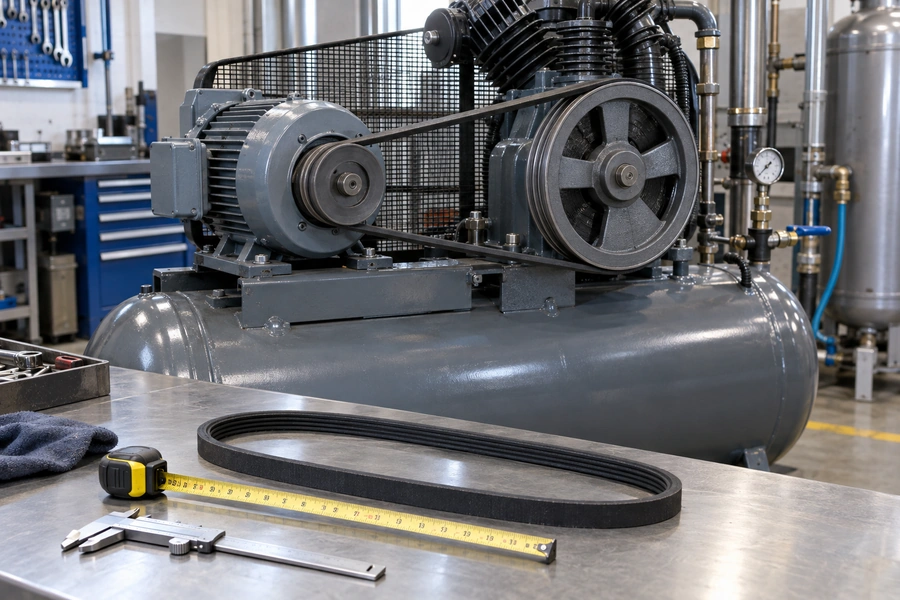
To measure a compressor belt, I remove the old belt, identify its type, measure its circumference, and record its cross-section. For a V-belt, I check top width, height, and length. For a Poly-V belt, I check length, rib profile, and number of ribs. I confirm the measurements against the compressor model or OEM belt number before ordering.
I prefer the original part number whenever it is still readable. Measuring becomes especially useful when the markings have worn away, the belt is unavailable locally, or I need to cross-reference an equivalent industrial belt.
How Do I Measure an Existing Air Compressor Belt?
The easiest situation is when the old belt is still complete. I can remove it, lay it out carefully, identify its profile, and measure the dimensions needed for replacement.
To measure an existing compressor belt, I first disconnect and isolate the compressor, release belt tension, and remove the belt. I record any printed part number, then measure the belt's width and profile. I measure circumference with a belt-measuring tool or flexible tape and identify whether the specified length is inside, outside, datum, or effective length before choosing a replacement.
I first look for the belt number
Before using a tape measure, I clean the belt and inspect its outer surface.
I may find markings such as:
A42
B68
SPA1500
5VX900
or a manufacturer's proprietary part number.
That information can be much more accurate than measuring a worn belt.
For example, Optibelt currently lists a conventional A/13 belt as an A-profile belt with a nominal 13 mm cross-section designation, while its B/17 range uses a 17 mm profile designation.
The number can therefore tell me both the belt family and its nominal length.
On an OEM compressor belt, however, I may see only a proprietary compressor part number.
I search that number against the exact compressor model before trying to convert it to a generic belt.
I measure the belt only after removing tension
I do not try to determine the belt's true size while it is installed and tensioned.
A belt under tension is stretched.
It is also wrapped around pulleys, which makes circumference difficult to measure consistently.
My normal process is:
- Isolate electrical power.
- Make sure the compressor cannot restart.
- Remove the belt guard.
- Release the motor or automatic tensioner.
- Remove the belt.
- Record all visible markings.
- Measure the belt profile.
- Measure its circumference.
For compressor maintenance, I follow the manufacturer's lockout and service instructions before accessing the belt drive.
I do not assume every “belt length” means the same thing
This is one of the most important points.
Industrial belt specifications can use different length references, including:
inside length
outside circumference
datum length
effective length
These numbers can differ even though they describe the same physical belt.
Gates product data illustrates this clearly. One current V-belt specification lists an effective length of 826 mm and an outside circumference of 847 mm for the same belt.
Likewise, a Gates industrial Micro-V example lists an effective length of 1,765 mm and an outside circumference of 1,788 mm.
So if I measure 1,788 mm around the outside and order a belt labeled “1788” without understanding the manufacturer's numbering system, I may receive the wrong part.
My rule is:
measure first → determine length convention → cross-reference manufacturer catalog
not simply:
measured circumference = belt number
What Measurements Do I Need for a Compressor V-Belt?
A V-belt is identified by more than circumference. Its cross-section must fit the pulley groove correctly.
For a compressor V-belt, I measure three main dimensions: top width, belt height or thickness, and belt length. I also identify whether it is a classical V-belt, narrow/wedge belt, cogged belt, or another profile. Two belts with the same circumference but different cross-sections are not interchangeable because they sit differently in the pulley groove.
Top width helps identify the V-belt section
I measure straight across the widest flat surface of the belt.
I do not measure diagonally down the V-shaped sidewalls.
Common classical industrial V-belt profile names include:
A/13
B/17
C/22
Optibelt's current catalog pages confirm, for example, that its A profile is designated A/13, its B profile B/17, and its C profile C/22.
These nominal values are useful for identifying the family.
However, I remain cautious when measuring a badly worn belt.
A worn belt can become narrower than it was when new.
The manufacturer's printed section or pulley groove dimensions can therefore be more reliable.
Belt height helps distinguish similar profiles
Next, I measure from the wide top surface vertically to the narrow bottom surface.
This is particularly useful when distinguishing a classical profile from a narrow wedge profile.
Two belts can have a similar top width while using different angles, heights, or pulley standards.
That means I do not identify a replacement using only:
width + circumference
I want:
belt family + section + length
I measure circumference carefully
If I have no dedicated belt gauge, I can use a flexible tailor's tape around the belt.
Another practical method is to mark one point on the belt, place it flat against a surface, and roll it through one complete revolution while measuring the distance traveled.
I keep the belt lightly straightened rather than aggressively stretching it.
If I use a string, I place it around the same reference surface consistently and then measure the string.
However, these methods give me a field measurement.
They do not automatically tell me whether a replacement catalog uses inside, outside, datum, or effective length.
This difference can be significant.
For example, Gates lists a banded A-section belt with a 1,275 mm effective length and approximately 1,270 mm outside circumference, while other belt constructions can show larger differences between published length definitions.
So I use field measurement primarily to identify the likely size, then verify it through the belt manufacturer's table.
A worn V-belt can mislead me
Suppose the old belt measures approximately:
16 mm wide
It might be tempting to conclude immediately that I need a 16 mm belt.
But the belt may originally have been wider before years of sidewall wear.
Likewise, an old belt can stretch.
That means a replacement chosen solely from the dimensions of a badly worn belt may be too long.
If possible, I compare:
| Information | Reliability |
|---|---|
| Compressor OEM part number | Very high |
| Original readable belt marking | Very high |
| Compressor parts manual | Very high |
| Pulley profile + measured old belt | Good |
| Worn belt dimensions alone | Lower |
| String around pulleys only | Useful estimate |
For maintenance procurement, I always prioritize the first three.
How Do I Measure a Poly-V Compressor Belt?
Some rotary screw compressors use a flat multi-ribbed belt instead of a conventional single V-belt. These are often called Poly-V, Micro-V, or multi-rib belts.
To measure a Poly-V compressor belt, I record the belt length, count the longitudinal ribs, measure the overall width, and identify the rib profile or pitch. I do not replace it with a belt based only on circumference because belts with the same length can have different numbers of ribs or rib profiles and therefore will not fit the pulley correctly.
I count the ribs first
Turn the belt over and look at the grooved side.
Count the raised longitudinal ribs.
A belt might have:
5 ribs
6 ribs
7 ribs
or another number.
This detail matters on compressors.
Ingersoll Rand currently lists a UP6 compressor Poly-V belt with 5 ribs and a 1,000 mm length, while another UP6 application uses 7 ribs and a 1,067 mm length. A further model uses a 7-rib, 1,080 mm belt.
That makes the point clearly:
similar compressor family ≠ identical belt
Even within one manufacturer's rotary screw series, belt dimensions can change with motor power and pressure configuration.
I identify the rib profile
Industrial multi-rib belts come in different cross-sections.
Gates, for example, offers industrial Micro-V belts in J, K, L, and M-type sections depending on product family.
For Gates' industrial Micro-V numbering system, a designation such as 780L16 indicates a 78-inch effective length, an L-section profile, and 16 ribs.
That tells me why counting ribs is not sufficient.
Two 6-rib belts could still have different:
rib pitch + rib depth + length
and therefore require different pulleys.
I measure overall width as a cross-check
Overall belt width helps confirm the rib count and profile.
For example, Gates lists one 6-rib industrial L-section belt with an overall top width of about 29 mm.
I treat this as confirmation rather than the primary identifier.
If the belt edges are damaged or ribs are missing, measuring total width alone can be misleading.
My preferred Poly-V identification is therefore:
marking → effective length → profile → rib count → width
OEM information is especially useful on screw compressors
Compact rotary screw compressors often use carefully engineered pulley ratios and tensioning systems.
Ingersoll Rand states that its OEM Poly-V drive belts are designed specifically to allow the motor to drive the compressor airend and are matched to particular compressor models.
For this reason, if the compressor manual gives me an exact belt part number, I use it as the reference.
I measure the old belt mainly to verify the replacement or find an equivalent when necessary.
How Do I Measure a Compressor Belt If the Old Belt Is Missing or Broken?
Sometimes the original belt is gone, shredded, or too damaged to measure. In that case, I work from the pulleys and the compressor's adjustment range.
If the original compressor belt is missing, I first search the model and parts manual. If no specification is available, I identify both pulley grooves, measure pulley diameters and center distance, and estimate belt length from the drive geometry. I then choose the correct standard belt section and verify that the motor adjustment or tensioner can accommodate the selected length.
The compressor manual remains my first choice
If I have:
brand + model + serial number
I try to identify the OEM belt before doing any calculations.
This avoids several uncertainties:
- Original pulley pitch diameter
- Belt-length convention
- Correct cross-section
- Number of belts
- Factory pulley ratio
If the model originally used a 1,067 mm 7-rib belt, for example, I would rather know that directly than reverse-engineer the system from worn pulleys. Ingersoll Rand's current UP6 parts listing provides exactly this kind of model-specific specification.
If necessary, I measure pulley center distance
With the compressor safely isolated, I measure from the center of the motor shaft to the center of the compressor shaft.
Call this distance:
C
Then I measure the relevant diameters of both pulleys.
Let:
D = larger pulley diameter
d = smaller pulley diameter
For an open two-pulley belt drive, a useful approximate belt-length equation is:
L ≈ 2C + π(D + d)/2 + (D − d)²/(4C)
This gives an engineering estimate of the belt path.
However, I treat this as a starting point, not an exact OEM belt specification.
The precise calculation depends on whether I use pitch, datum, effective, or outside pulley diameters and on the belt standard being selected.
A simple example
Suppose I measure:
center distance C = 500 mm
large pulley D = 300 mm
small pulley d = 120 mm
Then:
L ≈ 2(500) + π(300 + 120)/2 + (300 − 120)²/(4 × 500)
which gives an approximate belt-path length around:
1,676 mm
I would then look for the appropriate standard belt length near that value in the correct profile and length convention.
I also check whether the motor base has enough adjustment to tension that belt properly.
This is why I do not simply walk into a parts shop and ask for “a 1,676 mm belt.”
The next questions are:
Which profile?
Which length definition?
Which standard available size?
Does the tension adjustment accommodate it?
A string can provide a field estimate
Another field method is to place a non-stretch cord around both pulleys along approximately the belt path.
Set the motor near the middle of its adjustment range.
Pull the cord snug without excessive tension.
Mark the overlap and measure the total length.
This gives a useful approximate circumference.
I then identify the correct standard belt.
The middle-of-adjustment position is important because I want room to:
loosen the drive for installation
and:
tighten the belt afterward
If the motor is already at the end of its slot when I measure, the selected belt may leave no adjustment for tensioning.
My insights: How to Measure a Compressor Belt
I think belt measurement is often made unnecessarily difficult because people try to determine one number—length—when a compressor drive actually requires several dimensions to match.
To measure a compressor belt correctly, I identify the belt type first. For a conventional V-belt, I record the cross-section, top width, height, and correct length reference. For a Poly-V belt, I record length, rib profile, width, and rib count. I then verify those measurements against the compressor model, pulleys, or original OEM part number.
My first rule is to identify before measuring
I first determine whether the compressor uses:
classical V-belt
narrow/wedge V-belt
cogged V-belt
multiple V-belts
or:
Poly-V/multi-rib belt
This immediately tells me which dimensions matter.
For example, an Optibelt A/13 and B/17 can be available with similar lengths, but they have different cross-sections and are designed for different pulley grooves.
Length alone cannot make them interchangeable.
My second rule is to preserve any readable marking
Before cleaning aggressively or discarding the damaged belt, I photograph:
brand + part number + section + length designation + rib count information
That can save considerable time.
Even half of a worn marking can sometimes be cross-referenced using the compressor model.
My third rule is to understand which length I measured
This is the measurement mistake I consider most common.
A person measures the outside circumference and obtains:
1,080 mm
Then they assume the belt's commercial designation must be 1080.
Sometimes that may happen to match.
Sometimes it will not.
Belt catalogs can specify effective, datum, inside, or outside lengths. Gates' current product data shows these measurements are not automatically identical.
So I always document my measurement as:
outside circumference measured = ____ mm
rather than simply writing:
belt length = ____ mm
That small wording change prevents confusion.
My fourth rule is to use the pulley as evidence
If the belt is badly worn, I inspect the pulley grooves.
A classical A-section and a B-section belt should not sit in the same groove geometry.
Likewise, a multi-rib pulley tells me immediately that I need a Poly-V-type belt with a matching rib profile and rib count.
I also inspect for worn pulley grooves.
A new belt should not be expected to compensate for badly worn pulleys.
If the replacement sinks too deeply into a V-pulley or runs only on the bottom of the groove, I investigate pulley wear or an incorrect belt profile.
My fifth rule is to confirm the replacement before installation
When someone asks me, “How to measure a compressor belt?”, my practical procedure is:
| Step | What I record |
|---|---|
| 1 | Compressor manufacturer and model |
| 2 | Existing belt part number |
| 3 | Belt type |
| 4 | V-belt top width and height, or Poly-V profile |
| 5 | Number of ribs/belts |
| 6 | Measured circumference and measurement method |
| 7 | Pulley condition and groove type |
| 8 | Motor-to-compressor center distance if needed |
| 9 | Motor/tensioner adjustment range |
| 10 | OEM or belt-manufacturer cross-reference |
For a V-belt, my purchasing information may look like:
B profile + approximately 17 mm nominal width + specified catalog length
For a Poly-V compressor belt, it might look more like:
1,067 mm + 7 ribs + correct multi-rib profile
The latter is a real type of specification used on an Ingersoll Rand UP6 compressor application.
I do not stretch the new belt and judge it only against the old one.
An old belt may have worn or elongated during service.
My final reference should therefore be:
OEM specification first → manufacturer cross-reference second → physical measurement third
When the original belt information is completely unavailable, I use the pulley geometry and center distance to estimate the required belt, then select the nearest correct standard size that leaves adequate tension adjustment.
That approach helps me avoid the three most common replacement errors:
right length but wrong profile
right profile but wrong length
right belt dimensions but wrong rib/strand count
Getting all three correct is what allows the compressor belt to transmit motor power reliably without excessive slipping, heat, pulley wear, or bearing load.
Conclusion
To measure a compressor belt, identify its type, measure its profile and circumference, count ribs if applicable, and verify the result against the compressor or belt manufacturer's specification.