
](https://kaishanpro.com/wp-content/uploads/2026/10/Is-the-Air-Compressor-Belt-Driven.webp)
Not every air compressor uses a belt. Assuming the wrong drive type can lead to incorrect maintenance, unexpected downtime, and poor purchasing decisions.
Some air compressors are belt-driven, while others use direct-drive or gear-driven systems. A belt-driven compressor transfers motor power to the pump or airend through belts and pulleys. Direct-drive models connect the motor more directly to the compression element. Both piston and rotary screw compressors can use belt drives, depending on their design.
I identify the drive system before comparing performance or planning maintenance.
My evaluation follows:
Compressor type → drive arrangement → airflow → pressure → duty cycle → efficiency → maintenance → lifecycle cost
How Can I Tell Whether an Air Compressor Is Belt-Driven?
The easiest way to identify a belt-driven compressor is to check its technical documentation and determine how the motor transfers power to the compression element.
A belt-driven air compressor has a belt-and-pulley transmission connecting the motor to the compressor pump or airend. A direct-drive compressor uses a direct mechanical connection without a belt. I confirm the drive arrangement through the manufacturer's specifications, model number, and maintenance manual rather than relying only on external appearance.
Look for a motor and pulley arrangement
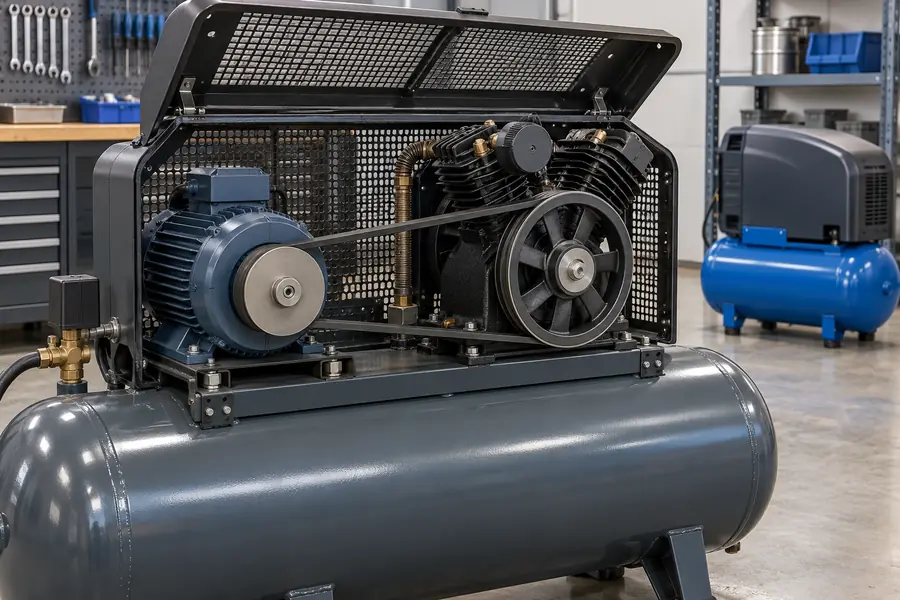
A conventional belt-driven compressor generally includes:
electric motor
motor pulley
drive belt
compressor pulley or flywheel
and:
compressor pump or airend.
The mechanical power path is:
Motor → pulley → belt → compressor pulley → compression element
When the motor rotates, the belt transfers power to the compressor.
A common example is a stationary reciprocating compressor with a large flywheel beside its motor.
However, a fully enclosed rotary screw compressor may hide its transmission system behind cabinet panels.
Therefore, external appearance alone may not confirm whether a belt is installed.
Check the manufacturer's specification sheet
I search for descriptions such as:
Belt drive
V-belt drive
Direct drive
Coupling drive
or:
Gear drive.
These terms identify different power-transmission arrangements.
For example, Kaeser offers belt-driven rotary screw compressors in its compact industrial range.
Its published 3–30 hp belt-drive product information includes:
9–140 CFM
and pressure options of:
125, 160, and 217 PSIG
depending on model.
The machines use a belt transmission with an automatic tensioning system.
Source: Kaeser — Belt-Drive Rotary Screw Compressors
Check the exact model, not only the manufacturer
A manufacturer may sell both belt-driven and direct-drive versions.
Kaeser's 30 hp product range illustrates this.
The manufacturer offers:
AS 30 — belt drive
and:
ASD 30 — direct drive.
Both are rotary screw compressors, but their mechanical transmissions differ.
Source: Kaeser — 30 HP Rotary Screw Compressors
This is why I never assume:
All rotary screw compressors are direct-drive.
That statement is incorrect.
Can I inspect the compressor to identify the drive?
A qualified maintenance technician can confirm the transmission using the equipment's approved inspection procedure.
However, rotating belts and pulleys create serious entanglement hazards.
I do not remove the belt guard or reach inside the machine while it is running.
For maintenance inspection, the equipment must be safely stopped, isolated, and protected against unexpected startup according to the manufacturer's instructions and applicable energy-control requirements.
The most reliable starting point remains:
Model number + manufacturer documentation.
What Is the Difference Between Belt-Driven and Direct-Drive Air Compressors?
Both arrangements transfer power from the motor to the compressor, but they use different mechanical connections. This affects transmission efficiency, speed selection, maintenance, and equipment layout.
Belt-driven compressors use belts and pulleys to transfer motor power and can operate the compression element at a speed different from the motor. Direct-drive compressors eliminate belts and normally use a direct shaft or coupling arrangement. Belt drives provide mechanical speed-ratio flexibility, while direct drives generally reduce transmission losses and belt-related maintenance.
How belt drive works
The belt connects two rotating pulleys.
The motor pulley drives the belt, and the belt rotates the pulley connected to the compressor.
Pulley diameter determines the mechanical speed ratio.
Ignoring belt slip, the relationship is approximately:
Compressor RPM = Motor RPM × Motor Pulley Diameter ÷ Compressor Pulley Diameter
For example:
Motor speed: 1,750 RPM
Motor pulley: 100 mm
Compressor pulley: 200 mm
The estimated compressor speed becomes:
875 RPM
This is only an illustration of mechanical power transmission.
Actual belt-drive design must also account for:
motor power
belt rating
shaft loading
compressor operating limits
and:
required cooling.
I would never change pulley sizes on an existing compressor without manufacturer approval.
An incorrect modification can overload the motor or compressor pump.
How direct drive works
A direct-drive compressor removes the belt-and-pulley transmission.
The motor and compression element are connected through a direct shaft arrangement or suitable coupling.
The simplified power path is:
Motor → coupling/shaft → compressor
This reduces the number of intermediate transmission components.
The absence of belts can reduce:
transmission losses
alignment requirements
and:
routine belt replacement.
Atlas Copco explains that direct-drive systems generally provide higher mechanical transmission efficiency because they avoid belt friction and slippage.
Source: Atlas Copco — Belt Drive Versus Direct Drive
What about gear-driven compressors?
Some industrial compressors use gears to transfer motor power and establish the required airend speed.
The power path becomes:
Motor → gearbox → compressor element
Gear drives are different from conventional belt drives and true direct-coupled systems.
However, some manufacturers use broader commercial descriptions for beltless drive arrangements.
I therefore confirm whether a machine uses:
direct coupling
or:
gears
when comparing technical efficiency.
Which drive type is more efficient?
Direct-drive compressors generally have fewer transmission losses because they eliminate belts.
However, the complete compressor's efficiency also depends on:
airend design
motor efficiency
operating pressure
controls
cooling
and:
load profile.
A well-designed belt-driven compressor can still have excellent overall efficiency.
For industrial comparisons, I request:
package input power + actual delivered airflow + operating pressure.
I prefer standardized performance data rather than choosing purely by drive type.
Which compressor is quieter?
Belt-driven machines can sometimes operate more quietly because pulley reduction allows the pump to run at a lower speed.
Belts may also reduce direct mechanical vibration transmission.
However:
belt-driven does not automatically mean quieter.
Noise depends on:
pump speed
compression technology
cabinet insulation
cooling fan
motor
and:
installation conditions.
A purpose-designed enclosed direct-drive rotary screw compressor may be quieter than an exposed belt-driven piston compressor.
I compare published dB(A) ratings under similar measurement conditions.
Belt drive vs direct drive comparison
| Feature | Belt-Driven | Direct-Drive |
|---|---|---|
| Power transmission | Belts and pulleys | Shaft or coupling |
| Mechanical speed ratio | Set by pulley arrangement | Usually direct motor-to-element relationship |
| Transmission losses | Includes belt-related losses | Generally lower |
| Belt maintenance | Required | Not required |
| Pulley alignment | Required | Not applicable |
| Installation footprint | May need additional space | Often compact |
| Initial cost | Often competitive | May be higher |
| Continuous-duty capability | Model-dependent | Model-dependent |
| Noise | Depends on speed and design | Depends on speed and design |
| Typical applications | Workshops and industrial systems | Portable and industrial systems |
The most important point is:
Drive type alone does not determine compressor quality or duty cycle.
Both technologies can be reliable when correctly engineered and maintained.
Which Types of Air Compressors Use Belt Drives?
Belt drives are found in both reciprocating and rotary screw compressors. Their use depends on machine size, operating speed, duty requirements, and manufacturer design.
Belt-driven compressors are common among stationary reciprocating machines and selected small-to-medium rotary screw compressors. Direct-drive arrangements are common in many compact portable compressors and larger industrial screw systems. However, neither piston nor rotary screw technology exclusively determines the drive type; buyers must check the exact model specifications.
Belt-driven reciprocating compressors
A reciprocating compressor uses pistons moving inside cylinders to compress air.
Traditional stationary units commonly include:
motor → drive belt → flywheel → crankshaft → pistons.
This arrangement is widely used for:
automotive workshops
farm maintenance
industrial service areas
and:
general pneumatic tools.
One advantage is the ability to select a suitable pump speed through the pulley system.
A slower pump may provide benefits related to:
mechanical noise
heat management
and:
operating life
when the complete machine is correctly designed.
However, the actual duty rating must come from the compressor manufacturer.
I do not assume every belt-driven piston compressor is rated for continuous operation.
Direct-drive reciprocating compressors
Many compact and portable air compressors connect the motor directly to the pump.
These models are common in:
home garages
construction sites
finish carpentry
and:
light-duty pneumatic applications.
Their advantages often include:
compact dimensions
lower weight
and:
no external belt maintenance.
The tradeoff depends on the design.
Some compact machines may have limited:
airflow
receiver capacity
or:
duty cycle.
However, industrial direct-drive piston compressors also exist, so direct drive should not be treated as synonymous with light duty.
Belt-driven rotary screw compressors
Rotary screw compressors use meshing rotors to compress air continuously.
Some models use belt drives to connect the electric motor to the screw airend.
Kaeser's current 3–30 hp compact rotary screw range is an established example.
These systems can include:
automatic belt tensioning
electronic compressor controls
integrated refrigerated dryers
and, on applicable models:
variable-speed operation.
This demonstrates that belt drives remain a legitimate modern industrial compressor technology.
Direct-drive rotary screw compressors
Many industrial rotary screw systems use direct mechanical transmission.
These are particularly attractive for:
high operating hours
continuous manufacturing
production utilities
and:
facilities prioritizing low routine transmission maintenance.
ELGi describes direct-drive systems as useful for applications where:
energy efficiency + uptime + reduced routine maintenance
are major priorities.
Source: ELGi — Direct Drive vs Belt Drive Air Compressors
Is a VSD compressor belt-driven or direct-driven?
A Variable Speed Drive, or VSD, controls electric motor speed.
It does not automatically specify the mechanical transmission.
A VSD compressor may use:
direct drive
or:
belt drive
depending on the design.
This distinction is important.
VSD = motor speed control technology
Belt drive/direct drive = mechanical power transmission technology
The two classifications describe different parts of the compressor.
Which arrangement suits different buyers?
| Application | Drive arrangement to investigate |
|---|---|
| Portable light-duty compressor | Direct-drive piston |
| Stationary automotive workshop | Belt-driven piston |
| Small industrial screw compressor | Belt or direct drive |
| High-hour industrial screw compressor | Efficient direct or belt-driven design |
| Factory prioritizing low belt maintenance | Direct drive |
| Machine requiring a specific pump speed | Suitable engineered belt-drive system |
| Variable-demand industrial application | VSD system with suitable mechanical drive |
I make the final decision using:
FAD at working pressure + motor input + duty cycle + annual hours.
How Should a Belt-Driven Air Compressor Be Maintained?
A belt-driven compressor can provide reliable service, but its transmission requires periodic inspection. Incorrect tension or alignment can reduce airflow, damage components, and increase downtime.
Belt-driven air compressor maintenance includes checking belt condition, pulley alignment, correct belt tension, guard integrity, and signs of unusual vibration or slippage. The compressor must be safely isolated before belt servicing. Replacement belts and tension settings should follow the manufacturer's specifications rather than generic assumptions.
Inspect the belts for wear
Typical warning signs include:
cracking
fraying
glazing
missing belt material
excessive belt dust
and:
uneven wear.
A belt can look acceptable from a distance while showing serious damage on its contact surfaces.
That is why scheduled inspections matter.
Check belt tension
Incorrect tension can create two different problems.
Too little tension
may cause:
slippage
squealing
heat buildup
and:
reduced compressor speed.
Too much tension
may cause excessive loading on:
motor bearings
compressor bearings
and:
shafts.
I use the manufacturer's recommended tensioning method.
Depending on the equipment, this may require:
a specified deflection-force method
or:
a suitable tension measurement instrument.
Automatic tensioning systems should be checked according to the manufacturer's maintenance schedule.
Check pulley alignment
Misaligned pulleys can make belts wear unevenly.
Potential symptoms include:
edge wear
belt tracking problems
vibration
and:
shortened belt life.
Alignment and replacement should be performed only when the machine is safely isolated.
I do not attempt to guide a belt by hand while the compressor is running.
Inspect belt guards
The guard prevents accidental contact with:
moving belts
pulleys
and:
pinch points.
For U.S. general-industry equipment within the standard's scope, OSHA 29 CFR 1910.219 addresses mechanical power-transmission guarding, including belts and pulleys.
Source: OSHA — Mechanical Power-Transmission Apparatus
I never operate a compressor with a required belt guard removed.
Follow safe energy isolation procedures
Stopping the motor is not sufficient preparation for maintenance.
A compressor may retain hazardous energy in:
electrical systems
compressed-air receivers
and:
mechanical components.
A qualified technician should follow the required isolation and stored-energy control procedure before servicing the belt drive.
OSHA 29 CFR 1910.147 addresses hazardous-energy control during covered servicing and maintenance activities.
Source: OSHA — Control of Hazardous Energy
The exact steps must follow the machine manufacturer's procedure and applicable workplace requirements.
What happens when a compressor belt breaks?
If a conventional belt-driven compressor loses its drive belt, the motor may continue running while the compressor pump no longer turns.
The result is:
motor running + little or no new compressed-air production.
Receiver pressure may temporarily supply connected equipment, but it will eventually fall as air is consumed.
A slipping belt may create less obvious symptoms.
These can include:
slow pressure recovery
unusual squealing
excessive belt dust
and:
heat near the transmission.
However, similar symptoms can also come from:
pump faults
air leaks
or:
motor problems.
A broken belt may also result from:
bearing seizure
pulley misalignment
or:
incorrect belt tension.
Replacing the belt without checking the cause can lead to another failure.
Maintenance troubleshooting table
| Symptom | Possible cause | Maintenance focus |
|---|---|---|
| Belt squealing | Slippage or incorrect tension | Check OEM tension specification |
| Belt dust | Wear or pulley misalignment | Inspect belt and pulleys |
| Slow pressure recovery | Belt slip or compressor fault | Check transmission and air output |
| Excessive vibration | Alignment, belt, or bearing problem | Inspect mechanical condition |
| Repeated belt failure | Incorrect belt, tension, or drive fault | Find root cause |
| Motor runs but no air builds | Broken/slipped belt or pump problem | Verify transmission after isolation |
| Belt overheats | Slip, misalignment, or overload | Inspect complete drive system |
| Guard damaged | Mechanical impact or improper fit | Repair before operation |
My maintenance rule is:
Inspect the complete transmission, not only the belt.
A new belt cannot correct:
worn pulleys
damaged bearings
or:
incorrect compressor loading.
My insights: Is the Air Compressor Belt-Driven
Whether an air compressor is belt-driven depends on its exact mechanical design. Belt drive is a transmission choice, not a defining feature of reciprocating or rotary screw compression.
An air compressor is belt-driven when its motor turns the compression element through belts and pulleys. Some piston and rotary screw models use this arrangement, while others use direct coupling or gears. I identify the drive from the model documentation, then compare efficiency, service requirements, airflow, and operating hours before deciding which design is better.
My first insight: Compressor type does not determine drive type
A reciprocating compressor can use:
belt drive
or:
direct drive.
A rotary screw compressor can also use:
belt drive
or:
direct drive.
This is why I do not identify the transmission solely from terms such as:
piston compressor
or:
screw compressor.
My second insight: Belt drive is not outdated technology
Belt drives are still used in modern compressors.
Kaeser's industrial rotary screw lineup provides a clear example.
The manufacturer offers belt-driven machines with:
electronic controls
automatic belt tensioning
and:
integrated air-treatment options.
Therefore, the presence of a belt does not automatically indicate an inefficient or low-quality machine.
My third insight: Direct drive can reduce maintenance, but does not guarantee better overall performance
Direct-drive compressors remove belt-related service requirements.
However, compressor performance also depends on:
airend design
cooling
motor efficiency
controls
and:
maintenance quality.
A poorly sized direct-drive compressor can use more energy than a properly sized belt-driven machine.
I therefore compare verified:
kW + FAD + working pressure
rather than transmission type alone.
My fourth insight: Belt maintenance should be evaluated against operating hours
For occasional use, belt inspection and periodic replacement may represent a relatively small ownership cost.
For a compressor operating:
6,000–8,000 hours per year
transmission efficiency and maintenance interruptions can become more important.
I calculate:
electricity + belts + maintenance labor + downtime
before assuming one arrangement is cheaper.
My fifth insight: My practical checklist for identifying a belt-driven compressor
When someone asks me, “Is the air compressor belt-driven?”, I use this sequence:
1. Identify the manufacturer and model.
Find the exact product designation.
2. Check the specification sheet.
Look for:
belt drive, direct drive, coupling, or gear drive.
3. Check the maintenance manual.
Does it specify belt inspection or replacement?
4. Identify the compression technology.
Piston?
Rotary screw?
Scroll?
Other?
5. Confirm the power transmission.
Is there a belt-and-pulley assembly between the motor and compressor?
6. Check motor speed and compressor speed.
A belt system may use a defined pulley ratio.
7. Verify airflow and pressure.
Use the compressor's rated output at its actual working pressure.
8. Check operating hours.
Intermittent or continuous?
9. Review maintenance requirements.
Does the machine require:
belt inspection + tensioning + alignment?
10. Compare energy efficiency.
Use:
delivered airflow + package input power.
11. Check replacement-part availability.
Confirm the correct OEM-approved belt specification.
12. Consider lifetime cost.
Include:
purchase + electricity + maintenance + downtime.
My final buyer comparison
| Buyer priority | My preferred starting point |
|---|---|
| Identify an existing compressor | Confirm exact model and drive specification |
| Lower initial industrial purchase cost | Compare belt-driven options |
| Reduce belt-related maintenance | Evaluate direct drive |
| Need a compact portable compressor | Investigate direct-drive models |
| Need a stationary workshop compressor | Compare belt-driven piston models |
| Require continuous factory operation | Compare verified industrial compressor efficiency |
| Have variable air demand | Evaluate VSD independently of mechanical drive |
| Want the lowest ownership cost | Compare complete lifecycle economics |
My final recommendation is:
Do not choose an air compressor simply because it is belt-driven or direct-driven.
Start with:
required CFM → pressure → duty cycle → operating hours.
Then evaluate:
drive efficiency + maintenance + noise + local service.
A belt-driven compressor can be a reliable and economical solution.
A direct-drive compressor can also provide strong efficiency and low routine maintenance.
The better choice is the machine that meets the air-demand requirement with the lowest practical lifecycle cost.
Conclusion
Some air compressors are belt-driven; others use direct or gear drives. Confirm the specific model and compare airflow, efficiency, duty cycle, maintenance, and ownership cost.