
](https://kaishanpro.com/wp-content/uploads/2026/10/Understanding-Down-the-Hole-Hammers-A-Guide-for-Engineers-and-Drillers.webp)
A DTH hammer can deliver excellent hard-rock productivity, but poor matching of the hammer, bit, compressor, rig, and geology quickly increases drilling cost.
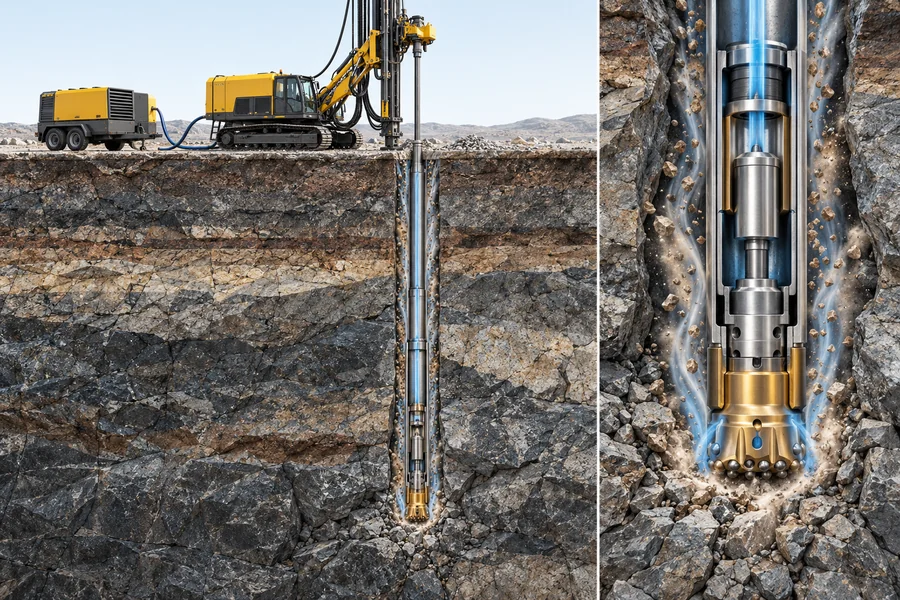
A down-the-hole hammer is a pneumatic percussion tool positioned directly behind the drill bit at the bottom of the borehole. Compressed air drives an internal piston that repeatedly strikes the bit, while the drill string provides rotation and feed. Exhaust air then passes through the bit and carries broken rock cuttings toward the surface.
A DTH hammer works within an energy-transfer chain: compressor, drill pipe, hammer, piston, bit, rock, and flushing air. Proper matching improves penetration, straightness, and reliability.
What Is a Down-the-Hole Hammer and How Does It Work?
A DTH hammer combines percussion, rotation, feed, and compressed-air flushing at the bottom of the hole rather than generating impact energy at the surface.
In DTH drilling, compressed air travels down the drill string and cycles a piston inside the hammer. The piston strikes the bit directly. The rig simultaneously rotates the drill string and maintains suitable feed force. Exhaust air exits through the bit, cleaning the hole and transporting fractured rock back through the annulus.
The hammer works directly behind the bit
The defining feature of DTH drilling is hammer location.
In top-hammer drilling:
hammer → surface
and impact energy travels through the drill string.
In DTH drilling:
hammer → bottom of hole
The percussion mechanism follows the bit downward as the hole becomes deeper.
Robit describes DTH as a pneumatic drilling method in which the hammer sits directly behind the bit, while drill pipes transmit rotation, feed force, and compressed air.
This arrangement reduces the distance that percussion energy must travel before reaching the rock.
That is one reason DTH is so useful for:
- Hard-rock water wells
- Quarry blastholes
- Open-pit mining
- Geothermal drilling
- Construction
- Foundation work
- Geotechnical drilling
Compressed air drives the piston
The compressor supplies pressurized air through:
hose → rotary head/swivel → drill pipe → hammer
Inside the hammer, air is directed so the piston cycles rapidly.
The piston repeatedly strikes the impact surface of the bit shank.
The bit then transfers that energy to tungsten-carbide buttons contacting the rock.
The process becomes:
air pressure → piston motion → impact energy → carbide buttons → rock fracture
Mincon's current DTH range covers hammer classes from approximately 3 inches to 40 inches, illustrating how the same basic percussion principle scales from conventional quarry and water-well holes to very large construction and foundation applications.
Rotation distributes the impacts
The hammer does not simply strike one point repeatedly.
The drill rig also rotates the hammer and bit.
That rotation allows successive carbide buttons to strike new areas of the hole bottom.
The combined action is:
percussion + rotation + feed
The bit progressively crushes and chips the rock.
The ideal rotational speed depends on:
hammer diameter + bit design + rock type + penetration rate
I do not automatically maximize rpm.
If rotation is too slow, the buttons can repeatedly strike nearly the same locations.
If rotation is unnecessarily high, button and gauge wear can increase.
Feed keeps the bit in contact with the rock
The rig applies feed force through the drill string.
The purpose is to maintain suitable contact between:
piston → bit → rock
Too little feed can create:
poor energy transfer + excessive vibration + unstable drilling
Too much feed can:
choke hammer action + increase bit wear + reduce penetration
The correct setting should therefore support hammer operation rather than simply applying the maximum feed force available.
Exhaust air cleans the hole
After compressed air drives the piston, it still has another critical job.
It exits through the hammer and bit as flushing air.
Robit explains that this exhaust flow carries the broken rock particles from the hole bottom toward the surface.
That means the compressor must do two jobs:
power the hammer
and:
clean the hole
A hammer may strike correctly while drilling performance remains poor because the compressor cannot remove cuttings fast enough.
This leads to:
cuttings recirculation → regrinding → slow penetration → higher bit wear → possible stuck tooling
For engineers, flushing is therefore part of hammer sizing—not a secondary consideration.
What Are the Main Parts and Types of DTH Hammers?
Although DTH hammer designs vary, most systems contain the same functional groups: an air connection, piston mechanism, outer housing, bit-retention components, and a chuck that connects hammer rotation to the bit.
Typical DTH hammer components include the backhead, check valve, air-distribution components, piston, wear sleeve or outer casing, bit-retaining parts, chuck, and compatible drill bit. Hammer designs may also differ by shank system, footvalve configuration, operating pressure, air consumption, hole-size range, and intended application.
Backhead
The backhead connects the hammer to the drill string.
Common connections can include standardized API thread configurations.
Its jobs include:
mechanical connection + compressed-air entry
The backhead specification should therefore match the drill pipe or adapter.
I verify this before ordering.
Check valve
Many hammer designs use a check valve to help prevent water and contamination from moving backward into the hammer when compressed-air supply is interrupted.
This becomes especially important in:
water-well drilling
wet holes
and:
deep boreholes with substantial groundwater inflow
Piston
The piston is the main moving impact component.
Compressed air accelerates it repeatedly toward the bit.
Its:
mass + stroke + frequency + air timing
strongly influence hammer behavior.
Different hammer designs may prioritize:
high-impact energy
or:
higher impact frequency
depending on the application.
Wear sleeve
The outer body or wear sleeve protects the hammer's internal components and guides it through the hole.
External wear becomes particularly important in:
abrasive formations
broken rock
and:
deep drilling
The engineer therefore needs to evaluate not only piston life but also:
outer-diameter wear + chuck wear + top-end wear
Chuck
The chuck holds and guides the bit while transmitting rotation.
The bit can move axially enough for the piston to strike it, while splines transfer rotational movement.
A worn chuck can affect:
bit guidance + rotation transfer + hole quality
and may eventually contribute to expensive hammer damage.
Bit-retaining components
Retaining rings or similar components prevent the bit from falling out of the hammer while still allowing the axial movement required for percussion.
These relatively small components can stop an entire drilling operation if neglected.
Bit shank
The bit shank is one of the most important compatibility dimensions.
A bit does not fit a hammer simply because both are described as:
5 inch
For example, Mincon's current 5-inch hammer family supports several shank systems, including QL50, DHD350, MQ50, and MC51, with models covering approximately 127–152 mm bit diameters.
Therefore my purchase specification says:
hammer model + shank + diameter + bit face + button design
not:
“5-inch DTH bit.”
Footvalve and tubeless designs
Some DTH bits use a footvalve.
Other hammer systems are designed for:
tubeless / no-footvalve bits
Mincon's current 5-inch family includes both configurations depending on hammer and shank design.
Robit also offers tubeless hammer designs intended to eliminate downtime associated with footvalve breakage, particularly in wet or unconsolidated drilling conditions.
Neither system is automatically superior for every application.
I choose according to:
hammer design + water conditions + bit availability + maintenance strategy
Conventional DTH hammers
These are used across:
mining
quarrying
water wells
geothermal
construction
and:
geotechnical drilling
Mincon currently markets hammer families from 3-inch through very large sizes for these different applications.
Deep-hole hammers
Deep drilling creates:
backpressure + water influx + air losses + long drill strings
so deep-hole hammer designs can emphasize air efficiency and performance under backpressure.
Epiroc's current QLX series is specifically optimized for deep-hole conditions and includes an Air Select system intended to match hammer operation to different air packages.
This is especially relevant for:
deep water wells + geothermal + exploration
where pulling the drill string because of a hammer problem can be extremely expensive.
Casing-advance DTH systems
In unstable ground, a standard open hole may collapse.
Special DTH systems can drill while advancing casing.
Robit's current Prime systems, for example, pair defined casing dimensions with DTH hammer classes and allow drilling through overburden while installing casing.
I therefore distinguish:
DTH hammer
from:
complete DTH casing system
when the geology includes unstable overburden.
How Should Engineers and Drillers Select the Right DTH Hammer?
The correct hammer is defined by the required hole and drilling system, not by nominal hammer size alone.
I select a DTH hammer in this order: application, geology, hole diameter, depth, hammer size, exact shank, bit design, operating pressure, airflow, compressor, drill pipe, and rig capability. I then compare real drilling metrics such as penetration rate, fuel consumption, bit life, hammer service intervals, downtime, and cost per drilled meter.
Start with the application
I first identify whether the project is:
quarrying
open-pit mining
water-well drilling
geothermal
foundation drilling
or:
geotechnical construction
The application determines what matters most.
For mining:
meters per shift + cost per meter
may dominate.
For water wells:
depth + water influx + compressor efficiency
become critical.
For foundations:
casing + straightness + ground stability
can determine success.
Define the geology
I classify the formation by:
hardness
abrasiveness
fracturing
water
and:
stability
Hard competent rock may favor strong impact performance.
Highly abrasive formations make:
wear sleeve + chuck + carbide life
more important.
Wet deep holes increase the importance of:
backpressure handling + flushing + check-valve performance
Match hammer diameter to hole diameter
The hammer should operate inside a bit-size range approved by the manufacturer.
For example, Mincon's current 5-inch MP hammer family covers approximately:
127–152 mm holes
depending on model.
Current Epiroc surface DTH rigs also illustrate how hammer class and hole range interact. Its FlexiROC D50 uses 4- and 5-inch-class hammers across roughly 90–130 mm holes, while larger DTH platforms extend toward larger hole diameters and additional hammer classes.
I treat these as equipment examples rather than universal size rules.
Match pressure and airflow
The hammer manufacturer should provide an operating curve or technical table.
I need:
air consumption at the pressure I actually plan to use
not only one maximum CFM value.
Higher pressure can increase hammer performance within the approved range, but it also increases air demand.
The compressor must therefore satisfy:
pressure + FAD simultaneously
For deep or large holes, I also add the flushing requirement.
Check the compressor at site conditions
The compressor catalogue is only the starting point.
I verify:
FAD at operating pressure
site altitude
ambient temperature
hose losses
pipe losses
and:
expected water conditions
Mincon's current product data explicitly notes that air density changes with altitude and that air-package requirements must account for site and ground conditions.
That makes altitude particularly important for:
mountain mines + geothermal projects + remote water wells
Match the drill rig
The drill rig must be able to:
rotate the hammer
apply controlled feed
support the drill string
and:
pull everything back out
Current Epiroc DTH rigs demonstrate this system approach. For example, the FlexiROC D55 combines 4- and 5-inch hammer capability, 90–152 mm holes, and a 354 l/s onboard air package in its listed configuration.
The exact rig-hammer-compressor combination therefore matters more than one isolated maximum specification.
Match the bit to the rock
After confirming shank compatibility, I select:
bit diameter
face design
button profile
and:
flushing arrangement
The engineering sequence is:
hammer → shank → diameter → face → buttons → flushing
not:
choose attractive bit → hope it fits the hammer
Consider serviceability
A high-performance hammer provides little value if every rebuild requires excessive downtime.
Epiroc's current QL family emphasizes modularity and serviceability, while its newer DTH 5 platform reduces part count and is designed for rebuildability.
For remote operations, I therefore ask:
Can technicians rebuild it locally?
Are piston, chuck, wear sleeve, seals, and retainers stocked?
How quickly can replacement bits arrive?
What Operating Practices and Problems Matter Most With DTH Hammers?
Many apparent hammer failures are actually system-matching or operating problems involving air supply, flushing, feed, rotation, lubrication, worn bits, or poor maintenance.
When a DTH hammer loses performance, I check compressor pressure and airflow, hole flushing, feed force, rotation speed, lubrication, bit condition, shank/chuck wear, air leaks, and water conditions before blaming the piston. Low penetration is often a system symptom rather than proof that the hammer itself has failed.
Low penetration rate
If penetration suddenly falls, I check:
air pressure
airflow
bit wear
feed
rotation
hole cleaning
water inflow
and:
hammer condition
Poor flushing is especially important.
If cuttings remain at the bottom:
the bit drills old cuttings instead of fresh rock
That wastes impact energy.
Hammer stops striking
Possible causes can include:
insufficient air pressure
internal contamination
piston sticking
incorrect feed
bit not properly contacting the bottom
internal wear
or:
water/foreign material
Diagnosis should follow the hammer manufacturer's service procedure rather than immediately dismantling equipment at random.
Excessive external wear
If the wear sleeve or chuck is wearing unusually fast, I look at:
abrasive rock
hole deviation
oversized annulus
cuttings velocity
rotation practices
and:
drilling through broken material
External hammer wear should be tracked just like bit wear.
Bit button wear
Carbide buttons gradually lose their original geometry.
As buttons flatten:
penetration falls + energy transfer becomes less efficient + stress patterns change
A regrinding program can therefore affect both bit life and hammer productivity.
I track:
meters drilled between grinds
rather than waiting until the bit becomes severely worn.
Poor lubrication
Many pneumatic DTH hammers depend on suitable rock-drill oil delivered with the compressed air.
The lubrication requirement changes with:
hammer size
airflow
pressure
and:
temperature
I follow the hammer supplier's oil specification and injection rate.
Too little lubrication can cause severe internal wear.
Wet-hole performance
Water changes hammer behavior.
Deep water can increase backpressure.
High groundwater inflow also increases the load on the flushing system.
Epiroc's QLX series is specifically positioned for demanding deep-hole conditions involving water influx and backpressure, showing how important those conditions become when hammer selection moves beyond shallow dry drilling.
Casing and unstable ground
Sometimes the hammer is not the problem at all.
If the formation collapses behind the bit, drilling can become impossible regardless of hammer performance.
In that case, I evaluate:
casing advancement
Robit's current DTH Prime system covers casing arrangements from relatively small to very large diameters and demonstrates how DTH can be integrated with casing rather than used only for open-hole drilling.
Track cost per meter
I monitor:
| Metric | Why it matters |
|---|---|
| Penetration rate | Productivity |
| Fuel consumption | Compressor cost |
| Bit meters | Consumable cost |
| Hammer service interval | Maintenance cost |
| Wear sleeve life | Hammer lifecycle |
| Regrind interval | Carbide economics |
| Hole deviation | Hole quality |
| Downtime | Rig utilization |
| Cost per drilled meter | Final economic result |
The fastest hammer on one shift is not necessarily the lowest-cost hammer across the project.
My insights: Understanding Down-the-Hole Hammers-A Guide for Engineers and Drillers
A DTH hammer looks like a relatively simple cylindrical tool, but its actual performance is created by the interaction of pneumatic, mechanical, geological, and operating variables.
For engineers and drillers, the most useful way to understand a down-the-hole hammer is as an energy-conversion device inside a complete drilling system. The compressor supplies air energy, the piston converts it into impact, the bit transfers it into the formation, and exhaust air removes the broken rock so the cycle can continue efficiently.
My first insight is that the hammer cannot be evaluated alone
I treat the system as:
rig + compressor + drill pipe + hammer + bit + geology
If one component is wrong, the others cannot fully compensate.
A premium hammer with an undersized compressor may perform worse than a well-matched standard hammer.
My second insight is that shank compatibility comes before bit optimization
Before discussing:
flat vs convex
or:
spherical vs ballistic carbide
I verify:
exact hammer model + exact shank
Mincon's current 5-inch family alone supports several different shank systems within one nominal hammer class.
That is why purchasing by nominal inches alone creates expensive mistakes.
My third insight is that compressor sizing determines whether the hammer reaches its potential
Compressed air is both:
power source
and:
flushing medium
I therefore calculate:
hammer air demand + cuttings-removal demand + site losses
before choosing the compressor.
For deep-hole drilling, this becomes even more important because water, backpressure, drill-string length, and leakage all affect the useful air reaching the hammer.
My fourth insight is that different applications need different DTH designs
My application logic looks like this:
| Application | What I prioritize |
|---|---|
| Quarrying | Penetration, durability, easy service |
| Mining | Meters/shift, fuel, cost/meter |
| Water well | Air efficiency, depth, wet-hole performance |
| Geothermal | Deep-hole reliability, straightness |
| Foundation | Casing compatibility |
| Geotechnical | Ground control, accurate drilling |
| Abrasive formations | External wear protection |
| Wet deep holes | Backpressure and water handling |
Modern hammer families reflect this specialization. Epiroc's current DTH 5 system supports soft through very hard rock and both high- and low-airflow configurations, while Mincon offers DTH hammer families from small to very large sizes across mining, construction, and well-drilling markets.
My fifth insight is that engineers should optimize total drilling cost
When I evaluate a DTH hammer, my sequence is:
1. Application
Mining, quarry, water well, geothermal, foundation, or geotechnical.
2. Geology
Hardness, abrasiveness, fractures, groundwater, and stability.
3. Hole diameter
Define the actual finished hole.
4. Depth
Include maximum, not just average, depth.
5. Hammer class
Use the manufacturer's approved hole range.
6. Shank
Specify exact compatibility.
7. Bit
Choose diameter, face, carbide geometry, and flushing.
8. Working pressure
Use the approved hammer performance range.
9. Airflow
Calculate hammer consumption and hole cleaning.
10. Compressor
Verify FAD at pressure and actual site conditions.
11. Drill pipe
Check thread, diameter, strength, and airflow path.
12. Drill rig
Confirm rotation, feed, pullback, and rod-handling ability.
13. Lubrication
Match oil and delivery rate to the hammer.
14. Maintenance
Plan spare parts and rebuild intervals.
15. Economics
Track penetration, fuel, tooling, downtime, and cost per meter.
This gives me a more useful definition of a “good DTH hammer.”
The best hammer is not automatically:
the hardest striking
the highest pressure
the largest
or:
the most expensive
It is the hammer that turns the available compressor energy into productive rock breaking while maintaining:
good flushing + acceptable wear + reliable service life + suitable hole quality
for the actual drilling project.
For drillers, that means paying attention to what happens at the bottom of the hole.
For engineers, it means treating the complete drilling package as one system.
That combination produces a better result than optimizing any single component independently.
Conclusion
A DTH hammer converts compressed-air energy into bottom-hole percussion. Successful drilling depends on correctly matching the hammer, bit, airflow, compressor, rig, geology, and operating practices.