
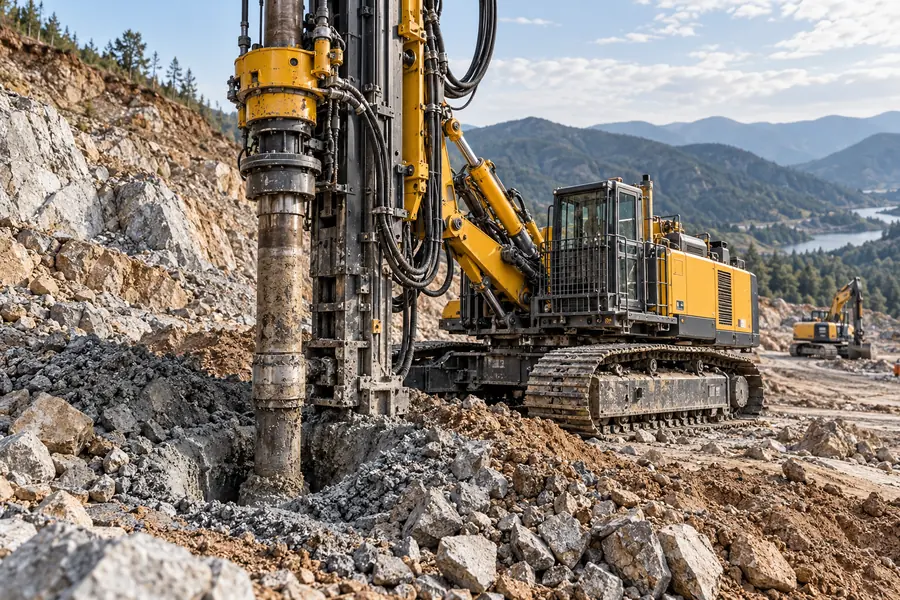
](https://kaishanpro.com/wp-content/uploads/2026/10/What-Are-the-Benefits-of-Using-a-Hydraulic-Rotary-Drilling-Rig.webp)
Drilling through difficult soil and rock requires precise force, reliable equipment, and efficient operation. Poor control can increase tool wear, fuel consumption, and project costs.
The main benefits of a hydraulic rotary drilling rig include high and controllable torque, adjustable drilling speed, precise feed and pullback control, versatile drilling methods, improved operator control, and potentially higher productivity. Modern hydraulic rigs can also integrate automation and monitoring systems to improve drilling consistency, reduce unnecessary machine loads, and support safer operation.
The real advantage is not simply producing more force. It is delivering the required force when and where the drilling process needs it.
How Does a Hydraulic Rotary Drilling Rig Work?
A hydraulic rotary drilling rig uses pressurized hydraulic fluid to operate the rotary drive and other drilling mechanisms. This allows the operator to control rotational movement, axial force, and auxiliary equipment.
A hydraulic rotary drilling rig typically uses an engine or electric motor to drive hydraulic pumps. These pumps supply pressurized oil to hydraulic motors and cylinders that operate the rotary head, feed system, winches, crawler tracks, and positioning mechanisms. Hydraulic valves and electronic controls regulate flow and pressure, allowing drilling parameters to be adjusted to the working conditions.
The basic hydraulic power system
The simplified power path is:
Diesel engine or electric motor → hydraulic pump → control valves → hydraulic motor/cylinder → drilling function
Different hydraulic components perform different tasks.
Hydraulic pumps
Convert mechanical input into hydraulic flow and pressure.
Hydraulic motors
Provide rotary motion for the drilling head and other equipment.
Hydraulic cylinders
Produce linear movement for positioning, feed, and auxiliary functions.
Control valves
Regulate pressure, flow, and movement direction.
Hydraulic reservoir
Stores and supplies hydraulic oil.
Hydraulic filters
Remove contamination from the hydraulic circuit.
Oil cooler
Helps keep hydraulic temperature within the equipment's operating limits.
Electronic controls
Coordinate hydraulic functions on modern machines.
The system allows different drilling functions to be controlled independently or simultaneously, subject to the machine's design and available hydraulic power.
How hydraulic rotary drilling generates torque
The rotary head converts hydraulic power into rotational force.
That force passes through the drilling assembly to the tool.
For example:
Hydraulic motor → rotary drive → Kelly bar or drill pipe → drilling tool → ground
The required torque depends on:
hole diameter
formation hardness
tool design
drilling depth
and:
cutting resistance.
Large foundation augers generally require very different torque and speed characteristics from smaller water-well drilling tools.
A hydraulic system allows the manufacturer to design the required operating range using suitable motors, pumps, and transmissions.
Torque and speed can be adjusted
One important advantage of modern hydraulic rotary drives is the ability to adapt torque and rotational speed to the formation.
For example, Liebherr's BAT 350 rotary drive provides:
Maximum listed torque: 347 kNm
Maximum listed speed: 46 rpm
The unit also offers automatic torque regulation and electronically adjustable speed ranges.
These are different points within the drive's operating envelope. Maximum torque and maximum speed should not be assumed to occur simultaneously.
The engineering advantage is the ability to select suitable operating parameters for changing drilling conditions.
The hydraulic feed and crowd system
Rotation alone does not drill efficiently.
The tool also requires axial force.
Depending on the application, the mechanism may be described as:
feed
crowd
pulldown
or:
pullback.
Hydraulic cylinders or hydraulically driven winch systems apply and regulate these forces.
For example:
Soft soil → controlled feed and appropriate rotation
Dense formation → greater cutting force where required
Tool extraction → controlled pullback
The correct combination depends on the tool and geological conditions.
Hydraulic power does not mean hydraulic percussion
This distinction matters.
A hydraulically powered rotary rig may perform:
Kelly drilling
continuous flight auger drilling
double rotary drilling
direct circulation rotary drilling
or other methods.
Some platforms also support DTH drilling.
In a conventional pneumatic DTH arrangement, the hammer's percussion is powered by compressed air, even though the rig's rotary drive and feed functions may be hydraulic.
Therefore:
Hydraulic rotary drive ≠ automatically hydraulic downhole hammer.
I always identify the actual rock-breaking method before comparing equipment.
What Are the Main Performance and Productivity Benefits of Hydraulic Rotary Drilling Rigs?
Hydraulic technology allows large drilling forces to be controlled across different operating conditions. The resulting benefits include flexibility, drilling consistency, and the ability to coordinate machine functions.
The main performance benefits include controllable high torque, variable rotational speed, precise feed force, strong lifting and extraction capability, compatibility with different drilling methods, and integration with automatic drilling controls. These features can reduce nonproductive time and improve hole quality when the rig, tooling, and operating parameters are correctly matched to the project.
1. High torque for demanding drilling
A major benefit is the ability to provide substantial torque through a compact, engineered drive system.
This is especially useful for:
large-diameter augers
Kelly drilling
harder formations
casing operations
and:
deep foundation construction.
Modern hydraulic rotary drives can deliver hundreds of kilonewton-meters of torque.
For example, Liebherr's BAT 550 rotary drive is rated for up to 550 kNm, depending on its operating configuration.
Source: Liebherr BAT 550 Rotary Drive.
However, torque alone does not determine drilling productivity.
The rig must also have suitable:
feed force + tool design + rotary speed + machine stability.
2. Precise control of drilling speed
Different formations require different drilling parameters.
For example:
Loose soil
May require controlled rotation to avoid excessive disturbance.
Dense clay
May require additional torque and careful management of auger loading.
Rock
May require a specialized cutting tool and suitable torque-speed characteristics.
Hydraulic and electronic controls allow operators to adjust the drilling response to these conditions.
Liebherr's drilling assistance technology coordinates rotary speed, torque, and crowd force and adjusts the process according to selected parameters.
Source: Liebherr Drilling Assistance Systems.
The advantage is more consistent application of the required drilling force.
3. Better feed and pullback control
Hydraulic rigs can regulate both downward and upward movement.
This matters because a drilling machine must do more than penetrate the ground.
It must also safely withdraw the equipment.
In foundation drilling, effective extraction may be necessary for:
large drilling tools
heavy casing
and:
adhesive soil conditions.
In water-well drilling, pullback is particularly important because the rig must recover the drill string from the completed borehole.
A representative hydraulic water-well platform is the Comacchio CA 1520, which lists:
20 tonnes retract force
12 tonnes feed force
7 m feed stroke
and a rotary torque range of approximately:
900–3,750 daNm.
These specifications illustrate how hydraulic drilling systems combine rotary performance and substantial axial force.
4. Compatibility with multiple drilling methods
Hydraulic rotary rigs can support a range of drilling technologies when correctly configured.
Common examples include:
Kelly drilling
Continuous Flight Auger (CFA)
Full displacement drilling
Double rotary drilling
Direct circulation rotary drilling
and, on suitable rigs:
DTH drilling.
Liebherr identifies Kelly, CFA, full displacement, double rotary, and DTH among its deep-foundation drilling methods.
Source: Liebherr Drilling Methods.
This can be valuable for contractors working across different projects.
However, the availability of multiple methods does not mean every attachment is included with the base machine.
Additional equipment may be required.
5. Improved drilling consistency
Modern hydraulic controls can maintain selected:
rotary speed
torque
feed rate
and:
extraction parameters.
This can help reduce variation between drilling cycles.
For CFA pile construction, Liebherr's drilling assistant can coordinate:
crowd force + rotary speed + extraction speed + concrete supply.
Correct coordination helps maintain the intended pile geometry and control the drilling process.
Source: Liebherr Drilling Assistant.
I see this as one of the strongest advantages of modern hydraulic systems.
The benefit comes from precise coordination, not simply high hydraulic pressure.
6. Potentially shorter drilling cycles
A modern hydraulic rig can coordinate several movements.
Examples include:
rotary motion
feed movement
winch operations
tool positioning
and:
tool extraction.
This may reduce delays between drilling steps.
Certain hydraulic and electronic assistance systems can also automate repeated functions.
However, actual cycle-time improvements depend on:
tooling + soil conditions + operator training + rig configuration.
I do not assume that every hydraulic machine is automatically faster than every mechanical or electrically driven alternative.
7. More flexible equipment control
Hydraulic power can operate multiple attachments and auxiliary functions.
For example, certain rigs can support:
casing oscillators
special rotary heads
winches
hydraulic clamps
and:
rod-handling systems.
Liebherr's LB 35.1 uses onboard hydraulic power for drilling equipment and compatible attachments, reducing the need for an additional power pack in certain configurations.
Source: Liebherr LB 35.1.
For a contractor, this can simplify equipment coordination.
Performance benefit summary
| Benefit | Hydraulic system advantage | Practical result |
|---|---|---|
| High torque | Strong hydraulic rotary drive | Large-tool capability |
| Variable RPM | Adjustable drive speed | Better formation matching |
| Controlled feed | Adjustable axial force | More consistent drilling |
| Strong pullback | Hydraulic extraction capability | Easier tool recovery |
| Multipurpose operation | Supports different attachments | Greater project flexibility |
| Coordinated functions | Integrated control systems | Potentially shorter cycles |
| Automation | Repeatable operating parameters | Improved consistency |
| Monitoring | Pressure and system data | Better fault diagnosis |
The most important performance advantage is:
controlled hydraulic power matched to the drilling task.
Where Are Hydraulic Rotary Drilling Rigs Most Useful?
Hydraulic rotary drilling rigs are widely used in construction, water-well drilling, geotechnical exploration, and specialized ground engineering. Their advantages vary by project.
Hydraulic rotary rigs are particularly useful for deep foundation piles, large-diameter boreholes, water wells, geological investigation, casing operations, and multipurpose drilling. Their adjustable torque, feed, and pullback systems help contractors adapt to changing formations. The best rig configuration depends on drilling diameter, depth, geology, site conditions, and the selected drilling method.
Foundation pile construction
Best suited for: large-diameter bored piles
Hydraulic rotary foundation rigs are widely used for:
high-rise building foundations
bridge foundations
industrial structures
transport infrastructure
and:
retaining systems.
These projects often require:
high torque
controlled crowd force
accurate hole positioning
and:
heavy-duty lifting systems.
Kelly drilling is one of the major methods used in foundation work.
Liebherr describes Kelly drilling as suitable for a wide range of soil and rock conditions using augers, buckets, and core barrels.
Source: Liebherr Kelly Drilling.
For unstable ground, casing may be required to support the excavation.
The hydraulic rig must therefore be selected around the full pile-construction process.
Continuous Flight Auger drilling
Best suited for: suitable ground conditions and cast-in-place pile production
CFA drilling uses a rotating continuous auger to penetrate the formation.
During withdrawal, concrete is pumped through the hollow auger stem.
The drilling process requires coordination between:
rotary speed
feed force
extraction speed
and:
concrete delivery.
A modern hydraulic control system can coordinate these functions.
This can help maintain pile geometry and improve repeatability.
However, ground conditions, correct concrete supply, and the approved pile-installation procedure remain essential.
Water-well drilling
Best suited for: multipurpose rotary and DTH-capable water-well rigs
Water-well contractors may encounter:
sand
clay
gravel
fractured rock
and:
hard bedrock.
A suitable hydraulic rotary rig can be configured for different methods.
For example, Comacchio's CA 1520 supports:
direct circulation rotary drilling
DTH drilling
and:
reverse circulation drilling
depending on the installed equipment.
The benefit is flexibility.
A contractor may be able to use one base rig for different geological conditions.
However, the quotation must include the necessary:
rotary head
pump or compressor
drill string
rod-handling equipment
and:
other accessories.
Geotechnical investigation
Best suited for: controlled drilling and sampling
Geotechnical work requires information about underground conditions.
Applications include:
soil investigation
environmental boreholes
groundwater monitoring
and:
rock sampling.
Hydraulic control can help the operator adjust:
rotation
feed
and:
tool handling
to the sampling method.
However, sample quality depends on the complete drilling and sampling procedure, not hydraulic power alone.
Casing and difficult extraction conditions
Some projects require temporary or permanent casing.
Casing can help stabilize:
unstable formations
or:
water-bearing ground.
Installing and extracting casing may require substantial torque and pullback.
Liebherr's Crowd Booster system, for example, coordinates winch systems to increase available extraction force on compatible equipment.
Source: Liebherr Crowd Booster.
This demonstrates how integrated machine systems can provide additional capability for difficult extraction operations.
Restricted or complex construction sites
Hydraulic rotary rigs can also be useful in constrained construction environments.
Depending on model, available features may include:
compact machine designs
folding leaders
short-mast configurations
and:
precision positioning.
For example, Liebherr's LB 20.1 can be transported with its leader folded and offers a shortened-leader option for restricted headroom.
Source: Liebherr LB 20.1.
These features can improve site accessibility.
However, transport weight, ground bearing capacity, and required drilling clearance must still be verified.
Application comparison
| Application | Main hydraulic benefit | Key rig specification |
|---|---|---|
| Large foundation piles | High torque and controlled crowd | Torque, diameter, depth |
| CFA piling | Coordinated feed and extraction | Torque, crowd, concrete controls |
| Water wells | Rotary and pullback flexibility | Torque, pullback, circulation |
| Geotechnical drilling | Controlled drilling parameters | RPM, feed, sampling compatibility |
| Casing installation | Controlled torque and extraction | Torque, pullback, tooling |
| Restricted construction sites | Controlled movement and positioning | Dimensions, stability, mast configuration |
| Multipurpose drilling | Compatibility with different equipment | Hydraulic capacity and accessories |
The most suitable application is the one where the hydraulic system's capabilities match the actual drilling requirements.
What Limitations, Safety Risks, and Buying Factors Should You Consider?
Hydraulic rotary drilling offers important benefits, but its performance depends on correct system design, maintenance, and operating procedures. Hydraulic technology introduces its own costs and risks.
The main considerations include hydraulic system efficiency, oil temperature, leaks, filtration, hose condition, equipment weight, working-platform stability, attachment compatibility, operator training, and maintenance support. Hydraulic rigs can be highly productive, but poor maintenance or incorrect sizing can increase fuel use, reduce available drilling force, and cause expensive downtime.
Hydraulic systems require careful maintenance
A hydraulic drilling rig contains:
pumps
hydraulic motors
valves
hoses
cylinders
filters
and:
cooling equipment.
Its reliability depends on the condition of the complete circuit.
Common maintenance concerns include:
hydraulic oil contamination
filter restriction
hose deterioration
seal wear
overheating
and:
internal leakage.
Contaminated oil can damage precision hydraulic components.
I therefore prioritize proper filtration and the manufacturer's hydraulic maintenance schedule.
Excessive temperature reduces performance
Hydraulic systems generate heat through:
fluid friction
pressure losses
and:
mechanical inefficiencies.
If the hydraulic cooler is inadequate or contaminated, oil temperature may rise.
This can affect:
oil viscosity
seal life
hydraulic performance
and:
component durability.
For hot climates, I verify:
maximum ambient temperature
cooling performance
and:
approved hydraulic fluid specifications.
Hydraulic pressure is not the same as usable drilling torque
A common purchasing mistake is selecting a rig based only on:
maximum hydraulic pressure.
High circuit pressure does not automatically prove that the machine delivers the required rotary torque or extraction force.
I request:
rotary torque-speed curve
feed force
pullback force
and:
system operating limits.
The hydraulic system must be assessed through actual machine performance.
Hydraulic rigs are not automatically more energy efficient
Hydraulic power transmission has losses.
These may occur through:
pump inefficiency
motor inefficiency
valve throttling
hose pressure drop
and:
heat generation.
Modern systems can reduce some of these losses through:
load-sensitive control
efficient hydraulic components
automatic engine-speed management
and:
energy recovery.
BAUER's Energy Efficient Power technology is an example of a manufacturer-specific system designed to optimize power distribution and energy use.
In its September 2026 technical update, BAUER reports fuel savings of up to 20% for its rotary drilling rigs equipped with the relevant efficiency technologies.
Source: BAUER — 50 Years of Rotary Drilling Rigs.
That is a manufacturer's qualified claim, not a guaranteed saving for every rig or jobsite.
Direct-electric drilling systems may also offer advantages in appropriate applications.
I therefore compare measured energy consumption rather than assuming hydraulic technology always wins.
Working-platform stability remains critical
Large hydraulic rotary foundation rigs can be extremely heavy.
They also generate considerable:
rotary reaction forces
crowd forces
and:
lifting loads.
The ground must safely support the machine during drilling, traveling, and tool handling.
NIOSH identifies inadequate working platforms and improper equipment use as significant contributors to rotary foundation drilling rig overturns.
Source: NIOSH — Preventing Drill Rig Overturns.
I require appropriate ground assessment and working-platform preparation before drilling begins.
Hydraulic control does not compensate for unsafe ground support.
High-pressure hydraulic fluid is a serious hazard
Hydraulic systems may retain pressure even after the engine is stopped.
A damaged hose can release a high-pressure fluid jet.
This can cause severe injuries, including fluid injection beneath the skin.
OSHA has documented workplace injuries from high-pressure hydraulic fluid injection.
I never use my hands to look for hydraulic leaks.
Maintenance must follow the correct:
shutdown → lockout/isolation → stored-pressure release → verification → servicing
procedure.
Automation supports safety but does not replace training
Modern rigs may offer:
operator-assistance systems
automatic leader positioning
machine diagnostics
remote controls
and:
drilling-data monitoring.
These features can reduce workload and help operators maintain selected drilling parameters.
Some automation can also reduce the need for personnel near hazardous mechanical operations.
However, it does not eliminate:
rotating-tool hazards
suspended-load hazards
crush points
or:
overturn risk.
Qualified operation and controlled exclusion zones remain necessary.
Cost considerations
Before purchasing, I compare:
machine price
fuel or electrical energy
hydraulic maintenance
tooling
mobilization
spare parts
service labor
and:
downtime.
A higher-performance rig may be economically attractive if it completes more accepted drilling work per operating hour.
Consider this illustrative example:
| Measure | Rig A | Rig B |
|---|---|---|
| Total operating cost | $240/hour | $300/hour |
| Accepted drilling output | 12 m/hour | 18 m/hour |
| Cost per accepted meter | $20.00 | $16.67 |
Although Rig B costs more per hour, it produces accepted drilled meters at a lower unit cost.
This is a hypothetical calculation, not actual performance data for any manufacturer.
The comparison must also include:
mobilization + tooling + geology + hole quality.
For foundation work, cost per completed pile may be more meaningful than cost per drilled meter.
My insights: What Are the Benefits of Using a Hydraulic Rotary Drilling Rig
The strongest benefit of hydraulic rotary drilling is the ability to control and coordinate several high-force machine functions. This allows the equipment to adapt to changing ground and drilling conditions.
Hydraulic rotary drilling rigs offer controllable torque, adjustable speed, precise feed and pullback, versatile attachment compatibility, and effective integration with modern assistance systems. These capabilities can improve drilling consistency, productivity, and operator control. However, their advantages depend on correct machine sizing, maintained hydraulic systems, suitable tooling, safe working platforms, and realistic project economics.
My first insight: Precise control matters more than maximum torque
Large rotary drilling rigs can generate enormous torque.
However, maximum torque is only one operating point.
The drilling tool also requires the appropriate:
RPM
feed force
and:
cutting conditions.
A rig with lower peak torque but better control over the required operating range may perform more effectively on a particular project.
Therefore, I ask for:
torque-speed characteristics
rather than relying only on a headline torque figure.
My second insight: Multipurpose capability is a major commercial advantage
Hydraulic systems can support different drilling tools and attachments.
This is especially valuable for contractors working across:
foundation piles
water wells
geotechnical investigation
and:
casing operations.
However, I confirm the actual quoted configuration.
A machine advertised as multipurpose may require additional:
rotary heads
pumps
winches
or:
tooling.
Versatility is valuable only when the configuration can perform the required work.
My third insight: Hydraulic and electronic controls work best together
Modern drilling performance comes from integrating:
hydraulic power + sensors + electronic control + operator assistance.
Liebherr's drilling assistance systems demonstrate this by coordinating:
rotary torque
speed
crowd force
and:
extraction parameters.
For CFA drilling, this coordination can also support concrete-placement control.
The advantage comes from improved process management rather than hydraulics alone.
My fourth insight: Efficiency must be measured at the project level
A modern hydraulic rig may reduce:
cycle time
unproductive movements
excessive engine operation
and:
tool stress.
But the actual benefit depends on machine design and working conditions.
I compare:
liters of diesel per accepted meter
productive drilling hours
tool life
hydraulic maintenance
and:
downtime.
I also evaluate direct-electric or electrohydraulic alternatives where site power and operating requirements make them relevant.
My fifth insight: My practical checklist for selecting a hydraulic rotary drilling rig
When someone asks me, “What Are the Benefits of Using a Hydraulic Rotary Drilling Rig?”, I use this sequence to determine whether those benefits will translate into real project value.
1. Define the drilling application.
Foundation, water well, geotechnical, or another method?
2. Specify hole diameter.
Use the required finished diameter.
3. Define drilling depth.
Include normal and maximum depths.
4. Study geology.
Soft soil, dense clay, gravel, fractured rock, or bedrock?
5. Choose the drilling method.
Kelly, CFA, direct rotary, RC, DTH, or another method?
6. Check rotary torque.
Evaluate the operating range, not only the maximum value.
7. Check rotational speed.
Confirm compatibility with drilling tools.
8. Check feed and crowd force.
Can the rig apply suitable axial loading?
9. Check pullback and hoisting capacity.
Can it recover the tool and drill string safely?
10. Review hydraulic power and cooling.
Confirm performance under actual ambient and operating conditions.
11. Check automation and controls.
Are the functions useful for the project?
12. Confirm attachment compatibility.
Verify the complete equipment package.
13. Evaluate working-platform requirements.
Check bearing capacity, stability, and safe access.
14. Review maintenance support.
Hydraulic components, filters, hoses, oil, and technical service.
15. Calculate lifecycle drilling cost.
Use cost per accepted meter or completed pile.
My final benefit comparison
| Buyer requirement | Hydraulic rotary rig advantage | What I verify |
|---|---|---|
| Large-diameter drilling | High controlled torque | Torque-speed curve |
| Changing soil conditions | Adjustable drilling parameters | Control range and tooling |
| Deep drilling | Controlled feed and pullback | Depth and extraction rating |
| Multiple drilling methods | Attachment flexibility | Actual supplied configuration |
| Repetitive pile production | Coordinated drilling controls | Cycle performance |
| Difficult casing extraction | Hydraulic lifting systems | Safe rated pull force |
| Operator assistance | Monitoring and automation | Installed system features |
| Lower operating cost | Potential productivity gains | Measured fuel and cost per meter |
| Long service life | Maintainable hydraulic equipment | Cooling, filtration, parts |
| Safer operation | Controlled machine functions | Platform, training, safeguards |
My final recommendation is:
Choose a hydraulic rotary drilling rig when the project benefits from controlled torque, adjustable feed, strong extraction capability, and flexible drilling methods.
Do not choose one merely because it advertises the highest:
hydraulic pressure
engine power
or:
maximum torque.
The real benefits appear when:
machine capability + drilling method + tooling + geology + operating conditions
are correctly matched.
That is how I evaluate whether a hydraulic rotary drilling rig can improve project productivity and reduce long-term costs.
Conclusion
Hydraulic rotary rigs provide controllable power, versatile drilling capabilities, and precise operation. Their greatest value comes from correct sizing, reliable maintenance, safe setup, and efficient drilling performance.