
](https://kaishanpro.com/wp-content/uploads/2026/09/What-Are-the-Different-Sizes-of-Drilling-Rigs.webp)
Choosing a drilling rig by physical size alone can lead to poor drilling performance, high fuel use, transport problems, and a machine that does not match the actual project.
Drilling rigs are commonly described as small, medium, large, and heavy-duty rigs, but there is no universal size standard. I classify them mainly by drilling depth, hole diameter, torque, pullback or lifting capacity, machine weight, and application. A small mining rig can still be very different from a small water-well or foundation rig.
This difference matters when I select equipment. I never assume that a larger machine is automatically better. I first look at the required hole diameter and depth. Then I consider rock conditions, drilling method, compressor demand, drill rod size, mobility, transportation limits, and expected daily workload.
What Are Small, Medium, and Large Drilling Rigs?
The terms small, medium, and large sound simple, but they can be misleading. Different drilling industries use completely different machines and different ways to measure their capacity.
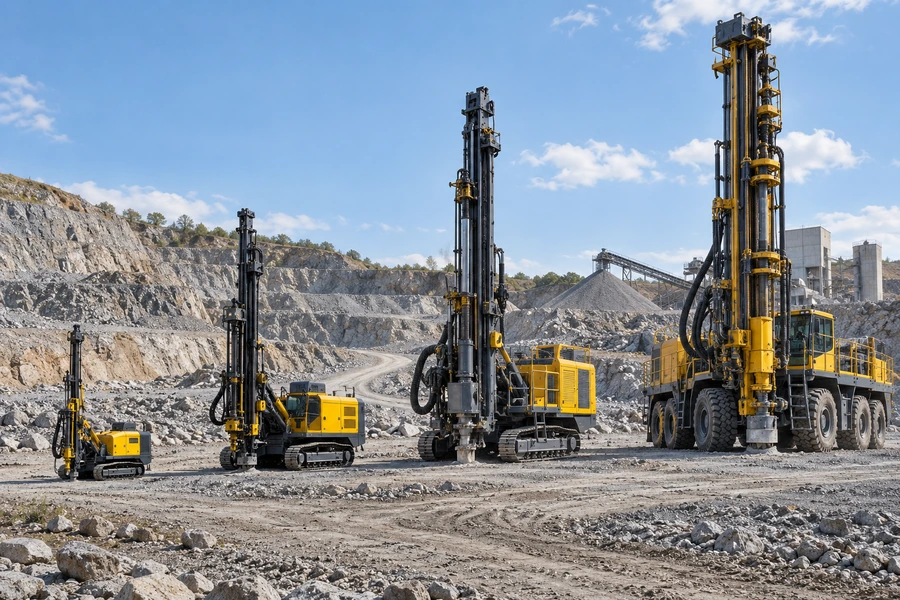
I normally describe drilling rigs as small, medium, or large according to their working capacity rather than only their dimensions. Small rigs focus on mobility and lighter holes. Medium rigs balance mobility and higher drilling capacity. Large rigs provide greater depth, diameter, torque, lifting force, and productivity for demanding projects.
Small drilling rigs
I normally consider a rig small when portability and easy transportation are major advantages.
Small rigs can be trailer-mounted, skid-mounted, crawler-mounted, truck-mounted, or even designed for confined sites. They are often used for shallow water wells, geotechnical investigation, environmental drilling, small foundation projects, light quarry work, solar-pile projects, and small blast holes.
For surface DTH drilling, smaller machines commonly work with relatively modest hole diameters. Current commercial surface DTH equipment includes machines working around the 80–165 mm range, although exact capacity differs significantly between models.
Small water-well rigs use a completely different scale. Portable or lightweight machines can be designed for roughly 50–150 m drilling, while compact crawler water-well rigs can reach much greater depths depending on their configuration.
Medium drilling rigs
I consider medium rigs the most flexible category for many contractors.
These machines usually offer more torque, lifting capacity, hydraulic power, and drill-string handling capacity than small rigs. They are commonly used in quarrying, mining, water-well drilling, construction, geotechnical work, and medium-scale foundation projects.
For example, commercial crawler water-well machines span capacities such as 180 m, 260 m, 300 m, and 350 m, with hole-diameter capability around 140–325 mm on several models.
Large and heavy-duty drilling rigs
Large rigs are used when hole diameter, drilling depth, torque, or production requirements become much greater.
They may weigh tens or even hundreds of tons. Large foundation rotary rigs illustrate the scale clearly. Current machines can range from about 53 tonnes with 1,500 mm maximum drilling diameter to more than 160 tonnes with maximum drilling diameters approaching 4,800 mm on very large foundation systems.
| Rig class | General characteristic | Typical advantage | Common applications |
|---|---|---|---|
| Small | Compact and mobile | Easy transport and lower site requirements | Light DTH, shallow wells, exploration |
| Medium | Higher power with reasonable mobility | Broad operating range | Quarry, mining, water wells, construction |
| Large | High torque and lifting capacity | Deeper or larger holes | Major mining, foundations, deep wells |
| Heavy-duty | Maximum production and capacity | Handles demanding projects | Large infrastructure and resource drilling |
I treat these categories as practical descriptions rather than fixed international standards.
What Size Drilling Rig Do I Need?
Buying too much drilling rig increases transport cost, fuel use, investment, and site requirements. Buying too little capacity can create an even bigger problem when the rig cannot finish the planned hole.
I select drilling rig size from the required hole diameter, target depth, geology, drilling method, drill-string size, torque, lifting capacity, and project workload. I usually choose enough reserve capacity for difficult formations and deeper sections, but I avoid buying a much larger machine unless the project actually requires it.
I start with hole diameter
Hole diameter immediately reduces the number of suitable rigs.
A quarry contractor drilling 90–115 mm blast holes needs a very different machine from a foundation contractor drilling a 2,000 mm pile.
This is why I ask for the finished borehole diameter before discussing specific equipment.
Surface DTH rigs commonly cover ranges such as 80–115 mm, 90–165 mm, or larger depending on hammer and machine configuration. Some heavier DTH models extend beyond 200 mm.
Foundation rotary drilling is completely different. One current classification gives small rotary foundation rigs roughly 0.6–1 m hole capability, medium machines around 1–2 m, and large machines around 2–3 m, although actual manufacturer ranges can go significantly higher.
Then I check depth
I never compare depth without knowing the diameter and drill-string configuration.
A rig may drill deeper with smaller rods but reach a much lower maximum depth with a larger and heavier drill string.
This point is especially important in core exploration. A current example shows one rig rated to about 1,300 m with a smaller NQ-size system, 800 m with HQ, and 500 m with the larger PQ configuration.
That is a huge difference.
I also need the geology
Rock condition can change my selection even when diameter and depth stay the same.
For soft soil, I may use auger or rotary methods. For hard rock quarry or mine drilling, I may use DTH or top-hammer technology. For deep water wells, I may evaluate high-pressure DTH, mud rotary, reverse circulation, or mixed drilling methods.
My basic selection checklist is:
| Project question | Why I need it |
|---|---|
| Required hole diameter | Determines bit, hammer and rig capacity |
| Required depth | Determines feed and drill-string handling requirements |
| Rock or soil condition | Determines drilling method |
| Drill rod diameter | Changes weight and depth capacity |
| Working pressure | Critical for DTH drilling |
| Required air volume | Determines compressor size |
| Daily drilling target | Determines production capacity |
| Site access | Determines crawler, truck or compact configuration |
| Maximum transport size | Can restrict machine weight and dimensions |
| Altitude and temperature | Can affect engine and compressor performance |
I therefore prefer to size the complete drilling system rather than the drilling rig alone.
How Deep Can Different Sizes of Drilling Rigs Drill?
Maximum drilling depth is one of the first specifications buyers compare, but it is also one of the easiest specifications to misunderstand.
Depending on application, drilling rigs can work from a few dozen meters to several thousand meters. Small construction or blast-hole rigs may drill tens of meters, water-well rigs commonly span hundreds of meters, exploration rigs can exceed 1,000 meters, and deep oil, gas, or geothermal rigs can reach several kilometers.
Surface DTH rigs normally drill relatively shallow holes
A surface DTH rig used in a quarry does not need the same depth capacity as a water-well machine.
Blast-hole and quarry rigs often work with holes measured in tens of meters. For example, current DTH machines include models with maximum or rated depths around 20–50 m and hole diameters roughly between 80 mm and more than 200 mm depending on the model.
This does not mean that the rig is small or weak.
A mining machine may weigh more than 10 tonnes and use a powerful compressor even though its drilling depth is only 20–30 m. Its job is to drill production holes quickly rather than make a 500 m borehole.
Water-well rigs work on another scale
Water-well machines can range from portable units to heavy crawler and truck-mounted rigs.
A useful general reference is:
| Water-well rig class | Approximate depth capability |
|---|---|
| Portable/light rig | 50–150 m |
| Professional crawler/DTH rig | 200–600 m |
| Heavy truck-mounted rig | 600–1,000 m+ |
These ranges are not universal specifications. Geological conditions and drilling configuration change real performance.
Current crawler water-well equipment also shows how wide the market has become. Commercial ranges include rigs rated from about 180 m upward, with models designed for several hundred meters of drilling.
Core exploration can go much deeper
Mineral exploration rigs are commonly measured by their capacity with specific core rod sizes.
Small diamond core rigs may work around 50–300 m. Medium exploration rigs can operate around 500–1,000 m. Heavy deep-hole systems can exceed 1,000 m.
This is why I never say, “This is a 1,000 m rig,” without asking: 1,000 m with which drill rod?
The working configuration matters as much as the headline depth.
How Does Hole Diameter Affect Drilling Rig Size?
Two rigs may have similar depth ratings but require completely different structures because one drills a small exploration hole and the other drills a large foundation pile.
As hole diameter increases, I normally need more torque, feed force, lifting capacity, larger drilling tools, stronger structural components, and often more compressor airflow or drilling-fluid capacity. This is why hole diameter must be considered together with depth when I compare drilling rig sizes.
Diameter changes the whole drilling system
For DTH drilling, a larger hole normally requires a larger bit and hammer.
The larger hammer usually needs more compressed air. The compressor therefore becomes part of the rig-sizing problem.
For example, current integrated DTH machines may cover hole ranges from roughly 80–115 mm at the smaller end to well above 150 mm on larger configurations.
As I move toward larger DTH holes, I check:
- DTH hammer diameter
- Drill bit diameter
- Drill pipe diameter
- Rotary torque
- Feed force
- Pullback force
- Compressor pressure
- Compressor air delivery
- Engine power
This is especially important for hard-rock drilling.
A machine may physically accept a larger bit, but that does not automatically mean it will drill efficiently with that bit under real rock conditions.
Large foundation holes are another category
Foundation drilling demonstrates the effect of diameter even more clearly.
Current heavy foundation rigs can reach maximum drilling diameters of approximately 1.5 m, 3.3 m, 4.1 m, 4.5 m, and up to around 4.8 m across different machine classes[^1]. As capacity rises, operating weight and torque rise strongly as well.
A simplified comparison looks like this:
| Application | Typical hole scale | Main sizing concern |
|---|---|---|
| Small blast holes | ~76–115 mm | Mobility and penetration |
| DTH quarry/mining | ~90–254 mm | Air pressure, airflow and torque |
| Water wells | ~100–400+ mm | Depth, pullback and flushing |
| Core exploration | Smaller boreholes | Depth and rod-string capacity |
| Foundation piles | ~600–4,000+ mm | Torque, stability and lifting capacity |
I therefore avoid comparing drilling rigs by depth alone.
A 300 m water-well rig is not automatically “larger” in every engineering sense than a 70 m foundation rig. The foundation machine may be much heavier because it is designed to create a hole several meters in diameter.
My insights: What Are the Different Sizes of Drilling Rigs
Rig buyers often ask for a small, medium, or large machine before defining their borehole. I think reversing that process gives much better results.
The different sizes of drilling rigs are best understood as application-specific capacity classes rather than fixed physical dimensions. I classify rigs by the combination of hole diameter, working depth, torque, lifting or pullback force, drilling method, weight, and support-equipment requirements. The correct size is the smallest rig that can perform the planned work reliably with adequate reserve capacity.
I do not believe one universal small-medium-large table is enough
The most important insight for me is that the meaning of “rig size” changes between industries.
A small HDD machine can be classified according to pullback and torque. One industry reference describes small HDD rigs as machines below roughly 40,000 lb of thrust/pullback and 4,000 ft-lb of torque.
A small foundation rotary rig, however, may be defined by drilling depth and pile diameter.
A small core exploration rig may be defined mainly by rod size and maximum core-hole depth.
A small surface DTH rig may be classified by hole diameter, compressor requirement, machine weight, and blast-hole depth.
These machines cannot be placed into one useful universal size chart.
My practical rig-size framework
When I evaluate equipment, I use five capacity levels.
| Capacity level | How I interpret it | Best fit |
|---|---|---|
| Compact | Maximum mobility and simple transport | Small jobs and restricted sites |
| Small | Light production capacity | Shallow holes and smaller diameters |
| Medium | Balanced production and mobility | General contractor work |
| Large | High torque, depth or diameter | Mining, deep wells and major construction |
| Heavy-duty | Maximum production and structural capacity | Major infrastructure and resource projects |
I then match that physical class to the actual drilling application.
A bigger rig is not always the safer purchase
It is easy to assume that buying extra capacity eliminates risk.
I do not always agree.
A much larger rig may require a bigger transport truck, higher fuel consumption, more expensive tools, more difficult site access, larger support vehicles, and more experienced operators. It can also be unnecessary for repetitive smaller holes.
At the same time, I avoid selecting a rig that will spend every day at its maximum rated capacity.
If a project requires regular 300 m drilling, I want to know whether 300 m is a comfortable working depth or simply the machine's published maximum.
The same applies to diameter.
If the project requires 165 mm holes every day, I would rather use a configuration designed to work efficiently around that diameter than a machine whose 165 mm rating represents its extreme limit.
I size the rig and compressor together for DTH projects
For DTH drilling, I see one more common purchasing mistake: the drilling rig and air compressor are selected separately.
The DTH hammer needs enough air pressure and airflow to operate correctly. A larger hole generally means a larger hammer, and a larger hammer usually means greater compressor demand.
For that reason, I match:
hole diameter → hammer size → pressure and airflow → compressor → drilling rig
rather than choosing the rig first and trying to make the compressor fit afterward.
That approach is especially important for mining, quarrying, construction, and water-well contractors because poor equipment matching can reduce penetration speed even when every individual machine looks adequate on paper[^2].
For me, this is the best way to understand drilling rig size: size is not how big the machine looks. Size is how much drilling work the complete system can perform reliably under the actual project conditions.
Conclusion
Drilling rigs range from compact machines to heavy-duty systems, but I choose size by depth, diameter, geology, torque, lifting capacity, drilling method, mobility, and real project workload.