
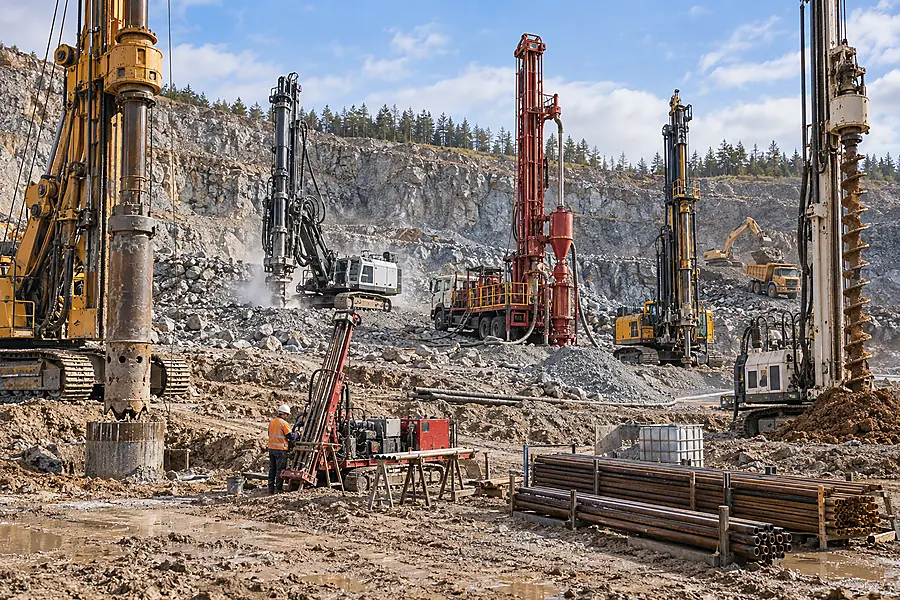
](https://kaishanpro.com/wp-content/uploads/2026/09/What-Are-the-Different-Types-of-Drill-Rigs.webp)
Choosing a drill rig by size or engine power alone can lead to poor penetration, wrong samples, excessive fuel use, and unnecessary project costs.
The main types of drill rigs include rotary, DTH, top-hammer, core, reverse-circulation, auger, horizontal directional, sonic, underground face, and production drilling rigs. I classify them by how they break the formation and what job they perform. The right type depends on geology, hole diameter, depth, sampling needs, and project purpose.
There is no single universal list of drill-rig types. One manufacturer may classify rigs by application, such as surface, exploration, underground, and blasthole rigs, while a drilling contractor may classify them by method, such as rotary, DTH, core, or RC. Current mining-equipment guidance uses both approaches.
What Are the Main Types of Drill Rigs?
The easiest way for me to understand drilling equipment is to classify it by the method used to penetrate the ground or rock.
The most common drilling methods include rotary drilling, down-the-hole drilling, top-hammer drilling, diamond core drilling, reverse-circulation drilling, auger drilling, horizontal directional drilling, and sonic drilling. Each method transfers energy to the formation differently, so each rig is suited to different hole sizes, depths, geology, and project objectives.
I use drilling method as the first classification
The main categories can be summarized like this:
| Drill-rig type | Main drilling action | Common applications |
|---|---|---|
| Rotary rig | Rotation and downward force | Mining, water wells, large blastholes |
| DTH rig | Downhole pneumatic percussion + rotation | Quarrying, mining, hard rock |
| Top-hammer rig | Surface percussion + rotation | Quarrying, construction, smaller blast holes |
| Core drill rig | Rotary diamond coring | Mineral exploration, geological investigation |
| RC rig | Reverse-circulation percussion sampling | Mineral exploration and grade control |
| Auger rig | Rotating auger removes soil | Geotechnical and environmental work |
| HDD rig | Steerable horizontal/curved drilling | Utility and pipeline installation |
| Sonic rig | High-frequency vibration + rotation | Environmental and geotechnical sampling |
I do not treat these categories as strict boundaries.
One rig may support more than one drilling method. Some modern blasthole rigs, for example, can operate in both rotary and DTH configurations. Current equipment ranges include dedicated rotary machines as well as multi-purpose rotary/DTH platforms.
Rotary drilling rigs
A rotary rig turns the drill string while applying downward force.
The bit cuts, scrapes, or crushes the formation.
I normally associate rotary rigs with larger holes, water wells, foundation work, and large mining blast holes.
The flushing medium may be compressed air, water, or drilling mud depending on the application.
For large surface mining, rotary drilling can handle very large diameter blastholes. Current rotary blasthole equipment covers a broad range, with some machines extending beyond 400 mm hole diameter.
DTH drilling rigs
A DTH rig places the percussion hammer directly behind the bit.
Compressed air travels down the drill pipe and drives the hammer piston.
The rig also rotates the drill string while exhaust air carries cuttings upward.
I usually consider DTH for hard rock, medium-to-large hole diameters, and applications where hole straightness is important.
Current DTH guidance places a useful blast-hole range at roughly 90–254 mm, although actual applications can extend outside that range.
Top-hammer drilling rigs
A top-hammer rig keeps the percussion mechanism on the drilling machine rather than down the hole.
Impact energy travels through the drill rods to the bit.
This method can provide very high penetration rates in suitable smaller and medium-size holes.
Current surface top-hammer machines commonly serve quarrying, road construction, civil engineering, and surface mining. One current example covers approximately 64–102 mm holes, while another covers about 64–115 mm.
What Is the Difference Between Rotary, DTH, and Top-Hammer Rigs?
These three rigs can all drill rock, but they transfer energy to the bit in different ways. That difference affects hole diameter, depth, straightness, compressor demand, and drilling efficiency.
A rotary rig breaks rock mainly with rotation and downward force. A DTH rig uses a pneumatic hammer directly behind the bit, while a top-hammer rig generates percussion at the surface and sends impact energy through the drill string. I choose between them by rock hardness, hole diameter, depth, production target, and required hole quality.
The location of the impact energy matters
For conventional rotary drilling:
rotary head → drill string → rotary bit → formation
There is normally no percussion hammer.
For DTH:
compressed air → downhole hammer → bit → formation
For top hammer:
surface rock drill → drill rods → bit → formation
Epiroc's drilling guidance describes top hammer as a method where impact energy is transmitted through the drill string, while DTH places the piston close to the bit so impact energy reaches the rock with very little percussion loss.
This explains why I often consider DTH as hole depth and diameter increase in hard rock.
Hole diameter also changes the choice
I use hole diameter as an early filter.
Epiroc's current DTH guidance says smaller blast holes generally favor top hammer, DTH occupies a useful middle range, and larger holes commonly move toward rotary drilling.
I simplify the comparison like this:
| Factor | Rotary | DTH | Top hammer |
|---|---|---|---|
| Main rock-breaking action | Cutting/crushing | Downhole percussion | Surface percussion |
| Typical compressor role | Flushing | Hammer power + flushing | Flushing/support |
| Hard-rock ability | Strong with correct tooling | Very strong | Very strong in suitable range |
| Hole size | Medium to very large | Medium to large | Small to medium |
| Deep-hole percussion loss | Not applicable | Low | Increases through drill string |
| Typical use | Mining, wells | Mining, quarrying, wells | Quarrying, construction |
I do not say one is always better.
A 76 mm construction hole and a 200 mm mining hole require very different equipment.
The borehole should determine the method.
What Types of Drill Rigs Are Used for Exploration and Sampling?
Production drilling creates holes for blasting, wells, or construction. Exploration drilling has a different purpose: I need reliable information about what is underground.
The main exploration drill rigs include diamond core rigs and reverse-circulation rigs. Core rigs retrieve an intact cylindrical rock sample for detailed geological analysis. RC rigs return fragmented samples through an internal reverse-circulation path and are commonly used for faster mineral exploration and grade-control work. Geotechnical projects may also use auger or sonic rigs.
Core drilling rigs recover intact rock
Diamond core drilling is a major mineral-exploration method.
Instead of crushing the complete bottom of the hole into cuttings, a hollow core bit cuts around a cylinder of rock.
The core enters a core barrel and can later be recovered for geological logging.
Current core-drilling equipment is available for both surface and underground exploration. Epiroc's present core-rig range includes compact surface machines as well as deep-capacity rigs; its Boyles C8C, for example, is published with depth capacity up to approximately 1,830 m, depending on drilling configuration.
I choose core drilling when the quality and structure of the geological sample are more important than simply creating a hole.
Core gives geologists information about:
rock sequence, mineralization, fractures, structure, and deposit geometry
Current exploration guidance describes core drilling specifically as a method for collecting rock cores so geologists can analyze subsurface structure, composition, and mineral content.
RC rigs prioritize fast sample recovery
Reverse circulation, or RC, uses a different sampling approach.
Air drives the drilling process and returns fragmented sample through an internal circulation path, helping reduce mixing with material from the borehole wall.
RC is commonly used in mineral exploration and grade control.
Current dedicated RC rigs range from relatively shallow systems to machines with published drilling capacities of several hundred meters. Epiroc's Explorac range, for example, currently includes machines rated from about 250 m to 675 m depending on model and configuration.
I normally think of the difference as:
core drilling = detailed intact geological sample
RC drilling = fast representative fragmented sample
One method is not universally better.
The exploration program decides what information is required.
Auger and sonic rigs serve other investigation work
Geotechnical and environmental drilling often works in soil, unconsolidated material, fill, gravel, or mixed formations rather than only hard rock.
Augers mechanically carry soil upward as they rotate.
Current exploration suppliers include augers as part of geotechnical and environmental drilling systems.
Sonic drilling uses high-frequency vibration, normally combined with rotation, to advance the drill string.
It can be useful in difficult unconsolidated formations and environmental sampling where good sample recovery and reduced disturbance are important. Current sonic contractors highlight its use in environmental investigations, geothermal work, dam projects, and sensitive sites.
What Is the Difference Between Surface, Underground, and Directional Drill Rigs?
A drilling method tells me how the hole is made. The rig's application tells me where and why the machine is designed to work.
Surface rigs work in quarries, construction sites, open-pit mines, and exploration projects. Underground rigs are compact machines designed for tunnels and mines, including face jumbos and long-hole production rigs. Directional rigs create controlled non-vertical bore paths, usually for utilities, pipelines, or specialized drilling projects.
Surface rigs cover many drilling methods
“Surface rig” does not describe one drilling method.
A surface rig may use:
top hammer, DTH, rotary, core, or RC
depending on the job.
Current equipment manufacturers classify surface rigs separately from rotary blasthole and exploration equipment, while also noting that surface machines can use top-hammer, DTH, and other rock-drilling methods.
I commonly see surface rigs in:
quarries, road construction, civil projects, open-pit mines, blast-hole drilling, and mineral exploration.
Underground rigs are built around restricted space
Underground equipment has to operate inside tunnels and mining drifts.
Machine size, maneuverability, boom positioning, safety, ventilation, and drilling direction become major design factors.
Two important underground classes are face drilling rigs, often called jumbos, and production drilling rigs.
A face jumbo drills the blast pattern into the tunnel or mine face before blasting.
A production rig normally drills longer holes used for underground ore extraction.
Current long-hole production rigs offer different feed lengths and positioning arrangements and increasingly include automation and remote-control options.
Underground core rigs form another class.
Some current machines can drill vertically upward, downward, or horizontally from confined mine spaces.
HDD rigs create controlled horizontal bore paths
Horizontal directional drilling is quite different from conventional vertical blasthole drilling.
An HDD rig first creates a steerable pilot bore.
The path can pass beneath roads, rivers, buildings, and other obstacles.
The hole is then enlarged as required before pipe or utility product is pulled through.
Current HDD rigs can provide substantial thrust, pullback, torque, and drilling-fluid capacity. For example, one modern mid-size HDD rig provides about 444.8 kN of thrust and pullback and nearly 19,000 Nm of rotary torque.
I consider HDD when the objective is trenchless installation rather than blasting, exploration, or vertical water-well drilling.
That can include:
water lines, gas pipelines, electrical conduits, telecommunications, and other underground utilities
The job may still involve drilling, but the machine and project logic are completely different from a quarry DTH rig.
My insights: What Are the Different Types of Drill Rigs
The phrase “types of drill rigs” can be confusing because the same machine can be described by drilling method, application, location, or even sample type.
The different types of drill rigs include rotary, DTH, top-hammer, core, reverse-circulation, auger, HDD, sonic, surface blasthole, underground face, and production rigs. I do not treat these as one rigid classification. I first identify the drilling method and project objective, then select the rig design that fits the geology, hole, and required result.
My first insight is to separate method from application
This makes drill-rig classification much easier.
DTH is a drilling method.
Surface mining is an application.
A surface-mining rig can use DTH.
Likewise:
core drilling = method
mineral exploration = application
and:
top hammer = method
quarry blasting = application
Current industry classifications reflect this overlap. Major equipment manufacturers group rigs into surface, exploration, face, production, rotary blasthole, well-drilling, and other categories, while individual surface machines may use top-hammer or DTH methods.
My second insight is that the hole should determine the rig
I do not begin with machine horsepower.
I begin with:
application → geology → diameter → depth → hole direction → required result
Then I choose the drilling method.
For a hard-rock quarry blast hole, I may compare DTH with top hammer.
For a 300 mm open-pit blasthole, I may move toward large rotary drilling.
For mineral exploration where an intact sample is needed, I consider diamond core.
For fast grade-control sampling, I may choose RC.
For utility installation beneath a highway, HDD is a completely different solution.
My third insight is that one project may need more than one rig type
A mine can use several drilling systems at the same time.
It may use:
| Mine activity | Possible drill-rig type |
|---|---|
| Early exploration | Diamond core |
| Grade control | RC |
| Surface production blasting | Rotary or DTH |
| Small construction holes | Top hammer |
| Underground development | Face jumbo |
| Underground production | Long-hole production rig |
This is why I avoid asking, “Which drill rig is best?”
I ask:
Which drill rig is best for this specific hole?
My fourth insight is that supporting systems matter as much as rig type
After I identify the drilling method, I still need to size the entire system.
For DTH drilling, I consider the hammer and compressor pressure and airflow.
For rotary drilling, I look closely at torque, weight on bit, and flushing capacity.
For core drilling, I consider rod size, core barrel, water supply, pullback, and depth capacity.
For RC, sample recovery and compressor performance are major factors.
For HDD, I evaluate thrust, pullback, torque, rod bend radius, and drilling-fluid system.
This is why two machines described as the same “type” can have completely different production capabilities.
My practical classification
When someone asks me, “What are the different types of drill rigs?”, I use this practical framework:
Rock production drilling: rotary, DTH, and top hammer.
Exploration and sampling: diamond core, RC, auger, and sonic.
Underground mining: face jumbos and production/long-hole rigs.
Trenchless installation: horizontal directional drilling.
Specialized applications: water-well, foundation, raiseboring, dimension-stone, geothermal, and other purpose-built rigs.
There is no need to memorize one perfect list.
For procurement, I think the useful selection sequence is:
project purpose → formation → hole diameter → depth → drilling direction → sample requirement → drilling method → rig size → supporting equipment
That sequence tells me much more than the words “drilling rig” alone.
The best rig is not simply the largest machine or the model with the highest engine power.
It is the machine whose drilling method, tooling, feed system, flushing system, mobility, depth capacity, and support equipment match the borehole I actually need to produce.
Conclusion
Drill rigs include rotary, DTH, top-hammer, core, RC, auger, HDD, sonic, surface, and underground systems. I choose the type from geology, hole requirements, and project purpose.