
](https://kaishanpro.com/wp-content/uploads/2026/10/What-Are-the-Specifications-of-a-DTH-Drilling-Machine.webp)
Choosing a DTH drilling machine without understanding its specifications can result in insufficient drilling capacity, poor compressor matching, excessive fuel consumption, and costly project delays.
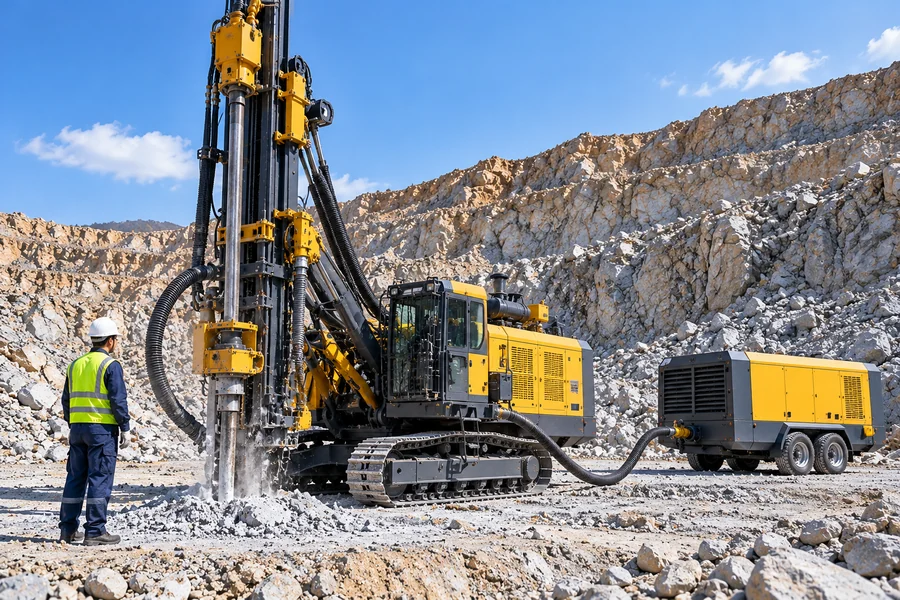
The main specifications of a DTH drilling machine include drilling diameter, maximum drilling depth, rotary torque, rotation speed, feed force, pullback capacity, engine power, and air compressor requirements. Different machines offer different performance ranges. The correct specifications depend on rock conditions, borehole size, drilling method, and project requirements.
Selecting a DTH drilling rig requires evaluating drilling diameter, depth, rotary torque, compressor pressure, airflow, and reliability to ensure efficient performance under actual site conditions.
What Are the Main Specifications of a DTH Drilling Machine?
Different DTH drilling machines are designed for mining, quarrying, water well drilling, and construction. Their technical specifications vary according to drilling requirements and machine configurations.
The main DTH drilling machine specifications include hole diameter, drilling depth, rotary torque, rotation speed, feed force, lifting capacity, engine power, air consumption, operating pressure, and machine weight. I use these parameters to compare equipment performance and determine whether a drilling rig is suitable for a particular geological condition and project.
1. Drilling Diameter and Depth
I consider drilling diameter and depth the starting points for selecting a DTH drilling rig.
Drilling diameter describes the size of the borehole that the machine is designed to produce.
Drilling depth indicates how deep the rig is rated to drill under specified conditions.
Small and medium crawler DTH rigs used in quarrying may be designed for boreholes around 90–190 mm.
Larger surface mining machines may support wider boreholes.
Water well drilling machines can have different technical configurations and may offer substantially greater drilling depths.
I always check whether the manufacturer's depth specification refers to maximum drilling capacity, economical drilling depth, or single-pass drilling length.
These values are not interchangeable.
2. Rotary Torque and Rotation Speed
The rotary head rotates the drill string and DTH hammer.
I evaluate rotary torque because it determines the turning force available to the drilling assembly.
Torque is usually measured in N·m or kN·m.
Rotation speed is commonly expressed in revolutions per minute (rpm).
For example, some compact crawler drilling rigs have rotary torque around 1,680 N·m, while larger machines may provide more than 6,000 N·m.
However, I would not assume that maximum torque and maximum speed are available simultaneously.
I prefer reviewing the rotary head performance curve when detailed manufacturer information is available.
3. Feed Force and Pullback Capacity
The feeding system applies controlled force to the drill string.
I consider feed force important for maintaining suitable contact between the drill bit and the rock.
Pullback or lifting force describes the machine's ability to raise the drill string and drilling tools.
These values become particularly important when drilling deeper holes or handling heavy drill pipes.
4. Engine Power, Weight, and Mobility
I also compare engine power, transport dimensions, operating weight, and traveling capability.
| Technical Parameter | Typical Unit | Main Function |
|---|---|---|
| Drilling diameter | mm | Determines borehole size |
| Drilling depth | m | Indicates rated depth capability |
| Rotary torque | N·m | Provides rotational force |
| Rotation speed | rpm | Controls drill string rotation |
| Feed force | kN | Applies force to the drill bit |
| Pullback force | kN or tonnes-force | Lifts the drill string |
| Engine power | kW | Powers the rig's systems |
| Compressor pressure | bar | Powers the pneumatic DTH hammer |
| Air consumption | m³/min | Determines required airflow |
| Machine weight | kg or tonnes | Affects transport and mobility |
I believe these parameters should always be evaluated together.
A drilling machine with high rotary torque may still perform poorly if its compressor cannot provide the required pressure and airflow.
What Drilling Depth and Hole Diameter Can a DTH Drilling Rig Achieve?
Drilling depth and hole diameter are two of the most frequently compared DTH drilling specifications. However, different applications require different machine designs.
DTH drilling rigs can produce boreholes from relatively small quarry holes to large mining and water well holes. Many quarry drilling machines operate within tens of meters of depth, while purpose-built water well rigs may have rated capacities of 200–300 meters or more. Actual performance depends on machine design, rock conditions, drilling tools, and compressor capability.
1. Typical DTH Drilling Diameter Ranges
I normally select the drilling rig after confirming the required borehole diameter.
The diameter determines which DTH hammer and drill bit can be used.
A small-diameter DTH hammer generally requires less airflow than a larger hammer operated under comparable conditions.
For rock drilling projects, the hole diameter also affects drill pipe selection, cuttings removal, and overall drilling costs.
I consider the following categories useful when evaluating equipment:
| Application | Common Hole Diameter Considerations |
|---|---|
| Small quarry drilling | Approximately 90–110 mm |
| General quarry and construction drilling | Approximately 105–165 mm |
| Larger surface mining holes | Approximately 152–229 mm and beyond |
| Water well drilling | Often 140–325 mm, depending on the rig |
| Specialized drilling | According to the project and equipment design |
These ranges are examples rather than fixed industry limits.
I always verify the manufacturer's specific drilling diameter range.
2. Comparing Actual DTH Rig Specifications
I find it useful to compare real equipment configurations rather than relying only on general specifications.
The following published model examples illustrate how dramatically DTH drilling machines can differ.
| DTH Rig Model | Drilling Diameter | Published Depth Specification | Engine Power |
|---|---|---|---|
| ZT5 integrated DTH rig | 90–105 mm | 24 m economical depth | 176 kW |
| KT15 integrated DTH rig | 135–190 mm | 35 m economical depth | 298 kW |
| SmartROC D65 | 110–229 mm | 56 m maximum depth | 403 kW |
| KW300 water well rig | 140–325 mm | 300 m rated depth | 85 kW |
These figures represent different models and applications. They are not directly comparable measures of productivity.
I pay particular attention to the distinction between quarry drilling and water well drilling.
A quarry drilling rig may be designed to produce many relatively shallow blast holes efficiently.
A water well drilling rig may be designed to handle long drill strings and support deeper drilling operations.
That difference explains why maximum drilling depth cannot be judged by engine power alone.
3. How Geological Conditions Affect Drilling Depth
I also consider rock hardness, abrasiveness, fractures, and groundwater conditions.
DTH hammers can perform effectively in competent hard rock because they generate percussion close to the bottom of the borehole.
However, unstable formations may require casing, different drilling methods, or additional supporting equipment.
The actual achievable drilling depth depends on several factors:
- Drill string weight and length
- Rotary head torque
- Pullback capacity
- DTH hammer operating pressure
- Available compressor airflow
- Borehole diameter
- Cuttings removal efficiency
- Geological stability
I do not treat the published maximum depth as a guarantee of performance under every geological condition.
I recommend confirming the drilling method and complete equipment configuration before finalizing the machine selection.
How Much Air Pressure, Airflow, and Engine Power Does a DTH Drilling Machine Need?
Compressed air is essential for conventional pneumatic DTH drilling. Incorrect compressor selection can reduce hammer efficiency and create drilling problems even when the rig itself has sufficient mechanical power.
DTH drilling machines require compressed air pressure and airflow matched to the selected hammer and borehole diameter. Integrated rigs may use compressors in the 15–25 bar range, while some water well configurations specify around 17–30 bar. Airflow requirements vary widely, so I select the compressor according to the actual hammer specifications rather than engine power alone.
1. DTH Hammer Operating Pressure
I consider hammer operating pressure one of the most important specifications in a pneumatic drilling system.
Compressed air passes through the drill string and powers the piston inside the DTH hammer.
The piston repeatedly strikes the drill bit to break the rock.
A hammer must operate within its approved pressure range.
Insufficient pressure may reduce its impact performance.
Excessive pressure can exceed the equipment's design limits and create safety and reliability problems.
I always follow the hammer manufacturer's pressure recommendations.
2. Air Consumption and Compressor Selection
Air consumption is commonly expressed in m³/min or CFM.
I compare the hammer's air requirements with the compressor's delivered airflow at the required working pressure.
For example, published integrated DTH rig specifications include:
| Drilling Rig | Compressor Pressure | Compressor Airflow |
|---|---|---|
| ZT5 | 15 bar | 12 m³/min |
| KT15 | 24 bar | 22 m³/min |
| KT25 | 25 bar | 26 m³/min |
These are model-specific configurations, not minimum requirements for all DTH rigs.
For the KW300 water well rig, published specifications identify a working air-pressure range of 17–30 bar and air consumption of 17–36 m³/min. Those figures describe operating requirements for the drilling configuration, not necessarily an onboard compressor.
I evaluate the operating pressure and airflow together.
I also consider site altitude, pressure losses through hoses and drill pipes, and the additional airflow needed to remove rock cuttings.
I would not choose a compressor based only on its maximum advertised airflow at an unspecified pressure.
3. Engine Power and Hydraulic Performance
The engine supplies power to the rig's systems, including rotation, feeding, traveling, and, where fitted, an integrated compressor.
I evaluate engine power as one part of the total equipment configuration.
However, I do not assume that increasing engine power automatically improves drilling penetration.
A machine with a powerful engine may still be limited by the hammer, drill bit, rotary head, or compressor.
In a split-type configuration, the drilling rig and portable air compressor may have separate engines.
This distinction is important when comparing integrated and non-integrated drilling systems.
4. Matching the Complete Drilling System
I prefer evaluating DTH drilling equipment as a complete package.
The basic system includes:
Drilling Rig → Rotary Torque and Feed Force
Air Compressor → Required Pressure and Airflow
DTH Hammer → Pneumatic Impact Energy
Drill Bit → Rock Breaking and Borehole Diameter
Drill Pipes → Air Delivery and Mechanical Connection
Flushing System → Removal of Rock Cuttings
I believe proper equipment matching can improve reliability and drilling efficiency more effectively than simply selecting the most powerful rig available.
How Do I Choose the Right DTH Drilling Rig Specifications for My Project?
A DTH drilling rig can have impressive specifications but still be unsuitable for the intended application. Correct equipment selection requires evaluating site conditions and technical requirements together.
I choose DTH drilling rig specifications by confirming hole diameter, required depth, geological conditions, compressor capacity, rotary torque, and feed or pullback force. I also consider rig mobility, fuel consumption, maintenance costs, spare-parts availability, and drilling productivity. The most suitable machine is the one that meets actual project requirements reliably and economically.
1. Start With the Application
I first identify the type of drilling project.
A machine used for open-pit mining may require a different configuration from a rig used for water wells or construction foundations.
For example, quarry drilling often involves repeated holes with controlled diameter, depth, and spacing.
Water well drilling may require deeper holes, casing operations, and the ability to adapt to changing geological formations.
I therefore avoid selecting equipment based only on the manufacturer's maximum drilling depth.
2. Confirm the Main Technical Requirements
Before comparing equipment quotations, I collect the following project information:
- Intended application
- Required borehole diameter
- Expected drilling depth
- Rock type and geological conditions
- Required drilling method
- Available power source
- Site altitude and temperature
- Terrain and access conditions
- Expected daily operating hours
This information helps me identify the drilling rig capacity and supporting equipment.
3. Choose Between Integrated and Split-Type DTH Rigs
I also consider whether an integrated or split-type drilling system provides better value.
An integrated DTH rig normally combines the drilling machine and air compressor into one equipment package.
A split-type drilling system uses a separate compressor connected to the rig.
| Comparison | Integrated DTH Rig | Split-Type DTH Rig |
|---|---|---|
| Compressor | Built into the rig package | Separate equipment |
| Mobility | Often convenient as one machine | Requires moving separate units |
| Initial investment | Depends on integrated configuration | Depends on rig and compressor package |
| Maintenance | Combined machine systems | Rig and compressor serviced separately |
| Equipment flexibility | More limited to installed compressor | Compressor can be selected separately |
| Suitable applications | Repeated mobile drilling projects | Projects requiring flexible compressor matching |
I would compare both configurations based on the actual project workload and transportation requirements.
The best choice depends on operating conditions rather than equipment category alone.
4. Evaluate Maintenance and Spare-Parts Support
I consider maintenance support an important purchasing factor.
A high-performance DTH drilling rig may create expensive downtime if its hammer parts, hydraulic components, or drill tools are difficult to replace.
I check the availability of:
- DTH hammers and drill bits
- Drill pipes and adapters
- Hydraulic seals and hoses
- Rotary head components
- Engine filters and consumables
- Air compressor service parts
- Control system components
I also recommend obtaining the correct operating manuals and maintenance schedules.
5. Compare Total Operating Costs
I evaluate drilling costs over the expected equipment service life.
My basic calculation is:
Drilling Cost per Meter = Total Project Drilling Cost ÷ Completed Drilling Meters
The total cost includes fuel, labor, drill bits, hammer components, maintenance, equipment ownership, and downtime.
A lower-priced machine may not provide better value if it drills slowly or requires frequent repairs.
Similarly, a larger machine can increase costs when its additional capacity is unnecessary.
I prefer a drilling rig with enough capacity for the expected workload and a reasonable margin for changes in operating conditions.
I also request a detailed specification sheet before making a final purchasing decision.
My Insights: What Are the Specifications of a DTH Drilling Machine
I believe DTH drilling machine specifications should be evaluated as a complete operating system rather than a collection of maximum performance values.
The most important consideration is how well the machine's capabilities match the drilling application.
I focus on the following practical factors:
Drilling Diameter → Determines the required DTH hammer, drill bit, and borehole size.
Drilling Depth → Indicates whether the machine can reach the required depth under suitable operating conditions.
Rotary Torque → Provides the turning force needed for the drilling assembly.
Rotation Speed → Controls the rotation of the drill string and supports effective rock breaking.
Feed and Pullback Force → Determines the rig's ability to manage drilling pressure and drill string handling.
Air Pressure → Supplies the pneumatic energy required by the DTH hammer.
Airflow Capacity → Supports hammer operation and efficient removal of rock cuttings.
Engine Power → Powers the rig's mechanical and hydraulic systems and, in integrated configurations, the compressor.
Mobility and Machine Weight → Affect transport, site access, and equipment positioning.
Maintenance Requirements → Influence equipment reliability, downtime, and long-term operating costs.
My Practical Recommendation
I would not select a DTH drilling rig only because it has the highest engine power, rotary torque, or drilling depth.
For quarry drilling, I focus on the required hole diameter, expected hole depth, drilling productivity, and site conditions.
For water well drilling, I pay more attention to depth capacity, pullback force, drill string handling, geological adaptability, and compressor matching.
For mining projects, I evaluate the required drilling pattern, rock characteristics, compressor capacity, and machine durability.
I also believe that proper compressor matching is one of the most important factors in DTH drilling performance.
A rig may provide sufficient torque and feed force but still operate inefficiently if its compressor cannot supply the required airflow at the correct pressure.
I recommend comparing the complete technical configuration and evaluating the equipment under realistic operating conditions.
My recommendation is to choose a DTH drilling machine based on compatible drilling specifications, reliable compressor performance, suitable operating capacity, and the lowest practical total drilling cost.
Conclusion
I believe the best DTH drilling machine specifications depend on borehole diameter, depth, torque, feed force, compressor requirements, geological conditions, and long-term equipment reliability.