
](https://kaishanpro.com/wp-content/uploads/2026/09/What-Are-the-Top-5-Air-Compressors.webp)
Choosing an air compressor by price or horsepower alone can create high energy costs, unstable pressure, excessive maintenance, and expensive production downtime.
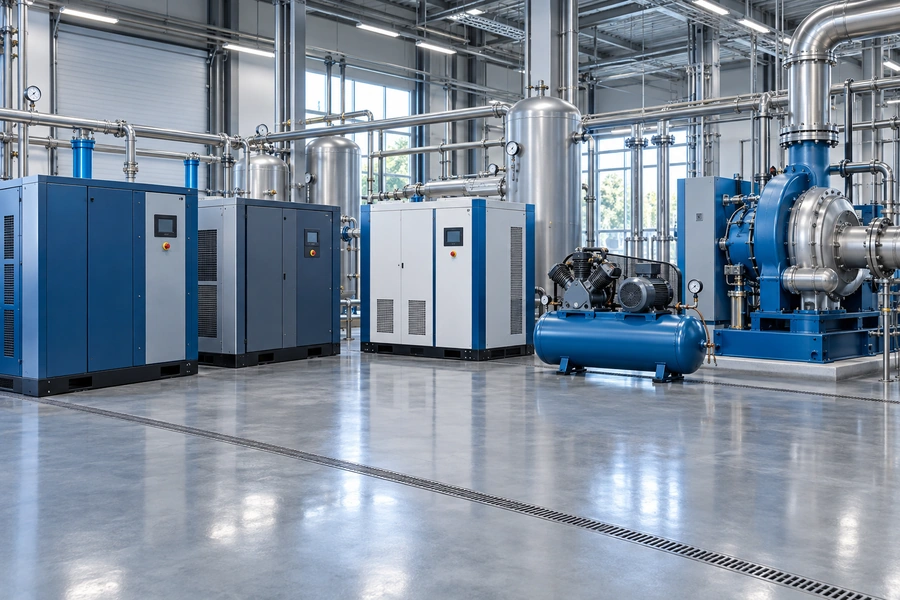
My top five air-compressor choices for industrial applications are oil-injected rotary screw, VSD rotary screw, oil-free rotary screw, reciprocating piston, and centrifugal compressors. I choose between them by airflow, pressure, duty cycle, demand variation, air-quality requirements, operating hours, and plant size rather than treating one compressor as best for every application.
For general continuous industrial use, I usually start with an oil-injected rotary screw compressor. For changing air demand, I consider VSD. I use oil-free screw technology when contamination cannot be tolerated, piston compressors for intermittent work, and centrifugal compressors for very large steady airflow requirements. Current industrial guidance continues to describe rotary screw technology as a mainstay for continuous compressed-air applications.
What Are the Top 5 Types of Air Compressors?
Different compressor technologies solve different problems. I therefore do not think a small workshop compressor should be compared directly with a large centrifugal machine serving an entire industrial plant.
For practical industrial selection, my top five are: oil-injected rotary screw compressors for continuous production, VSD rotary screw compressors for variable demand, oil-free rotary screw compressors for contamination-sensitive processes, piston compressors for intermittent use, and centrifugal compressors for very high continuous airflow.
1. Oil-Injected Rotary Screw Compressor
For general industrial compressed air, this is my first option to evaluate.
A rotary screw compressor uses two rotating screw elements to compress air continuously. The design produces stable airflow and is well suited to manufacturing processes that require compressed air for long periods.
Current industrial screw compressors are commonly designed for 100% duty-cycle operation, which makes them fundamentally different from many smaller piston compressors intended for intermittent use.
I commonly consider oil-injected screw compressors for:
- Manufacturing plants
- CNC machining
- Metal fabrication
- Packaging
- Automotive production
- Textile factories
- Mining support
- General industrial air
- Multi-shift workshops
The injected lubricant helps lubricate, cool, and seal the compression system.
For many factories, this technology gives me a practical balance of reliability, continuous operation, maintenance, efficiency, and purchase cost.
2. VSD Rotary Screw Compressor
A VSD compressor is still a rotary screw compressor, but the motor speed changes according to real compressed-air demand.
I consider this one of the most useful configurations when plant demand rises and falls during the day.
Current VSD systems adjust motor speed and compressor output to match real-time air consumption instead of operating continuously at one fixed speed.
For example, a plant may require:
- 100% airflow during peak production
- 70% during another shift
- 40% during lunch
- 60% during evening production
A correctly selected VSD compressor can reduce output when less air is required.
I normally consider VSD for:
- Variable production schedules
- Several pneumatic production lines
- CNC plants with changing demand
- Packaging facilities
- Plants with strong daytime/nighttime variation
However, I do not assume VSD is automatically better.
If the plant operates close to full compressor capacity almost continuously, a properly sized fixed-speed machine may still make economic sense.
3. Oil-Free Rotary Screw Compressor
I choose an oil-free compressor when compressed-air contamination creates unacceptable production risk.
Current Class 0 oil-free screw compressors are designed for applications including food and beverage, pharmaceuticals, electronics, chemicals, battery manufacturing, and other processes requiring high-purity compressed air.
Unlike an oil-injected screw compressor, oil is not introduced into the compression chamber.
That makes oil-free technology suitable where compressed air may contact a sensitive product or process.
Typical applications include:
| Industry | Why I consider oil-free air |
|---|---|
| Food and beverage | Product contamination control |
| Pharmaceuticals | Critical process cleanliness |
| Electronics | Protect sensitive components |
| Semiconductor | Very strict air-quality requirements |
| Chemical production | Process contamination control |
| Battery manufacturing | Sensitive manufacturing processes |
I do not select oil-free technology simply because the words “oil-free” sound better.
If a normal workshop or factory can safely use treated oil-injected compressed air, an oil-injected screw compressor can be simpler and more economical.
The application should justify the additional air-quality requirement.
4. Reciprocating Piston Compressor
Piston compressors remain one of my top choices when compressed air demand is intermittent.
A reciprocating compressor uses a piston moving inside a cylinder to reduce air volume and increase pressure. The U.S. Department of Energy identifies reciprocating machines as one of the main positive-displacement compressor families and notes their wide range of available capacities.
I commonly recommend piston technology for:
- Small workshops
- Repair garages
- Tire service
- Maintenance departments
- Occasional pneumatic tools
- Small production facilities
- Applications requiring compressed air only periodically
A good piston compressor can be mechanically simple and cost-effective.
Its main limitation is duty cycle.
For continuous industrial production, I generally move toward rotary screw technology because current industrial screw designs can provide continuous 100% duty operation.
5. Centrifugal Air Compressor
At the other end of the scale, I consider centrifugal compressors for very large industrial compressed-air systems.
A centrifugal compressor is a dynamic compressor.
Instead of trapping a fixed volume of air between pistons or screw rotors, it uses high-speed rotating impellers to accelerate air and then converts that velocity into pressure.
Current industrial centrifugal systems can provide extremely high airflow. For example, Atlas Copco lists current centrifugal equipment spanning approximately 2,696 to 20,744 CFM, with Class 0 oil-free air available.
I consider centrifugal technology for:
- Large automotive plants
- Steel production
- Petrochemical facilities
- Large chemical plants
- Major food and beverage plants
- Power generation
- Very large manufacturing complexes
Centrifugal compressors can also have relatively few moving components in the compression system, which helps minimize mechanical wear.
However, I would not install one simply because it is technically advanced.
The plant needs enough stable airflow demand to justify it.
Which Air Compressor Is Best for Industrial Use?
The best industrial compressor depends on how the factory actually consumes compressed air. I begin with duty cycle and airflow rather than brand.
For most continuous industrial applications, I consider a properly sized oil-injected rotary screw compressor the strongest overall starting point. I move toward VSD when air demand varies substantially, oil-free technology when contamination is unacceptable, piston compressors for intermittent demand, and centrifugal compressors when very large plants require high and relatively steady airflow.
I match the compressor to the operating pattern
My simplified selection table looks like this:
| Application | Compressor I evaluate first |
|---|---|
| Small workshop | Piston |
| General factory | Oil-injected rotary screw |
| Continuous multi-shift production | Rotary screw |
| Strongly variable factory demand | VSD rotary screw |
| Food/pharma requiring oil-free air | Oil-free rotary screw |
| Very large constant airflow | Centrifugal |
| Mining or drilling | Heavy-duty rotary screw |
| General pneumatic production | Rotary screw |
This is more useful to me than asking which compressor has the highest horsepower.
A 100 hp machine is not better than a 50 hp machine when the plant actually needs the smaller compressor.
Likewise, the biggest air receiver does not automatically make one compressor better than another.
I size from:
required pressure + required airflow + demand profile + duty cycle
Then I evaluate the compressor technology.
I also look at total ownership cost
Purchase price is only one part of the decision.
For an industrial compressor, I consider:
- Electricity
- Maintenance
- Lubricants
- Filters
- Separators
- Dryer operation
- Spare parts
- Downtime
- Installation
- Cooling
- Future expansion
Energy is especially important because an industrial compressor may operate thousands of hours per year.
This is why VSD becomes attractive when demand changes significantly. Current VSD guidance describes the technology as adjusting motor speed to match real-time demand rather than continuously producing one fixed airflow.
For stable demand, I still compare a fixed-speed screw compressor.
The correct load profile decides which configuration makes more sense.
Is a Rotary Screw Compressor Better Than a Piston Compressor?
These are two of the most frequently compared compressor technologies, but I use them for different operating patterns.
I prefer a rotary screw compressor when compressed air is required continuously throughout the working day. I prefer a piston compressor when air demand is intermittent and initial investment is important. Rotary screw compressors provide continuous airflow and can support 100% duty cycles, while piston compressors remain practical for lighter periodic use.
Continuous demand favors screw technology
Suppose a factory operates several pneumatic machines throughout an eight-hour shift.
The compressor may need to supply air almost continuously.
This is where I prefer rotary screw technology.
Current industrial screw machines are specifically designed around continuous operation. Kaeser, for example, states that its industrial screw equipment operates at a 100% duty cycle.
Now consider a maintenance workshop that uses an impact wrench for several minutes and then does not need air for twenty minutes.
The operating pattern is very different.
A piston compressor can be a much more economical solution.
My practical comparison
| Factor | Rotary screw | Piston |
|---|---|---|
| Continuous operation | Excellent | Usually more limited |
| Intermittent use | Good but may be unnecessary | Excellent |
| Purchase cost | Higher | Lower |
| Airflow | Smooth and continuous | Pulsating |
| Industrial production | Strong fit | Limited depending on duty |
| Small workshop | Sometimes excessive | Strong fit |
| Noise | Usually lower | Usually higher |
| Maintenance pattern | Planned industrial service | More mechanical wear components |
Neither technology wins every application.
I would rather install the correct piston compressor than an unnecessarily expensive screw compressor.
I would also rather install a properly sized rotary screw compressor than repeatedly overwork a piston machine in a continuous production environment.
My insights: What Are the Top 5 Air Compressors
Lists of “top air compressors” often mix workshop machines, industrial compressors, and large plant equipment without explaining why each machine belongs on the list. I think application should define the ranking.
My top five air compressors are oil-injected rotary screw for general industry, VSD rotary screw for changing demand, oil-free rotary screw for contamination-sensitive processes, piston for intermittent use, and centrifugal for very large steady airflow. I rank them by application fit rather than claiming that one design is universally superior.
1. My best overall industrial choice: oil-injected rotary screw
If a buyer tells me only that the machine will serve a normal industrial factory for long working hours, this is where I begin.
Rotary screw technology has become a major industrial standard. The U.S. Department of Energy describes rotary screw machines as industrial “workhorses,” while current manufacturers offer screw systems specifically for continuous-duty operation.
For me, it offers the best general balance of:
- Reliability
- Continuous airflow
- Broad capacity range
- Reasonable maintenance
- Fixed-speed and VSD options
- Long operating life
- Strong parts availability
2. My best choice for variable demand: VSD rotary screw
I select VSD when compressed-air consumption changes enough to justify motor-speed control.
Current 2026 guidance notes that an integrated VSD compressor is designed around variable-speed operation, with components engineered together for efficiency, reliability, and lifecycle performance.
I do not automatically retrofit a VFD to any existing compressor and assume it will perform like a purpose-designed VSD package.
The entire compressor must be suitable for variable-speed operation.
3. My best choice for critical clean air: oil-free screw
For food, pharmaceuticals, electronics, and other sensitive processes, contamination risk changes the priority.
Current Class 0 systems are designed specifically for these industries.
I would rather pay for genuine oil-free compression when the process requires it than depend entirely on downstream filters to solve a contamination risk that should not exist in the first place.
4. My best economical intermittent choice: piston
The piston compressor remains very useful.
I see no reason to buy an industrial screw compressor when the customer needs only occasional compressed air.
For small workshops, light maintenance, and short-duration tool use, the piston design offers simple operation and lower initial investment.
The U.S. Department of Energy continues to recognize reciprocating compressors as a major compressor family, particularly across smaller horsepower ranges.
5. My best high-volume plant choice: centrifugal
When airflow becomes extremely large and relatively stable, centrifugal technology deserves serious evaluation.
Modern centrifugal packages can deliver several thousand to tens of thousands of CFM and provide oil-free air for large industrial systems.
I would not compare that directly with a 20 hp workshop compressor.
They solve completely different problems.
My final selection rule
When someone asks me, “What are the top 5 air compressors?”, I use this practical shortlist:
| Position | Compressor | Where I would choose it |
|---|---|---|
| 1 | Oil-injected rotary screw | Best overall for continuous industry |
| 2 | VSD rotary screw | Best for variable factory demand |
| 3 | Oil-free rotary screw | Best for critical clean-air processes |
| 4 | Piston compressor | Best for intermittent and smaller applications |
| 5 | Centrifugal compressor | Best for very large steady industrial airflow |
I do not treat the numbering as a universal quality ranking.
A piston compressor can be a better purchase than a rotary screw machine for a small intermittent workshop.
A centrifugal compressor can be a much better solution than either one for a huge plant.
So I choose in this order:
application → pressure → airflow → duty cycle → demand variation → air quality → compressor technology → energy cost → maintenance → spare-parts support
That sequence gives me a more useful answer than starting with brand or price.
For most normal factories, I begin with an oil-injected rotary screw compressor.
If demand changes significantly, I compare VSD rotary screw technology.
If the process cannot tolerate compressor oil, I move toward oil-free screw technology.
If air use is light and intermittent, I consider a piston compressor.
And if the plant needs extremely large, stable airflow, I evaluate a centrifugal compressor.
Those are my five strongest practical compressor choices because together they cover most industrial compressed-air requirements.
Conclusion
My top five are oil-injected screw, VSD screw, oil-free screw, piston, and centrifugal compressors. I choose among them by application, duty cycle, air quality, demand, and lifecycle cost.