
](https://kaishanpro.com/wp-content/uploads/2026/10/What-Is-a-Safety-Valve.webp)
Excessive pressure can damage an air receiver, piping, or pressure equipment, so compressed-air systems need an independent device that can safely relieve dangerous overpressure.
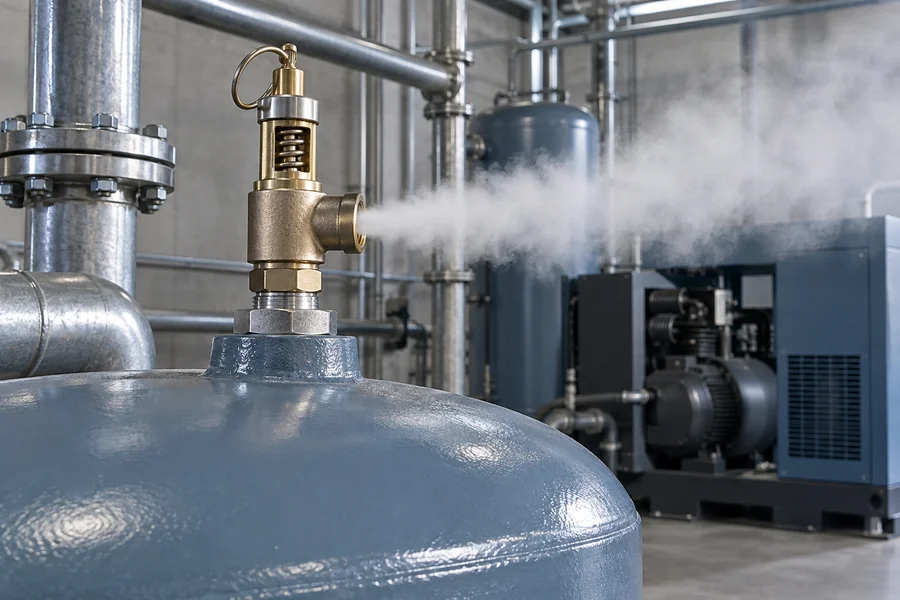
A safety valve is a mechanical pressure-protection device that automatically opens when system pressure reaches a predetermined set pressure. It releases compressed air or another fluid to prevent pressure from rising beyond the equipment's allowable limit, then closes again after pressure falls. It serves as emergency overpressure protection, not normal pressure control.
In an air-compressor system, I treat the safety valve as the final mechanical backup when normal pressure controls fail.
How Does a Safety Valve Work?
A safety valve normally uses a spring-loaded mechanism that keeps the valve closed during normal operation and allows it to open when pressure force becomes high enough.
During normal operation, spring force keeps the safety valve closed. As system pressure rises, pressure acting on the valve disc creates an opposing force. When pressure reaches the valve's set pressure, the valve begins to lift and discharge air. It remains open enough to relieve excess pressure and closes after pressure returns to a safe range.
The valve reacts directly to pressure
The operating principle can be simplified as:
system pressure → force on valve disc
versus:
spring force → keeps valve closed
Under normal conditions:
spring force > pressure force
so:
valve remains closed.
When pressure reaches the designed set point:
pressure force becomes sufficient → valve lifts → compressed air escapes.
This does not normally require:
electric power
software
or:
a PLC command.
That mechanical independence is an important reason safety valves are used as backup protection.
What is set pressure?
The set pressure is the pressure at which the safety valve begins to open under its specified conditions.
Spirax Sarco defines set pressure as the pressure at which the safety valve starts to lift and distinguishes it from normal working pressure, relieving pressure, overpressure, and MAWP.
These terms should not be treated as interchangeable.
For example:
Normal working pressure
is the pressure the system normally uses.
Set pressure
is where the safety valve begins operating.
MAWP
is the maximum allowable working pressure of the protected equipment.
What is MAWP?
MAWP means:
Maximum Allowable Working Pressure.
It is a key limit for pressure equipment.
I never choose or adjust a safety valve without considering:
receiver MAWP + applicable code + valve relieving capacity.
Spirax Sarco notes that the safety-valve set pressure must not exceed the protected system's MAWP and must also be selected so the relieving pressure stays within the permitted accumulation limit.
Why does the valve close again?
A safety valve is not intended to empty the entire receiver.
After sufficient pressure has been discharged:
system pressure falls
and:
spring force reseats the valve.
The difference between opening/set behavior and reseating behavior is part of the valve's engineered operating characteristics.
Repeated opening during normal compressor operation is therefore not something I consider normal.
It usually tells me that another part of the pressure-control system needs investigation.
Why Is a Safety Valve Important on an Air Compressor?
Compressed air stores energy. If pressure continues rising because normal controls fail, the receiver and other pressure-containing components need an independent means of limiting overpressure.
On an air compressor, the safety valve protects the receiver and pressure system if normal controls fail to stop pressure buildup. In the United States, OSHA 29 CFR 1910.169 requires covered air receivers to have one or more spring-loaded safety valves with sufficient relieving capacity and prohibits placing a valve between the receiver and its safety valve.
Normal control should act before the safety valve
A normal reciprocating compressor may operate approximately like this:
pressure falls → pressure switch starts compressor
then:
receiver reaches cut-out pressure → pressure switch stops compressor.
A rotary screw compressor may use:
controller + pressure sensor + load/unload system + inlet valve/VSD
to control pressure.
The safety valve should normally remain closed.
Its job begins when the normal control system does not keep pressure within the intended range.
The normal pressure hierarchy
I think about the system in this order:
normal operating pressure
↓
compressor cut-out / control pressure
↓
safety valve set pressure
↓
receiver MAWP / applicable code limit
The exact numbers depend on the equipment and governing standard.
I do not invent a universal difference such as:
“always set the safety valve 10 psi higher.”
The correct relationship comes from:
equipment design + valve specification + code requirements.
U.S. air-receiver requirements
For covered air receivers, OSHA 1910.169 states that every receiver must have a readily visible pressure gauge and one or more spring-loaded safety valves. Their total relieving capacity must prevent receiver pressure from exceeding MAWP by more than 10%.
OSHA also states:
no valve of any type
may be installed between the air receiver and its safety valve or valves.
That requirement matters because an isolation valve could accidentally:
block the safety path.
OSHA further requires covered safety valves to be tested frequently and at regular intervals to determine whether they remain in good operating condition.
Local requirements outside the U.S. can differ, so I always check the jurisdiction governing the installation.
The valve must have enough relieving capacity
Set pressure alone is not enough.
The valve also needs enough capacity to discharge pressure faster than the compressor or pressure source can continue adding it.
Kaeser notes that an air-receiver safety relief valve should be sized for the full compressed-air flow that may need to be relieved, and larger systems can require multiple valves when one valve cannot provide enough capacity.
So I check both:
pressure rating
and:
relieving capacity.
Safety valve location matters
A valve can release:
high-pressure air + significant noise + debris or condensate
depending on the system.
Kaeser recommends installing receiver relief valves where they can be inspected and where discharged compressed air will not injure personnel.
That means I do not point the discharge directly toward:
an operator station
walkway
or:
maintenance area.
What Is the Difference Between a Safety Valve, Relief Valve, Regulator, and Pressure Switch?
These components all interact with pressure, but their jobs are different. Confusing them can lead to unsafe adjustments and poor troubleshooting.
A safety valve protects equipment against abnormal overpressure. A pressure regulator reduces downstream working pressure during normal use. A pressure switch or electronic controller starts, stops, loads, or unloads the compressor. A relief valve is also an overpressure device, although terminology varies by industry and service. None of these normal control devices replaces properly sized pressure protection.
Safety valve
Main job:
emergency overpressure protection
It normally:
stays closed
and opens only when pressure reaches its set point.
For compressed-air receivers, this is the component OSHA describes as a:
spring-loaded safety valve.
Pressure regulator
A regulator is used during normal operation.
For example:
receiver pressure = 120 psi
but a pneumatic tool requires:
90 psi.
The regulator reduces the downstream pressure.
It does not replace the receiver safety valve.
If I want lower tool pressure, I adjust the:
regulator
not the safety valve.
Pressure switch or compressor controller
A pressure switch controls compressor operation.
On a smaller piston compressor:
cut-in pressure → compressor starts
cut-out pressure → compressor stops.
On an industrial screw compressor, electronic controls may instead:
load/unload
modulate
or:
change motor speed.
Again, the safety valve remains a backup.
Safety valve vs relief valve
The terms are sometimes used loosely in compressed-air equipment.
For example, Kaeser refers to receiver protection as a:
safety relief valve
and notes that it is also called a pressure relief valve.
In more formal pressure-system terminology, valve names and operating characteristics may differ by:
gas/steam service
liquid service
and:
applicable code.
For a compressor buyer, the most important issue is not the label alone.
It is whether the valve is:
correctly certified + correctly sized + correctly set + suitable for the protected equipment.
Quick comparison
| Component | Main purpose | Normal operation? |
|---|---|---|
| Safety valve | Protect against overpressure | Normally closed |
| Pressure relief valve | Relieve excess pressure | Normally closed |
| Regulator | Reduce downstream pressure | Continuously controls |
| Pressure switch | Start/stop compressor | Normal control |
| Controller | Load/unload/VSD control | Normal control |
| Pressure gauge | Display pressure | Monitoring only |
Why Does a Compressor Safety Valve Open or Leak?
A safety valve that repeatedly vents should not simply be tightened or adjusted. The valve may be doing its job because another system has allowed pressure to rise too high.
A compressor safety valve may open because the pressure switch or controller fails, the inlet or unloading system does not respond, system pressure exceeds the valve set point, or the valve itself has a fault. Leakage can also result from contamination, seat damage, aging, corrosion, or a valve that has not reseated correctly after lifting.
Pressure switch or controller problem
On a piston compressor, a failed pressure switch may allow the motor to continue running past normal cut-out pressure.
Pressure then rises toward the safety-valve set point.
If the valve opens at its correct pressure:
the safety valve may be functioning correctly.
The real fault is:
normal pressure control.
Unloading or inlet-valve problem
On a rotary screw compressor, pressure control can involve:
pressure transducer
controller
solenoid valve
and:
inlet/unloader valve.
If the compressor fails to unload correctly, pressure may continue increasing.
Again, repeated relief-valve opening can be a symptom rather than the root cause.
Incorrect pressure setting elsewhere
Someone may increase compressor cut-out pressure without checking:
receiver MAWP
and:
safety valve setting.
The machine then begins operating too close to its protective limit.
This is one reason I do not change pressure settings casually.
Dirt on the valve seat
A valve can vent once and then continue:
hissing
after system pressure has fallen.
Contamination may prevent the valve from reseating correctly.
Depending on valve design and manufacturer instructions, the valve may require:
inspection + approved servicing + replacement.
I do not recommend grinding, modifying, or improvising repairs to a pressure-safety device.
Corrosion or mechanical aging
Moisture is normal in compressed-air systems before effective treatment.
If a valve is exposed to:
condensate + corrosion + contamination
its performance can deteriorate.
This reinforces the importance of:
receiver drainage + inspection + periodic valve testing.
OSHA requires covered air receivers to be drained often enough to prevent excessive liquid accumulation and separately requires regular safety-valve testing.
Wrong replacement valve
A valve that physically fits the thread is not automatically suitable.
I verify:
set pressure
connection size
relieving capacity
temperature/service rating
and:
required certification.
An undersized valve may open at the right pressure yet still be unable to relieve the full incoming air flow.
Can You Adjust an Air Compressor Safety Valve?
A safety valve is a calibrated pressure-protection device, so field adjustment should not be treated like adjusting a regulator or pressure switch.
I do not recommend casually adjusting an air-compressor safety valve. Its set pressure must protect the receiver within the applicable MAWP and code requirements. If a valve is lifting unexpectedly, I first diagnose the compressor's control system and verify pressure with an appropriate gauge. A defective or incorrectly rated valve should be professionally serviced or replaced.
Do not increase set pressure to stop venting
Suppose a safety valve opens repeatedly.
A dangerous response is:
“Turn the adjustment higher so it stops.”
This can remove the intended overpressure protection.
Instead I ask:
What pressure is the receiver actually reaching?
Then:
Why is the compressor reaching that pressure?
Check the pressure gauge
A faulty gauge can mislead troubleshooting.
If the safety valve opens but the gauge shows an unexpectedly low value, I verify pressure using suitable test equipment and approved procedures.
OSHA requires covered receivers to have a readily visible indicating pressure gauge.
Check normal controls
My troubleshooting order is usually:
pressure gauge → cut-out/controller setting → pressure sensor/switch → unloading system → valve set point/rating
I do not start by changing the last safety device in the chain.
Replace with the correct rated valve
When replacement is required, I match the valve to:
receiver MAWP + required set pressure + full relieving capacity + connection + applicable certification.
Kaeser specifically notes that receiver relief-valve capacity must match the system's potential compressed-air flow and that there should not be an isolation valve between receiver and relief device.
My insights: What Is a Safety Valve
The simplest definition is that a safety valve automatically releases excessive pressure, but its real importance is that it remains independent of the compressor's normal pressure-control system.
A safety valve is the final mechanical overpressure protection for an air receiver or pressure system. It stays closed during normal operation, opens automatically at its specified set pressure, relieves enough air to protect the equipment, and reseats after pressure decreases. I never use it as a regulator or normal compressor-control device.
My first insight is to separate control from protection
I use this hierarchy:
regulator → controls downstream working pressure
pressure switch/controller → controls compressor operation
safety valve → protects against abnormal overpressure
This distinction solves many troubleshooting mistakes.
If the user wants:
lower tool pressure
adjust the regulator correctly.
If the compressor:
runs too high
investigate the normal control system.
If pressure becomes dangerously high:
the safety valve is the backup.
My second insight is that MAWP controls the decision
The protected vessel defines the pressure limit.
For covered U.S. air receivers, OSHA requires enough safety-valve capacity to prevent pressure from exceeding receiver MAWP by more than 10%.
Spirax Sarco also emphasizes that valve set pressure must not exceed the MAWP of the protected system.
Therefore I never select a safety valve only from:
compressor maximum pressure.
I check the protected equipment first.
My third insight is that capacity matters as much as pressure
Two valves may both be set at:
150 psi
but have very different relieving capacities.
If the compressor can continue supplying air faster than the valve can release it:
pressure may keep rising.
The correct valve therefore needs:
correct set pressure + sufficient relieving capacity.
My fourth insight is that repeated venting is a warning
A safety valve that opens repeatedly is telling me something.
Possible causes include:
pressure-control failure
unloader/inlet problem
incorrect settings
or:
valve malfunction.
I do not silence that warning by simply increasing the valve setting.
My fifth insight is to understand the safety valve as part of the entire pressure-protection system
When someone asks me “What is a safety valve?”, my practical sequence is:
1. Identify the protected equipment.
Receiver?
Pipe?
Pressure vessel?
2. Find its MAWP.
Do not guess.
3. Identify normal operating pressure.
How does the system normally run?
4. Identify compressor cut-out or control pressure.
This should remain below the protective limit.
5. Verify safety-valve set pressure.
Use the equipment and valve documentation.
6. Check relieving capacity.
It must be adequate for the possible incoming flow.
7. Check the installation.
For covered U.S. air receivers, OSHA prohibits a valve between the receiver and safety valve.
8. Check discharge direction.
Relieving air should not create another personnel hazard.
9. Inspect for leakage or corrosion.
Do not ignore persistent hissing.
10. Follow required test intervals.
OSHA requires covered air-receiver safety valves to be tested frequently and at regular intervals.
11. Investigate repeated lifting.
Check the pressure-control system before blaming the safety valve.
12. Do not casually alter the setting.
Use qualified service and the correct replacement when necessary.
My practical comparison is:
| Situation | Correct component/action |
|---|---|
| Tool pressure too high | Adjust regulator |
| Compressor does not stop at normal pressure | Check pressure switch/controller |
| Screw compressor does not unload | Check controls/inlet system |
| Pressure reaches emergency limit | Safety valve should protect system |
| Safety valve repeatedly vents | Diagnose overpressure cause |
| Safety valve leaks after venting | Inspect/service/replace as required |
| New valve required | Match MAWP, set pressure and capacity |
| Want higher system pressure | Verify entire system rating first |
The most important principle is simple:
a safety valve is not there to control normal pressure.
It is there for the situation where normal pressure control has already failed or an abnormal overpressure condition exists.
That is why I treat the valve as a:
critical safety component
rather than an ordinary compressor accessory.
Conclusion
A safety valve automatically relieves dangerous excess pressure to protect compressed-air equipment. It is an emergency backup—not a regulator, pressure switch, or normal control device.