
](https://kaishanpro.com/wp-content/uploads/2026/09/What-Is-DTH-Drilling-Rig.webp)
Hard rock can make drilling slow, expensive, and difficult to control. I use DTH drilling when I need strong impact energy directly at the bottom of the hole.
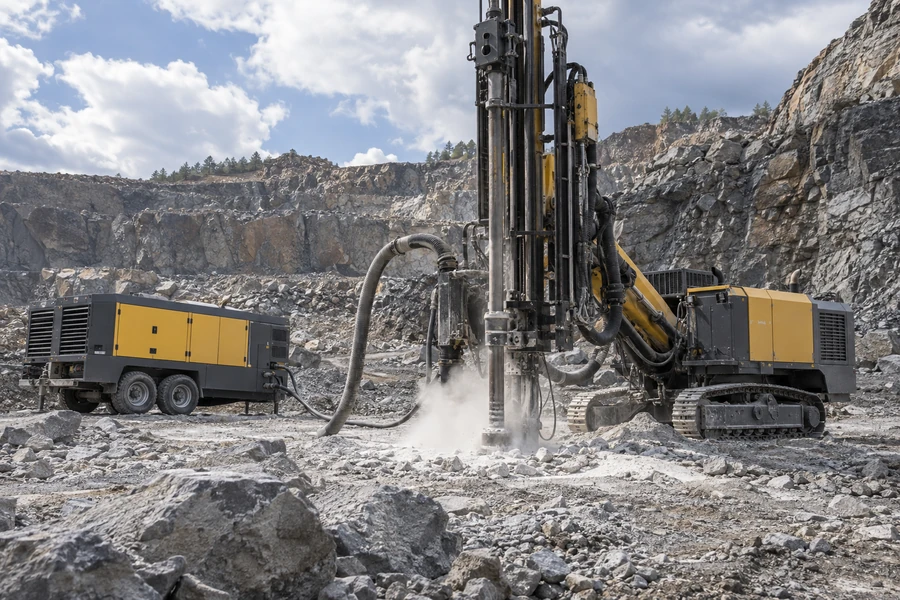
A DTH drilling rig, or down-the-hole drilling rig, is a machine that uses a pneumatic hammer located directly behind the drill bit. Compressed air drives the hammer while the rig rotates and feeds the drill string. I commonly use DTH rigs for mining, quarrying, water wells, construction, and hard-rock drilling.
I think the most important feature of DTH drilling is the hammer position. Unlike top-hammer drilling, the impact energy is produced at the bottom of the hole instead of traveling through the complete drill string. This helps maintain effective impact energy and good hole straightness as depth increases.
How Does a DTH Drilling Rig Work?
A DTH rig does more than simply rotate a drill bit. Its drilling performance comes from the combination of rotation, percussion, feed force, and compressed-air flushing.
A DTH drilling rig works by sending high-pressure compressed air through the drill pipe to a hammer located behind the bit. The air drives a piston inside the hammer, which repeatedly strikes the drill bit. At the same time, the rig rotates the drill string and pushes it downward while exhaust air carries rock cuttings out of the hole.
I see the DTH hammer as the center of the drilling system
The name down-the-hole describes exactly where the percussion mechanism works.
The hammer goes down the borehole with the drill bit.
Inside the hammer is a reciprocating piston. Compressed air reaches the hammer through the drill pipe and drives this piston.
The piston repeatedly strikes the rear of the drill bit.
The carbide buttons on the bit then break the rock.
At the same time, the rotary head turns the drill string so the buttons strike different areas of the rock face rather than hitting exactly the same point repeatedly.
Epiroc describes DTH drilling as a process where the drill string rotates while the downhole hammer strikes and breaks the rock into fragments and dust.
I normally think about the drilling process in five steps:
| DTH drilling stage | Main function |
|---|---|
| Compressor supplies air | Provides energy and flushing air |
| Air passes through drill pipe | Delivers compressed air to hammer |
| Hammer piston strikes bit | Breaks hard rock |
| Rotary head turns drill string | Moves cutting buttons around hole face |
| Exhaust air flows upward | Carries rock cuttings out of borehole |
These actions happen continuously while the machine drills.
Compressed air performs two important jobs
Compressed air does not only operate the hammer.
It also cleans the hole.
After driving the hammer piston, the air exits through ports in the drill bit. It then travels upward through the annular space between the drill pipe and the borehole wall.
This airflow carries broken rock and dust toward the surface.
I consider this flushing function extremely important.
If cuttings remain at the bottom, the drill bit wastes energy breaking already fragmented rock again. Epiroc notes that adequate free-air delivery is important for proper flushing and that poor flushing can reduce drilling efficiency because cuttings are recrushed.
So I do not select a DTH compressor by pressure alone.
I need both:
enough pressure to operate the hammer efficiently
and
enough airflow to flush the borehole properly
That relationship makes compressor matching one of the most important parts of DTH system selection.
What Is a DTH Drilling Rig Used For?
DTH drilling is especially useful when I need to penetrate hard rock while maintaining relatively straight holes and good drilling productivity.
I use DTH drilling rigs mainly for mining blast holes, quarrying, water-well drilling, geothermal projects, construction, and other hard-rock applications. The method is particularly useful for medium and larger boreholes where hole straightness, consistent impact energy, and effective cuttings removal are important.
Mining and quarrying are major DTH applications
Surface mines and quarries need large numbers of accurately positioned blast holes.
The quality of those holes affects the next stage of the operation.
If holes deviate significantly, explosive distribution can change.
That can affect fragmentation, bench shape, blasting efficiency, and downstream loading or crushing.
DTH drilling is attractive because the hammer works directly behind the bit.
Epiroc specifically describes hole quality and straightness as important advantages associated with DTH drilling.
Current large surface DTH rigs illustrate the normal operating range.
For example, Epiroc's FlexiROC D65 is designed for mining and quarrying with DTH hole diameters of 110–203 mm and maximum hole depth around 55.5 m, depending on configuration.
Its SmartROC D65 extends the hole range up to approximately 229 mm with compatible DTH hammer sizes from 4 to 7 inches.
These are examples rather than universal DTH limits.
Water-well drilling uses the same principle at greater depths
Water-well drilling can also use DTH technology, especially when hard rock is present.
The rig rotates and feeds the drill string in the same basic way, but the machine configuration is different from a quarry blast-hole rig.
Water-well rigs often require:
- Greater pullback force
- Longer mast or rod-handling capacity
- Greater total drilling depth
- Casing capability
- Different compressor configurations
- Mud or foam options in some formations
I therefore do not assume that a DTH quarry rig and a DTH water-well rig are interchangeable just because both use a downhole hammer.
The drilling objective changes the whole machine.
Construction and geotechnical work are additional applications
DTH hammers can also be used for:
- Foundation drilling
- Anchor holes
- Slope stabilization
- Micropiles
- Construction blasting
- Geothermal drilling
- Ground engineering
Boart Longyear describes DTH hammer applications across quarrying, mining, geotechnical drilling, water wells, geothermal projects, and mineral-related drilling.
The method is therefore much broader than only blast-hole drilling.
What Are the Main Parts of a DTH Drilling Rig?
A DTH drilling rig is a complete system rather than one hammer and one bit. I evaluate the rig, compressor, feed system, rotary head, rods, hammer, and bit together.
The main components of a DTH drilling rig include the crawler or carrier, engine or power system, hydraulic system, mast and feed beam, rotary head, drill rods, DTH hammer, drill bit, rod-handling system, and air compressor. Some machines have an integrated compressor, while others use a separate portable compressor.
The rotary head provides rotation
The rotary head turns the drill string.
It does not normally create the main percussion energy in DTH drilling.
The hammer handles percussion.
The rotary system makes sure the drill bit changes position after each impact.
Current hydraulic DTH rotation units can cover substantial hole-diameter ranges. For example, Epiroc lists its DHR 6H rotary unit for surface DTH applications from about 92 to 203 mm.
I match rotary torque and speed to:
- Hammer size
- Bit diameter
- Rock formation
- Drill pipe
- Hole depth
Too much or too little rotation can reduce drilling efficiency and increase tool wear.
The feed system controls weight on the hammer
The mast and feed system move the rotary head up and down.
During drilling, feed force keeps the hammer and bit working properly against the rock.
During rod changes, the feed system also helps pull the drill string out of the hole.
For deeper applications, pullback capacity becomes increasingly important because the machine must lift the weight of many drill rods plus the hammer.
The hammer produces impact energy
The DTH hammer sits between the drill pipe and drill bit.
Its basic components may include:
- Top sub
- Outer casing
- Internal piston
- Distributor or air-control components
- Chuck
- Wear sleeve
- Bit
The exact construction varies by manufacturer.
Hammer size is closely related to hole diameter.
Epiroc's DTH tooling guidance says the optimum DTH blast-hole range is approximately 90–254 mm, with smaller holes more commonly using top-hammer systems and larger holes often moving toward rotary methods.
As a basic rule, I try to match the hammer closely to the required hole diameter rather than using a very small hammer with an unnecessarily oversized bit.
The air compressor can decide the drilling performance
This is the component I believe buyers underestimate most often.
The compressor must provide the pressure and airflow required by the hammer and hole size.
A modern integrated DTH rig can use a very large compressor.
For example, Epiroc's current PowerROC D60 uses a two-stage screw compressor capable of up to 25 bar maximum working pressure and approximately 428 l/s, or 906 cfm, of free-air delivery.
A larger or deeper drilling application may need a different compressor.
This is why I do not buy the rig first and ask about the compressor later.
I select them as one drilling system.
What Is the Difference Between DTH and Top-Hammer Drilling?
Both methods combine rotation and percussion, but they generate impact energy at different locations.
In top-hammer drilling, the rock drill remains on the rig and impact energy travels through the drill string to the bit. In DTH drilling, the hammer sits directly behind the bit at the bottom of the hole. I generally consider top hammer for smaller, shallower holes and DTH when deeper straight holes or larger hard-rock holes are required.
Hammer location changes energy transmission
With top-hammer drilling:
rock drill → drill rod → drill rod connections → bit → rock
Impact energy must travel through the complete drill string.
As depth increases, some energy is lost through the rods and threaded connections.
Epiroc notes that microscopic movement at threaded connections creates energy loss and heat in top-hammer systems, and that the loss becomes more important as the drilling depth increases.
With DTH:
compressed air → hammer at bottom → bit → rock
The impact piston is very close to the drill bit.
That helps reduce percussion-energy loss through the drill string.
Hole straightness is another important difference
Top-hammer systems apply feed force through a relatively slender drill string.
At increasing depth, the string can bend and the bit can move away from its intended direction.
DTH was developed partly to address these hole-straightness challenges.
My simplified comparison is:
| Factor | DTH | Top hammer |
|---|---|---|
| Hammer position | At bottom of hole | On drilling rig |
| Percussion transmission | Directly behind bit | Through drill string |
| Typical hole size | Medium to larger | Small to medium |
| Deeper-hole straightness | Strong advantage | More challenging as depth grows |
| Compressor demand | High | Usually lower for hammer operation |
| Hard-rock performance | Strong | Strong at suitable hole size/depth |
| Typical application | Mining, quarrying, wells | Quarry, construction, tunneling |
I do not say that DTH is always better.
Top-hammer drilling can provide very high penetration rates in smaller, shallower holes and may use less compressed air.
The borehole decides the correct method.
How Do I Choose the Right DTH Drilling Rig?
A machine can have a powerful engine and still perform poorly if its hammer, compressor, rods, and hole requirements do not match.
I choose a DTH drilling rig by starting with the required hole diameter, drilling depth, rock formation, daily production target, and application. I then match the DTH hammer, bit, drill pipe, compressor pressure, compressor airflow, rotary torque, feed force, pullback capacity, and rig mobility to those requirements.
Hole diameter comes first
The required hole diameter helps determine the hammer size.
Epiroc's DTH tooling guide gives a useful rule: the smallest practical hole diameter is generally close to the hammer's nominal diameter, while production holes are commonly limited to roughly the nominal hammer size plus about one inch.
For example, a 4-inch hammer commonly works around the 4–5 inch hole range.
This is only a selection guide because actual allowable combinations depend on the hammer and bit manufacturer.
Then I match pressure and airflow
After I know the hammer size, I determine its air requirement.
Higher pressure can increase DTH penetration performance when the hammer is designed for that pressure. Epiroc states that higher working pressure can increase penetration rate, while adequate FAD remains necessary for effective flushing.
I therefore work in this order:
hole diameter → hammer size → hammer pressure → hammer airflow → compressor size
Then I check whether the drilling rig can carry and operate that tool package.
I also consider the site
My rig-selection checklist includes:
| Project information | Why I need it |
|---|---|
| Hole diameter | Determines hammer and bit size |
| Hole depth | Affects rod handling and pullback |
| Rock hardness | Affects tool selection and penetration |
| Required daily meters | Determines productivity requirement |
| Compressor pressure | Must match DTH hammer |
| Compressor airflow | Must operate hammer and flush cuttings |
| Altitude | Can reduce compressor and engine performance |
| Ambient temperature | Affects cooling |
| Site access | Determines machine dimensions and mobility |
| Drilling angle | Affects feed and positioning requirements |
| Dust regulations | Determines dust-collection requirements |
| Spare-parts availability | Affects long-term uptime |
Altitude deserves special attention.
A compressor produces less mass airflow as elevation increases unless its system compensates for the thinner atmospheric air. Engine performance can also change.
For high-altitude projects, I verify the manufacturer's correction data instead of assuming sea-level performance.
My insights: What Is DTH Drilling Rig
The simplest definition says that DTH means the hammer works down the hole. I think the more useful definition includes the complete drilling system around that hammer.
A DTH drilling rig is a rotary-percussive drilling system that places the pneumatic impact hammer directly behind the drill bit. I use compressed air both to power the hammer and clean the hole. Its main practical strengths are efficient hard-rock impact, good hole straightness, scalable hole diameter, and strong performance in mining, quarrying, water wells, and construction.
My main insight is that the rig and compressor should be selected together
I do not consider the DTH rig and compressor two independent machines.
The compressor is part of the drilling process.
A rig may have enough hydraulic power to rotate the drill string, but an undersized compressor will limit hammer performance.
The result can be:
- Slow penetration
- Poor flushing
- Cuttings accumulation
- Recrushing of rock
- Higher bit wear
- Unstable hammer operation
- Increased fuel cost per drilled meter
Epiroc emphasizes that high free-air delivery is important for flushing and also notes in field applications that DTH hammer efficiency depends on correctly matched compressor capacity.
So my selection sequence is:
required hole → hammer → compressor → drill pipe → rotary system → rig
not:
buy rig → find any compressor that connects to it
I also see DTH as a system for hole quality, not only drilling speed
Penetration rate is important.
But drilling a hole quickly in the wrong direction is not good production.
In mining and quarry blasting, hole deviation can affect where explosives are placed relative to the designed blast pattern.
DTH technology has a strong reputation for hole straightness because percussion happens close to the rock face. Epiroc's drilling references specifically identify straightness and reduced energy loss as important DTH advantages.
For me, this means the value of DTH should be measured by more than meters per hour.
I also look at:
- Hole straightness
- Hole diameter consistency
- Fuel per drilled meter
- Hammer life
- Bit life
- Rod life
- Compressor utilization
- Final blast or well quality
Integrated and separate-compressor rigs solve different problems
Some DTH drilling rigs include the compressor onboard.
Others require a separate portable compressor.
An integrated rig can simplify site movement because the drilling unit and compressor move together.
Current machines such as the PowerROC D60 combine hydraulic drilling systems with a large onboard two-stage compressor.
A pneumatic or lighter DTH rig can use an external compressor instead. Epiroc's AirROC D45, for example, is designed to operate with a separate compressor.
I choose between these arrangements by considering:
- Transport
- Site mobility
- Required air capacity
- Fuel consumption
- Maintenance
- Initial cost
- Project duration
- Whether the compressor will serve other equipment
There is no universal winner.
DTH is strongest when its application matches its advantages
I would seriously evaluate DTH when I need:
hard rock + medium or large borehole + straight drilling + reliable percussion at depth
For very small and shallow blast holes, top hammer may be more economical.
For very large blast holes, rotary drilling may become more suitable.
Epiroc's DTH tooling guidance places the practical blast-hole sweet spot roughly between 90 and 254 mm, while noting that smaller holes generally favor top hammer and larger holes often move toward rotary drilling.
That range is not a hard boundary.
It is a useful engineering guideline.
My practical definition
So when someone asks me, “What is a DTH drilling rig?”, my practical answer is:
A DTH drilling rig is a rock-drilling machine that rotates a drill string while compressed air powers a hammer positioned directly behind the drill bit. The hammer repeatedly strikes the rock, and exhaust air removes the cuttings from the borehole. I use this method when hard-rock performance, hole straightness, and efficient medium-to-large-diameter drilling are important.
The rig itself is only one part of the solution.
For reliable DTH performance, I match the rig, hammer, bit, rods, pressure, airflow, and rock formation as one complete drilling system.
Conclusion
A DTH drilling rig uses a downhole pneumatic hammer, rotation, feed force, and compressed air to drill hard rock efficiently while maintaining good hole straightness and flushing.