
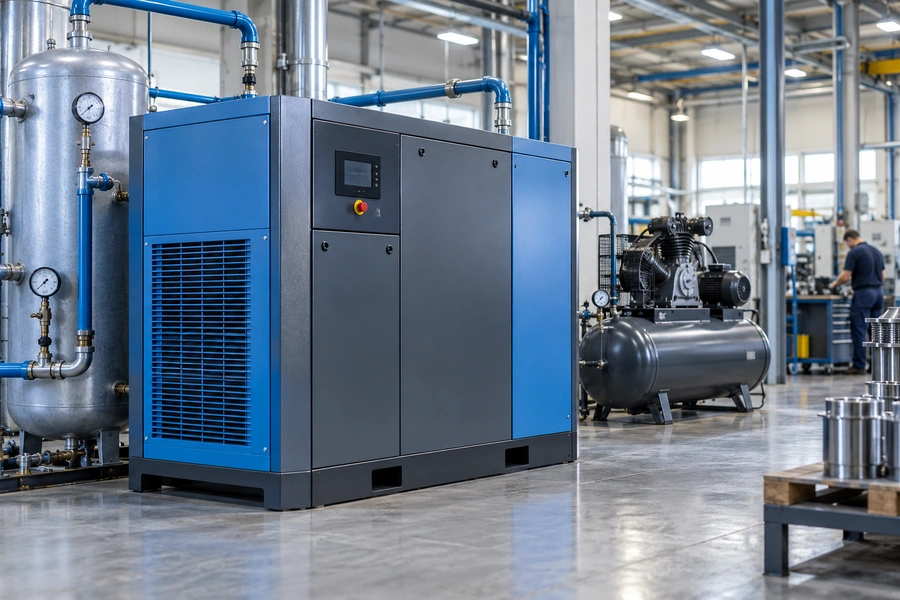
](https://kaishanpro.com/wp-content/uploads/2026/09/What-Is-the-Best-Air-Compressor-in-2026.webp)
Choosing the wrong air compressor can raise energy costs, cause pressure drops, and create downtime. The cheapest machine can become expensive once daily operation begins.
For most industrial applications in 2026, I consider a correctly sized rotary screw air compressor the best overall choice. I prefer VSD models when air demand changes, fixed-speed models for stable continuous loads, oil-free compressors for sensitive processes, and piston compressors for intermittent work. The application should always decide the machine.
When I compare compressors, I do not start with horsepower, tank size, or brand. I start with airflow, pressure, duty cycle, air quality, working environment, and future demand. These factors tell me much more about whether a compressor will actually perform well after installation.
What Type of Air Compressor[^1] Is Best for Industrial Use?
A compressor can look powerful on a specification sheet and still be a poor match for the job. I first separate occasional air use from continuous production demand.
For most factories, workshops, mines, and other continuous-duty operations, I would choose a rotary screw air compressor. It provides steady airflow and is designed for long operating periods. I would use a piston compressor for lighter intermittent work and consider centrifugal technology when a large plant needs very high continuous airflow.
I match compressor technology to the duty cycle
I see duty cycle as one of the most important selection points. A factory that needs compressed air throughout an eight-hour or twenty-four-hour production schedule has different requirements from a repair shop that uses an impact wrench several times per hour.
Rotary screw compressors use rotating screw elements to produce continuous airflow. This design makes them a practical choice for manufacturing, machining, packaging, mining support, drilling applications, and multi-tool workshops.
Piston compressors work well when air demand comes in shorter bursts. They normally have a lower initial purchase price. This can make them suitable for small workshops, maintenance work, garages, and operations with limited daily compressor hours.
Centrifugal compressors enter the discussion at much larger airflow requirements. I normally look at them for large industrial plants where compressed air demand is high and relatively steady.
| Compressor type | Best fit | Typical operating pattern | Main reason I choose it |
|---|---|---|---|
| Piston | Small workshop or occasional tools | Intermittent | Lower initial cost |
| Rotary screw | Factory, workshop, mining or industrial use | Continuous | Stable airflow and high duty capability |
| VSD rotary screw | Factory with changing demand | Variable continuous demand | Output follows air consumption |
| Oil-free | Food, pharmaceutical, electronics and sensitive processes | Continuous | Lower contamination risk |
| Centrifugal | Large industrial plant | High-volume continuous demand | Efficient large-scale airflow |
I therefore do not call one compressor technology the winner in every situation. For general industrial production, however, the rotary screw design gives me the broadest balance of airflow stability, continuous operation, noise control, and system flexibility.
What Size Air Compressor Do I Need?
Oversizing wastes investment and can hurt operating efficiency. Undersizing is worse because pressure can fall exactly when production needs air the most.
I size an air compressor from required airflow at the actual working pressure, not from horsepower alone. I add the simultaneous CFM or m³/min demand of the equipment, check pressure losses, consider peak consumption, and leave a reasonable reserve for leakage and future expansion before selecting the compressor.
I start with airflow and pressure together
I never compare CFM without checking PSI. A compressor may publish an attractive airflow number, but that number has limited value if it is measured at a pressure below the customer's real operating requirement.
For example, a pneumatic production line may need around 7–8 bar. A drilling application can require much higher pressure. These two applications should not use the same sizing logic even when their airflow numbers look similar.
I first list every tool, machine, valve, nozzle, drill, or production process that may operate at the same time. Then I calculate the simultaneous air demand.
I also allow some reserve. One industry sizing example recommends adding about 20% beyond calculated simultaneous tool demand. I view this as a useful starting point rather than a universal rule because real systems differ.
I check more than the compressor nameplate
Before I recommend a final configuration, I want to know:
- Required working pressure
- Required airflow
- Maximum simultaneous demand
- Hours of operation per day
- Number of production shifts
- Power supply and voltage
- Ambient temperature
- Altitude
- Indoor or outdoor installation
- Expected future production growth
- Air quality and dew-point requirements
I also compare verified package performance where possible. Standardized CAGI-style data can help buyers compare rated capacity, package input power, and specific power under similar conditions instead of relying only on horsepower or marketing claims. Specific power is especially useful because it shows how much electrical power a compressor needs to produce a given amount of compressed air.
For me, the best-sized compressor is not the largest machine within the budget. It is the compressor that keeps the required pressure at real peak demand without spending most of its working life far outside its efficient operating range.
Is a Rotary Screw Air Compressor Better Than a Piston Compressor?
The wrong answer to this question can create years of unnecessary operating cost. I do not compare these machines without first asking how many hours they will run.
I prefer a rotary screw compressor for continuous industrial air demand because it delivers steady airflow and is designed for sustained operation. I prefer a piston compressor when usage is intermittent, initial cost matters more, and the machine has enough recovery time between operating periods.
Rotary screw compressors solve a different problem
A piston compressor can be a very sensible purchase. I would not replace it with a screw compressor simply because the screw machine is more industrial.
If a workshop uses compressed air only occasionally, a piston compressor can provide the required pressure with a much lower initial investment. It is also mechanically familiar to many technicians.
The decision changes when air becomes part of production.
When several pneumatic tools operate together, a production line runs throughout a shift, or a drilling operation depends on constant airflow, I begin to favor rotary screw technology. Continuous and smoother air delivery becomes more important than the lowest purchase price.
| Decision factor | Rotary screw | Piston |
|---|---|---|
| Continuous operation | Excellent fit | Usually less suitable |
| Intermittent work | Can work, but may be unnecessary | Strong fit |
| Initial investment | Higher | Lower |
| Airflow stability | Very good | More pulsating |
| Noise | Usually lower at comparable industrial duty | Usually higher |
| Small workshop use | Sometimes oversized | Often practical |
| Multi-shift production | Strong fit | Usually not my first choice |
I also consider total cost instead of purchase price alone. Electricity, maintenance, production losses, spare parts, and downtime can become much larger expenses than the original compressor price.
This is why I would rather buy the correct piston compressor for occasional work than an unnecessary screw machine. At the same time, I would rather pay more for a properly sized screw compressor than force a lower-cost piston compressor into a continuous-duty production role.
Is a VSD Air Compressor Worth It in 2026?
A VSD label does not automatically mean lower operating cost. The real question is whether the plant's air demand changes enough for variable-speed operation to create value.
I consider a VSD rotary screw compressor especially useful when compressed air demand rises and falls during shifts. The drive changes motor speed to match actual air demand. If demand remains close to full load for long periods, I also compare a fixed-speed compressor because it can be more efficient at that operating point.
I look at the demand profile before choosing the drive
This is one of the biggest changes in the way I evaluate industrial compressors in 2026. I do not treat VSD as an automatic upgrade.
Consider a factory with three production lines. During the morning, all three lines operate. During lunch, only one line remains active. In the afternoon, two lines operate. At night, demand drops again.
A fixed-speed compressor cannot reduce its motor speed in direct proportion to this changing air demand. A VSD compressor can adjust its speed and air output as demand changes. This can reduce unnecessary unloaded operation.
But another factory may run the same process around the clock with nearly constant airflow. In that case, a correctly sized fixed-speed machine deserves serious consideration. Current compressor guidance also notes that VSD does not always beat fixed-speed operation at continuous full load.
My practical VSD decision rule
| Air demand pattern | My first option to evaluate |
|---|---|
| Strongly changing demand | VSD screw compressor |
| Multiple production shifts with changing loads | VSD screw compressor |
| Long periods near constant full load | Fixed-speed screw compressor |
| Very low or occasional demand | Piston or smaller compressor |
| Several compressors in one plant | System audit and coordinated controls |
I also study the complete system. Air leaks, excessive pressure settings, blocked filters, poor piping, and bad control settings can waste energy even when an efficient compressor is installed.
So I see VSD as a tool, not a badge. The best compressor in 2026 is still the one that matches the measured demand profile.
My insights: What Is the Best Air Compressor in 2026
Buyers often search for one winning model, but compressed air systems do not work that way. I think the better question is which compressor creates the lowest operational risk for the specific application.
The best air compressor in 2026 is the one that supplies the required airflow and pressure at the lowest practical lifecycle cost while meeting duty-cycle, air-quality, environmental, maintenance, and service requirements. For most continuous industrial applications, I would begin the comparison with a properly sized rotary screw compressor rather than choosing by brand or horsepower alone.
I would rank application fit above brand ranking
When I combine current compressor guidance with the questions industrial buyers actually need to answer, I reach one main conclusion: the best compressor is a system decision, not a product-ranking decision.
A compressor with excellent efficiency figures can still be a poor purchase if local technicians cannot service it. A cheaper machine can become expensive when spare parts take months to arrive. A very large compressor can look safer during selection but waste energy when real demand is much lower. An oil-free machine can add unnecessary cost when the process does not need oil-free compressed air.
On the other hand, choosing an oil-lubricated system purely to save money can be a serious mistake when the air contacts sensitive food, pharmaceutical, electronics, or other contamination-critical processes. Oil-free technologies are specifically intended for applications where air purity requirements justify them.
I therefore evaluate the complete buying decision in this order:
- Application — What will the compressed air actually do?
- Pressure — What minimum working pressure must reach the point of use?
- Airflow — What is the real simultaneous demand?
- Duty cycle — Will the compressor run occasionally or continuously?
- Demand variation — Does airflow change enough to justify VSD?
- Air quality — Is oil-free air required?
- Environment — What are the temperature, altitude, dust, ventilation, and installation conditions?
- Air treatment — What dryer, filtration, receiver, and condensate control are required?
- Service support — Are maintenance parts and technical support realistically available?
- Lifecycle cost — What will the system cost to run and maintain for years?
My 2026 selection matrix
| Application | Compressor I would evaluate first |
|---|---|
| General factory production | Rotary screw |
| Variable factory demand | VSD rotary screw |
| Stable 24/7 production | Fixed-speed rotary screw |
| Small workshop with intermittent use | Piston |
| Food or pharmaceutical process requiring very clean air | Oil-free compressor |
| Large plant with very high steady airflow | Centrifugal |
| Mining or drilling project | Heavy-duty screw compressor matched to required pressure and airflow |
| Portable construction or field operation | Portable engine-driven screw compressor |
This is why I would not answer “What is the best air compressor in 2026?” with one model number.
For an industrial buyer, I think the strongest answer is a correctly sized rotary screw compressor with the right control system and air-treatment package. If demand varies, I would strongly evaluate VSD. If demand stays close to full load, I would compare fixed-speed efficiency. If the process cannot tolerate oil contamination, I would move directly toward an appropriate oil-free solution.
That approach gives me a much better chance of buying a compressor that works efficiently after installation instead of simply buying the machine that looks best in a catalog.
Conclusion
The best air compressor in 2026 is not one universal model. I choose it by airflow, pressure, duty cycle, demand profile, air quality, service support, and total operating cost.