
](https://kaishanpro.com/wp-content/uploads/2026/10/What-Is-the-Difference-Between-a-DTH-Drill-and-a-Top-Hammer-Drill.webp)
DTH and top hammer rigs both use percussion to break rock, but choosing the wrong method can increase deviation, fuel use, tool wear, and drilling cost.
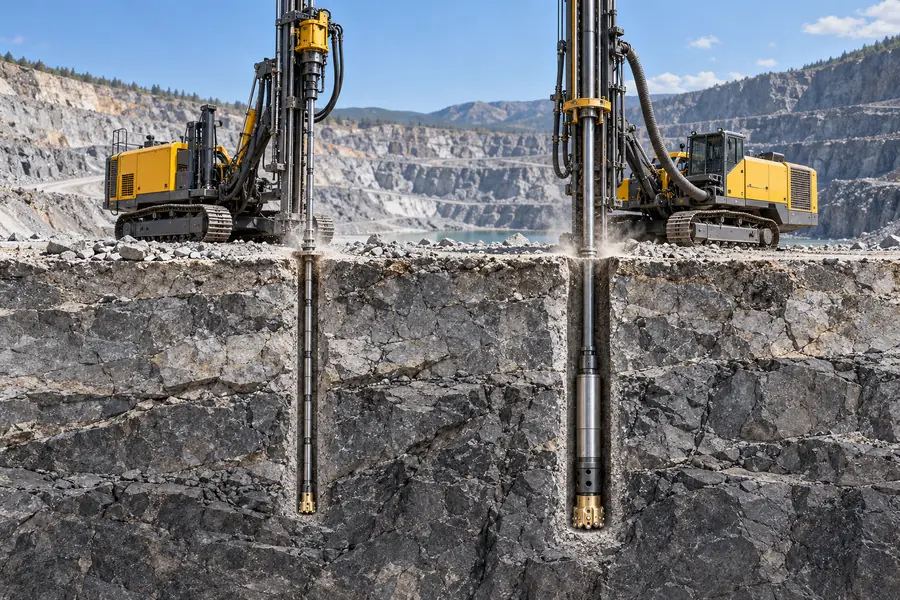
The main difference is hammer location. A top hammer drill places the rock drill at the surface and sends impact energy through the drill string to the bit. A DTH drill places the hammer directly behind the bit inside the hole. DTH usually favors deeper, straighter, larger holes, while top hammer often favors fast production in smaller or medium holes.
I compare drilling systems by impact location, energy transfer, hole size, depth, straightness, flushing, fuel consumption, tooling requirements, and overall drilling cost per meter.
How Do DTH and Top Hammer Drilling Work Differently?
Both methods combine percussion, rotation, feed, and flushing, but the impact energy travels through the drilling system in very different ways.
In top hammer drilling, a surface-mounted rock drill strikes the shank adapter and sends stress waves through rods and couplings to the bit. In DTH drilling, compressed air drives a piston inside the hammer at the bottom of the hole, where the piston strikes the bit directly. This difference strongly affects energy transmission, hole deviation, air demand, and tooling wear.
How a top hammer drill works
A top hammer system can be simplified as:
rock drill → shank adapter → coupling → drill rod → bit → rock
The rock drill is mounted on the feed beam at the surface.
It provides:
percussion + rotation
while the feed system keeps the bit loaded against the bottom of the hole.
The impact energy must travel through:
rods + couplings
before reaching the bit.
Sandvik describes top-hammer tooling as a system designed to transmit intensive impact power through the drill string into the rock while minimizing energy loss.
As more rods are added, the energy-transfer path becomes longer.
This is one reason drill-string condition becomes particularly important.
Worn:
threads
couplings
rods
or:
shank adapters
can reduce system efficiency and increase operating cost.
How a DTH drill works
A DTH system has a different energy chain:
compressor → drill pipe → DTH hammer → piston → bit → rock
The drill pipe mainly provides:
rotation + feed force + compressed air
while the impact mechanism works near the bottom of the hole.
Mincon describes DTH pile drilling similarly: high-pressure air operates a piston inside the down-the-hole hammer, and that piston repeatedly strikes the pilot bit against the rock.
This means the impact piston remains close to the bit as the hole gets deeper.
That is the key mechanical advantage of DTH.
Flushing is also different
Both methods need to remove cuttings.
Top hammer rigs commonly use compressed air or water for flushing through the drill string.
DTH has an additional relationship with compressed air because air performs two jobs:
1. It powers the hammer.
2. It exits through the bit and flushes cuttings from the hole.
This is why DTH rigs often require much larger and higher-pressure compressor packages.
Current Sandvik examples make the difference easy to see.
Its Leopard DI560 DTH rig provides approximately 24.4 m³/min at 24 bar, whereas surface top-hammer rigs use substantially lower-pressure flushing systems because compressed air is not normally providing the primary percussion energy in a hydraulic top hammer system.
Which Is Better for Hole Diameter, Depth, and Straightness?
Traditional rules are useful as a starting point, but modern top hammer and DTH ranges increasingly overlap. I therefore choose by the complete drilling requirement rather than diameter alone.
Top hammer is commonly attractive for smaller and medium-diameter production holes where fast penetration and lower compressed-air demand are priorities. DTH becomes increasingly attractive as holes become deeper or larger and straightness becomes critical. However, modern top-hammer systems now reach much larger diameters, so the transition point must be evaluated project by project.
Hole diameter
A traditional comparison might say:
smaller holes → top hammer
larger holes → DTH
That is directionally useful, but no longer a hard rule.
Epiroc's current surface rig range illustrates the overlap.
Examples include:
| Rig | Method | Published hole range |
|---|---|---|
| FlexiROC T35 | Top hammer | 64–115 mm |
| FlexiROC T40 | Top hammer | 64–127 mm |
| FlexiROC T45 | Top hammer | 89–140 mm |
| PowerROC T50 | Top hammer | 102–152 mm |
| FlexiROC D50 | DTH | 90–130 mm |
| FlexiROC D55 | DTH | 90–152 mm |
| FlexiROC D60 | DTH | 110–178 mm |
| FlexiROC D65 | DTH | 110–203 mm |
So a:
115 mm quarry hole
could potentially be drilled with either technology.
The correct decision requires more information.
Modern top hammer has moved into larger holes
Sandvik's Top Hammer XL system was developed specifically to extend top-hammer drilling into approximately:
140–178 mm holes.
Sandvik reported field-test advantages over DTH under the tested conditions, including lower fuel use and higher productivity, although those figures are manufacturer-specific field results rather than universal performance guarantees.
This reinforces an important rule:
do not choose solely from old diameter charts.
Current rock drills and drill strings have expanded the useful top-hammer range.
DTH maintains impact energy close to the bit
As a DTH hole gets deeper, the hammer stays:
directly behind the bit.
The drill pipe becomes longer, but the main percussion mechanism does not move farther away from the cutting face.
That makes DTH particularly attractive when:
depth + hole quality
become important.
A current Sandvik Leopard DI650i, for example, is designed for approximately 115–229 mm DTH holes and uses 4-, 5-, and 6-inch hammers for large quarry and mining production.
DTH normally offers strong hole straightness
Because the hammer body operates at the bottom of the hole and the drilling assembly can form a relatively stiff bottom section, DTH is widely selected when deviation matters.
Boart Longyear specifically promotes its DTH tooling for straighter holes with reduced deviation, highlighting the effect on blast accuracy and fragmentation.
This can matter significantly for:
deep blastholes
water wells
geothermal holes
and:
foundation drilling.
A few degrees of deviation at shallow depth may appear small.
At substantial depth, the bottom of the hole can be far from the intended position.
Top hammer can still provide excellent accuracy
This does not mean:
top hammer = inaccurate.
Correct:
feed
rotation
drill string
bit
rig alignment
and:
operator/control settings
can produce excellent top-hammer holes.
Modern automated rigs can also control drilling parameters much more consistently than older equipment.
The real comparison is:
how much deviation can the project tolerate at the required depth?
Which Method Has Better Penetration, Air Demand, and Drilling Cost?
Neither technology always produces the lowest cost per meter. The winner changes with rock, diameter, depth, compressor requirements, drilling speed, and tooling consumption.
Top hammer can provide very high penetration rates in suitable shallow-to-medium production drilling and usually needs less compressor power because air is primarily used for flushing. DTH requires substantial high-pressure air but transfers percussion directly at the bit and maintains strong performance in deep hard-rock drilling. I compare total fuel, tooling, productivity, and deviation—not penetration rate alone.
Top hammer can be extremely fast
For suitable:
quarry + construction + mining blastholes
top hammer is known for high drilling speed.
The surface rock drill generates rapid percussion at the top of the drill string.
Modern large top-hammer systems continue to increase available impact power.
Sandvik's current surface lineup includes Pantera top-hammer rigs covering approximately 89–178 mm, depending on model.
That means top hammer should no longer be viewed only as:
small-hole drilling.
DTH needs more compressor capacity
This is one of the largest equipment differences.
Compare current Epiroc rigs around overlapping diameters.
A PowerROC T50 top-hammer rig covers approximately:
102–152 mm
and lists about:
232 l/s FAD.
A FlexiROC D55 DTH machine also reaches approximately:
90–152 mm
but lists about:
354 l/s FAD.
The comparison is not perfectly one-to-one because the rigs have different designs.
But it demonstrates the fundamental DTH requirement:
the compressor is part of the hammer power system.
For DTH purchasing, I therefore pay particular attention to:
pressure + FAD at that pressure.
Top hammer puts more impact transmission through the drill string
The top-hammer energy path is:
rock drill → shank → rods → couplings → bit
Every mechanical interface matters.
That makes:
threads + rod condition + coupling wear
important to energy transfer.
Sandvik's top-hammer tooling is specifically engineered to reduce losses while transmitting intensive impact power through these components.
Tooling condition therefore directly affects productivity.
DTH has another major wear component: the hammer
A DTH system requires:
DTH hammer + DTH bit + drill pipes
rather than only conventional top-hammer drill steel.
The hammer contains:
piston + wear sleeve + chuck + internal air-control components
that need inspection and maintenance.
So DTH may reduce some drill-string energy-transfer issues but adds:
hammer maintenance + lubrication + high-pressure compressor cost.
Fuel per meter must be measured
DTH may consume more compressor power.
But that does not automatically make it more expensive per meter.
If it gives:
straighter holes + fewer redrills + consistent deep-hole penetration + better blast results
the project economics may still favor DTH.
Likewise, a fast top-hammer rig may provide:
lower fuel per meter
when the hole size and depth suit the technology.
Sandvik's Top Hammer XL field program reported substantially lower fuel use than DTH in its tested large-hole application, illustrating that modern top-hammer systems can compete economically well into traditional DTH territory. Those results should be validated against the buyer's own geology and drilling pattern.
I compare total cost per drilled meter
My calculation includes:
rig fuel
compressor energy
bit cost
hammer/rock-drill maintenance
rods and couplings
labor
downtime
redrilling
divided by:
accepted drilled meters.
Accepted meters matter.
A cheap meter that produces a badly deviated hole may not actually be cheap.
When Should I Choose DTH Instead of Top Hammer Drilling?
The choice should come from the application rather than a preference for one drilling technology.
I generally investigate DTH first for deep or larger-diameter hard-rock holes, water wells, geothermal work, and projects where straightness is especially important. I investigate top hammer first for construction, bench drilling, tunneling, and quarry or mining blastholes where high penetration, mobility, and lower compressor demand can produce better economics. Modern overlap means both should sometimes be quoted.
Choose DTH when hole straightness dominates
I strongly consider DTH when the project has:
deep blastholes
tight deviation limits
water wells
geothermal wells
or:
long foundation holes in hard rock.
DTH tooling is widely used for these deep-hole applications because the hammer remains close to the bit.
Epiroc's current QLX DTH hammer family is specifically optimized for difficult deep-hole conditions involving challenges such as water influx and backpressure.
Choose DTH for water wells
This is one of the clearest application differences.
Top hammer is rarely my first choice for a conventional deep water well.
DTH fits the application because it can provide:
deep hard-rock penetration
effective air flushing
and:
relatively straight holes.
Mincon also identifies DTH as a solution for drilling rock in piling and other deep foundation applications.
Choose top hammer for smaller fast production holes
For:
construction blasting
road cuts
small and medium quarries
and many surface-production patterns, top hammer can be highly productive.
Current Epiroc top-hammer rigs cover everything from approximately:
27 mm construction holes
to:
152 mm production holes
depending on model.
This broad range explains why top hammer remains a major surface-drilling method.
Choose top hammer when compressor cost matters
Because a hydraulic top hammer creates percussion at the rock drill rather than with a pneumatic hammer at the bottom, its compressed-air system is mainly associated with:
flushing + dust collection + auxiliary functions.
DTH requires enough compressed-air pressure and flow to:
run the hammer + clean the hole.
If fuel and compressor size are major constraints, top hammer may therefore have an advantage for a suitable hole.
Compare both in the overlap zone
I would not automatically choose one method for:
102 mm
115 mm
127 mm
or even:
140–152 mm
surface blastholes.
Current equipment ranges clearly overlap.
For those projects, I request quotations for:
meters/hour
fuel/hour
fuel/meter
bit life
rod life
expected deviation
and:
total cost/meter.
The geology then helps decide.
My insights: What Is the Difference Between a DTH Drill and a Top Hammer Drill
The most important difference is where impact energy is generated. That one design choice influences nearly every other drilling characteristic.
A top hammer creates percussion at the surface and transmits impact energy through drill steel to the bit, while a DTH hammer creates percussion directly behind the bit at the bottom of the hole. I generally favor top hammer for fast smaller-to-medium production drilling and DTH for deeper, straighter, larger hard-rock holes, but modern ranges increasingly overlap.
My first insight is to remember the energy path
For top hammer:
surface rock drill → shank → rods → couplings → bit → rock
For DTH:
compressor → pipe → bottom-hole hammer → piston → bit → rock
That difference explains much of the rest.
Top hammer requires excellent:
drill-steel energy transmission.
DTH requires excellent:
compressed-air delivery.
My second insight is that “shallow vs deep” is useful but too simple
The traditional rule still helps:
top hammer → shallower
DTH → deeper
But I would not turn that into a rigid purchasing rule.
Epiroc currently sells top-hammer rigs with published depths into roughly the 35–37 m range, while DTH platforms extend to roughly 45–56 m in comparable surface production families.
Actual project depth also depends on:
rod system + hole diameter + geology + accuracy requirements.
My third insight is that diameter ranges overlap much more than buyers expect
Consider the current examples:
PowerROC T50 top hammer: 102–152 mm
FlexiROC D55 DTH: 90–152 mm
Both can therefore target parts of the same diameter range.
So:
diameter alone cannot select the drilling method.
I also need:
depth + geology + straightness + production target + compressor economics.
My fourth insight is that DTH compressor sizing is part of drilling-tool selection
With top hammer, I focus strongly on:
rock drill + rod + coupling + bit.
With DTH, I focus on:
hammer + bit + pressure + airflow + pipe ID.
A current Sandvik Leopard DI650i illustrates the scale: it uses 4–6 inch DTH hammers with approximately 28.3 m³/min at 24 bar of flushing/hammer air capacity.
That compressor is not an accessory.
It is part of the percussion system.
My fifth insight is to choose between DTH and top hammer from the complete drilling project
When someone asks me, “What is the difference between a DTH drill and a top hammer drill?”, I use this practical selection sequence:
1. Define hole diameter.
Do not rely on nominal rig size.
2. Define depth.
Typical and maximum.
3. Describe geology.
Hard?
Abrasive?
Fractured?
Soft?
4. Define straightness requirements.
How much deviation can the blast or final hole tolerate?
5. Define productivity.
Meters per shift?
Holes per day?
6. Evaluate top hammer.
Check:
rock drill power + rod system + bit + flushing.
7. Evaluate DTH.
Check:
hammer + bit + compressor pressure + FAD + pipe.
8. Compare fuel use.
Include the complete air package.
9. Compare consumables.
For top hammer:
bit + rods + couplings + shank.
For DTH:
bit + hammer components + drill pipe.
10. Compare deviation.
Use field data in comparable geology where possible.
11. Compare maintenance.
Which system can the local team support?
12. Calculate accepted cost per meter.
Include:
redrilling + downtime + blast quality
rather than tooling price alone.
My practical comparison is:
| Factor | Top Hammer | DTH |
|---|---|---|
| Hammer location | Surface | Bottom of hole |
| Impact path | Through drill string | Directly behind bit |
| Typical strength | Fast production drilling | Deep, straight hard-rock drilling |
| Common hole tendency | Smaller/medium | Medium/larger |
| Deep-hole consistency | More affected by string length | Strong advantage |
| Hole straightness | Good with correct setup | Usually very good |
| Compressor demand | Lower for hydraulic systems | High pressure and high flow |
| Drill-string impact stress | Higher | Lower impact transmission through pipes |
| Main special wear items | Rods, couplings, shank | DTH hammer and bit |
| Water wells | Less common | Strong fit |
| Quarry blasting | Strong fit | Strong fit |
| Construction drilling | Very strong fit | Application-dependent |
| Large deep blastholes | Application-dependent | Strong fit |
My basic decision rule is:
fast, smaller or medium, relatively shallow production holes → investigate top hammer first
deeper, straighter, larger hard-rock holes → investigate DTH first
But when the project sits in the overlap zone, I do not guess.
I compare:
real penetration + fuel + consumables + deviation + cost per meter
under similar geological conditions.
That is the most reliable way to choose between the two technologies.
Conclusion
Top hammer strikes from the surface through the drill string; DTH strikes directly behind the bit. Choose by diameter, depth, geology, straightness, air demand, and cost.