
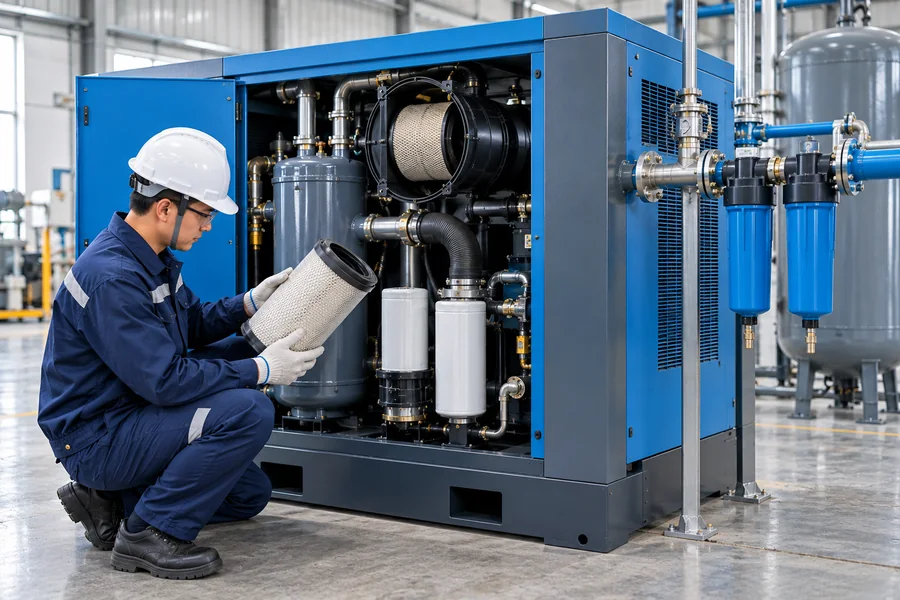
](https://kaishanpro.com/wp-content/uploads/2026/10/When-Do-Air-Compressors-Need-Filters.webp)
Air compressors operate in dusty, humid, and demanding environments. Without proper filtration, contaminants can damage internal components, reduce air quality, increase maintenance costs, and interrupt production.
Air compressors need intake filters whenever they operate to protect internal components from dust and debris. Oil-lubricated compressors also require oil filters and air-oil separators. Additional inline filters become necessary when compressed air must meet specific cleanliness standards. Filter replacement depends on operating hours, environmental conditions, pressure drop, and manufacturer recommendations.
Air compressor filtration protects equipment, tools, and manufacturing processes. Filtration needs vary: construction requires dust protection, while food, painting, and precision applications demand cleaner air.
Why Do Air Compressors Need Filters?
Compressed air can contain dust, moisture, oil aerosols, and other contaminants. These impurities may affect compressor performance and damage equipment connected to the compressed air system.
Air compressors need filters to prevent contaminants from entering sensitive components and reaching downstream equipment. Intake filters protect the compressor from airborne particles, while oil filters, air-oil separators, and inline filtration systems control lubricant contamination and compressed air quality. Proper filtration helps maintain reliability, product quality, and efficient operation.
1. Protect Internal Compressor Components
I consider the intake air filter the first important protection component in an air compressor.
Ambient air contains airborne dust, dirt, pollen, and other particles. Industrial environments may expose compressors to additional contamination from manufacturing, construction, mining, or agricultural activities.
When the compressor draws in air, these particles can enter the compression system if the intake filter is missing or damaged.
Dust can accelerate wear on internal components and increase maintenance requirements.
For rotary screw compressors, I pay particular attention to protecting the screw elements and intake system.
For piston compressors, intake filtration helps reduce contamination of cylinders, valves, and related components.
2. Prevent Contamination in Compressed Air Systems
I also consider the quality of the compressed air delivered to the equipment.
Even when the intake air has been filtered, compressed air can still contain contaminants.
These may include:
- Solid particles that pass through the intake filter
- Rust and pipe scale from the distribution system
- Water droplets created during cooling
- Fine oil aerosols from lubricated compressors
- Oil vapors and other atmospheric hydrocarbons
The intake filter is primarily designed to protect the compressor. It does not necessarily provide the air purity required by downstream equipment.
For this reason, I evaluate additional filtration whenever compressed air quality affects manufacturing operations.
3. Reduce Equipment Damage and Production Problems
Contaminated compressed air can cause several operational problems.
For example, solid particles may damage pneumatic valves and cylinders.
Moisture can contribute to corrosion, interfere with pneumatic equipment, and affect production quality.
Oil contamination may cause problems in spray painting, product finishing, and sensitive manufacturing processes.
I therefore evaluate filtration requirements according to the equipment connected to the compressed air system.
| Contaminant | Potential Problem | Suitable Treatment |
|---|---|---|
| Dust and solid particles | Component wear and blocked valves | Intake and particulate filters |
| Liquid water | Corrosion and equipment problems | Water separator and condensate drainage |
| Water vapor | Condensation in downstream piping | Refrigerated or desiccant dryer |
| Oil aerosols | Product and equipment contamination | Coalescing filter |
| Oil vapor | Unwanted hydrocarbon contamination | Activated carbon adsorption |
| Rust and pipe scale | Blocked pneumatic components | Downstream particulate filter |
I believe the most effective filtration system addresses the actual contaminants rather than installing every available filter type.
What Types of Filters Do Air Compressors Need?
Different filters perform different functions in an air compressor system. Choosing the wrong filter may fail to solve contamination problems and increase unnecessary operating costs.
Air compressors commonly use intake air filters, lubrication oil filters, air-oil separators, particulate filters, coalescing filters, and activated carbon filters. Intake filters protect the compression system, oil filters clean lubricant, separators recover oil from compressed air, and inline filters improve the quality of air delivered to equipment.
1. Air Intake Filters
I consider intake air filters necessary for normal compressor operation.
These filters are installed at the air inlet and remove airborne dust and larger particles before compression.
They are particularly important in dusty environments.
Examples include construction sites, cement plants, mining operations, and woodworking facilities.
I normally check the intake filter condition during routine maintenance and follow the manufacturer's specified replacement requirements.
2. Oil Filters
Oil-lubricated compressors require oil filtration to maintain lubricant cleanliness.
The oil filter removes particles and contaminants circulating through the lubrication system.
I consider this important for protecting bearings, compression elements, and other lubricated components.
Oil filters are normally serviced according to the compressor manufacturer's maintenance schedule.
Oil-free compressors generally do not require a compression-chamber lubricant filter, although certain oil-free compressor designs may have separate lubricated gearboxes or bearings that require their own oil filtration.
3. Air-Oil Separators
Oil-injected rotary screw compressors use separators to remove most of the lubricant carried with compressed air.
The separated oil returns to the lubrication circuit.
I consider separator condition important because excessive oil carryover can contaminate downstream equipment.
A damaged or restricted separator may also increase operating costs.
I evaluate separator performance through the manufacturer's maintenance indicators, operating hours, and observed system conditions.
4. Particulate and Coalescing Filters
Particulate filters remove solid contaminants from compressed air.
Coalescing filters capture fine liquid aerosols, including oil mist and water droplets.
I normally consider coalescing filtration when downstream equipment requires reduced oil aerosol contamination.
These filters are also important when protecting some compressed air dryers and other sensitive treatment equipment.
5. Activated Carbon Filters
Activated carbon filters are designed to adsorb oil vapor and certain hydrocarbon contaminants.
I consider this filtration technology when applications require particularly low hydrocarbon vapor concentrations.
Activated carbon should be protected from excessive liquid oil and aerosols by suitable upstream treatment.
It does not replace particulate filtration, water separation, or compressed air drying.
Filter Type Comparison
| Filter Type | Main Function | Typical Application |
|---|---|---|
| Intake air filter | Removes ambient dust | Most air compressors |
| Oil filter | Removes lubricant contamination | Oil-lubricated compressors |
| Air-oil separator | Separates lubricant from compressed air | Oil-injected screw compressors |
| Particulate filter | Removes solid particles | Industrial pneumatic systems |
| Coalescing filter | Removes fine oil and water aerosols | Manufacturing and air treatment |
| Activated carbon filter | Reduces oil vapor and odors | Sensitive industrial applications |
I believe understanding these differences helps buyers avoid unnecessary filter purchases and select components that provide actual protection.
How Often Should Air Compressor Filters Be Replaced?
Air compressor filters gradually accumulate contaminants or lose filtration performance. Delayed replacement may cause increased pressure drop, reduced air quality, and unnecessary maintenance costs.
Air compressor filters should be replaced according to manufacturer service intervals, operating conditions, and signs of restriction or failure. Intake filters may require earlier replacement in dusty environments, while oil filters and separators follow equipment-specific maintenance schedules. Many industrial inline filter elements have annual replacement recommendations, even when pressure drop remains acceptable.
1. Air Intake Filter Replacement
I normally check the intake filter condition during routine compressor inspections.
Air filters used in dusty environments may accumulate contamination more quickly than those operating in clean factories.
For example, a portable diesel compressor used at a quarry may require more frequent intake filter servicing than a stationary compressor in a controlled industrial environment.
Some compressor manufacturers specify intake filter replacement at approximately 2,000–4,000 operating hours.
However, I do not treat this range as a universal maintenance rule.
The actual schedule depends on the compressor model, filter design, operating environment, and manufacturer recommendations.
2. Oil Filter and Separator Replacement
I follow the compressor manufacturer's service schedule for oil filters and air-oil separators.
Different compressor designs use different lubricant systems and replacement intervals.
Oil filter changes may be linked to scheduled lubricant service.
Air-oil separator replacement may depend on operating hours, differential pressure, oil carryover, and maintenance indicators.
I would not replace these components solely based on a general schedule taken from another compressor model.
3. Inline Filter Replacement
Many manufacturers recommend replacing compressed air line filter elements at least once every 12 months.
I consider this recommendation particularly important where air purity must be maintained consistently.
However, actual filter life depends on the filtration grade, contamination level, operating conditions, and approved service requirements.
A differential pressure indicator can help detect restriction, but it cannot confirm that the filter medium is undamaged or that compressed air meets its purity specification.
I therefore use service records and air-quality requirements alongside pressure monitoring.
4. Signs That a Filter Needs Attention
I consider the following conditions important warning signs:
- Increasing pressure drop
- Reduced compressed air delivery
- Unusual compressor operating behavior
- Oil or moisture appearing downstream
- Filter restriction or maintenance alarms
- Excessive dust exposure
- Contaminated compressed air reaching equipment
- Expired manufacturer replacement interval
Typical Maintenance Considerations
| Filter Component | Maintenance Trigger | Important Consideration |
|---|---|---|
| Intake air filter | OEM interval, restriction, or damage | Dusty environments accelerate loading |
| Oil filter | Scheduled lubricant service or OEM alarm | Use the correct replacement element |
| Air-oil separator | OEM interval, restriction, or oil carryover | Investigate the cause of abnormal performance |
| Particulate filter | OEM interval or abnormal pressure drop | Maintain the required air purity |
| Coalescing filter | OEM interval or contamination problems | Check condensate drains |
| Activated carbon filter | OEM service life or contaminant breakthrough | Monitor vapor-related air quality |
I recommend maintaining records of replacement dates, operating hours, and filter specifications.
These records make maintenance planning more reliable and help identify unusual contamination problems.
Before replacing any filter, I also require appropriate isolation of electrical, mechanical, and pneumatic energy.
The filter housing must be fully depressurized before opening, and maintenance personnel must follow the equipment manufacturer's procedures.
How Do I Choose the Right Air Compressor Filtration System?
Installing too many filters can increase pressure losses and maintenance costs, while insufficient filtration can expose downstream equipment to contamination.
I choose air compressor filters by identifying the contaminants that must be removed, determining the required compressed air purity, and matching filtration capacity to airflow and working pressure. I also evaluate dryer requirements, filter pressure drop, replacement costs, and maintenance accessibility before designing a complete compressed air treatment system.
1. Identify the Application Requirements
I start by understanding how the compressed air will be used.
Different applications have different cleanliness requirements.
| Application | Filtration Considerations |
|---|---|
| Construction compressors | Effective intake filtration and compressor maintenance |
| General manufacturing | Particulate filtration and moisture control as needed |
| Pneumatic tools | Suitable particle and water removal |
| Spray painting | Control of oil, water, and solid contamination |
| Food processing | Verified air purity according to process requirements |
| Pharmaceutical manufacturing | Application-specific validated air treatment |
| Precision manufacturing | Fine filtration and controlled moisture |
| Instrument air systems | Clean, dry compressed air meeting equipment specifications |
I do not assume that every factory requires the highest available filtration grade.
The correct filtration level depends on the sensitivity of the equipment and the consequences of contamination.
2. Understand ISO 8573-1 Air Quality Requirements
I consider ISO 8573-1 an important reference when selecting industrial compressed air filtration.
This standard classifies compressed air purity according to three main contamination categories:
Solid Particles → Particle Concentration and Size
Water → Moisture Content or Pressure Dew Point
Oil → Total Oil Concentration
The standard helps buyers define specific compressed air quality requirements.
However, it does not mean that every application needs the same purity class.
I recommend confirming the required air quality at the point where compressed air is used.
3. Combine Filters With Compressed Air Dryers
I consider moisture control an important part of compressed air treatment.
When compressed air cools, some of its water vapor may condense into liquid water.
Water separators can remove bulk liquid water.
Coalescing filters can remove fine liquid aerosols.
However, conventional filters cannot remove water vapor sufficiently to control pressure dew point.
When an application requires dry compressed air, I recommend selecting a suitable refrigerated, desiccant, or membrane dryer.
The system layout depends on the compressor, dryer technology, air quality target, and operating conditions.
For example, a desiccant dryer may need upstream coalescing filtration to protect its drying material, followed by a particulate filter to capture desiccant dust.
4. Check Filter Flow Capacity and Pressure Drop
I always compare filter capacity with the compressor's actual air delivery.
A filter that is too small may restrict compressed air flow and create unnecessary pressure losses.
A filter that is unnecessarily fine may also increase resistance without providing a useful benefit for the application.
I evaluate:
- Maximum operating airflow
- Working pressure
- Filter housing pressure rating
- Filtration efficiency
- Pressure drop at rated flow
- Compressed air temperature
- Condensate drainage
- Replacement element availability
I consider pressure drop particularly important because the compressor may need to operate at a higher discharge pressure to compensate for losses in the filtration system.
This can increase electricity consumption.
5. Evaluate Long-Term Filtration Costs
I do not select air compressor filters solely by their purchase prices.
I calculate the total cost of filtration, including replacement elements, maintenance labor, downtime, and energy consumption.
A low-priced filter may become expensive if it creates excessive pressure drop or requires frequent replacement.
I also verify compatibility with the compressor or filter housing before purchasing.
My preferred approach is to select the filtration system that achieves the required compressed air quality with reliable performance and reasonable lifetime costs.
My Insights: When Do Air Compressors Need Filters
I believe air compressors need filters whenever contamination could damage the compressor, affect compressed air quality, or interfere with the connected industrial process.
My recommendation is to use the correct filters at the correct locations, replace them according to verified maintenance requirements, and avoid excessive filtration that increases operating costs without improving application performance.
However, I distinguish between filters required for the compressor itself and filters needed for downstream air treatment.
The easiest way to understand air compressor filtration is:
Intake Air Filter → Protects the compressor against airborne dust
Oil Filter → Maintains lubricant cleanliness in oil-lubricated systems
Air-Oil Separator → Reduces oil carryover from oil-injected compressors
Particulate Filter → Removes solid contamination from compressed air
Coalescing Filter → Removes fine oil and water aerosols
Activated Carbon Filter → Reduces oil vapor and certain hydrocarbon contaminants
Air Dryer → Controls water vapor and pressure dew point
Scheduled Maintenance → Maintains filtration performance and reliability
I also believe that air compressor filtration should be evaluated as part of the complete compressed air system.
A compressor can have a clean intake filter but still deliver air containing moisture or oil aerosols.
Similarly, installing a fine inline filter cannot solve every moisture problem if the system lacks suitable drying equipment.
For industrial buyers, I recommend confirming the compressor type, operating environment, required air quality, and connected equipment before selecting a filtration package.
I give particular attention to businesses operating in dusty environments because intake filtration directly affects compressor reliability.
For factories with sensitive manufacturing processes, I focus on downstream air purity and contamination monitoring.
I also recommend evaluating replacement costs and spare-parts availability before purchasing filters.
A filtration system that is difficult or expensive to maintain may create unnecessary downtime.
Conclusion
I believe air compressors need proper intake filtration and application-specific downstream treatment. Correct filter selection, scheduled replacement, and maintenance protect equipment, improve air quality, and control costs.