
](https://kaishanpro.com/wp-content/uploads/2026/09/Which-Air-Compressor-Is-Best.webp)
Choosing the wrong compressor can increase electricity use, reduce pressure stability, create maintenance problems, and leave a plant with either too little air or excessive unused capacity.
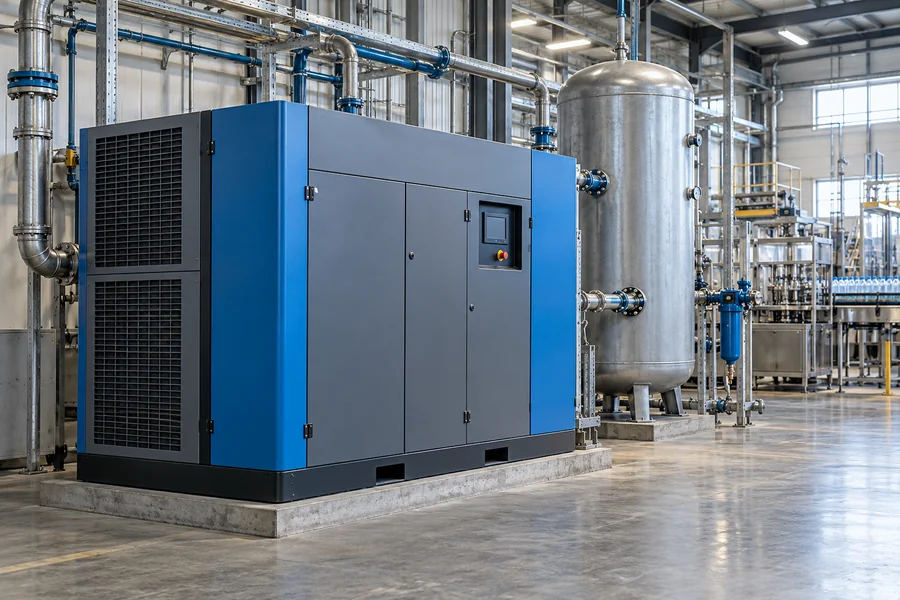
For most continuous industrial applications, a correctly sized rotary screw compressor is the best all-around choice. I prefer a fixed-speed screw compressor for stable demand and a variable-speed model for strongly fluctuating demand. Piston compressors are better for intermittent use, centrifugal compressors suit very large steady air demand, and oil-free compressors are best where contamination cannot be accepted.
I therefore do not start with a brand or horsepower. I start with airflow, pressure, duty cycle, demand variation, air quality, operating environment, and lifecycle cost.
Which Type of Air Compressor Is Best for Most Industrial Applications?
Most industrial plants need reliable compressed air for many hours every day. That makes continuous-duty capability, energy efficiency, maintenance requirements, and pressure stability more important than the lowest initial purchase price.
For most factories, workshops with heavy air demand, and continuous-production applications, I normally choose a rotary screw compressor. Rotary screw machines are designed for long duty cycles and steady airflow, while reciprocating compressors are generally better suited to lower-use, intermittent applications where low initial cost is more important.
Why rotary screw compressors are a strong general choice
A rotary screw compressor uses two intermeshing rotors to compress air continuously.
That operating principle provides a relatively smooth flow instead of the stronger pulsations associated with reciprocating cylinders.
For industrial buyers, the important advantages are:
continuous operation + steady airflow + lower vibration + relatively quiet operation + compact installation
Atlas Copco's current selection guidance positions rotary screw compressors for continuous-duty applications and piston compressors for applications with lower daily operating hours and lower duty cycles.
Kaeser likewise describes its current industrial rotary screw machines as suitable for 100% duty-cycle operation in continuous production.
That is why I normally begin with rotary screw technology when the application includes:
- CNC machines
- Automated production equipment
- Pneumatic tools running throughout a shift
- Packaging lines
- Textile machinery
- General manufacturing
- Mining support
- Industrial processing
A screw compressor is not automatically the best in every plant
Continuous-duty capability does not mean I should install a rotary screw machine for every air requirement.
Suppose a small workshop runs an impact wrench for a few minutes and then uses almost no air for the next hour.
A large screw compressor may spend too much time unloaded.
In that situation, a reciprocating compressor may provide a much lower-cost solution.
Atlas Copco specifically recommends considering piston compressors when requirements include low duty cycle, low running hours, and lower initial investment.
The word best therefore depends on the operating profile.
I compare lifecycle cost rather than purchase price
A piston compressor may cost less initially.
A screw compressor may cost more.
But the cheapest purchase is not necessarily the cheapest compressed air.
I consider:
purchase price + electricity + maintenance + downtime + replacement parts + expected service life
The more hours the machine operates, the more important energy and maintenance become.
For a plant operating:
8,000 hours per year
even a relatively small difference in compressor efficiency can produce substantial long-term cost differences.
For a compressor running only:
500 hours per year
initial cost may matter much more.
That is why operating hours are one of my first questions.
When Should I Choose Piston, Screw, Centrifugal, or Oil-Free Compressors?
Different compressor technologies solve different problems. I choose the machine whose operating characteristics match the air demand rather than assuming one design is technically superior everywhere.
I choose a piston compressor for intermittent low-volume use, an oil-injected rotary screw compressor for most continuous industrial demand, a centrifugal compressor for very large and relatively stable airflow, and an oil-free compressor when process purity is critical. Each can be the best compressor when used in the application it was designed to serve.
Piston compressors: best for intermittent use
Reciprocating compressors are simple and proven.
They compress air using a piston moving inside a cylinder.
I consider them when the customer wants:
lower purchase cost + smaller airflow + intermittent use + straightforward maintenance
Atlas Copco's commercial-compressor guidance describes piston machines as suitable for start/stop operation, while screw compressors are intended for continuous duty.
Typical applications include:
small repair shops → tire service → garages → occasional pneumatic tools → small fabrication shops
I would not normally make a standard piston compressor my first choice for a plant that requires full airflow continuously through multiple production shifts.
Rotary screw: best general industrial solution
For regular industrial production, screw compressors are usually my starting point.
A properly selected unit can provide:
continuous airflow + stable pressure + relatively low vibration + long duty cycle
Current Atlas Copco guidance specifically describes rotary screw compressors as engineered for continuous operation.
For most buyers comparing:
30 kW, 45 kW, 75 kW, 110 kW
or similar factory air compressors, this is the technology I would evaluate first.
Centrifugal: best for very large steady demand
At very high airflow, centrifugal compressors become increasingly attractive.
Instead of trapping a fixed volume of air mechanically, they use high-speed impellers to accelerate air and convert that velocity into pressure.
Current Ingersoll Rand MSG Centac equipment demonstrates the scale involved. Its C700e range covers approximately 1,900–4,200 cfm at pressures up to around 150 psig, while larger centrifugal platforms extend far beyond that flow range.
I consider centrifugal compressors when a large plant has:
high continuous airflow + relatively stable base load + centralized compressed-air demand
Examples include large:
chemical plants → refineries → steel operations → automotive plants → major manufacturing facilities
They are not normally my first choice for a small workshop with constantly changing demand.
Oil-free: best when compressed-air purity is critical
The term oil-free describes air purity and compressor design rather than one single compression principle.
Oil-free compressors can include:
piston + screw + centrifugal + scroll
depending on size and application.
Atlas Copco identifies food and beverage, pharmaceutical, electronics, chemical, and other contamination-sensitive applications as important users of oil-free compressed-air technology.
I choose oil-free compression when even a small risk of lubricant entering the process is unacceptable.
Typical examples include:
pharmaceutical manufacturing → food contact air → electronics → critical process air
The question is not:
“Is oil-free always better?”
It is:
“Does this process require oil-free air?”
If the answer is no, an oil-injected screw compressor with appropriate downstream treatment may be more economical.
Is a Variable-Speed or Fixed-Speed Compressor Better?
After selecting screw-compressor technology, the next major decision is often whether to use fixed-speed or variable-speed drive.
A fixed-speed compressor is generally best when air demand stays close to a stable level for long periods. A variable-speed compressor is usually better when demand rises and falls significantly because motor speed can follow actual air consumption. The correct choice should be based on a measured demand profile rather than assuming VSD is always more efficient.
Fixed speed works well with steady demand
A fixed-speed compressor basically operates around one motor speed.
It is particularly effective when the plant consistently requires most of the machine's capacity.
For example:
compressor capacity = 100 m³/min
and plant demand remains around:
90–100 m³/min
for most operating hours.
In that situation, a properly sized fixed-speed unit can be a very sensible choice.
Kaeser's current guidance similarly recommends fixed-speed equipment where compressed-air consumption stays near full capacity for most of the day.
VSD follows changing demand
Now imagine a plant where air consumption changes like this:
morning = 35%
midday = 85%
afternoon = 60%
night shift = 25%
A fixed-speed machine may spend considerable time cycling between load and unload.
A variable-speed compressor adjusts motor speed to more closely match the required airflow.
Kaeser describes this approach as adjusting output in real time to changing demand and recommends VSD technology particularly where demand changes rapidly or frequently.
VSD is not automatically the best machine
This is an important buying point.
Variable-speed drive adds:
electronics + frequency converter + additional control complexity
If the compressor will operate at near-full load almost continuously, the extra investment may provide less benefit.
I therefore want an actual air-demand study.
The question is:
How many hours will the compressor operate at each flow level?
not:
Does VSD sound more advanced?
Multiple compressors can sometimes be better than one oversized machine
Suppose a factory needs:
1,000 cfm peak
but normally consumes:
400–600 cfm
Instead of installing one compressor sized only around the peak, another strategy may use:
base-load compressor + trim compressor
or:
multiple coordinated compressors
Kaeser notes that multiple machines can be more effective when plant demand varies, while also making backup capacity easier to provide.
I therefore look at the complete compressor room rather than selecting each compressor independently.
How Do I Choose the Best Air Compressor Size and Specification?
A high-quality compressor can still perform poorly if its airflow or pressure is wrong for the application. Correct sizing is more important than choosing the most expensive machine.
I size an air compressor from required airflow and pressure at the point of use, then account for demand variation, distribution losses, air quality, altitude, ambient temperature, duty cycle, and future operating conditions. I avoid excessive oversizing because a larger compressor can increase purchase cost, unloaded energy use, and maintenance without improving production.
Start with airflow
Airflow is normally expressed as:
cfm
or:
m³/min
I total the equipment that may operate simultaneously.
For example:
| Equipment | Air demand |
|---|---|
| Machine A | 20 cfm |
| Machine B | 30 cfm |
| Tool group | 25 cfm |
| Packaging line | 40 cfm |
| Total simultaneous demand | 115 cfm |
I then consider realistic system margin and operating variation.
Atlas Copco recommends calculating simultaneous peak demand rather than simply adding arbitrary excess compressor capacity.
Then determine required pressure
A compressor should not be selected from cfm alone.
The same airflow delivered at:
7 bar
is a different duty from the same airflow at:
13 bar
I identify the highest legitimate pressure requirement at the point of use and then analyze distribution pressure losses.
Atlas Copco notes that pipe size, fittings, hose length, and system layout can create meaningful pressure drop between the compressor and the tool.
I therefore prefer fixing excessive distribution loss rather than simply increasing compressor discharge pressure.
Higher pressure generally requires more energy.
Check air quality
I next determine:
How clean and dry must the compressed air be?
The answer determines whether I need:
oil-injected or oil-free compression
and:
filters + refrigerated dryer + desiccant dryer
A normal workshop may tolerate a different air-quality specification from:
pharmaceutical manufacturing
or:
food production
Atlas Copco's current oil-free portfolio is specifically aimed at industries where contamination control is critical.
Check environmental conditions
Air-compressor ratings normally assume defined inlet conditions.
I therefore give the supplier:
site altitude + maximum ambient temperature + minimum ambient temperature + humidity + indoor/outdoor installation
High altitude reduces air density.
High ambient temperature affects cooling.
Dusty mining or cement environments increase filtration requirements.
I do not want a compressor sized perfectly for laboratory conditions but marginal at the actual project site.
Consider redundancy
If one compressor failure stops an entire factory, I consider backup capacity.
Instead of:
one compressor = 100% plant demand
I may prefer:
two or three coordinated compressors
depending on production risk.
Atlas Copco also recommends considering multi-compressor systems where compressed-air failure would interrupt multiple production areas.
For critical production, reliability is a system-design issue, not merely a compressor-brand issue.
My insights: Which Air Compressor Is Best
There is no universal best compressor because compressed-air requirements vary too much. However, one technology is a particularly strong starting point for normal continuous industrial service.
For most factories requiring continuous compressed air, I consider a correctly sized oil-injected rotary screw compressor the best general-purpose choice. I use fixed speed for stable demand and variable speed for fluctuating demand. I choose piston compressors for intermittent work, centrifugal compressors for very large steady loads, and oil-free compressors when air purity is critical.
My first rule is application before brand
I do not start by asking:
Atlas Copco, Kaeser, Ingersoll Rand, Sullair, ELGi, or another manufacturer?
I start with:
What must the compressor actually do?
My selection sequence is:
application → airflow → pressure → duty cycle → demand profile → air quality → site conditions → compressor technology → size → manufacturer
That prevents me from choosing a famous compressor that does not fit the duty.
My second rule is rotary screw for continuous industrial air
If the buyer tells me:
“We operate two or three shifts and need compressed air continuously.”
my first evaluation is usually a rotary screw compressor.
Both Atlas Copco and Kaeser currently position screw compressors around continuous or 100% duty-cycle industrial operation.
That makes screw technology a strong default for:
manufacturing + fabrication + automation + processing + continuous pneumatic equipment
My third rule is piston for intermittent demand
If the buyer tells me:
“We use air only occasionally.”
a piston compressor may make more sense.
It offers:
simple design + lower purchase cost + good start/stop suitability
Atlas Copco specifically recommends reciprocating equipment when compressed air is not required continuously and initial cost is an important consideration.
I would rather install the correct piston compressor than an oversized screw compressor that spends most of its life unloaded.
My fourth rule is to choose VSD only when the demand profile supports it
If demand fluctuates strongly:
VSD deserves serious evaluation.
If demand remains nearly constant:
fixed speed deserves serious evaluation.
Kaeser recommends variable-speed technology for fluctuating air consumption because the compressor can adjust motor speed to match actual demand.
So I do not automatically specify the more complicated machine.
I use operating data.
My fifth rule is to buy compressed air performance, not horsepower
When someone asks me, “Which air compressor is best?”, this is my practical selection table:
| Application | Compressor I would evaluate first |
|---|---|
| Small garage / occasional air tools | Reciprocating piston |
| Small factory with intermittent demand | Piston or small screw |
| Continuous manufacturing | Oil-injected rotary screw |
| Fluctuating industrial demand | VSD rotary screw |
| Stable continuous industrial demand | Fixed-speed rotary screw |
| Large plant with very high steady airflow | Centrifugal |
| Food/pharma/electronics critical process | Oil-free compressor |
| Mobile construction | Portable rotary screw |
| High-pressure DTH drilling | High-pressure portable screw |
| Critical plant requiring uptime | Multiple coordinated compressors with redundancy |
The table is only a starting point.
I still check the numbers.
For example, if a manufacturing plant needs:
20 m³/min at 8 bar continuously
I would likely start with a rotary screw compressor.
If demand varies between:
6 and 20 m³/min
throughout the shift, VSD becomes attractive.
If the plant requires:
100 m³/min continuously
the comparison may begin to include large screw and centrifugal systems.
Current Ingersoll Rand centrifugal machines, for example, cover several thousand cfm in standard industrial configurations, illustrating why centrifugal technology belongs mainly in a very different capacity class from a small workshop compressor.
If compressed air directly contacts a pharmaceutical product, I may instead make oil-free air quality the first selection requirement regardless of whether the compressor itself is screw or centrifugal.
My complete buying checklist is therefore:
Required airflow
How many cfm or m³/min are actually needed?
Required pressure
What pressure must reach the equipment?
Duty cycle
Intermittent or continuous?
Demand pattern
Stable or highly variable?
Air quality
Can lubricant contamination be tolerated?
Dew point
Does the plant need refrigerated or desiccant drying?
Site conditions
What are altitude, temperature, dust, and ventilation conditions?
Electrical supply
What voltage, frequency, and available power are present?
Redundancy
What happens if the compressor stops?
Service support
Are parts and technicians available locally?
Lifecycle cost
What will electricity and maintenance cost over the machine's operating life?
Only after these questions do I compare brands and individual models.
That is why my answer to “Which air compressor is best?” is not one universal machine.
For most continuous industrial plants, rotary screw is my general benchmark.
For intermittent workshop use, piston can be better.
For fluctuating industrial demand, VSD screw can be better.
For extremely large stable demand, centrifugal can be better.
For contamination-sensitive processes, oil-free technology can be essential.
The best compressor is therefore the one that produces the required airflow at the required pressure and air quality, for the required duty cycle, with the lowest reliable lifecycle cost.
Conclusion
For most continuous industrial applications, a correctly sized rotary screw compressor is the best starting point, but duty cycle, airflow, pressure, air quality, and demand profile determine the final choice.