
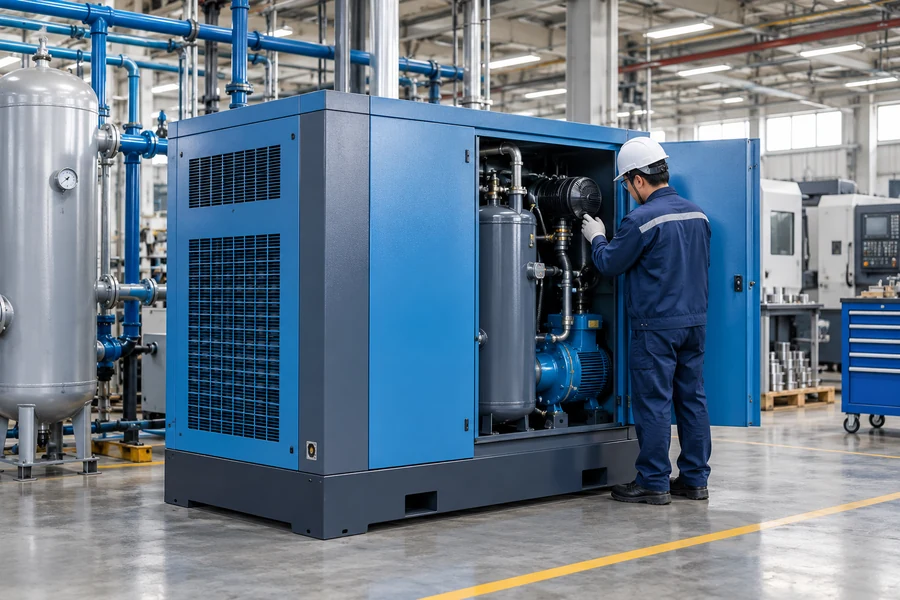
](https://kaishanpro.com/wp-content/uploads/2026/10/Which-Air-Compressor-Is-the-Best-Value-for-Money.webp)
Buying the cheapest air compressor can create expensive problems. High electricity bills, frequent repairs, and unexpected downtime may turn a low purchase price into a costly investment.
For most factories that need compressed air throughout the working day, a properly sized oil-injected rotary screw compressor offers excellent value for money. Piston compressors are often more economical for occasional use, while variable-speed screw compressors can reduce energy costs when air demand changes. The best choice depends on total ownership cost.
The best-value air compressor matches actual demand, pressure, and duty cycle while minimizing energy consumption, maintenance, and unnecessary capacity, rather than prioritizing purchase price alone.
What Type of Air Compressor Offers the Best Value for Money?
Different air compressors serve different applications. A compressor that works well in a small workshop may not be suitable for a factory operating continuously.
I consider oil-injected rotary screw compressors the best overall value for many industrial applications because they combine continuous air delivery, reliable operation, and competitive lifetime costs. Piston compressors offer better purchase value for intermittent applications, while variable-speed screw compressors are attractive when compressed air demand varies significantly throughout the day.
1. Rotary Screw Air Compressors for Industrial Applications
I generally recommend rotary screw compressors for manufacturing facilities that require a stable compressed air supply.
These compressors use rotating screw elements to compress air continuously. They are widely used in manufacturing, automotive production, metal processing, and industrial automation.
Their main advantages include:
- Continuous compressed air delivery
- Relatively smooth operation
- Compact industrial configurations
- Lower vibration than many reciprocating designs
- Compatibility with automated control systems
- Good efficiency when correctly sized and operated
I consider an oil-injected rotary screw compressor a practical option when compressed air is needed for several hours each day.
However, I do not automatically recommend the largest available machine. An oversized compressor can waste energy when demand is low.
2. Piston Air Compressors for Small Workshops
Piston compressors often provide better value for businesses with limited compressed air requirements.
I would consider a piston compressor for small repair workshops, tire inflation, occasional pneumatic tools, and other intermittent tasks.
The main advantage is the lower initial investment.
Piston compressors are also available in relatively simple configurations that may be easier to maintain with basic workshop resources.
However, I would carefully check the rated duty cycle before using a piston compressor for long periods.
Frequent operation can increase wear and maintenance needs when the machine is not designed for continuous use.
3. Comparing Air Compressor Types
| Compressor Type | Purchase Cost | Suitable Application | Value for Money |
|---|---|---|---|
| Piston compressor | Low | Occasional workshop use | Excellent for intermittent demand |
| Fixed-speed rotary screw | Medium | Stable industrial demand | Excellent for continuous operation |
| Variable-speed rotary screw | Medium to high | Fluctuating industrial demand | Excellent when energy savings justify the premium |
| Oil-free compressor | High | Strict air purity requirements | Strong value when contamination control is essential |
| Portable diesel compressor | Medium to high | Construction and remote drilling | Strong value for mobile applications without grid power |
I also consider equipment availability and local maintenance support when comparing these options.
A less expensive machine is not necessarily a better investment if replacement parts are difficult to obtain.
For most industrial buyers, I would start with a properly sized rotary screw compressor and then determine whether fixed-speed or variable-speed control provides better operating economics.
Is a Rotary Screw Compressor Better Value Than a Piston Compressor?
Many buyers compare piston compressors with rotary screw compressors because both technologies can supply compressed air for industrial equipment. However, their operating characteristics are different.
Rotary screw compressors generally provide better long-term value for continuous industrial use because they are designed for sustained air delivery and can offer lower operating costs at high utilization. Piston compressors usually provide better value for occasional use because their initial purchase prices are lower and their maintenance requirements can be simpler.
1. Initial Purchase Price
I usually find piston compressors more attractive when the buyer has a limited equipment budget.
A basic piston compressor contains fewer sophisticated components than a complete industrial rotary screw compressor package.
This often makes its initial purchase price lower.
Rotary screw compressors typically require a larger initial investment because they include specialized compression elements, lubrication systems, cooling equipment, and control components.
However, I do not consider purchase price the most important factor when equipment operates for thousands of hours every year.
2. Energy Efficiency and Operating Hours
I focus on actual operating hours when comparing these technologies.
A workshop that operates pneumatic tools for short periods may not benefit enough from a rotary screw compressor to justify the higher investment.
A factory that requires compressed air throughout the day faces a different situation.
In continuous-duty applications, a correctly selected rotary screw compressor can provide more economical long-term operation.
I also compare actual package power consumption and delivered airflow rather than relying only on motor horsepower.
| Comparison | Piston Compressor | Rotary Screw Compressor |
|---|---|---|
| Initial investment | Generally lower | Generally higher |
| Continuous operation | Depends on model and rated duty cycle | Commonly designed for continuous duty |
| Noise and vibration | Often higher | Often lower |
| Maintenance | More accessible on simpler models | Requires scheduled oil, filter, and separator service |
| Industrial automation | Basic to moderate | Broad control options |
| Best operating pattern | Intermittent demand | Regular or continuous demand |
3. Maintenance and Equipment Reliability
I also look at how maintenance affects business operations.
Piston compressors contain components such as pistons, rings, valves, and connecting rods. These parts experience mechanical wear and require inspection or replacement over time.
Oil-injected rotary screw compressors need scheduled lubrication maintenance, filter replacements, and air-oil separator servicing.
Neither compressor type is maintenance-free.
I would compare actual maintenance schedules, consumable prices, and service accessibility before making a recommendation.
4. Which One Would I Choose?
For a small repair shop that uses compressed air occasionally, I would generally select a suitable piston compressor.
For a manufacturing facility requiring continuous air delivery, I would normally prioritize a rotary screw compressor.
I believe operating hours and demand patterns are more useful selection criteria than purchase price alone.
The machine that operates efficiently under the actual working conditions is usually the one that provides better long-term value.
Is a Variable-Speed Air Compressor Worth the Extra Cost?
Variable-speed compressors often cost more than fixed-speed machines. Many buyers want to know whether the additional investment can reduce operating expenses enough to justify the higher purchase price.
A variable-speed air compressor can be worth the extra cost when compressed air demand changes frequently. It adjusts motor speed to match demand within its operating range, reducing unnecessary energy consumption. However, fixed-speed compressors may provide better value when demand remains stable and the equipment operates efficiently near its rated capacity.
1. How Variable-Speed Technology Saves Energy
I consider variable-speed drive technology an important option for factories with changing production schedules.
A variable-speed compressor adjusts motor speed to respond to compressed air demand.
For example, a factory may require more compressed air during peak production and less during breaks or reduced production shifts.
A properly controlled variable-speed compressor can reduce its output when demand decreases.
This can avoid some of the energy losses associated with inefficient unloaded operation.
However, I would never assume that every variable-speed compressor is more efficient than every fixed-speed compressor.
The actual benefit depends on the equipment design, operating pressure, part-load efficiency, and demand profile.
2. Fixed-Speed vs. Variable-Speed Compressors
| Factor | Fixed-Speed Compressor | Variable-Speed Compressor |
|---|---|---|
| Initial cost | Generally lower | Generally higher |
| Motor operation | Fixed operating speed | Adjustable operating speed |
| Stable air demand | Often economical | May offer limited additional savings |
| Fluctuating air demand | Depends on control strategy | Often better suited |
| Control complexity | Generally simpler | More advanced |
| Best value | Stable industrial production | Variable industrial production |
I recommend collecting operating data before investing in variable-speed equipment.
A compressor that regularly operates near full load may not generate sufficient energy savings to recover the additional cost.
In contrast, a factory with significant changes in compressed air demand may benefit from variable-speed technology.
3. How I Calculate Potential Energy Savings
I use a simple calculation to estimate annual electricity savings:
Annual Energy Savings = Average Power Reduction × Annual Operating Hours × Electricity Price
For example, I can compare two compressor configurations that deliver the same required compressed air:
| Calculation Item | Example Value |
|---|---|
| Average measured power reduction | 3 kW |
| Annual operating time | 4,000 hours |
| Electricity price | US$0.12/kWh |
| Annual electricity savings | US$1,440 |
| Additional equipment investment | US$3,600 |
| Simple payback period | 2.5 years |
These values are illustrative rather than actual product performance data.
The calculation assumes that the 3 kW reduction is sustained over the stated hours and that other costs remain unchanged.
I would also consider maintenance costs, financing, and equipment operating life before making a final purchasing decision.
4. When I Would Choose Fixed-Speed Equipment
I would select an efficient fixed-speed compressor if a factory operates at a relatively stable demand level for most of its working hours.
I would also evaluate multiple-compressor arrangements when the system requires both a stable base air supply and flexible peak capacity.
For example, a fixed-speed machine can supply the base load while a variable-speed unit adjusts output to follow changes in demand.
I consider this combination useful for larger compressed air systems when individual compressor capacities and control strategies are properly matched.
The best value does not always come from purchasing the most advanced compressor. It comes from using the most appropriate control technology.
How Do I Choose an Air Compressor With the Lowest Total Cost of Ownership?
A low equipment price can be attractive, but the real cost of operating an air compressor continues long after installation. Electricity, maintenance, repairs, and downtime all affect the final investment.
I choose the best-value air compressor by calculating total ownership costs, confirming actual airflow and pressure requirements, comparing verified energy efficiency, and evaluating maintenance support. I also consider air quality, operating environment, equipment reliability, and spare-parts availability before selecting a compressor for industrial use.
1. Calculate the Total Cost of Ownership
I recommend using a total cost of ownership calculation instead of comparing purchase prices alone.
My basic formula is:
Total Ownership Cost = Purchase Price + Installation + Energy + Maintenance + Repairs + Downtime Costs
Energy consumption is particularly important for compressors operating for long periods.
A small efficiency difference may create significant electricity savings over several years.
For example, I can compare two machines with the same air delivery and working pressure.
If one compressor consumes an average of 2.4 kW less electricity and operates 3,000 hours annually, it saves 7,200 kWh per year.
At US$0.12 per kWh, that represents US$864 in annual electricity savings.
Over five years, the estimated savings reach US$4,320 before accounting for maintenance differences and other operating costs.
I use calculations like this to determine whether paying more for an efficient compressor makes financial sense.
2. Match Airflow and Pressure to the Application
I always confirm two key technical parameters before selecting an air compressor.
Airflow → The volume of compressed air required by the equipment.
Working Pressure → The pressure necessary for the equipment to function correctly.
Airflow is commonly expressed in CFM or m³/min, while pressure is typically measured in bar or psi.
A compressor that supplies insufficient airflow may cause pressure drops and interrupt production.
An oversized compressor may waste energy through inefficient loading and unloading.
I also check how compressor performance is measured. Inlet conditions, discharge pressure, and performance test standards can affect comparisons between machines.
3. Evaluate Energy Efficiency
I prefer comparing the energy required to produce the same amount of compressed air at the same operating pressure.
One useful metric is specific power.
Specific Power → Compressor Input Power ÷ Delivered Airflow
A lower specific power value generally indicates better efficiency when the operating conditions and measurement basis are comparable.
I also request performance data based on recognized testing standards when available.
4. Consider Maintenance and Spare Parts
I believe maintenance support is one of the most overlooked factors in compressor purchasing.
An inexpensive compressor may create expensive downtime if replacement filters, valves, seals, or electronic components are difficult to obtain.
I check the following points before selecting equipment:
- Availability of replacement parts
- Recommended service intervals
- Cost of oil, filters, and separators
- Warranty coverage and exclusions
- Access to technical support
- Local repair and service capability
- Shipping and delivery requirements
I also review operating conditions such as ambient temperature, dust exposure, ventilation, and installation space.
5. Avoid Unnecessary System Costs
I evaluate the entire compressed air system rather than the compressor alone.
Air leaks, unsuitable pipe sizes, excessive pressure settings, and dirty filters can increase energy consumption.
Poor air treatment can also damage pneumatic equipment or affect product quality.
For these reasons, I consider air receivers, dryers, filtration, distribution piping, and control systems part of the investment.
In many cases, improving an existing compressed air system can provide better value than replacing the compressor immediately.
I believe the most economical purchasing decision comes from balancing equipment specifications, operating efficiency, and long-term reliability.
My Insights: Which Air Compressor Is the Best Value for Money
I do not believe there is one air compressor model that offers the best value for every business.
The value of an air compressor depends on the relationship between equipment investment, actual operating demand, maintenance requirements, and the cost of compressed air production.
I evaluate the best-value compressor through six important factors:
Purchase Price → I compare the initial investment with the equipment capacity and included components.
Energy Consumption → I prioritize efficiency when the compressor operates for thousands of hours annually.
Operating Pattern → I match compressor technology with intermittent, stable, or fluctuating demand.
Equipment Reliability → I consider component quality, maintenance schedules, and the risk of unexpected downtime.
Maintenance Support → I evaluate spare-parts availability, service costs, and local technical support.
Application Requirements → I confirm airflow, working pressure, air quality, installation conditions, and future expansion plans.
My Practical Recommendation
For small workshops with occasional air demand, I generally consider piston compressors the most economical starting point.
For manufacturing facilities with regular compressed air requirements, I would usually choose a properly sized oil-injected rotary screw compressor.
For factories with changing air demand, I would evaluate variable-speed compressors and compare the expected energy savings against the additional investment.
For applications with strict air purity requirements, I would consider oil-free compression or an appropriately engineered air-treatment system according to the actual contamination limits. I would not assume that filtration alone can satisfy every oil-free air requirement.
For construction, mining, and drilling projects without a reliable electrical supply, I would focus on portable diesel compressors with suitable airflow, pressure, fuel efficiency, and service support.
I also believe buyers should give more attention to the reliability of the complete compressed air system.
An efficient compressor connected to leaking pipes or operated at unnecessarily high pressure can still waste significant energy.
The lowest purchase price rarely tells the complete story.
My final recommendation is to choose the air compressor that delivers the required airflow and pressure at the lowest practical lifetime cost, rather than simply selecting the cheapest machine or the most expensive brand.
Conclusion
I consider properly sized rotary screw compressors excellent value for continuous industrial use, piston compressors economical for occasional tasks, and variable-speed models valuable when demand fluctuates.